Complications
AndrewD introduces the Girard-Perregaux Constant Escapement, a groundbreaking innovation unveiled at Baselworld 2013. This article delves into the technical marvel of its design, which reimagines constant force delivery in watchmaking. AndrewD highlights the significance of this new escapement architecture, a culmination of five years of research and development.


This is the first Girard-Perregaux mega-watch of 2013 and a piece that has been rumored for several years. Some of you will have seen the evolution of the prototype movements if you visited the secret GP Research and Development Laboratory in La Chaux-de-Fonds. It has been a 5 year journey but the final cased up watch is finally being launched at Baselworld this week.
It is not often in the long history of watchmaking that we get to experience a totally new escapement architecture and a rethink on the problems of delivering constant force. The principle of a constant force escapement is that whatever energy is supplied by the main spring barrel, the escapement returns a constant energy to the regulator (the balance wheel).


In the new GP Constant Force escapement an intermediate device, consisting of an extremely thin silicon blade (it measures 14 micrometers – one sixth of a human hair’s thickness), is integrated into the escapement. This blade stores energy and then transmits it all, instantaneously, to the balance before commencing another cycle. This blade is flexed to a point as close as possible to its unstable state, and only needs an infinitesimal quantity of energy, a micro-impulse given by the balance wheel – less perturbing than in a lever escapement – for it to snap from one state to the other, and in the process, to push the balance wheel forward, compensating for the variable energy of the barrel and liberating the same quantity of energy every time. This force is instantaneous and continuous.
While the escapement design is beautifully symmetrical, this is a case of form follows function – the forces at the center of the balance wheel are indeed balanced and therefore avoid a concentration of constraints at that point in order to ensure totally unencumbered rotation.

The blade is formed in one piece with the frame which holds it by both ends and plays a role in the very precise locking of the point of contact for the micro-impulse which will make it snap over. The micro-engineering required to build such an escapement is impressive and requires modern materials such as silicon and manufacturing techniques such as deep reactive ion etching (DRIE). This has been achieved via a partnership with CSEM (the Swiss Center for Electronics and Microtechnology) in Neuchâtel, Switzerland. The whole escapement is modular and can be replaced making service easier.
There is no friction in the blade except at the moment of the impulse and the flexing of the blade. The natural vibration of the blade governs the frequency: 3 Hz or 21,600 vibrations per hour. The two novel escape wheels have three teeth for a frequency of 3 Hz, but other frequencies could be used by increasing the number of teeth (four would be required for a 4 Hz escapement).

The movement runs for a week and the power reserve is shown in a linear power reserve indicator. The energy is supplied by twin barrels coupled in parallel and each drum contains two springs stacked in series. The total length of the springs is 3 meters!
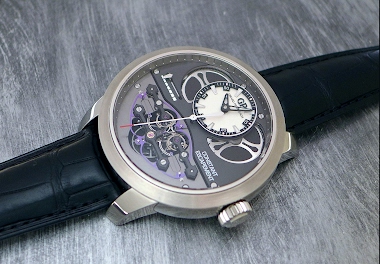
Despite all this modern jiggery-pokery, the movement blanks are in brass coated in black PVD and there are references to GP design icons such as the three bridges supporting the movement on the dial side and two arrow bridges on the rear. In fact the view of the rear is as inspiring as the front and all is on display under non-reflective sapphire.
This first model in the Constant Escapement L.M. collection has been designed to be modern and imposing and to fully demonstrate the engineering tour de force it carries. The case is in white gold and measures 48mm x 14.63mm. The hours and minutes are displayed on a sub-dial at 12 o’clock, flanked by the double barrels.


Barrel

Clickwheel

Escape wheel

Spherical differential


Technical Specifications
Case: white gold
Diameter: 48.00 mm
Glass: domed anti-reflective sapphire
Crown: white gold with engraved GP logo
Dial: silvered with grained finish and rhodium-plated appliques
Hands: dauphine style
Case back: sapphire glass, secured with 6 screws, all inscriptions hand engraved
Water resistance: 30 meters
Girard-Perregaux Movement MVT-009100-0007
Hand wound mechanical movement
Caliber: 17½ ’’’
Frequency: 21,600 Vib/h – (3 Hz)
Power reserve: approximately one week
Jewels: 28
Number of components: 271
Functions: hour, minute, central second, linear power reserve
Black alligator strap
White gold folding clasp
Reference: 93500-53-131-BA6C

The Girard-Perregaux Constant Escapement, part of the Bridges collection, represents a significant horological advancement focused on achieving constant force delivery. This model integrates a revolutionary escapement system designed to ensure consistent energy transmission to the balance wheel, regardless of the mainspring's state of wind. It was developed over five years, culminating in its debut at Baselworld 2013.
The watch features a 48mm case, housing a movement that incorporates an ultra-thin silicon blade, measuring 14 micrometers in thickness. This blade acts as an intermediate energy storage device, flexing to an unstable state before delivering a precise, instantaneous micro-impulse to the balance. The escapement's symmetrical design prioritizes functional balance, utilizing modern materials and manufacturing techniques like deep reactive ion etching (DRIE).
For collectors, the Constant Escapement is notable for its genuine innovation in escapement architecture, a rare occurrence in watchmaking history. Its technical complexity and the use of advanced materials position it as a landmark piece demonstrating Girard-Perregaux's commitment to pushing mechanical boundaries.
Mechanically, I will have to read it again, to fully understand how it works. One regret, the size of this new creature: 48 mm is a challenge for most of the wrists. Best, and thanks for this nice write up, my friend. Nicolas
embedded youtube video into post -AT
very technically impressive. My only question is about the durability of the silicon strip. It is so small and thin that it makes me wonder how it holds up to the constant flexing back and forth. I am sure it has been tested extensively, but it just looks like it would wear out quickly. Regardless of the answer to this question I love the watch and the positioning of the mechanism on the front which is mesmerizing to view. Stewart
... of the technical gurus in La Chaux-de-Fonds, but it is interesting that they have designed the escapement in a modular way. But I suspect the silicon wears very well. Andrew
Hi Stewart, Our man in Girard-Perregaux informs me that the silicon will not fatigue. The blade will maintain its elasticity over a long period of time. It is of course the reason that silicon was chosen, as no other material has the same properties. Regards Andrew
It seems that silicon is becoming the popular material to solve many horological problems in the most modern of watches being produced. I knew it was desirable for its low coeficient of friction, but I did not know it was considered a durable material that will hold up to long term wear and tear. Stewart
This thread is active on the Girard Perregaux forum with 10 replies. Share your knowledge with fellow collectors.
Join the Discussion →