When I was moderator of the Gerald Genta forum, I had a lot of pleasure to present you the striking watches of the brand. They were so special, so unique in their chiming systems that it was not only a joy for our eyes but also for our ears. What made them so fascinating was the use of the 4 chime hammers in the context of a Grande Sonnerie complication.
I have the same feeling when I write these lines dedicated to the 3 Opera watches from Girard-Perregaux. They occupy a prominent place in the small world of striking watches.
Several reasons may explain why I decided to write about these 3 watches. First of all, I had the opportunity to see them a few days ago. I had the chance to handle the Opera 3 two years ago at the Salon Belles Montres in Paris but it was for me the first opportunity to see them at the same time.
Secondly, I believe they are an excellent proof of the skills of the Girard-Perregaux Manufacture which is, sadly, totally underestimated.
And lastly, they embody the spirit of innovation and the daring way of thinking of Jean-François Bautte who was maybe the first watchmaker who really created the concept of Manufacture by gathering in the same place several watchmaking trades. I remember an exhibition of the Girard-Perregaux Museum which took place in 2010 in Paris at the Boucheron premises : I only had very few opportunities before to walk along such broad range of complications in displays : Patek Philippe, JLC, GP and which brand can you add to this list ? Not a lot...
Despite the current impressive catalogue of available complications, GP is not perceived today by the large audience as one of the top Manufactures which is not understandable for me. Is it due to the lack of an iconic model which would be able to lift the whole collection to the top of the hill ? Is it due to a lack of communication ? I don't really know and my wish with these few lines is to remind that the GP Manufacture has the capacity to produce watches which can't be seen elsewhere.
With the 3 Opera watches, we enter a special world : the world of striking watches. We all know that this world gathers several types of watches like the Alarm, Minute Repeater, Grande and Petite Sonneries, Striking hours watches...
Inside the category of Minute Repeater, Grande and Petite Sonneries watches, only a few ones, when they can play at least 3 different notes, deserve the right to be considered as « carillon ».
We can spend a lot of time speaking about what is required to create a top striking watch : what are the best materials to give enough power to the sound, the best method to get a clear and precise sound, the best gong shapes, the most efficient hammer techniques and so on... but at the beginning, a striking watch is a story of « music » and of « notes », better said of « melody ». And the more notes the watch is able to play, the more the melody is nice for the ears. We don't have to think like Antonio Salieri in this specific context : it is better to have more notes available !
We can split the 3 Opera watches into 2 categories :
・ the 4 gongs Minute Repeaters (Opera 1 and Opera 2) : they only strike on demand
・ the Music Box (Opera 3) : it can strike hourly au passage or on demand
The first 2 Opera watches are amongst the very few examples of 4 gongs Minute Repeaters watches (The Ulysse Nardin Genghis Khan or Alexander The Great also belong to this category) completed by prestigious complications : Tourbillon for the Opera 1 and Tourbillon and Perpetual Calendar for the Opera 2.
The
Opera 1 was introduced in 1998, the Opera 2 three years later and the Opera 3 in 2003 : at each presentation, it was a big slap to the high-end industry !

The Opera 1 may bring something unusual with its 4 gongs Minute Repeater complication, it is a true Girard-Perregaux watch : the caliber is based upon the 3 Golden Bridges Tourbillon.
The Tourbillon bridges have been redesigned (especially the top and bottom ones) to give enough room for maneuver to the hammers and to create an interesting dial lay-out : the hammers are visible dial side and when the watch plays the melody, it creates a very nice show. When the watch doesn't chime, only 3 hammers are visible (Sol-Do-Ré, G-C-D), the 4th one (Mi, E) can be seen only when it strikes the gong.

You will notice that the notes are engraved on the hammers : the Opera 1 makes me think about the keynotes of a piano.
How and when these notes are played ?
The Opera 1 plays the notes as follows if I'm not wrong :
For the minutes : Mi (E)
For the hours : Sol (G)
For the first quarter : Mi-Do-Ré-Sol (E-C-D-G)
For the second one : Mi-Do-Ré-Sol/Sol-Ré-Mi-Do (E-C-D-G/G-D-E-C)
For the third one : Mi-Do-Ré-Sol/Sol-Ré-Mi-Do/Mi-Do-Ré-Sol (E-C-D-G/G-D-E-C/E-C-D-G)

I really love the Opera 1 : its hidden complexity makes it dial very pure and our sight is only attracted by the Tourbillon and the hammers. When you have a closer look on the other parts of the watch, the figures, the indexes, the case shape, you easily recognize the Girard-Perregaux style.
Case size remains very reasonnable (diameter of 40mm and a thickness of 13mm) : Girard-Perregaux decided to preserve the elegancy of the watch rather to improve the sound power with a larger case. That's good news because for this kind of watch, the most important point is the sound purety and not its power.

To activate the Minute Repeater, there is nothing original here : just slide the lever upward and the hammers start to play...
Caliber is the handwind GP9899 created in partnership with Claret. Its frequency is 3hz and the power reserve is 75 hours which allow to leave the watch the week-end... if you are not a true music lover !
When you turn over the watch, you discover the mecanism dedicated to the Minute Repeater. If you know the back of the Ulysse Nardin Genghis Khan, you won't be disoriented. It is finished with a lot of care of details and with a sober style.

For me, the GP9899 is the fruit of a combined work between GP and Claret : it is an in-house movement due to the Three Bridges Tourbillon base but clearly, the Minute Repeater mecanism is not exclusive to GP.
Anyway, this doesn't change my point of view about the Opera 1 : it is an impressive and charming watch at the same time. And believe me, we only have one wish with the Opera 1 : to wait for the last 15 minutes to enjoy the three-quarters melody ! I think that the best moment to listen to the Opera 1 carillon is between 4:45 pm and 5:00. Prepare your cup of tea, listen to the Westminster carillon and you have the feeling to come back from a walk down Whitehall.
Three years later, Girard-Perregaux unveiled the
Opera 2. The Opera 2 is a sort of step further in terms of complication when compared with the Opera 1. The watch is basically an Opera 1 in which a Perpetual Calendar complication has been added.

In a pure Minute Repeater point of view, we stay exactly in the same world : turn over the watch and you will find the same type of mecanism despite some differences. One way to make the difference between them when we look at their casebacks is to measure the thickness of the bezel : it is larger with the Opera 2 due to the use of a 42mm case. Movement keeps its main features : 3hz frequency and a 75 hours of power reserve.
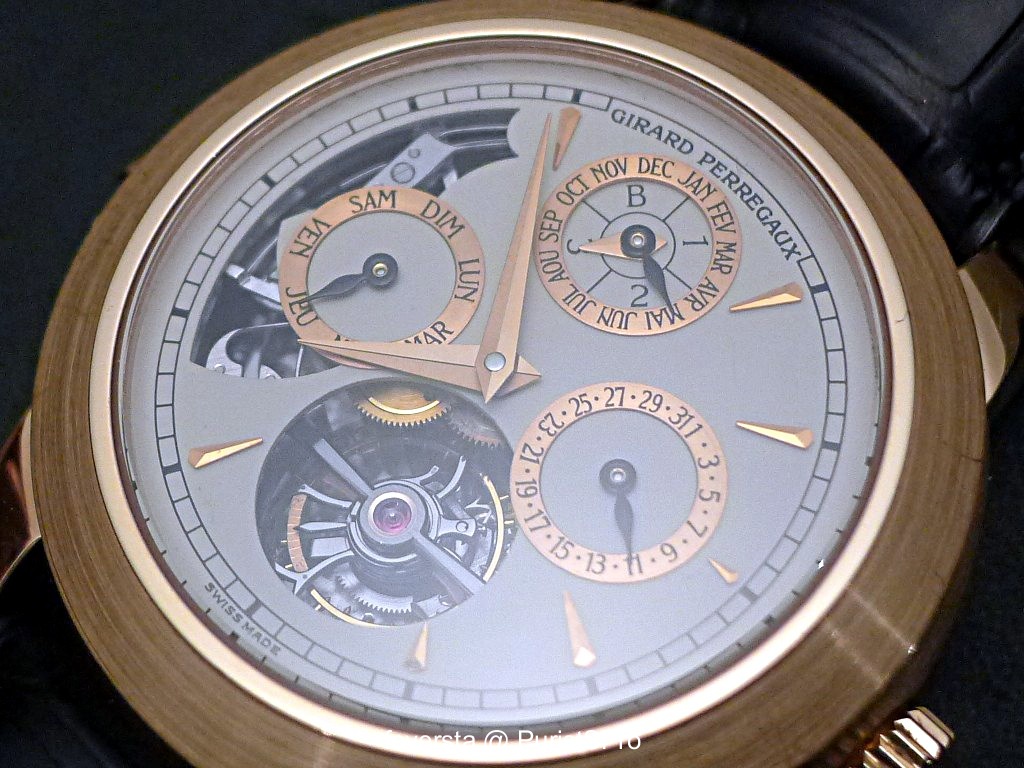
The main difference is located dial side with the Perpetual Calendar display. I feel mixed emotions about it. Of course, nobody can deny the impressive work which has been done to add this complication and to create a watch which combines Tourbillon, Minute Repeater and Perpetual Calendar. But at the same time, the dial becomes busier and this lack of simplicity is not, for me, that welcome in the context of a watch dedicated to the sound.

Hoefully, Girard-Perregaux managed to keep the opening of the dial and we can still enjoy the moves of the 4 hammers. The watch remains balanced despite its larger and thicker (14,54mm) case. I especially like the « diamond » shaped indexes and the scale rings on the dial. On the other hand, I don't like that the right ring slightly encroaches upon the Tourbillon opening which is not the case of the left ring. Due to the presence of the hammers on the left, the Tourbillon and the Perpetual Calendar complication are not symmetrically located in the case. The Opera 1 gets the same small shift but it is less visible.

With the Opera 2, Girard-Perregaux reached the end of the path. Adding another complication wouldn't have been a big horological challenge and the spirit of the collection, focussed on the sound, would have been weaker.

So Girard-Perregaux changed its mind and took the decision to create a watch which would be a true musicbox on the wrist.
The
Opera 3 was released in 2003 and it was a beautiful surprise for all the high-horology fans : we often speak about the musical side of the watches... but with the Opera 3, Girard-Perregaux offered a watch entirely dedicated to music.

Did you see before a watch with a selector on the dial which allows you to choose between Mozart or Tchaikovsky ?
The dial of the Opera 3 is very simple : the melody selector on the upper left side, the striking reserve on the right, the off-centered time display and... a little originality with a visible flywheel at 12 o'clock.
Unlike the first two Opera watches, no hammer can be seen here. And there is a logical explanation : the watch doesn't use any hammer.

In fact, the Opera 3 movement really works like a musicbox using a keyboard with 20 blades and a musical roll with around 150 hand-mounted pins. If you change the tune you wish to be played, the roll moves in order that the correct pins are in front of the blades.
The pins position on the roll creates the melody : if the owner of the watch wishes a specific tune, the Girard-Perregaux team is able to personalize the Opera 3. The GP00950 movement, created in collaboration with Christophe Claret has a 4hz frequency and a power reserve of 50 hours.

There is another big difference between the Opera 3 and the other 2 Opera watches : the Opera 3 can play « au passage » on an hourly basis.
Case is larger (43mm) and its thickness is very acceptable in this context (14,05mm) due to the size of the musical roll. The playing time of the melody is long, it is the reason why a specific power reserve display was added on the dial to check if there is enough energy to start the music.

The Opera 3 is an unique watch in the industry. You may find some watches which works like a musicbox and at a reasonable price. But the Opera 3 features the choice between two melodies and the ability to play them « au passage ».

With these watches dedicated to music, Girard-Perregaux created in 5 years a iconic trilogy of striking timepieces. In 2010, Girard-Perregaux released a new version of the Opera 1 with a sapphire dial : it was an excellent attempt to make its design more contemporary.
But we expect more from Girard-Perregaux now.
The Opera 3 gave the opportunity to Girard-Perregaux to do some step with a wristwatch which strikes « au passage ». I really think that my dream would be to see an Opera 4 with a Grande Sonnerie complication and of course, a carillon... The 3 Opera watches play more than 3 notes so you couldn't expect less with an Opera 4 !
Fr.Xavier
PS: I would have be very happy to insert some movies with sound to make you enjoy the melodies played by these watches. Sadly, the place was too noisy to record them.
This message has been edited by foversta on 2011-09-25 10:21:37