Girard-Perregaux Vintage 1945 Jackpot Tourbillon
Complications

Girard-Perregaux Vintage 1945 Jackpot Tourbillon

By Ornatus-Mundi · Nov 5, 2012 · 7 replies
Ornatus-Mundi
WPS member · Girard Perregaux forum
7 replies3447 views14 photos
f 𝕏 in 💬 🔗

Ornatus-Mundi revisits his exclusive encounter with the Girard-Perregaux Vintage 1945 Jackpot Tourbillon, offering a unique perspective on its classification and artistry. His detailed photo essay, inspired by a prior article from Daos, highlights the watch's distinctive blend of traditional horology and playful mechanics. This piece remains highly relevant for understanding how watchmakers integrate whimsical complications without compromising fine craftsmanship.
7 collectors discussing this on the WatchProSite forumJoin the Conversation →
Daos' recently posted article on the Girard-Perregaux Vintage 1945 Jackpot Tourbillon inspired me to search my files - I knew that some years back I had the opportunity for some quality time with exactly that watch. Finally, after 5 years, here are the results of my rendez-vous:


Before I start I'd like to discuss a bit the possible classification of the Girard-Perregaux Vintage 1945 Jackpot Tourbillon: It is not a Grande Complication (too few 'classical' complication, I am sorry...), it is also not innovative in the sense of employing as much new materials as conceivable (a doubtful endeavour anyway, in my opinion) or breaking new (theoretical) horological grounds. 

Yet, is a deeply fascinating and emotionally moving watch which for me at least exemplifies great contemporary watchmaking artistry and humanity. 


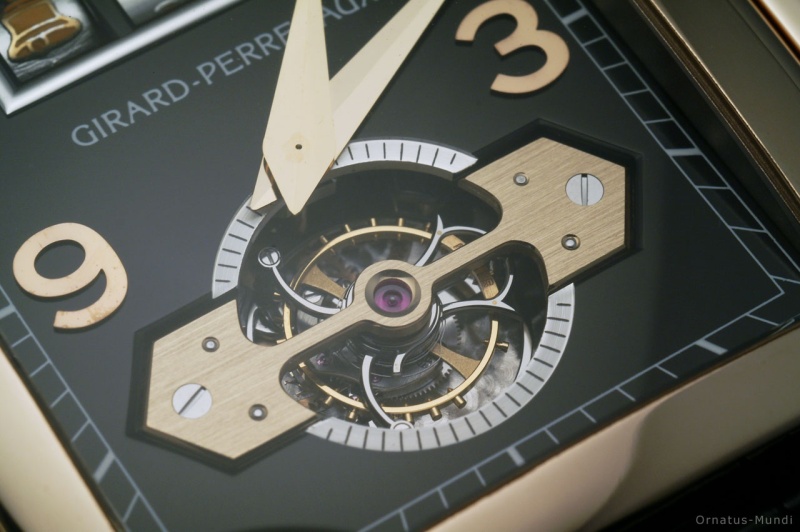
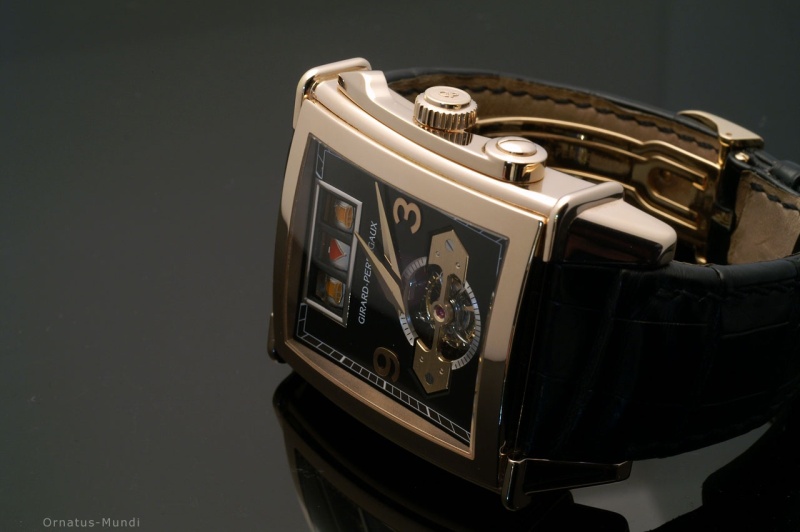
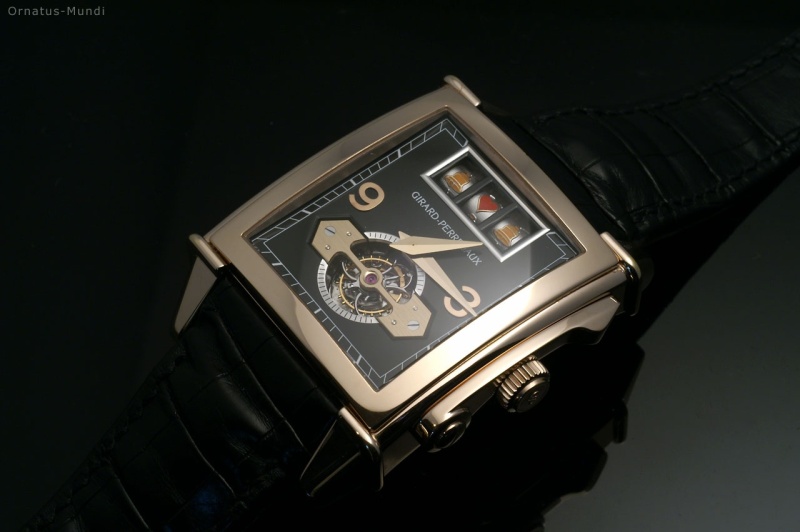
The Jackpot combines a handwound watch with the signature G-P Tourbillon (under one golden bridge) and adds a true and functional jackpot mechanism.


As Daos aptly stated the tourbillon 'is only a supporting player on the dial'. Nevertheless, it is clearly the famous G-P mechanism with its classic and beautiful curved cage, a still outstanding marvel amongst the countless of such constructions on the market today:


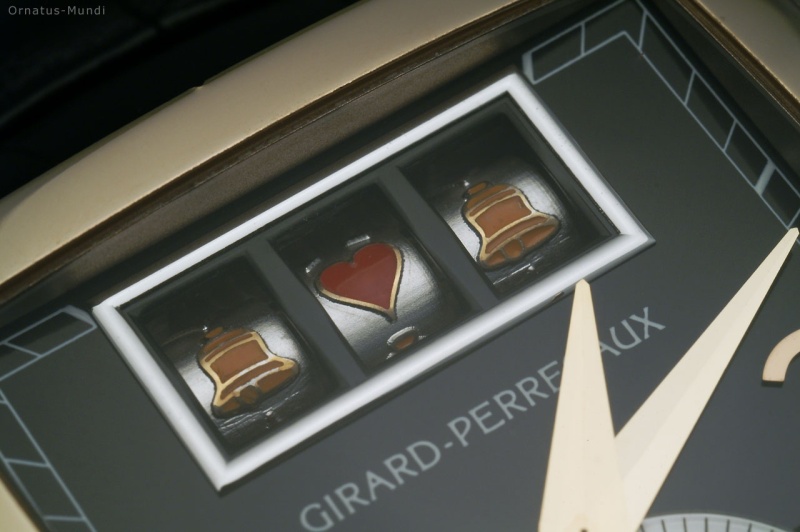
It is the jackpot window at the 12 o'clock position which gives this watch its unique position in the watchmaking universe. There are three drums with five handcrafted suits each, hearts, spades, diamonds, horseshoes, and bells (this gives 125 possible combinations: 53=125). The design of which is inspired by the first slot machine called 'liberty bell'.


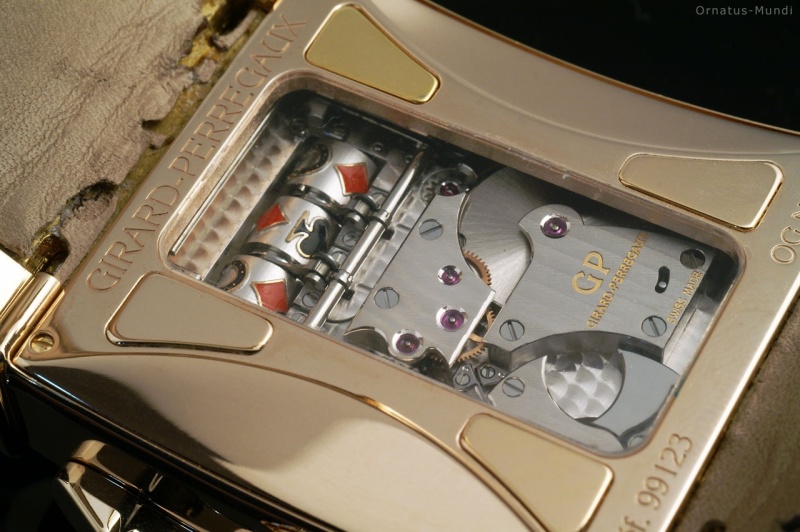
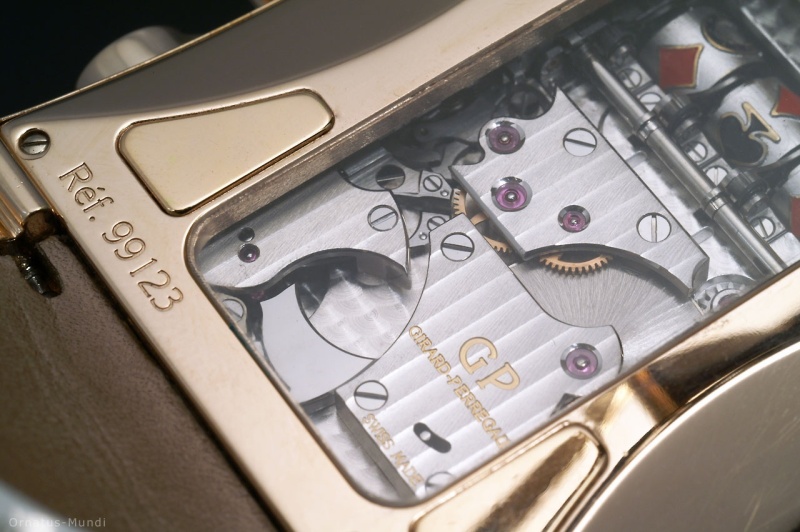
Such displays without doubt call for a close examination of the innards. I shall comply. The movement looks remarkably simple for such a wealth of functions.


Daos gave a good explanation on how the slot machine is operated in her post linked above, therefore I am merely citing her words here:

" The slot machine mechanism is set into motion when the lever of this mini "one-armed bandit" is pulled. The lever is connected to a rack. Once pulled, the handle raises the rack, which slides to its highest point. At its apex, and only then (what is referred to as an "all or nothing mechanism"), the rack starts the jackpot reels spinning before slowly sliding back down. Approximately two-thirds of the way back down to the zero position, the rack activates stoppers which halt the spinning jackpot reels one by one, and simultaneously engages a striking mechanism. "


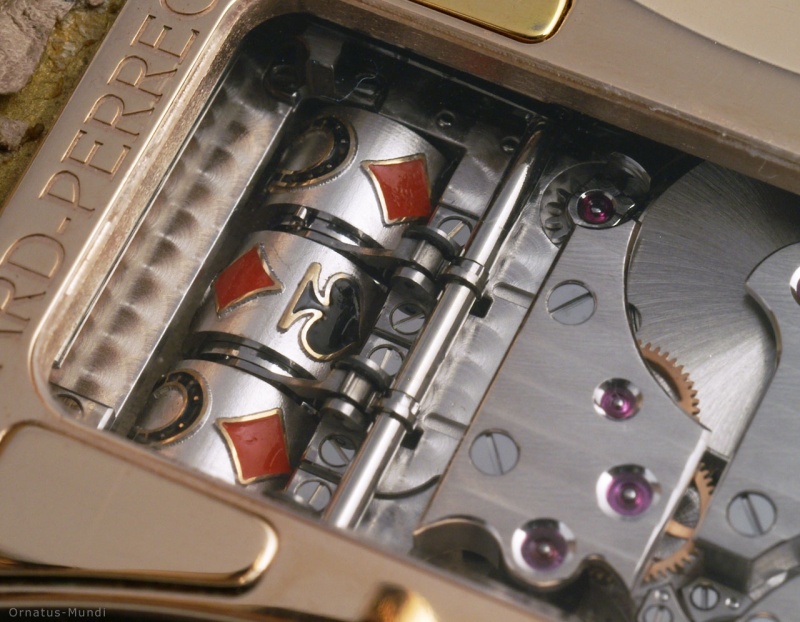
If you take a close look on the spinning reels and the associated gears and levers...


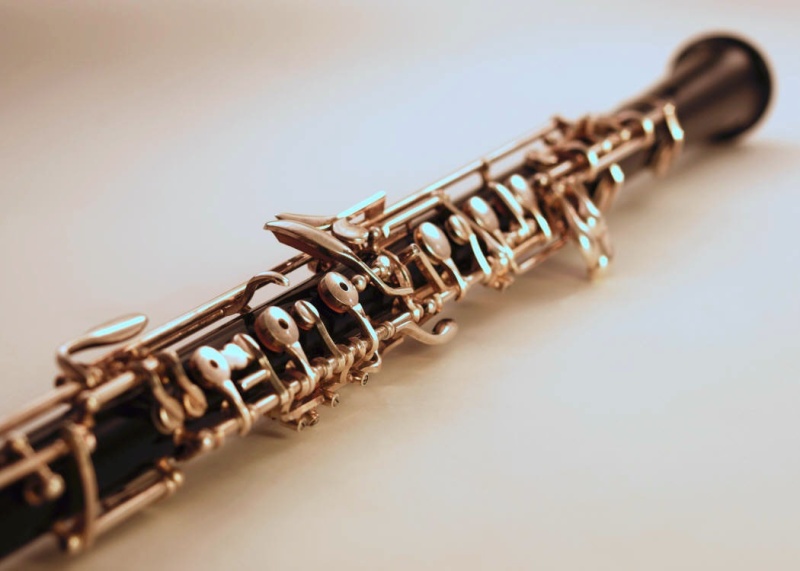
... one is immediately reminded on the vents of an oboe (image taken from the web):


This musical connotation is a pun well intended as the stop of each reel is hallmarked by a gong (think minute repeater) actuated by a hammer located on the ventral part of the movement (you can also see the mainspring barrel):


With all human-created things (and theories), they say, the proof of the pudding is in the eating. The meal starts with a determined pull of this lever:


Immediately the three reels start their dance, slowing down and stopping one after the other:


I have no words to describe the magic of this complication. If you ever have the chance to 'play' (pun well intended, again) with this watch - do it, your efforts will be greatly rewarded! What also amazes me how G-P managed to keep the overall design, particularly the dial, so simple. Art Déco is so versatile! 


Apropos, Art Déco: "It is an eclectic style that combines traditional craft motifs with Machine Age imagery and materials" (Wikipedia) - isn't this an aptly chosen design theme for such a watch? 


That's it for this masterpiece. Unfortunately I cannot offer any wristshots. Back when I took the images (5 years ago...) I underestimated the utility of taking wristshots. All I can do is to apologise for this omission.

Cheers,
Magnus

P.S.: I am grateful to G-P Germany and in particular to watchmaker Ms Cirsten Drobner who made these images possible!


This message has been edited by Ornatus-Mundi on 2012-11-05 07:23:33

About the Girard-Perregaux Ref. Vintage1945

The Girard-Perregaux Vintage 1945 line, introduced in 1994, draws inspiration from historical models, specifically a 1945 Art Deco piece. This collection is characterized by its rectangular or tonneau-shaped cases and a design language that evokes mid-20th century aesthetics. The Vintage 1945 series quickly became a cornerstone of Girard-Perregaux's offerings in the 1990s, reinterpreting classic forms with contemporary watchmaking standards. It represents a significant period for the brand in re-establishing its heritage-inspired collections.

Early models in the Vintage 1945 series typically featured stainless steel cases, though gold variants were also produced. The case dimensions varied depending on the specific model, often presenting a balanced profile suitable for dress wear. These watches were frequently equipped with automatic movements, showcasing Girard-Perregaux's in-house capabilities or finely finished outsourced calibers. The crystal was commonly sapphire, ensuring durability and legibility, while water resistance was generally suitable for daily wear rather than aquatic activities.

For collectors, the Vintage 1945 series appeals to those interested in neo-vintage watches that successfully blend historical design with modern execution. The 1994 introduction year marks it as one of the earlier and more influential lines from Girard-Perregaux's resurgence in the 1990s. Its various iterations, including time-only, small seconds, and later complicated versions, offer a range of choices for enthusiasts seeking a distinctive rectangular watch with a clear lineage.

Specifications

Caliber
GP3000
Case
Stainless Steel
Diameter
28mm x 28mm
Dial
Silver
Water Resist.
30m
Crystal
Sapphire

Key Points from the Discussion

Advertisement
The Discussion
AR
Ares501 - Mr Green
Nov 5, 2012
..and we all hit the jackpot too

we got marvelous post with outstanding pictures of one of my grail pieces Thank you for this Monday evening treat ..just what I needed after whole day lecturing Best regards Damjan

AM
amanico
Nov 5, 2012
Outstanding photos and superb write up, Magnus.

For a moment I thought you got this watch! My only concern with this watch is that it is too thick and too big, but I guess that it was not possible to give it more reasonable volumes, due to all the mechanical sophistications required for such an " opus ". A beast, and a very nice one. Your pictures give it justice, for sure. All the best, and a huge thanks for this superb article. Nicolas.

FO
foversta
Nov 5, 2012
Thanks a lot for this excellent post Magnus.

The Jackpot, one of the few watches in which the Tourbillon becomes almost invisible due to the complication. ;) Fx

ZT
ztirual
Nov 5, 2012
Such a delightful, playful watch and post. Many thanks Magnus! [nt]

CG
CGJ0
Nov 6, 2012
Great read. Thanks! [nt]

TI
timerider
Nov 6, 2012
Hi Magnus. You do bring back the memories,

this is all I could find on short notice for a wrist shot. It was a great tour, great day and the Jackpot was in play. The Jackpost was quite comfortable on my 7.5" wrist. Thanks for sparking the memory. Best, Tim

Advertisement

Continue the conversation

This thread is active on the Girard Perregaux forum with 7 replies. Share your knowledge with fellow collectors.

Join the Discussion →