WPS member · Independents forum
43 replies15440 views23 photos
DonCorson offers an exclusive look inside Heritage Watch Manufactury (HWM), spotlighting master watchmaker Karsten Frässdorf's distinctive approach to chronometry. This article delves into Frässdorf's signature large, slow-beating balance wheels and the patented innovations that define HWM's Tensus, Magnus, and Centenus models. Readers gain insight into the technical philosophy behind these precision instruments and their unique constant force mechanisms.

Behind the scenes at Heritage Watch Manufactury
Don Corson 2011
Chronometers with large slow beating balance wheels have always been the field of predilection of German master watchmaker Karsten Frässdorf. We have seen his designs, for example, in the watches of Marc Brogsitter. (click here to see my report from the Basel Fair 2008 ahci.watchprosite.com
)

Karsten Frässdorf
After moving to Normandy in northern France Karsten founded the Fabrication de Montres Normandes again making stunning sculptured movements with that big slow beating balance wheel. (click here to see my report from the Basel Fair 2009 ahci.watchprosite.com
)
Karsten is back in Switzerland now and is associated with the German and Swiss financed Heritage Watch Manufactury (HWM) located in Neuchâtel. We can see again his signature movement style. Each iteration of his movements over the years has brought with it its own set of improvements. With 5 patents he has now protected the most important points. These patents cover the constant force mechanism, the balance wheel adjustments, the hairspring pinning and adjustments, the barrel axle and escapement adjustments. These are many fine and esoteric topics, but essential to assure the best chronometric results for the movements. Below we will take a look at these watches and the patents that help make them tick and tick so precisely.

The model palette of the Heritage Watch Manufactory includes the Tensus, the Magnus and the Centenus. The Tensus includes a constant force escapement, small seconds and power reserve indication. The Magnus has a Swiss anchor escapement with small seconds and has been designed so that there is sufficient space and volume on the dial side to be able to add different complications in the movement without adding a supplementary module. The Centenus is the first watch based on a Magnus with an added display of the time in traditional Chinese units as well as in Western units. Because the Magnus was designed to accept further complications this adds neither diameter nor height to the watch and the Centenus case is identical to that of the Magnus.

Tensus

Magnus

Centenus
Let us start with the most interesting development (for me at least), the Tensus and its constant force escapement. This is a true constant force escapement where each individual impulse has the same force and the force is stored in the escapement. Storing the force in the escapement is important as this means minimum inertia between the propelling element and the balance. Note the difference to a remontoir d’égalité; the idea of a remontoir d’égalité is that a second smaller spring which is somewhere between the mainspring and the escapement is rewound once a second or other time period, but not for each impulse. A remontoir d’egalité assures that the impulses are very similar, but not that they are all equal. The energy from the remontoir may also go through several gears of the going train before it gets to the escapement, adding their inertia which will slow the escapements reaction time.
The HWM constant force mechanism is based on a structure with an additional wheel which is co-axial with the escape wheel. This “constant force” wheel is driven by the going train of the watch and is connected to the escape wheel through a “constant force spring”. The movement of the constant force wheel is controlled by an anchor which allows it to turn the space of one pair of teeth on the escape wheel after each impulse. The escape wheel always sees the impulse from the constant force spring and is independent of the power of the main spring as long as the main spring has more force than the constant force spring. Note that the autonomy of the watch is specified for the time where this is the case. The watch will run much longer, but without the benefits of constant force on the timekeeping.
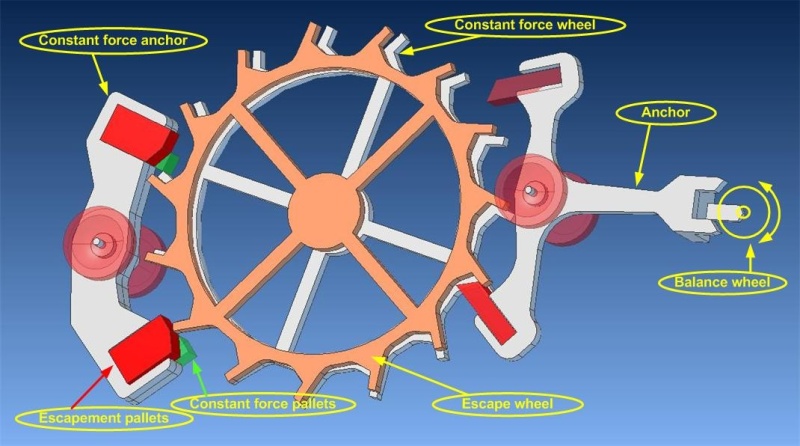
Let’s go through a cycle to see how this constant force mechanism works in detail. The following schematic diagram identifies the parts of the constant force mechanism.

The Escape wheel and the constant force wheel are turning on 2 coaxial axles which are not pictured. Also not pictured is the constant force spring which connects the two wheels and pushes the escape wheel forward when it is unlocked by the anchor. The wheels will be turning clockwise. The anchor and the constant force anchor both have axles with jeweled bearings as pictured and turn back and forth freely around their respective axles. This motion retracts one of the pallets from the wheel while the other advances toward the wheel.
It is important to note that the constant force anchor has two levels that move together. The upper level has the two pallets that intercept the escape wheel (red) and control the position of the constant force anchor, the lower level has the two pallets that intercept the constant force wheel (green) and lock or allow the constant force wheel to turn as a function of position of the anchor.
In the first image below we see the escape wheel locked by the exit pallet of the anchor at (C). The constant force wheel is locked by the constant force pallet at (A), remember the wheels turn in a clockwise direction. At (B) we can see that the constant force pallet is prevented from unlocking by the tooth of the escape wheel. The red pallet at (B) cannot advance toward the wheel because of the tooth of the escape wheel; this prevents the green pallet at (A) from moving back which would allow the constant force wheel to turn.

In the next image below the balance wheel (not pictured) is turning clockwise and has just moved the anchor counterclockwise enough that the pallet at (A) is now on the inclined face. The constant force wheel is still locked by the pallet at (B) so the spring between the constant force wheel and the escape wheel forces the escape wheel forward. This causes the tooth of the escape wheel to push along the incline of the pallet which forces the anchor to turn, giving the impulse to the balance wheel through the anchor.

Below we see the system at the instant when the impulse stage is over. The tooth of the escape wheel has pushed the pallet at (A) back turning the anchor counterclockwise. At (B) the tooth of the escape wheel now pushes the constant force anchor back freeing the constant force wheel locked up to this point by the green pallet.

Both wheels turn (clockwise) independently. The escape wheel stops when the tooth hits the pallet at (A). The constant force wheel stops when the tooth hits the pallet at (C).

Now we start the same sequence with the entry pallet of the anchor at (A). The counter-clockwise movement of the balance rotates the anchor clockwise a tiny bit unlocking the pallet and tooth at (A). The force of the constant force spring turns the escape wheel as the constant force wheel remains locked at (C ).

Below we can see the case when the tooth of the escape wheel at (C ) has just unlocked the constant force wheel. The escape wheel will lock at (A), the constant force wheel at (B)

Now we have completed the entire cycle and are back at the position of the first image. The escape wheel is locked at (A), the constant force wheel is locked at (B). The next cycle will begin when the balance wheel turning clockwise turns the anchor and unlocks the escape wheel at (A).

In this arrangement the escape wheel is always turned by the constant force spring between the two wheels during the time of the impulse, when the escape tooth is pushing against the incline of a pallet. The constant force spring is re-armed immediately after this impulse phase during the time when the balance wheel turns freely and is not being impulsed. Because the constant force spring is only moving the escape wheel and anchor to impulse the balance the inertia is very low. The tooth of the escapement wheel follows very closely the shape of the pallet making the amplitude difference between horizontal and vertical positions very small.
This description is not simple, but the reality of the situation is even more complicated. The system must be stable in all positions and in the case of shocks, never hang or let the watch unwind abruptly. The security and reliability must be 100%. The genius of Karsten Frässdorf’s design is that he can make reliable movements with realistically manufacturable tolerances and pallet adjustments. Thus he has a reliable truly constant force escapement greatly enhancing the accuracy of the watch. Every impulse given to the balance wheel is identical independent of the winding state of the mainspring. This is the first and most important of the HWM inventions.

The further inventions are also all with the goal of increasing the reliability and accuracy of the watch. Some seem simple and evident such as the patent on the mainspring barrel axle. This patent is about the axle of a superimposed double spring barrel. One of the problems of the mainspring barrel can be uneven forces from the mainspring forcing it to one side or to tilt. Worst case this can lead to the main spring touching the barrel bottom or lid causing friction and a reduction of the usable torque. To reduce this the HWM patent specifies a barrel axle for a double barrel where the two springs are hooked 180° from each other. Their radial forces will counteract each other reducing the tendency to tip and wear at the bearings. Simple, no?

A further patent has to do with the adjustment possibilities of the balance wheel. The Vivax balance includes a centrifugal weight that slows the balance at high amplitudes. As Karsten explains, this particular balance wheel hairspring system speeds up at high amplitudes. For the Tensus with its constant force escapement this makes no difference, of course, but HWM makes also the Magnus and other models using standard Swiss anchor escapements. The Vivax balance has a centrifugal regulation to counteract this behaviour.

The next patent, Tenere, concerns the system that holds the hairspring and adjusts its working length. As you may know the hairspring is often just clamped in a round hole in the stud using a conical pin. This causes the beginning of the spring to be curved which changes its characteristics. The Tenere system holds the spring flat in the perfect continuation of its curve. The second part of the patent concerns the adjustable regulating pins. In general these pins that determine the vibrating length of the hairspring are bent to correct the distance between them in which the hairspring moves. This distance must be very small, but the hairspring must not be wedged between the pins. This adjustment can cause the pins to no longer be perfectly parallel which can cause hairspring twist. Using the Tenere system this distance can be easily adjusted with the assurance that surfaces always remain parallel.

The final patent, Sectator, concerns the banking adjustment of the anchor. In many watches the banking can not be adjusted or is difficult to adjust. This can lead to lead to wasted and unnecessary movement of the anchor. The Sectator system has spring loaded levers which can be adjusted with finely threaded adjusting screws. When the adjustment is correct both the adjusting screws and the levers are screwed down to block then.

This armada of fine regulation possibilities enables HWM to produce highly accurate mechanical chronometers. They are big handsome watches from the front and fascinating mechanical sculptures from the back.

Magnus and Tensus


This message has been edited by DonCorson on 2011-11-30 13:37:27 This message has been edited by AnthonyTsai on 2011-11-30 14:11:10 This message has been edited by AnthonyTsai on 2011-12-09 07:50:05 Key Points from the Discussion
- The definition of a 'constant force escapement' versus a 'remontoir d'égalité' is a nuanced debate, with Karsten Frässdorf emphasizing that his design stores force within the escapement itself for each impulse, unlike a remontoir which rewinds less frequently.
- George Daniels' definition of a constant force escapement, where impulse is delivered by a separate detent, is a key reference point in the discussion, though its applicability to all modern designs like HWM's is debated.
- Frässdorf clarifies that despite appearances, his escapement is not a traditional Swiss Escapement due to critical differences in impulse surface and energy transfer, optimizing for precision.
- The HWM constant force mechanism is lauded for its boundary-pushing design, which genuinely delivers constant force at each impulse, a rare achievement among many so-called constant force devices.
- The 'Affixe' arms on HWM's balance wheels, made from the same material as the balance, serve to fine-tune temperature compensation, a technique with historical parallels to Ditisheim's work on chronometers.
- A contributor shares personal experience of being captivated by Karsten Frässdorf's work, particularly the massive balance wheels in his tourbillon and constant force calibers, after a direct explanation from the watchmaker.
Advertisement
Continue the conversation
This thread is active on the Independents forum with 43 replies. Share your knowledge with fellow collectors.
Join the Discussion →