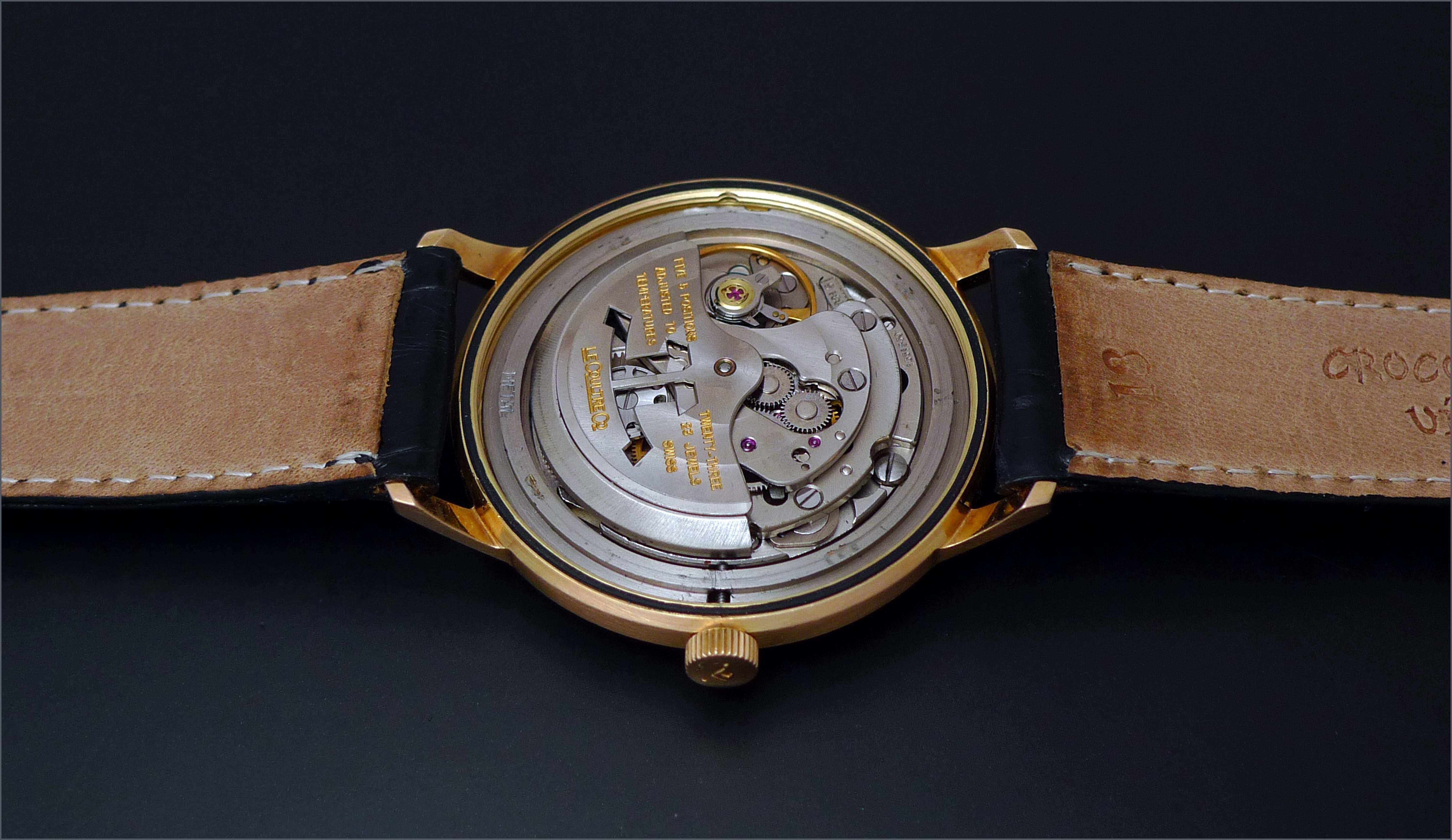
When we do our home work on the topic of automatic movements, we learn that this technical solution was found since the end of the 18th Century, by a certain Mr Sarton, in 1778, to be precise, very close followed by Mr A.L Breguet, in 1782.
But when it comes to wristwatches, the automatic solution came much later, as we had to wait till 1922 to see Mr Léon Leroy making the first prototype... Which seemed to have never been in production.
The first automatic wristwatch to have been released had a famous and well known name, for all the watch lovers, Harwood:
Here is what I wrote about this Harwood, in my dedicated review on the Futurematic:
" The Harwood was made in collaboration with Frederic Emile Blancpain, and was presented at the Basel Fair in 1926.
The interest of this watch is capital, as it is the first automatic wrist watch in the world!
At this moment, it was a 12 hours ( !! ) Power Reserve, And...And...we're coming back at our intial topic, no crown to change the hour nor to wind the watch..."
We can't say that Jaeger-LeCoultre was a precursor in the domain of Automatic Watches, as they came 20 years after ( 1946 ) , with their own self winding time keeper.
Still, it would be interesting to know who else offered such a technical solution at this time, which is, nowadays, the most used and seen in our wirstwatches.
I decided to sum the JLC Automatic watches to 6 examples, 6 watches which were a milestone, at their time, in a chronological presentation.
Let's see them in the detail:
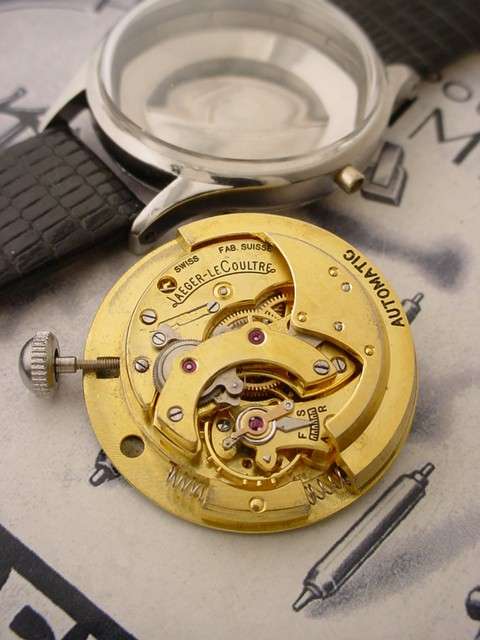
1/ The first JLC Automatic movement, the Cal 476 ( since 1946 ).
We're far from the Harwood, with a much larger power reserve, which is about 40 hours.
The finish is not awesome, the decoration is not unpleasant, the movement is accurate, and reliable, so accurate that it was used as a Chronometre, 12 years later, but we'll have the time to see that, later...
2/ The Powerwind, Ref E 163.
An evolution of the Cal 476, introducing a complication which will almost never leave the watches from the Manufacture, The Power Reserve ( Reserve De Marche ) from 1948 to 1959.
Indeed, Jaeger- LeCoultre still has the watch in the catalog, whose name is Reserve De Marche, with a more modern, yet a bit retro, presentation.
Please note that the Powerwind / Powermatic came in several references, cases, sizes and dials, mostly for the US market, which can be distinguished by their smaller size and the LeCoultre signature on the dial.
Here, an European E 163 in a 37 mm case:
Its movement, the Cal 481, is an evolution of the Cal 476, the original automatic low beat movement:
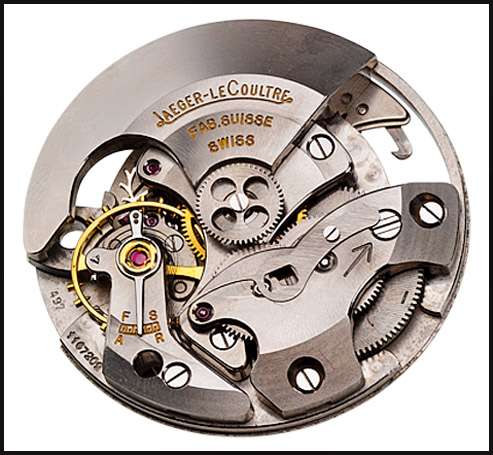
3/ Futurematic Ref E 501.
A totally new and dedicated movement came from JLC for the Futurematic, the Cal 497.
Reading the old documents is a great source of informations as you learn that this movement has the following virtues.
- A larger balance, which goal is to provide a greater accuracy.
- The swinging weight is locked once the watch is sufficiently wound.
- When you slide the crown, the movement hacks, which allows a precise setting of the hands, coordinated to a radio time, for example.
- An ingenuous system which provides a 6 hours power reseve and allows the watch to immediately run when you put it on your wrist, after it stopped.
Aesthetically speaking, different cases and dials were produced, but all share this original display, the lack of the visible crown, and these great movements ( Cal 497 / 817 / 837 ).
Its movement:
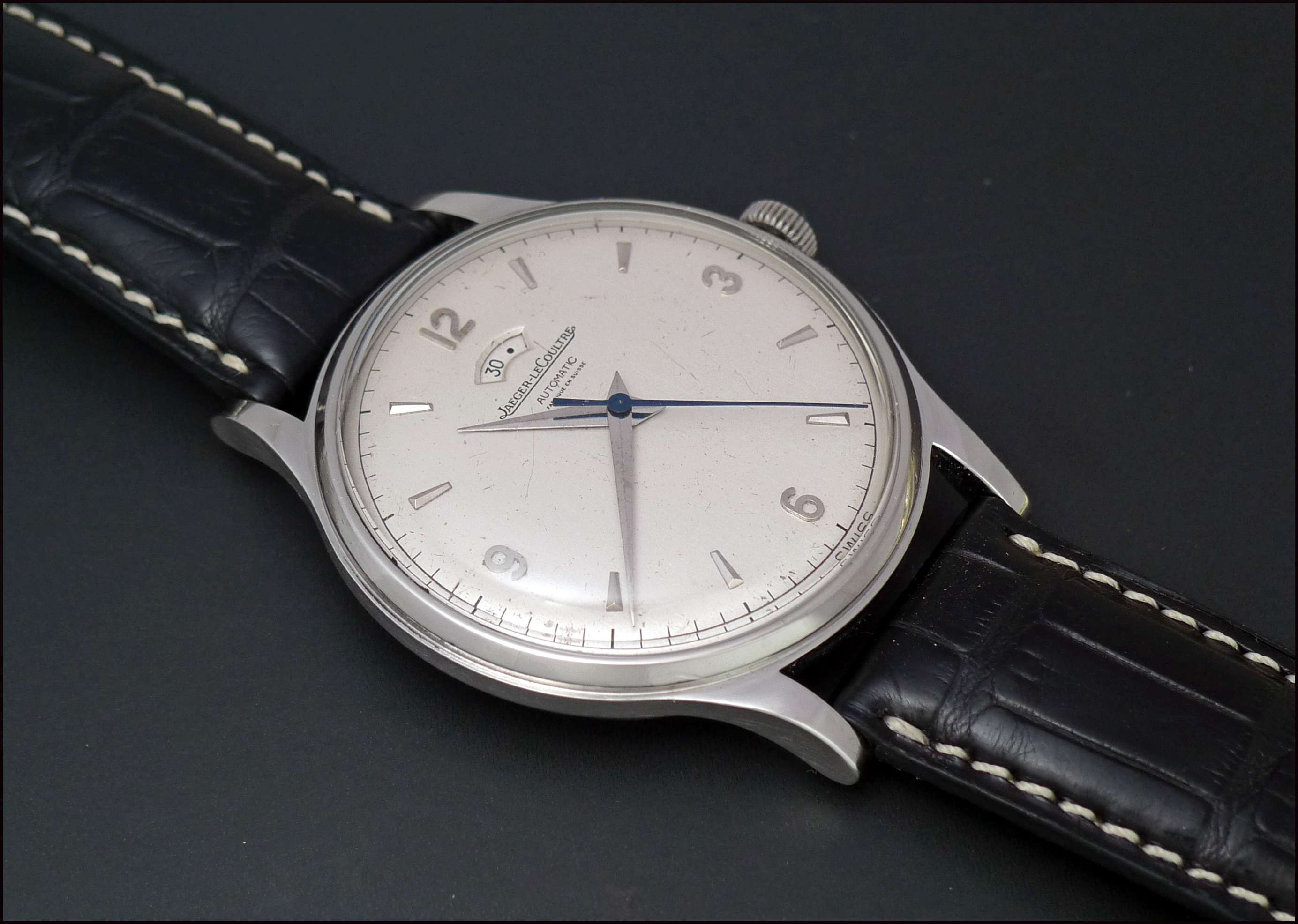
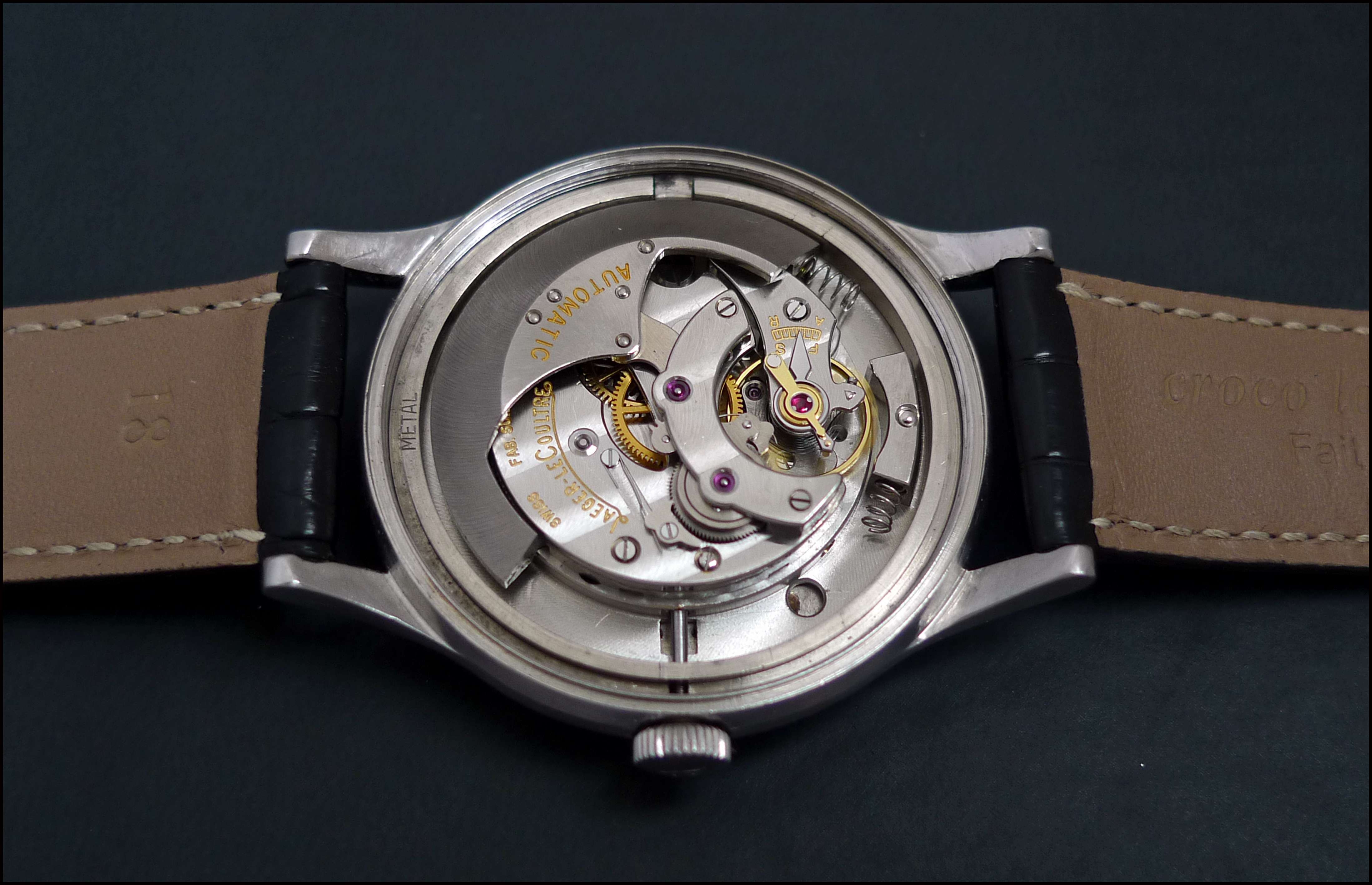
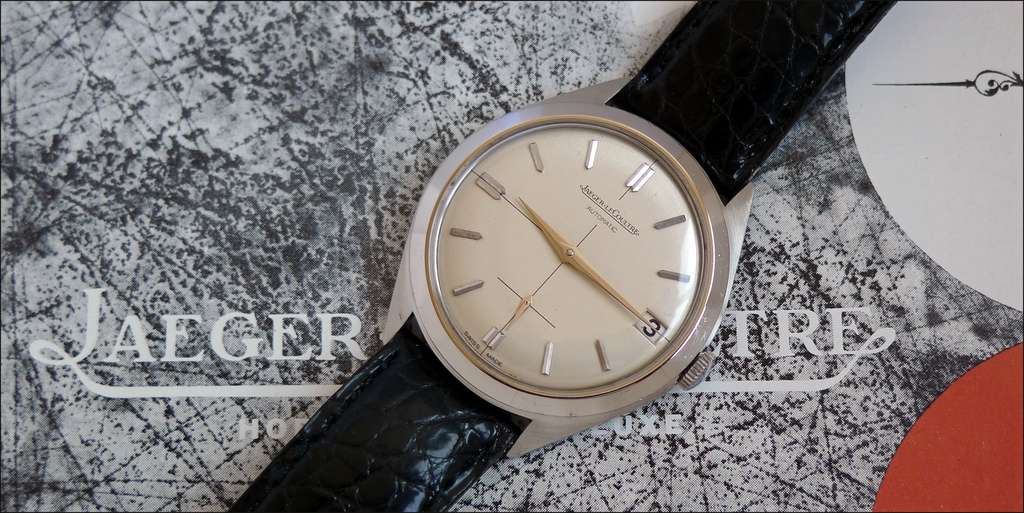
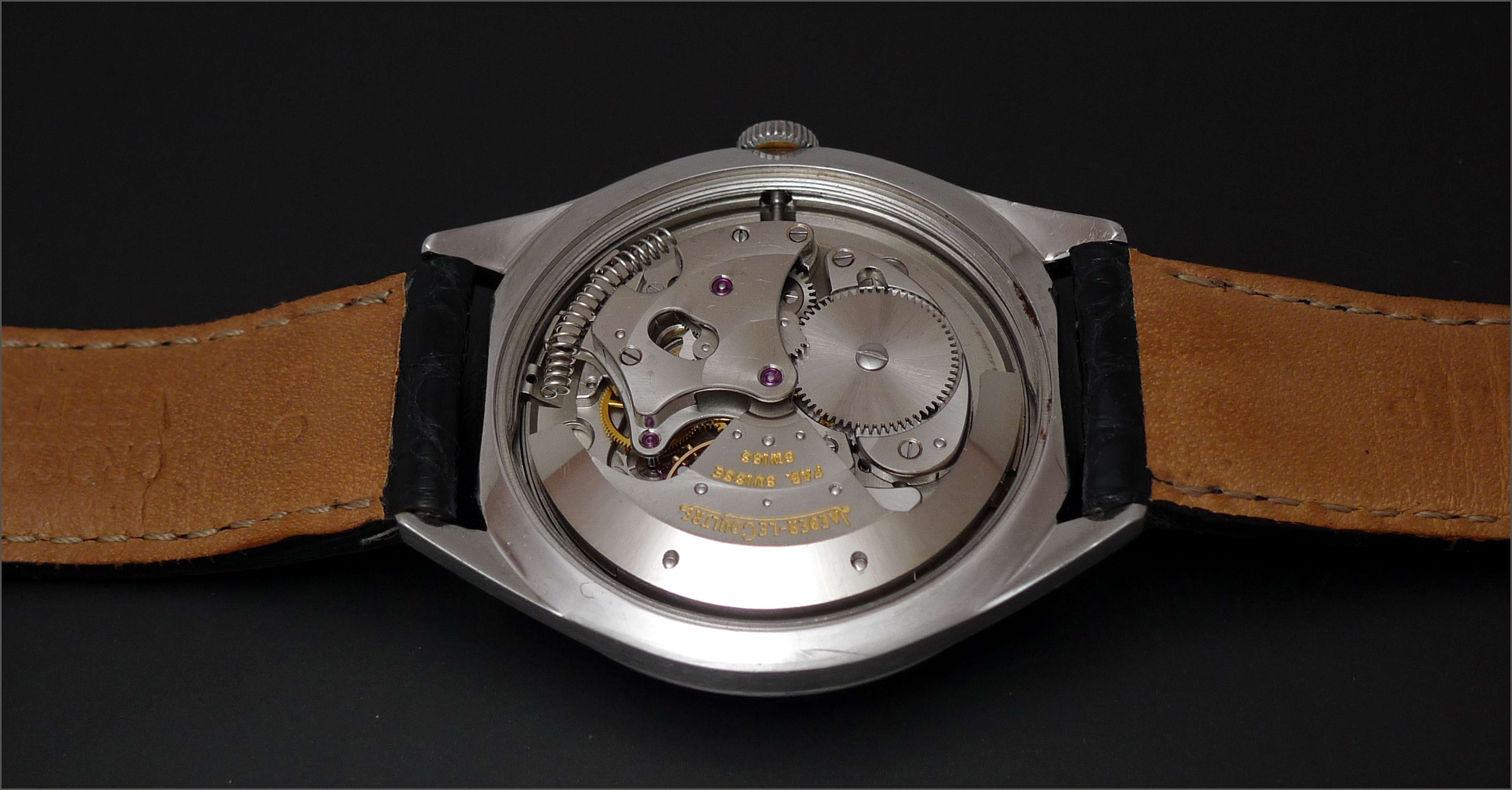
4/ The Ref E 329:
This is a watch you won't often see, here or there.
What I know is that is was produced for a a few years, from 1957 to 1962, in a small batch: 4121 pieces in Stainless steel, and also in yellow or rose gold.
This is a decently sized watch ( 35 mm ) with a sober and elegant case whose orignality lies in the date: Black on white for even days, white on black for odd days.
As for the movement, nothing exceptional, we have here the Cal 813, which beats at 19800 vibrations per hourt, displaying the date and a small second. As you can see, it is a bumper movement.
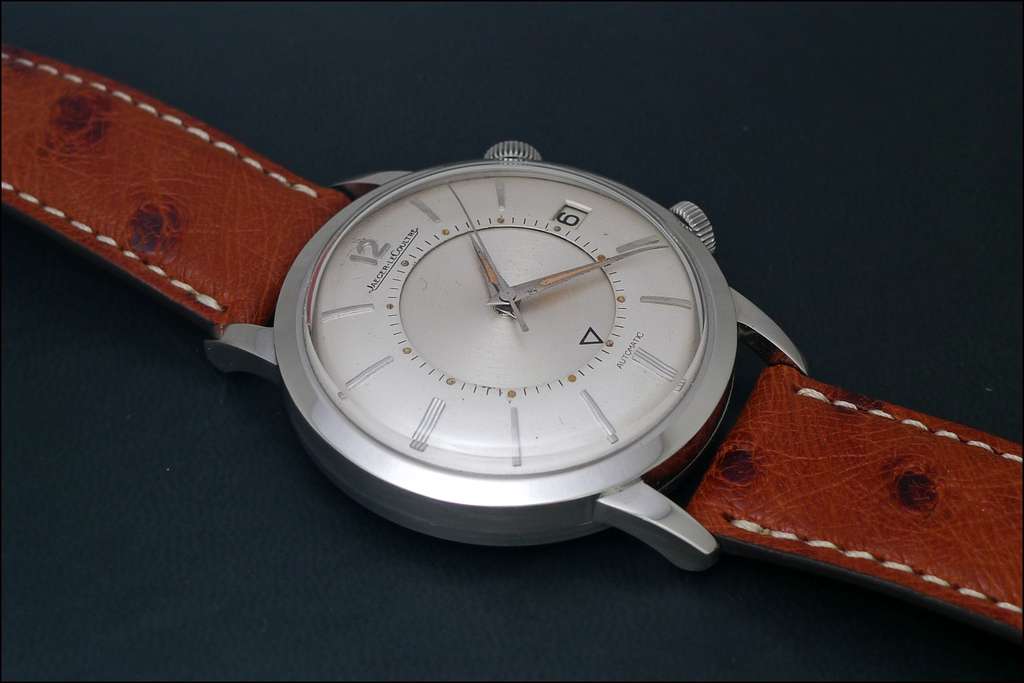
5/ The Memovox E 855:
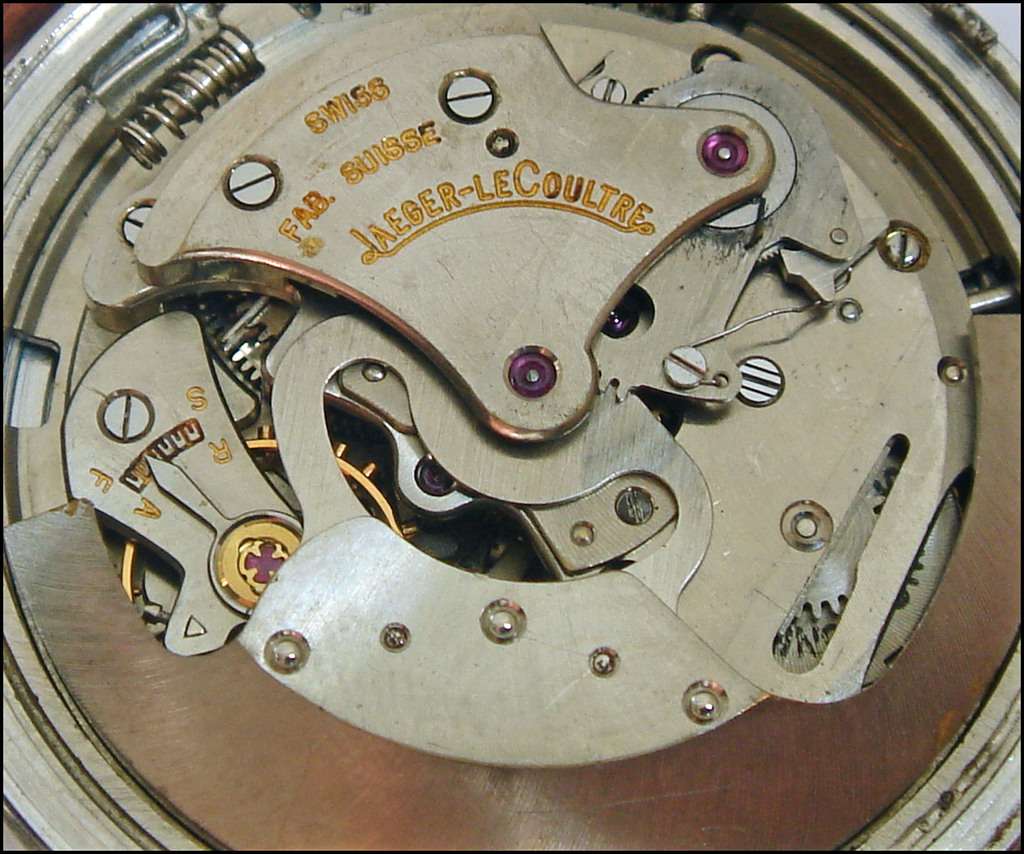
You will pardon me for this light anachronism, as the E 855 was not the first Automatic Alarm Wristwatch, as it housed a Cal 825 while the first one was the Cal 815, introduced in 1956 ( The Cal 825 was introduced in 1959 ).
So, the first Reference to house the Cal 815 is an E 853 ( 1956 ), the second one being the ... Deep Sea Alarm, ref E 857 ( 1959 ).
The difference between the Cal 815 and the Cal 825?
One doesn't display the date ( 815 ) while the other does ( 825 ).
Anyway, JLC released the first Automatic Alarm Watch, since 1956, which justifies that we mention the Memovox, here.
The Memovox... A timeless watch, which is still in the catalog, after a break of a bit ore than 10 years, which is nothing in a 61 years old model.
A model which knew so many iterations and versions that it would be an endless thema of collection.
The watch
The Cal 825:
6/ Geomatic Ref E 398:
I recently discovered that the Geomatic was not the first automatic chronometer made by the Grande Maison, the first one being the P 476/ 3, which was a bumper movement.
The Cal 881, born in 1961, is very different. The bumper has been replaced for a more modern 360° rotor, winding in both directions, beating at 19800 vibrations per hour, and submitted to the COSC, as a good chronometer it is.
There was an impressive variations of cases ( round / tonneau ), showing different lugs, too, and I don't even mention the dials.
The Geomatic is a very elegant watch, in a certain way, more elegant than the " Macho " Geophysic, the two most known JLC Chronometers;
The watch:
The Cal 881:
Conclusion:
I could have included some other watches, of course, such as the Mystery / Galaxy, or the last Vintage Chronometer mad made by JLC, the (in)famous Cal 906, but these one are the dign representant of the Manufacture production, at this time, and I had to make a choice, a selection, here.
I wouldn't close this topic without sharing some thoughts, about these Automatic movements, in the " Grande Maison " history.
I have to say that I have mixed feelings with these automatic movements.
In the Fifties, they became very popular, and the " big names " of the moment all offered their own vision to their respective clientèle.
Indeed, it was very seducing to think that the watch could live with you, without having to wind it every day.
Intellectually, it was certainly a good idea.
At the beginning of its life, the automatic movement peacefully co existed with their manual " brothers ".
In a few cases, I would even say that it was not thinkable to have another caliber than an automatic one.
Could you imagine a manual winding Futurematic? Me, not: Futurematic sounds much better than Futuremanual.
They were an interesting technical improvement for some watches, too, like the Diving watches.
Winding on a daily basis a diving watch is not good for the seal, so there were two possibilities: An 8 Day movement, or a self winding one.
BUT isn't there a price to pay?
More and more, the automatic movements take the path on the manual, which we can see, still nowadays.
When you compare both the manual and the automatic, I'd say that the last is more functional, when the ifrst could be very pleasant to look at.
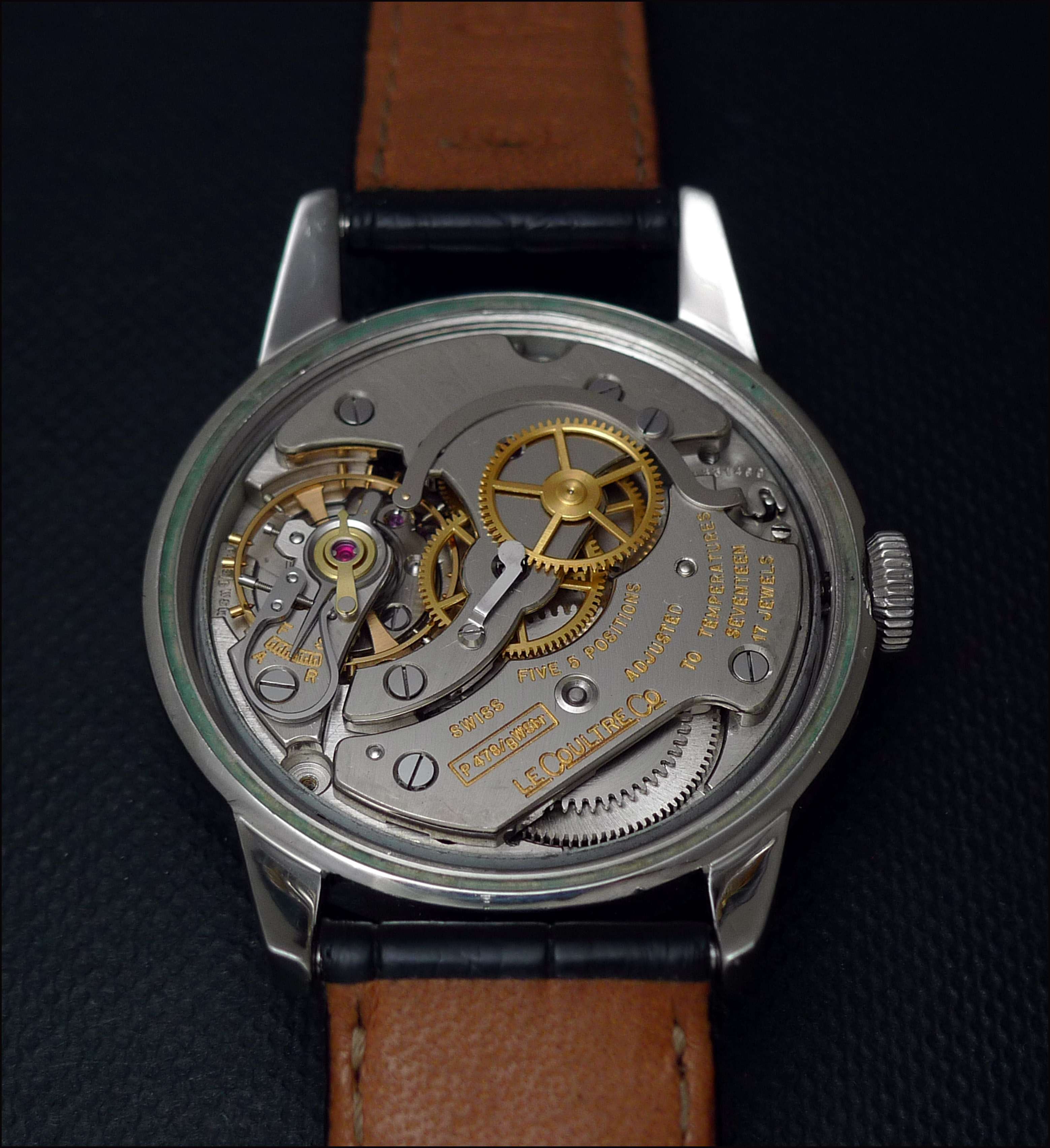
On an aesthical point of view, I don't see ANY Vintage JLC automatic movement which can compete with the beauty of a Cal P 478 BWSBr ( Geophysic ), a Cal 479 ( Military WWW ), a Cal 488 ( Mark 11 ), a Cal 470 or 450 ( Mark 7 ), and, Creme de la Creme, the famous Cal 484 / 494 ( Triple Dates ) for example.
The Elusive Geophysic movement:
With the automatic, did we go from beauty to functionality?
Once again, this question is very actual...
Food for thought.
Looking forward to reading your comments,
Best.
Nicolas.
This message has been edited by amanico on 2013-07-16 21:57:11 This message has been edited by amanico on 2013-07-22 07:24:21