Watchmaking in Russia – Ripe with Prejudices
In his booklet Watchmakers and Clockmakers in Russia 1400 to 1850 of 1972, Valentin Chenakal opens the text with the paragraph: “With all their great merits, the world list of watch and clock makers of the past – such as F.J. Britten, Old Clocks and Watches and their makers (…), G.H. Bailie, Watchmakers and Clockmakers of the World (…), etc. – have all suffered from one important omission. Not one of them contains the names of clockmakers who worked in the countries of Eastern Europe, and, in particular, Russia. It is nevertheless true that clockmakers working in these countries, including Russia, have made contributions to the development of the craft of clock making as important as those of other countries.”

Not much has changed in the last 45 years, with prejudices still ripe when watchmaking in Russia is mentioned. The presentation of Konstantin Chaykin’s watches on a well-known blog still solicited comments like “But still, its Russian, and if theres one thing Russians are not known for its fine craftmanship.” (sic)
All this does not bother Konstantin Chaykin too much, he is used to it, not the least because he experienced the same sceptical reaction when applying for membership to the AHCI in 2008. A committee paid a visit to his atelier (then) in St. Petersburg, because they did not believe that he has made the presented astronomical Easter clock himself. Though, these fellow master watchmakers were impressed what they saw and membership to the AHCI was granted to Konstantin Chaykin in 2010. Furthermore, they elected him in 2016 president of the AHCI, obviously also in recognition of what he does for high end watchmaking.

Konstantin Chaykin also wrote a fascinating book Das Uhrmacherwesen in Russland - Meister und Bewahrer (Watchmaking in Russia; available only in Russian or German [German Edition ISBN-13: 978-5869833440] at the time) to draw attention to all the watchmakers in Russia creating masterworks of watchmaking long before him. And before the Perestroika around 15 watch factories existed in Russia, but then slowly died away when Western products were preferred.
How to become a master watchmaker in Russia
Konstantin Chaykin is a self-taught watchmaker. He started his professional career as a radio engineer, ran from 2000 onwards a watch distributorship with a partner for some years. Due to a lack of reliable watchmakers he started to repair himself watches he had to handle in his wholesale business. The “serious” watchmaking was taken up in 2003, when he wanted to gift his father for the 50th anniversary a decent watch and had to produce it himself.
With no watchmaking schools in Russia, Konstantin Chaykin had all to learn by studying books, magazines and what information he found on the internet. With his education as an engineer it was not too difficult for him to understand what he found described in the literature. Inspired by a Breguet exhibition in the Hermitage of St. Petersburg, he started in 2003 to work for nine months to create a carriage clock with a tourbillon (the first tourbillon movement made in Russia). While he built some more variations of table clocks with tourbillons in the following years, he was particularly keen to attack a real challenge: The creation of an astronomical Easter clock, with a perpetual indication of Orthodox holidays. An integral part of this complication is an Easter indicator, judged the most complicated indicator mechanism in the world.

The clock contains many more complications, from a minute tourbillon to a celestial map of the sky above St. Petersburg, moon phase indicator and a set of automatically shifting perpetual calendars for day, date, month and year, amongst others. No wonder, the AHCI committee could not believe that Konstantin Chaykin had done all these mechanical calculations himself as well as making the more than 700 parts all by hand, without the back-up of a watch industry as you find it in Switzerland. But then Konstantin Chaykin does also not see himself as a “watchmaker”. He would rather like to be seen as an inventor. The abundance of ideas leads sometimes to complications the more conservative enthusiasts might describe as slightly weird, like the Cinema watch or the Carpe Diem model with a “working” hour glass. Entering his atelier building you thus also walk first past his many patents proudly hung on the walls.

Perhaps even more revealing is that you do not find pictures of famous watchmakers like Breguet and Berthoud displayed around his personal workplace, but an illustration of Edison.
Except rubies and escapement springs, everything is made in the atelier of Konstantin Chaykin. And when the collaboration with a partner is required, e.g., for the sapphire glass, he had to instruct and educate a glass manufacturer in St. Petersburg for almost seven years to get the quality he needs for his watches. In the atelier you see many simple machines and tools adapted in house for specific tasks, including cutting teeth of gears. While in Switzerland projects for entirely hand-made watches (Le Garde Temps Naissance d’une Montre, Oscillon) are featured as the last bastion of proper watch making, with Konstantin Chaykin it is daily life.
The raw materials are also stored in the atelier, with the boss’ “laboratory” just around the corner.
At the “clean place” Konstantin Chaykin does CAD construction work as well as assembly work. Being able to do all yourself not only encourages to constantly try what is possible and how a solution could still be improved, but leads also to an incredibly quick delivery of proposals that leave no questions open. In no other project did I receive 3D illustrations within days, which allowed the discussion and specification of the tiniest details of the watch.

Because there is still no watch school in Russia, all the watchmakers have to be trained in the atelier. Konstantin Chaykin dreamed also of expanding his production (and started a cooperation with a partner), but had to realise that the requirements are totally different for making watches and clocks on the highest level compared to supplying watches for a wider market. Konstantin Chaykin makes thus about 15 to 20 wristwatches and perhaps one highly complicated table clock per year. Most of the work on these watches is done by himself, with the around six employees – at the time of my visit – mostly doing assembly work for his former partner’s company Nika watches (this work is done in self-built mini “clean rooms” with air being sucked out to avoid the inclusion of dust particles in the watches). Konstantin Chaykin’s know-how is also hired by Nika for development and engineering work, and in return he can use the production facilities of Nika for certain operations in the production of parts requiring specific machines.

No derivative designs
This continued isolation from the usual watch making centres in Europe as well as Konstantin Chaykin’s keenness to find technical solutions without relying on/copying what has been done since decades by other watchmakers, leads to highly unusual watch designs.
After looking at the sea of sameness in the main halls of Baselworld in 2013, I was totally fascinated by the Lunokhod watch shown by Konstantin Chaykin. This had not only an unusual display of the time and the moon phase (including patented continuous corrector), but is also made of a Damascus-like Indian steel called wootz (Punjab gunsmiths had made blades centuries ago from this steel). Futuristic form and ancient material worked perfectly together in my eyes.
At Baselworld 2014 I quickly went to the booth of Konstantin Chaykin to find out what surprises are now found.
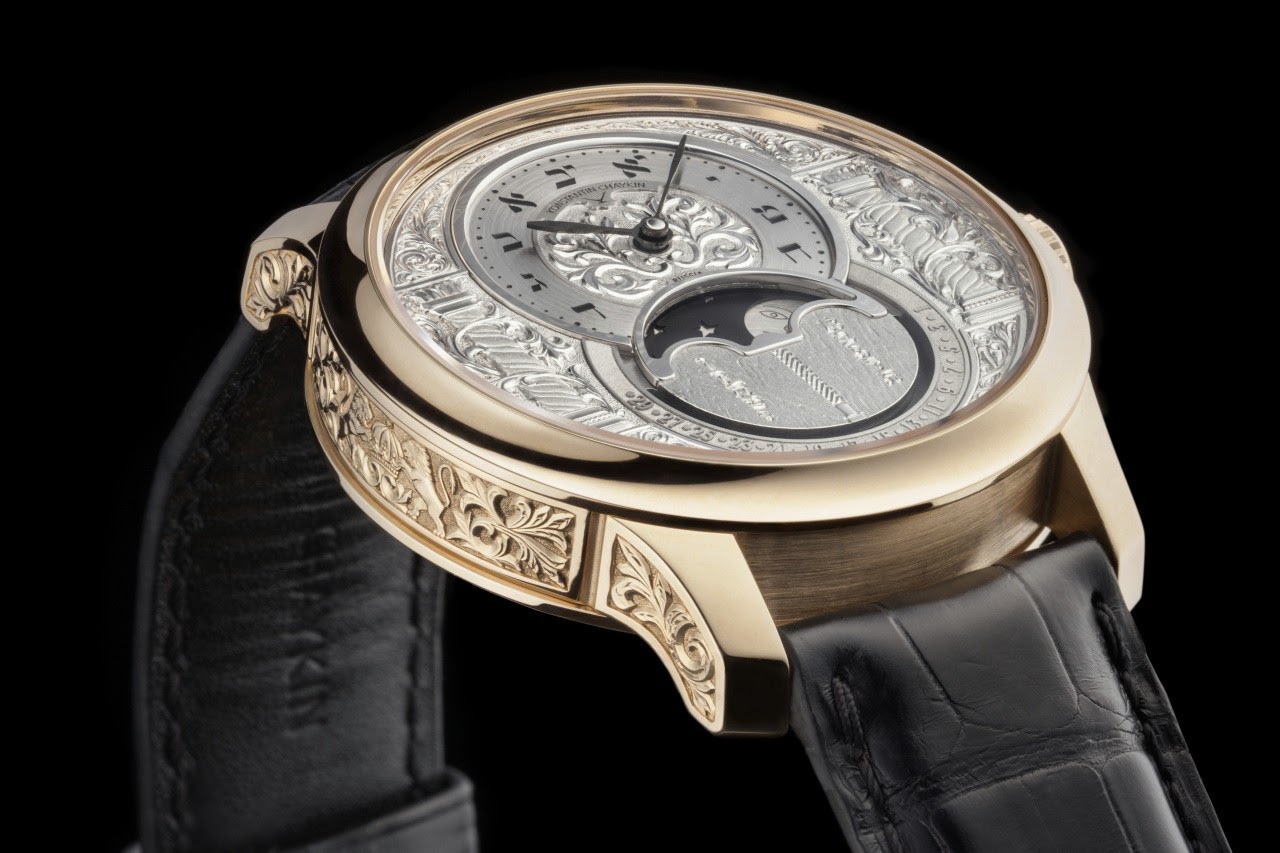
This time I fell in love with the model Decalogue Luah Shana. The rich engravings let me think of the ornate decoration of Russian orthodox basilicas. This design embodies for me the Russian Imperial time that left us also superb art like the Fabergé eggs.
Collecting (only) world time watches, I approached Konstantin Chaykin trying to find out if he could make for me a world time or time zone watch based on this design. I was told to wait a bit because he was working on another watch which would be much more suitable to fulfil my desire.
Russian Time Zone Watch
Early November 2014 I could no longer wait and got in contact with Konstantin Chaykin respectively his sister Nadja Chaykina. Nadja Chaykina is not only supporting her brother in his business endeavours since many years (so she knew his watches and the manufacturing process very well), but studied in Germany, making communication in German very convenient.
Within only four days I got details of the new model Russian Time. Since the model was still in development and a patent registration pending, I was asked to keep this information to myself. This model debuting at Baselworld 2015 had a unique display arrangement to show all 11 time zones of Russia.
Inspiration for the watch was a table clock in the Peterhof palace outside St. Petersburg. In 1861 Iwan Jurin built this clock displaying the time in the various governments of Russia.
Carrying all the time a notebook with him to avoid losing sudden ideas, Konstantin Chaykin thought it appropriate to remind with a watch that Russia has still 11 time zones. He tried to find a solution that fits the space offered by the dial of a wristwatch and is still easy to read. The combination of reference cities with a map of Russia seemed the best way to go ahead. In the patent paper he elaborates, the purpose of his dial arrangement “is to provide the opportunity to focus in a particular sector of the dial in order to facilitate the perception of information processing by the human eye and its brain”…
In common with world time watches the required movement mechanism is not very complicated (in this case a 24-hour disks with two rows of Arabic numerals turning clockwise added to the main 12-hour display of hours and minutes). The challenge with multiple time displays is the visual design, to get a nice looking dial that is still easy to read.
The patent filed by Konstantin Chaykin thus covers the mechanical issues only in a minor role and concentrates on the design aspects of the time display.
The finished Russian Time watch is offered with the in-house calibre ?01-7, a hand-wound movement with anchor escapement, a frequency 21 600 vph, 17 jewels and a power reserve of 48 hours. The case is of 44 mm diameter and in stainless steel.
For Nika Konstantin Chaykin has simplified the display module. This watch is offered (not by Konstantin Chaykin) for less than $ 1’000.00 with a quartz movement in a silver case.
Technical and Decoration Design of a Unique Piece
My wish was to have the model Russian Time converted into a world time watch, with a decoration that reminds me of the opulence of Russia at the time of the czars.
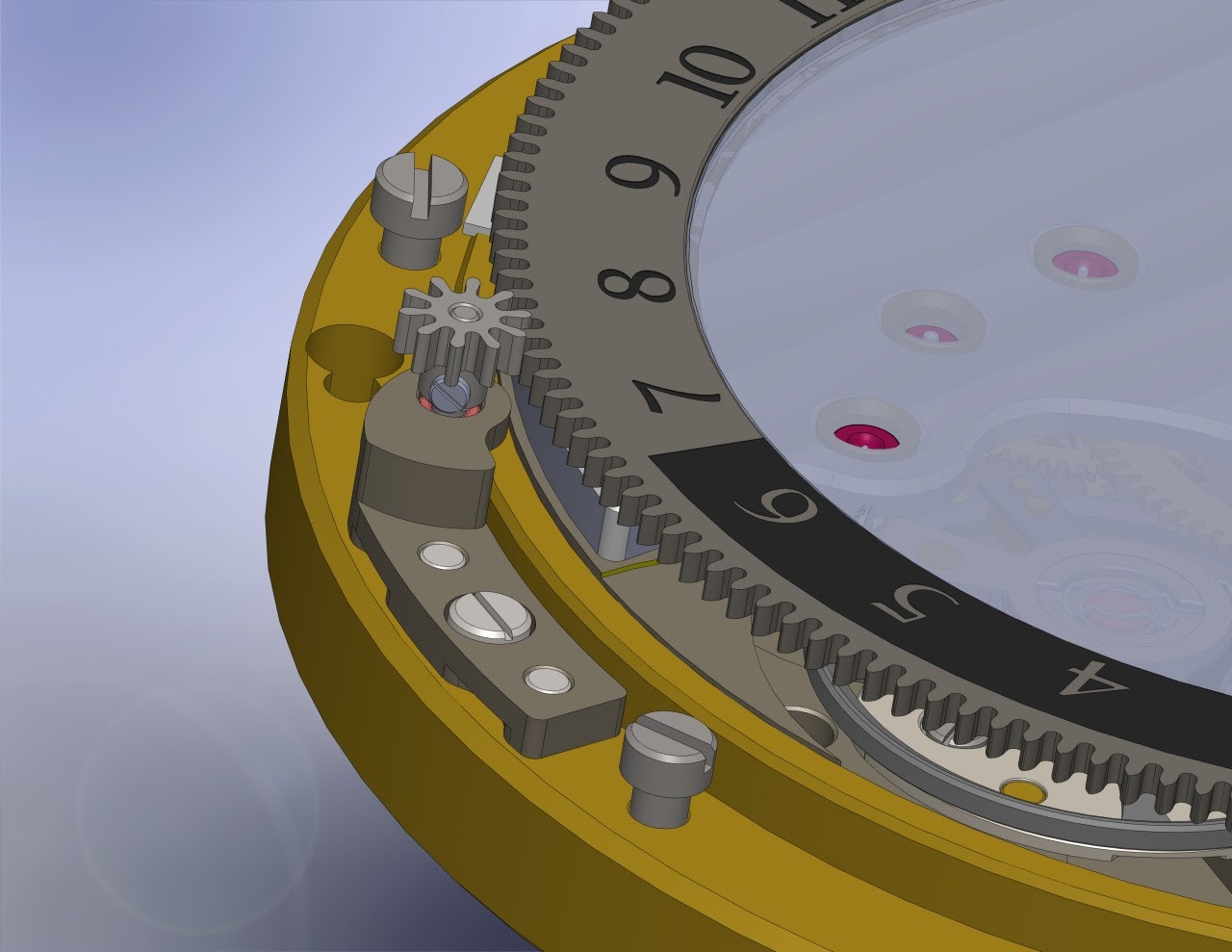
The world time display had, obviously, to be moved to the back. I provided Konstantin Chaykin with sample photos of displays found on the front of other watches I liked. He quickly chose the system made popular by Louis Cottier, a 24-hour disk running past reference cities for the different time zones placed at the periphery of the dial. The proposal was to print the 24-hour display onto a sapphire glass, with a toothed metal ring added at its periphery. Parts of the mechanism of the Levitas mystery watch could be adapted to transfer the power to the 24-hour disk by a pinion running through the case.
These mechanical parts needed a slightly higher case than the standard Russian Time. But this was no problem, because I wanted a pink gold case and Konstantin Chaykin does the foundry work for these cases himself anyway, in a mini furnace he has in his atelier.
While I could contribute nothing on the mechanical side due to my lamentable lack of technical proficiency, there was more input on the decoration side.
My goal was to get a watch embodying what I associate with the old Russia. And this is the opulence of the decoration found in the interior of Orthodox basilicas. While the craftsmanship in the decoration of Catholic churches of the baroque (as particularly found in Southern Germany) is also superb, these interiors look to me like a lot of decoration elements just filling a room. On the other hand the interior design of the Isaac basilica of St. Petersburg (and other Orthodox churches) looks much more coherent and inviting, thus in my eyes there is less risk that the richness of the decoration is tipping towards kitsch.
(Copyright: Semen Lixodeev/Shutterstock)
I therefore asked for rich engravings, also retaining the decorativ cyrillic writing for the reference cities on the dial, with hot enamel colours and an ornate bezel design further adding to the opulence. I also stressed that the tendril ornaments have to be historically correct for Russia.
What I got from Konstantin Chaykin almost within days as elaborate hand drawn illustrations as well as 3D graphics completely overwhelmed me. Not only because what I had tried to descibe in words was so well translated into visuals (as if my mind could be read), but I was even bombarded with choices. This showed me further how deeply Konstantin Chaykin was imersing himself into the project and how good he is at creating the look of a watch. He even went as far as altering the radius of the 24-hour disks for the Russian times on the dial (compared to his standard model) for more pleasing proportions of the layout.

For me it was only to say that I leave the choice of the final desin of the tendril ornaments as well as the details for the bezel design to Konstantin Chaykin. After seeing his proposals I completely trusted his taste and wanted to make sure that he feels free to make possible tiny adaptions when working in metal since reflections or other such details could make little adjustments necessary to get the best possible result.
This was a good decision, because Konstantin Chaykin found indeed at least two details to improve the visuals when working on the watch: the recesses in the bezel were blasted for an interesting surface structure and to add contrast by matting; the pusher to set the zone times was also ditched and all setting functions integrated into the crown.
With the offer to propose more or less what I wanted, the discussion about the view of the back of the movement respectively the watch went even as far as establishing how much of the ratchet wheel (to be laser engraved) and the crown wheel should stay visible to avoid a “cut-off” look. Konstantin Chaykin never complained or even objected; he just went ahead and adapted the technical drawings which were sent me by return for approval.
The quite high case of the watch left on its sides perfect canvases for further engravings. Since a travel theme had to be used, Konstantin Chaykin first proposed me some kind of skyline with the contours of well known buildings from around the world. On a prototype he had something similar tried before.
Though, I was more keen in a Russian story to be told in these spaces. When some Russian travelers were presented, I quickly started to Google, hoping to find a story that I like. With Adam Johann von Krusenstern I found almost immediately what I looked for: The story of the first Russian circumnavigation of the world from 1803 to 1806. Furthermore, von Krusenstern had German ancestral roots, giving an additional interesting back ground to the story for me. This regional connection led also to the idea to give the back side of the watch (the “international view”) a Germanic look, with reference cities written in German and correspondingly in an efficient typeface.
The two flanks of the case were therefore reserved, one side for illustrations of the two ships Neva respecively Nadezhda, and on the other side for the route taken by von Krusenstern on this journey.

The watch in the making prompted me to find out more about von Krusenstern. I found a biography written by a relative of him based on collected documents and resarch of several years. I found out how much von Krusenstern was a man I with convictions I could associate with. He refused to play political games and concentrated on his work. This was not only to improve the education and training of the young sailors, but also to do meaningful scientific research on his sea travels. And these sea travels had as main purpose to establish trade routes for Russia and not to conquer foreign land. This all made von Krusenstern no friends with the Russian establishment of the time. His career path was difficult, despite what he all did for the good of Russia, and it took a long time until his merits were officially recognized.
Maybe a sign of his (late) famousness is also the record price of a Urban Jürgensen chronometer gifted to von Krusenstern and auctioned by Antiquorum on 16 May 2016 for 12 times its high estimate.
(Copyright: Antiquorum Geneve SA)
Konstantin Chaykin used his drawing skills again to work out various proposals how the von Krusenstern story could be presented on the case, like the following set.
The hard work fell then to Konstantin Chaykin’s engraver, working from home 270 km from Moscow. It took him serveral months to work out all the details, with the progress of the work regularly checked by Konstantin Chaykin.
Working under a microscope is such hard work for the eyes that it is not possible to do more than six hours per day.
When I saw the final work, I was definitely more than pleased. I thought the detailing to be much better than what I had seen on earlier watches of Konstantin Chaykin. I particularly like how well the lugs could be integrated to let the sides of the case appear slimmer.
Konstantin Chaykin wanted to present the finished watch at Baselworld 2016. So in the end he had to rush to finish work in time. Nevertheless, this watch was realised in absolute record time. No other (similar) projects were finished within roughly one year. The usual timeframe for the creation of Unique Pieces with movement modifications is (in my experience) around two years (but I have to stress that the waiting time was never a problem for me, because being directly involved in the creation of the watch the process is as enjoyable as final ownership).
What was also outstanding was the communication. In no other project did I get such detailed and illustrated proposals, nor was it ever ensured with such thoroughness that all was well understood by both parties, as Konstantin Chaykin did it for every detail by return. The project ran therefore without the slightest hiccup, at least from what I could gather from my side.
Wonderful experience instead of just buying goods
Baselworld 2016 was particularly eagerly awaited, because I had also not seen the finished watch before.
To discover the fine hand engravings (the Cyrillic text was particularly difficult because there is not much experience with its graphic design to work on a small dial), filled with enamel, was a real joy for me. The design/decoration is certainly not to everyone’s taste. Though, if someone complains that it is “too Russian”, then it is exactly what I wanted.
I connect also wonderful experiences with the watch, what just shows how interesting it can be to leave trodden paths now and then. When you are understood and guided so well as I experienced it with Konstantin Chaykin, you really feel to be integrated in the creation process of something you have already a keen interest in, i.e. watches. To feel that you can give a substantial input towards the final product, bonds me with a “dead” material.
In this case another person contributed crucially to this rose tinted view from hindsight. Nadja Chaykina is not only an enormous help for Konstantin Chaykin in organising exhibitions and other administrative work, but her language skills made it very easy to communicate with Konstantin in German. This could also only work so smoothly because she was not just translating, but actually understanding what was important to me and what is important in watch building. The communication was thus on a completely different level from what is usually experienced in the watch retail business.
Working together for a year on such a project gives also opportunities to learn more about the ideas and philosophy of the master watchmaker. Such back ground knowledge is for me a further detail that makes the watch more interesting for me, because I believe to understand it better.
Additional highlights were the visits in St. Petersburg and Moscow, with Nadja Chaykina being the perfect guide to show the splendour of old Russia, as you find it particularly in museums, basilicas, but also in superb restaurants.
Being self-sufficient, Konstantin Chaykin, on the other hand, had no intention to immerse himself into the watch making business when visiting Switzerland. He was much keener to combine his other interests (mountaineering and motor biking) by touring the Swiss Alps on his beloved Ducati. Riding every day 160 km one way from home to his atelier he was hardy enough not to be deterred by the winter weather drawing in.
Nowadays you read often buying luxury goods to be out with the younger generation. Money is rather spent on “experiences”. But when kicking the football forwards and backwards a few times with Beckham at an “exclusive” event is cited in this context, I wonder what the difference could be to the simple consumption when buying goods. You will certainly not interact with Beckham at eye level in such events.
On the other hand to be really involved on a personal as well as creative level when the goods are made by a top craftsman is for me a real experience. In my case the research to define what I want as decoration of the watch also awakened new interests in the history of Russia. What more can you expect as a lasting “experience”, especially when you have a “luxury product” thrown in as an extra?
I therefore do not understand why not more watch enthusiasts dare to get involved in such ways. The survey a couple of months ago on PuristS about who owns watches of independent master watchmakers, was quite depressing for me. Are really not more enthusiasts on this forum interested to have something special?
The AHCI booth at Baselworld would be a good starting point for initial contacts. Almost every one of these master watchmakers offers to create a unique piece for you. And the “experience” is available at all price levels. The quality of the experience to be involved is not at all dependent on the price of the final product!
And Baselworld 2017 would even give the opportunity to inspect the latest masterpiece of Konstantin Chaykin before it disappears in a private collection. The Moscow Comptus Easter Clock consists of over 2,500 components and offers the following functions: hours, minutes, seconds; perpetual calendar with day, date, month, year, leap year, annual indication of Eastern Orthodox Easter in the Gregorian and Julian Calendars, power reserve with critical alert strike, lunar phase, star map for Moscow, sidereal time, equation of time, time of year, analemma indication, sun’s declination, sunrise/sunset times in Moscow, length of day and night in Moscow, indication of the lunar cycle relative to the solar cycle, and world time.
To have a wristwatch in the collection from the hands of such a master watch maker is a real pleasure.
Björn
(Photos: Konstantin Chaykin, Antiquorum Geneve SA, Semen Lixodeev/Shutterstock, Jürg Meier)