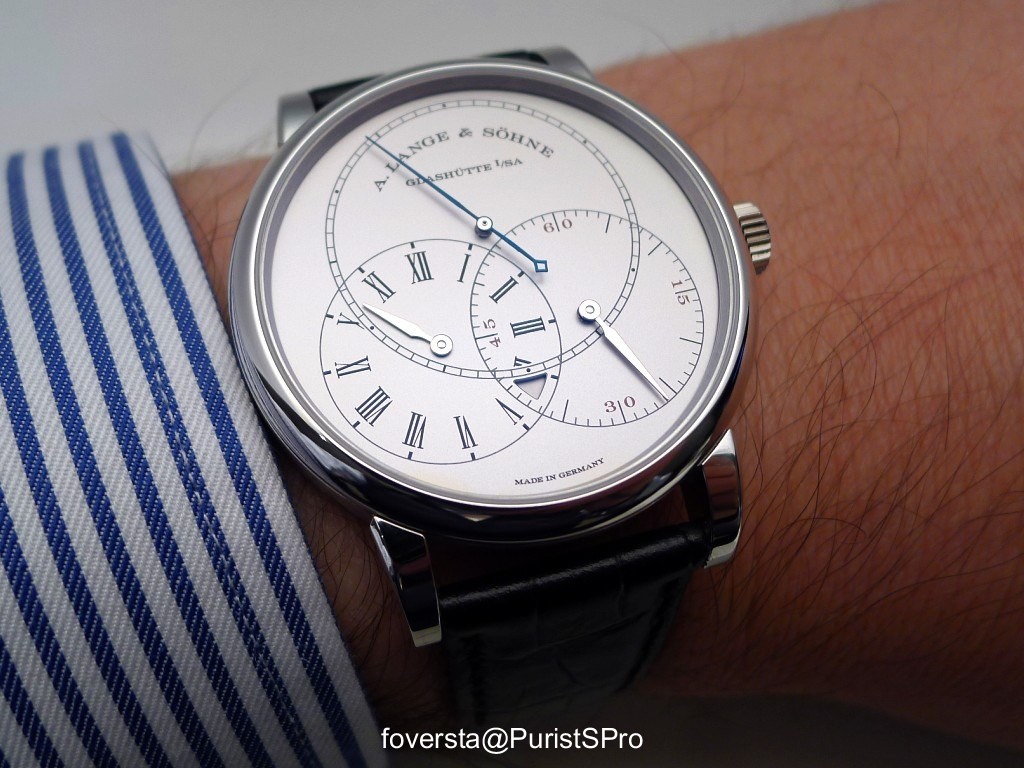
Foversta's hands-on review from SIHH 2016 spotlights the A. Lange & Söhne Richard Lange Jumping Seconds, positioning it as the most compelling release of the year. The article meticulously details the watch's technical and aesthetic merits, drawing comparisons to historical pocket watches and other Richard Lange models. Foversta emphasizes the watch's unique dial layout and the deliberate design choices that prioritize legibility and highlight its namesake complication.
The Richard Lange Jumping Seconds is not the most complicated watch of the 2016 Lange & Söhne collection but it is in my opinion the most interesting and attractive one. In fact, this watch fully meets my expectations from both the technical and aesthetic points of view and it is why I place it on top of my selection of the key watches of the SIHH 2016.
Inspired by the dial of the Johann Heinrich Seyffert's pocket watch dating from 1807, the Richard Lange Jumping Seconds however differs from the two other watches in the same case: the Richard Lange Tourbillon Pour le Mérite and the Richard Lange Terraluna. Firstly, it doesn't have any additional display if I forget the very discreet end of power reserve indicator at the intersection of the two lower sub-dials. There isn't any date window, any tourbillon: the dial is clean and close to the one of the pocket watch for my deepest pleasure. I must confess that I have wished (and wanted!) this much simpler approach for many years. The rotating dial part of the Richard Lange Tourbillon Pour le Mérite and the lovely mess of Richard Lange Terraluna dial, even well executed, have never managed to fully convinced me.
A change of dial lay-out
Then, as it is required by the complication which gives its name to the watch, the displays are not placed in the same locations. On the first two watches, the main and upper sub-dial is dedicated to the minutes. It is logic for a "regulator" type of watch because the minute is the primary indication. On the other hand, the seconds display occupies the position of honour on the Richard Lange Jumping Seconds. And also in this case, the choice is logic since the whole watch is organized around these jumping seconds ("jumping" being a much more positive adjective than "dead"): the behavior of the seconds hand not only decorates and animates the dial but also interacts with the movement. The hours are displayed on the left subdial while they are located on the two previous watches on the right one. We must therefore imagine that their dials have made a kind of 120 degrees rotation to the left to get the lay-out of the Richard Lange Jumping Seconds one.
My first reaction by discovering this latest Richard Lange was to appreciate its reasonable diameter smaller than 40mm, actually 39,9mm to use the very precise German way to write the specifications. This size is ideal because it gives an overall elegance to the watch while leaving enough space on the dial to ensure a minimum legibility of the data. The watch features a great sobriety since the solid silver rhodiumed dial extends the neutral color of the platinum case. This sobriety has one main goal: to highlight the seconds hand in blued steel. Moreover, the two rhodiumed gold hands dedicated to hours and minutes seem to fade behind the sharper contrast of the seconds hand. The two concessions in the almost monochrome atmosphere are the red indications of the quarters of minutes and the small triangle housed at the intersection of two hours and minutes sub-dials. It is by no means a power reserve indicator since at no time, it provides information on the precise level of this reserve. However, it can be defined as an end of power reserve indicator. When it drops below ten hours, this triangle turns red and reminds the owner of the watch that it is time to wind it. The challenge here is to preserve the watch against an unwanted stop in the end of the power reserve but not to incite a regular winding to ensure the best isochronism: the constant force mechanism plays its role and the watch behaves the same way at the end or at the beginning of the power reserve.
The behavior of the large seconds hand:
The dial is executed with care and delicacy. However, it doesn't have any applied element what can give the impression of a rather flat rendering. I guess Lange favored such an approach to make time reading as comfortable as possible. Because we must not forget that watches inspired by the Seyffert pocket watch are regulators and this type of dial lay-out requires some mental gymnastics.
I must confess that I have always struggled to correctly read the time with regulators due to the separation of the hour and minute axis. Moreover, to avoid confusion, Lange indicated the quarters of minutes but left the sub-seconds dial without any number around the scale. When we are used with it, time reading becomes easier even if in certain positions of the hands, it can remain delicate. But after all, is it so important? Our eyes are captivated by the behavior of the large seconds hand that beats like a metronome.
This hand doesn't have the sole purpose of displaying the time more precisely by moving only once the second has elapsed. How it evolves recalls the particular construction of the movement.
First of all, the Richard Lange Jumping Seconds is not only a jumping seconds watch: it has also a constant force mechanism and a zero-reset, rarely seen on a handwind watch from Lange (the first in this case being the Richard Lange Referenzuhr). I love the idea of combining the jumping seconds with the zero-reset. It is indeed a pleasure to see (and feel!) the instantaneous return to zero of the big hand by pulling the crown. The caliber L094.1 role is to implement these complications and especially to make them operate harmoniously.
3 elements are clearly distinguishable when we observe carefully the movement:
- the balance wheel equipped with eccentric poising weights and an in-house spiral. The frequency of the movement is 3Hz and the power reserve is 42 hours. - the bridge with a very particular shape close to the balance wheel which covers the zero-reset mechanism - and finally, the opening located above the balance wheel which reveals a part of the constant force mechanism. The consistency of the technical features of the movement
The movement uses two wheel trains. The first one is particularly dedicated to the management of the energy. It transmits the energy delivered by the barrel to the regulating organ through the constant force device and at regular intervals of one second. Not only the constant force escapement mechanism ensures a stable amplitude including at the end of the power reserve but it also compensates the fluctuations in the torque when the second hand jumps.
The second wheel train is dedicated to the jumping seconds mechanism. Since the frequency of movement is 3Hz, the seconds hand would logically make 6 steps per second. The jump mechanism forces the hand to make one jump per second thanks to a five-point star attached to the escape wheel arbor. This star makes a complete revolution in five seconds. At every second, a point of the star releases a long lever which performs an instantaneous rotation before being blocked by the next point of the star. This rotation drives the wheel train which is connected to the second hand axis and then the seconds hand performs its move. It is also important to note that the impetus of the jumping seconds is used to give energy to the spring of the constant force escapement. The jumping seconds and the constant force mechanism are linked together reinforcing the coherence of the watch.
The zero-reset mechanism was not easy to develop in the context of the jumping seconds. It also occupies a significant place in the architecture of the movement. By pulling the crown, the zero-reset mechanism stops the balance wheel through a specific spring and releases a clutch of three discs. Then the reset process starts thanks to a lever which, by touching the heart cam, immesdiately move the seconds hand to the zero position.
The L094.1 caliber is not only technically successful: it is also visually appealing using the Lange codes and features and respecting its criteria of quality and finish. I love the strong presence of zero-reset mechanism and how the balance wheel is highlighted. However, I would have make the constant force mechanism more visible, the opening on the 3/4 plate being a bit too small for my taste.
The Richard Lange Jumping Seconds is not a simple watch with deadbeat seconds. By combining this feature with the mechanisms of constant force and zero-reset, Lange & Söhne managed to create a watch with a great consistency in which each function has a specific role. I find the spirit of Richard Lange collection based on timekeeping and chronometry. The constant force ensures a stable operation even in the context of a low power reserve. The zero-reset allows the precise time setting. And with the jumping seconds, the time is accurately displayed for an optimal reading. This technical harmony is the greatest asset of this watch. Nothing seems to be there by chance and all the functions perfectly combine.
The pleasure to wear this watch is therefore reinforced. The observation of the seconds hand jumps causes a permanent reminder of the movement performance and the offbeat side of the presentation of the dial contributes greatly to the charm and the subtly casual elegance of the watch. The Lange Manufacture is back with this piece at its best. Classic and original, elegant and technical, the Richard Lange Jumping Seconds is one of the finest watches created by Lange & Söhne in recent years. The Richard Lange Jumping Seconds is available in a limited series of 100 pieces in platinum only.
Thanks to the Lange & Sohne team for their warm welcome during the SIHH 2016
Pros: + an aesthetic and technical success + the consistency of the meachnism features + the ideal size of the case + the lay-out of the movement including the zero-mechanism reset + the quality of the finishes
Cons: - the dial lacks some details with relief - the constant force mechanism deserves to be more visible
This message has been edited by foversta on 2016-01-30 13:37:30
Key Points from the Discussion
The Richard Lange Jumping Seconds, while impressive, is compared to JLC's more 'affordable' jumping seconds offering from the previous year, raising questions about value proposition.
The mechanical harmony between the jumping seconds and constant force mechanism is a key highlight, with every element contributing to accurate timekeeping in an elegant 39.9mm platinum case.
The 39.9mm diameter is a welcome change from previous larger Richard Lange models, making the Jumping Seconds a more wearable and appealing option, despite some reservations about the power reserve indicator's design.
The constant force system in the Richard Lange Jumping Seconds results in a dead-beat second, and the zero-stop mechanism is an astonishing feat of engineering, potentially involving more parts than the dead-beat seconds itself.
A. Lange & Söhne faces a design dilemma with its 3/4 plate tradition, as it limits the visibility of intricate mechanisms like the constant force escapement, which some collectors would prefer to see more exposed.
The 'scientific' and sober design of the dial, with its focus on precision, resonates well with the watch's theme and technical nature, making it a highly desirable piece for some collectors.
Advertisement
The Discussion
ST
Stylophile
Jan 30, 2016
Great review FX!
Very informative indeed; you are absolutely right; movement side should have been more exposed to reveal the mechanism; also I feel the dial lacks contrast, although I like the proportions; seems very balanced and emphasizes the stop second mechanism. Thanks again.
FO
foversta
Jan 31, 2016
Thanks Stylophile, glad you enjoyed the review... and more important: the watch. [nt]
TH
TheMadDruid
Jan 30, 2016
Terrific, Francois.
You have covered every point for this exceptional watch. Congratulations. This watch is a technical marvel (as are so many Langes) and it DOES look good on your wrist. The RL Jumping Seconds has surpassed the Datograph on my "WTB" list.
FO
foversta
Jan 31, 2016
A Lange wish list is always long...
Thanks Padj! By the way, I have just answered your PM. Fx
MA
Mark in Paris
Jan 30, 2016
I overlooked this reference completely
I remember the two previous models which were too big, though very interesting and I prefered the PLM Tourbillon version (especially because of the opening/closing hour window). However, knowing that it is now 40mm and that I like the jumping second feature, I think it is finally a watch I would like to have a much closer look at. The only thing I don't like is the power reserve reminder though. I like the indicator on the Dato U/D or the new Dato Tourbillon but not on this one. I don't know, ma
FO
foversta
Jan 31, 2016
Thanks Mark!
I understand your point about the end of power reserve indicator. But at the end, I like its presence. It is the only element which brings a rupture on the flat dial and it is also nice to have from time to time a red touch... even if you wind it daily, the watch will never display it. Fx
Continue the conversation
This thread is active on the A. Lange & Söhne forum with 29 replies. Share your knowledge with fellow collectors.