The tenth anniversary of an independent brand is an important step in its history because it symbolizes its perennial presence and demonstrates its sustainability. That is why 2015 is extremely busy for MB&F since Max Büsser couldn't miss the opportunity of such a birthday to remind the vitality of his brand and its contribution to the creative watchmaking in recent years.

The HMX (X which obviously refers to the 10th anniversary) is in this context, and if it represents a way to pay tribute to the MB&F path since its creation, it is at the end much more than that. Its primary objective is to thank the collectors who trusted Max Büsser in 2005 and who, due to their different acquisitions of Legacy and Horological Machines, have comforted him in his approach and secure the development of the brand. Their "crushes" and risk takings were rewarded by the very good performance of several Machines that were auctioned recently. The concept of "value" sought by any collector goes obviously way beyond the pure pecuniary aspects. Even if MB&F has always been distinguished by a bold design, the watchmaking contents were never forgotten as evidenced by the movement of the first Machine, the HM1 which features a central tourbillon. The HMX is based on this notion of value thanks to an attractive price which doesn't neglect the contents. It also provides the proof of a great Max Büsser's skill: his ability to anticipate market evolutions.

Indeed, it is extremely rare that an anniversary piece, released in a limited edition, is offered at a price significantly lower than the segment usually practiced by a brand. Yet it is the case of the HMX and it doesn't mean that it is a "cheap" Machine. It contains everything that made the success of the collection including the care to details. The HMX accentuates the trend observed during the releases of HM6 and LM101. MB&F prices tend to diverge with the common presence in the collection of superlative watches at higher prices and of others which are significantly more accessible, falling under the psychological threshold of EUR 50K. However, we don't have to be wrong. The will of Max Büsser is to dedicate in top priority the HMX to the people who have supported the brand and not to present it as a kind of "loss leader" to expand the customers base.
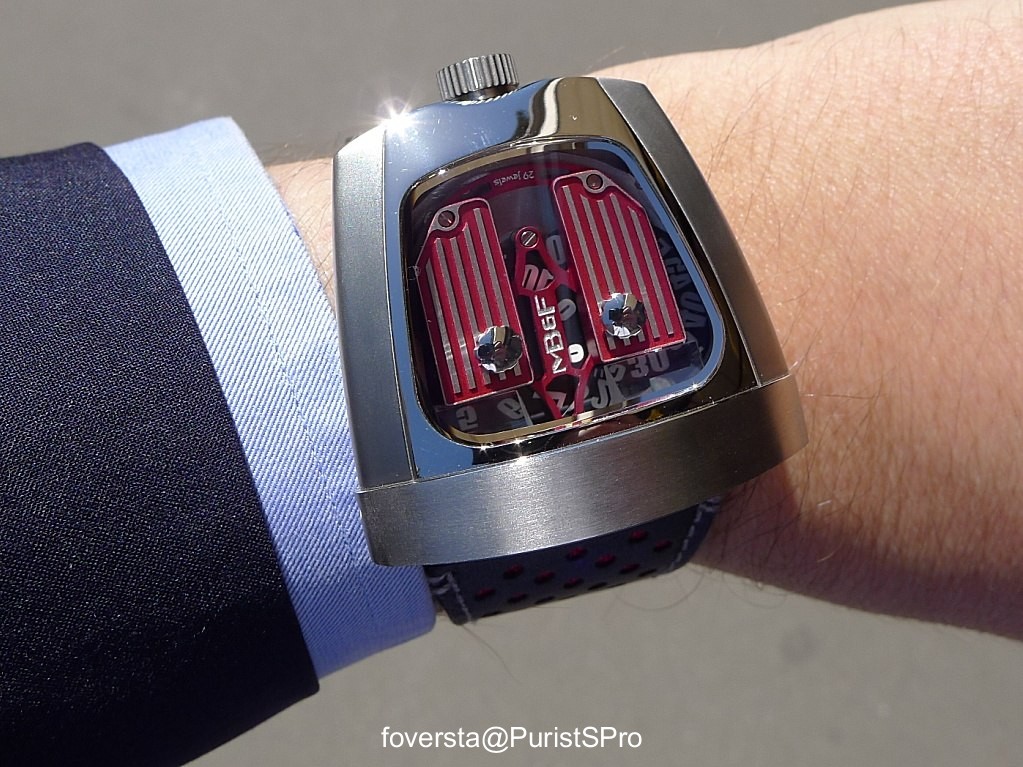
The rotor doesn't have anymore the battle-axe shape and completely covers the basic movement:We can feel this will with the immediate observation of the watch. It remains uncompromising and with a limited access for those who are not sensitive to MB&F style. The family resemblance with the HM5 is obvious and by the way, Eric Giroud led the product design in both cases. The HMX and HM5 share the same sources of inspiration, those of "casquette" watches and Supercars from the 70s. However, I consider the HM5 as rawest and radical, perhaps more in line with the spirit of these supercars. The HMX, the most affordable one, is at the end the most refined, the most slender and good point for it, the most legible of the two watches.
It is above all the way the light plays with the watch that explains this phenomenon. The HM5 case remains closed unless you open the shutters which make the light partially pass. However, the HMX is fully open and the top glass allows to fully reveal its "engine" and diffuses the light to the sapphire crystals that magnify and project vertically the digits located on the time display discs.
The battle-axe is still present on the crown:
The two rocker covers are located just above the time display discs. Each of them gets a chrome oil filler cap on its top. These rocker covers have two functions. The first one which is surprising, is functional. As in a real car, the watchmaker by servicing the watch, must loosen the caps to lubricate the movement. I love this idea that creates even more clearly a connexion between the HMX with the automobile world. The rocker covers play the same role that the flaps of the HM5 although interactivity with the HMX remains reserved for the watchmaker. The second function is aesthetic. The rocker covers decorate the upper part of the watch and nicely complement with their straight lines (which make me think about the Chopard Engine One) the curves of the case. They also serve as supports for the colored touches differentiating the 4 versions that make up this anniversary limited edition. These 4 colors which are also found on the bracelets are available: red (Ferrari), blue (Bugatti), green (British Racing Team) and black (Lotus), each version being produced in 20 pieces. I had the opportunity to handle the red and the black versions and my preference goes without hesitation to the red, more dynamic and more convincing for me. The contrast provided by the color reinforces the link with the world of motor racing and do not bother me. The originality of the watch allows this daring use of colors! However, I found the black version too sad and the rocker covers even seem to fade which is a pity.

The time is readable on the front of the watch and summarizes one of the main principles of MB&F: the separated displays. The left part is dedicated to jumping bi-directionnal hours (which are recommended to avoid confusion), while the trailing minutes are indicated on the right side. This display requires a habituation period and if the hours are not a problem, reading accurately the minutes is more delicate taking in to account the graduation system. But very quickly our eyes leave this area to focus on the greatest asset of the HMX: the beauty of its case.

Frankly speaking, I find it hard to consider this watch as the most affordable Machine! Its case is a real aesthetic success and personally, I find it more successful than the HM5 one. The point of balance between power and refinement is achieved and the fluidity of its lines, the subtlety of its sides, the combination of titanium and steel make it a model of its kind. If HM5 remains a vehicle that devours the road, I feel that the HMX, which is visually speaking lighter, is about to fly away, a bit like the floating cars of Renaud Marion. The case dimensions remain large (46.8 mm x 44.3 mm) and thick (20,7mm) but I didn't feel it when I put the watch on the wrist!
But then where is the trick that may explain the attractive selling price of the HMX? The only element that contributes to cost control is the use of a Sellita basis with a 4hz frequency and a power reserve of 42 hours, replacing the one from Girard-Perregaux to animate the internally developed display module. And yet, the gain is relative given the beautiful gold winding mass that bears the 10th anniversary of the slogan: "A creative adult is a child who survived." Slogan of the 10th anniversary? I see much more in this sentence the motto of Max Büsser which was implemented from the first Machine. Max Büsser wants above all to create through these machines that tell time playful watches and this pleasure is really contagious.
The HMX is a truly amazing watch. In fact, the preconceived ideas I may have before I could see it were swept away.
A quality below the MB&F standards to achieve an attractive selling price? The level of finishes is in line with the brand principles. The HMX even has the luxury to offer one of the finest cases of the collection. So if I think very down to earth, I am sure that MB&F has significantly reduced its margins.
A simple evolution of HM5? Both watches are radically different. If the sources of inspiration are common, they are distinguished by the emotions they provoke and styles they embody.
A watch impractical on a daily basis? The HMX is more legible than the HM5 and the fluidity of its lines makes it comfortable to wear.
So, as you understood it, I was very seduced by this HMX that manages to be a very attractive "anniversary" watch. Max Büsser had no right to disappoint while he was eagerly awaited given the importance of the event. He brilliantly met the challenge while allowing collectors that accompany this celebration to keep funds for acquisitions of upcoming Machines ... It is once again very cleverly done!
Thanks a lot to Charris for the presentation of the HMX in Paris.
Pros:
+ A real Machine (it gets all what we expect from a MB&F watch) at an attractive price
+ The case design
+ The energy of the colored versions
+ The improved legibility when compared with the HM5
+ The comfort on the wrist despite the case size
Cons:
- The black version is a bit sad
- Reading the trailing minutes with accuracy remains tricky
Fr.Xavier


