foversta's insightful review of the MB&F Legacy Machine 2 (LM2) offers a crucial perspective on how the brand evolved its 'Legacy Machine' concept. This article is particularly valuable for understanding the design philosophy behind MB&F's more traditional yet still avant-garde collection, highlighting the subtle but significant differences between the LM1 and LM2. foversta's detailed comparison helps readers appreciate the nuances of these complex independent timepieces.
The Legacy Machine 1, which was unveiled two years ago, is a very important watch for Max Büsser. Indeed, it not only marks the beginning of a new collection but it explores territories and embodies ideas that are not so clearly addressed with the Horological Machines. If these latter are a representation of modernity or of what could be the future of watchmaking being daring creators of trends, the Legacy Machine 1 operates in a different register. Rather than imagining the next steps of watchmaking from our vision of the contemporary world, it adopts the same forward-looking approach but by placing its starting point a century earlier. This is why it combines traditional classical dimension, with a singular character as evidenced by the impressive suspended balance wheel, visible dial side, the three-dimensional power reserve indicator or the sub-dials, which are a glmpse of the displays of Horological Machines. The beauty of the movement and its flawless presentation pay homage to the pocket watches of the beginning of the previous century renowned for their ability to combine aesthetics and performance. The irresistible charm of the Legacy Machine 1 has all these ingredients, the combination ends up creating a Jules Verne atmosphere.

I must admit that I had great difficulty imagining what could be the Legacy Machine 2. Max Büsser however, had left us a clue pointing out that the case of the LM1 would be a common basis for all the Legacy Machine. But apart from this, all options remained open. Actually, I imagined a watch which would create a clear separation from the LM1 hoping to find the same aesthetic differences between the LM1 and LM2 than between two Horological Machines. I was wrong! This is why Max Büsser's talent is unique: as always with him, he unveils the unexpected. Thus, contrary to what I thought, the LM2 is firmly in the style defined by the LM1 and the family resemblance is undeniable.

At first glance, this continuity may seem to be disappointing since the LM2 does not cause the same reaction of surprise when we face a new Horological Machine for the first time. It is however not a demonstration of ease or the will to choose the simplest solution. This similar context allows Max Büsser and his team to focus very specifically on all the differences between the two Legacy Machine and they will appear subtly and irreparably one by one. I also consider this context as an opportunity to highlight the great asset of each Legacy Machine: the animation of the dial. Finally, the persistence of several elements and details between the two watches is an integral part of this interpretation of traditional watchmaking desired by Max Büsser. The reassuring side of a classic brand comes from the continuity, watches after watches, defined by common and easily recognizable aesthetic elements.

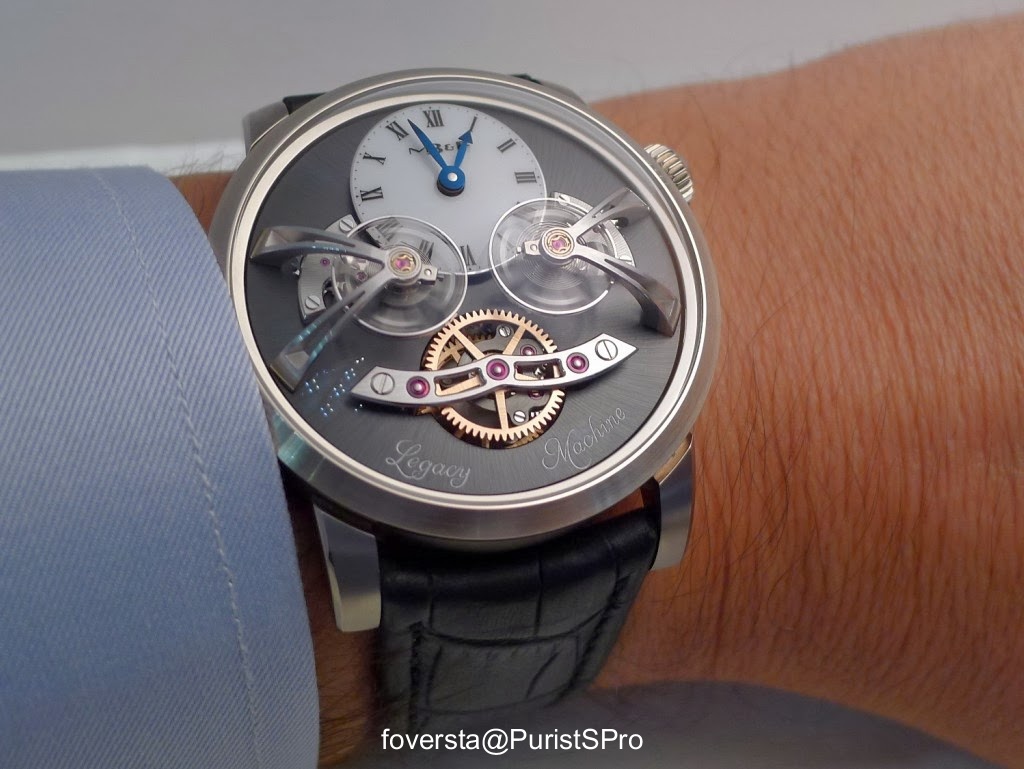
However, we should not reduce the LM2 to a simple evolution of the LM1. It could rather be seen as its opposite: the LM1 has two sub-dials and a balance wheel, LM2 reverse the roles with two balance wheels and a single sub-dial. This change is not trivial because beyond the technical constraints it entails, the whole architecture of the dial, its rendering, its animation, its perception are reshuffled. By observing the LM2, there is no doubt in my mind: I'm facing a watch that has its own identity.

The fundamental point is obviously the transition to two balances. The underlying idea is faithful to the spirit of the collection which is inspired by the eighteenth and nineteenth centuries historical clocks and watches featuring two balances. One of these regulators is the Antide Janvier's clock (one example is visible at the FP.Journe Manufacture) and it works based on the resonance principle. The resonance is not the only way made ??possible by the use of two balance wheels and the LM2 does not follow it. We can even say that its objective is to avoid it since the distance between the two balances prevents such phenomenon. The keystone of the LM2 is the use of a differential whose goal is to average the timing rates of the two balance wheels to regulate the single gear train.
Dome and suspended balance wheels provide an impressive feeling of relief:
It should be understood that despite their identical size and parameters, the two balances have their own behaviors. With a watch with an unique balance wheel, any deviation of the behavior of the regulating organ directly impacts the accuracy of the watch. Wth the LM2, the possible deviation of the balance wheel is softened by integrating thanks to the differential the performance of the other balance wheel. The accuracy of the watch could be affected only if there is a deviation on each balance wheel in the same way. The advantage of such a system is that it leads to stability of the accuracy of the watch. It is rarely implemented today. Only two contemporary watches come to mind: the Philippe Dufour Duality and the Greubel Forsey Double Balance 35 °, each in its own style.
The astero-axe is present on the crown: 
A special place is dedicated to the planetary differential to highlight its important role. The differential occupies almost the entire lower part of the dial replacing the three-dimensional power reserve display of the LM1. The main gear spectacularly decorates the dial while balancing the design doing a mirror effect in front of the sub-dial dedicated to the time display. The differential bridge is equally impressive thanks to its shape based on two curved arms, its embossed effect which prefigures the curves of the balance wheels arms without forgetting the 3 large jewels. The shape of the differential bridge is also a reminder, a hint of what is visible on the back of the watch: the beautiful handwind movement developed by Jean-François Mojon and Kari Voutilainen.
Beyond its technical interest, the system allows the two balance wheels to fully differentiate the LM2 from the LM1. It is not only an aesthetic appearance. It is mainly the animation of the dial which has changed.

The two suspended balance wheels are facing themselves along a horizontal axis. Taking into account the case size similar to the LM1 one, the diameter of the balance wheels was lowered in order to accommodate them while maintaining the sufficient distance between them. Their diameter is 11mm while the diameter of the unique balance wheel of the LM1 is 14mm which is a significant difference. They oscillate differently despite a similar movement frequency (2.5 Hz). The show proposed by these two balance wheels is much more energetic and lively than the single balance wheel of the LM1 which gives the impression of operating like a diesel machine. I personally prefer the majestic and mesmerizing behavior of the unique balance wheel but the liveliness of the two balance wheels and the mirror effect they create is a real feast for the eyes. The other obvious reason which explains the decrease in the size of the balance wheels is the need to control the energy consumption. Despite the presence of two balance wheels (but with a unique time display), the power reserve is identical to the LM1 one around 45 hours, which is great news.

The location of the two balance wheels requires the four arms to have a vertical curve steeper than the two arms of the LM1. The shape of the domed sapphire crystal is actually slightly different and the LM2 has a maximum height of 20mm against 16mm for the LM1. Anyway, the arms are as always beautiful, at the same time imposing and light. They remind me more the work of an architect than a pure component of a watch.
The presence of a single sub-dial has a logical consequence: unlike the LM1 which provides with two completely independent time displays (a rarity in the watchmaking world), the LM2 merely features an indication of the hours and minutes. The white stretched lacquer sub-dial has a diameter bigger than the LM1 ones and undoubtedly the time on this watch is more legible. It allows also to better appreciate the specific finishings of this sub-dial and the blued hands which combine perfectly with the Roman numerals. The white stretched lacquer creates a rendering close to the aspect of enamel while maintaining a welcome touch of warmth.
The movement of the LM1 is already considered one of the finest contemporary handwind movements. I must say that the pedigree of fairies who bent over its cradle is awesome. I still have the image of Jean-François Mojon who creates movements with innovative architectures and very modern presentations (eg the movement of the Harry Winston Z6) while Kari Voutilainen embodies the absolute classicism of watchmaking. This is why their work together, a kind of marriage of fire with ice was highly anticipated. The movement presented two years ago was up to the expectations and immediately seduced by its size, its architecture, the shapes of the bridges and the exceptional finishings. Its low frequency (2.5 Hz) was also considered as being consistent with the spirit of the Legacy Machine collection.
Finally, the feeling I have when I observe the watch dial side is found again when I turn over the LM2: the movement of the LM2 is a continuation of its predecessor. However, the presence of the differential changes its organization and presentation. It has a structure in two parts with the upper main plate from one side and the whole lower region dedicated to the differential and its bridges. The movement of the LM1 is characterized however by its more « closed » appearance and its interlocked bridges.

The opening of the differential area allows us to observe its three wheels and the gears while giving a more airy style to the movement that best enhances the curves of the plate and of the bridges. The oversized jewels inserted into gold chatons amplify the ends of the bridges curves and strongly contribute to the beauty of the movement. The finishings remain of course at the same level with a perfect execution of all the great esthetical standards of classic watchmaking. The continuity of the Geneva waves, the bevel angles and the hand-made engravings are flawless.
The movement is equally very pleasant to use. Despite its position at two o'clock, the crown can be easily handled thanks to its size and shape and the handwind process causes great sensations. It is a big movement with a low frequency and we can feel it. A true pleasure!

While putting the LM2 on the wrist, I had two fears: the case size and the height of the dome. The size didn't bring any concern because the shape of the lugs allows the watch to be well positioned on the wrist. I find again the LM1 sensation. The maximum height of the dome is more problematic as the difference between the two watches is 4mm. If the shirt cuff is not too tight, the domed sapphire crystal allows the shirt to go over it but it is a point to keep in mind. But do we really need to insist to make it disappear under the shirt?
The ballet of the two balance wheels:
The LM2 is a watch that catches the light, which features two surprising suspended balance wheels, which plays with mirror effects, which offers an uchronic and therefore timeless aesthetic. The balance wheels ballet is perhaps not as mesmerizing as with the single balance wheel of the LM1 but it instantly catches the eyes thanks to the energy it transmits. As such, the LM2 distinguishes from its predecessor by the nature of the sensations it creates. This is proof of the success of this watch which manages, very subtly, to define its own identity despite a similar aesthetic context.
The LM2 is available in rose gold, white gold and platinum in a limited edition of 18 pieces for the latter material.
Thanks a lot to Max Büsser for its availability and the Chronopassion team.
Pros:
+ an uchronic watch with an unique character
+ the vivacity of the ballet of the two balance wheels and the mirror effect it creates
+ the flawless execution and finishings of the movement which features a different style from the LM1 one
+ the legibility of the time, easier than with the LM1
+ the pleasure given by the handwind process
Cons:
- no additional time function
- the maximum height of the watch is 20mm
This message has been edited by foversta on 2013-10-05 11:20:58 


