Ornatus-Mundi revisits the fascinating origin story of the MIH watch, five years after its inception. This article highlights Dr. Ludwig Oechslin's innovative approach to creating a technically unique annual calendar watch with only nine moving parts, designed not only as a horological marvel but also as a fundraiser for the Musée International d'Horlogerie.
It started in 2003 with a humble prototype movement produced by - Dr. Ludwig Oechslin. The idea was to create a watch that was not only technically uniqie, but also doubles as a fund raiser for the Musée International d'Horlogerie, La-Chaud-De-Fonds, where Oechslin acted as Chief Conservator.
Just a run-off-the-mill with a customised dial would not be sufficient...The problem: who should fund development & industrialisation?
Dr. Oechslin went to the high-end watc h retailer Embassy
in Lucerne, a strong supporter for independent watchmakers. During his
famous 5 ultra-short Espressi, they talked about the project of a museum
watch worth the reputations of both, the MIH and Embassy, and agreed
to cooperate for this project. Everything seemed fine, but there was
a big surprise ahead, as Beat Weinmann, person in charge
for this project at Embassy, explains: "At Embassy, we are
Ulysse Nardin authorised agents and therefore familiar with Oechslin's
complicated creations, and consequently expected something ultracomplicated
as the MIH watch. We were completely wrong...". Clearly, it had to have its origin from the brain of
the master himself, to be based upon the ETA 2892-2:
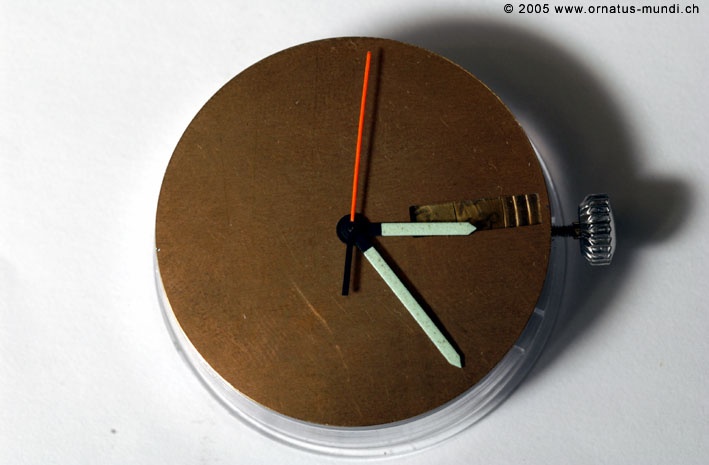
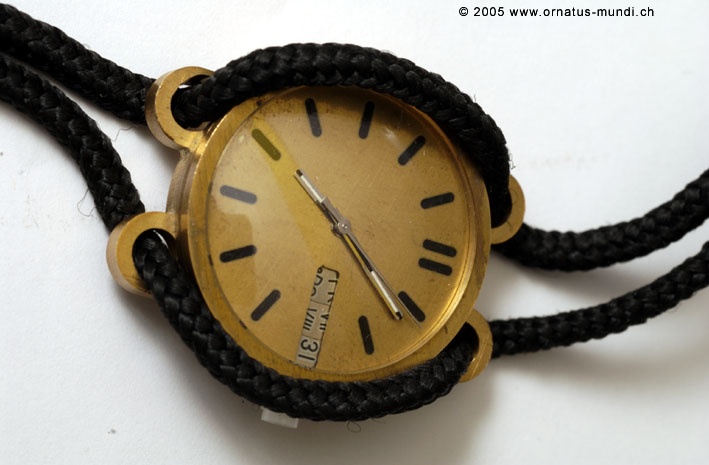 It looks mundane, but the beauty was hidden beneath the bonnet:
- annual calender, that is a calender which automatically
displays the correct month lengths, except for February each year, when
it has to be corrected manually
- the calender can be adjusted via crown, and
not only in forward, but also backwards, because Oechslin avoided the
use of springs, but instead employed wheels
- the watch displayed the date easily readable in one
window, and not scattered over the dial like many complete, annual or
perpetual calenders on the market.
- the mechanism consists of only 9 (nine!) moving parts!
After a deep breath by the remaining participants in this project, it
soon became clear: Oechslin proposed something unique, simple, useful
and very intellectual. It immediately triggered fascinated discussions
on how to proceed. The team had three pillars
in our mind to determine the realisation of the MIH watch:
traceability, a streamlined mode of operation and no marketing, as Beat Weinmann from Embassy explains:
- Traceability:
I am personally an ardent supporter of local organically grown agricultural
produce. I want to know the farmer who grows my lettuce and who
feeds the hens which lay my eggs. We wanted to achieve the same
transparency with the MIH watch. Concrete this means that the
watch should be entirely 'Swiss-made' true to the word and not
only to the extent required to fulfill the legal obligations
for such a label. We name the partners which provide us with
components and services. - Mode
of operation:
We involve only as many partners as necessary. This reduces logistical
complexity and physical distances. Furthermore, decisionmaking is streamlined
and thus less compromises made. Practically, the core team consists
of Ludwig Oechslin, Paul Gerber, Christian Gaffner and me. Each of
us is responsible for certain sub-dossiers according to individual
competence. Decisions are quickly taken over the phone or even by SMS.
The team shares a common mindset and aimed at a very high technical
quality in terms of materials and workmanship but without embellishments
which would only translate into a higher price point. We found that
this mode of operation is highly efficient and we certainly would continue
on this path for future projects. - No marketing:
It was important to us to make a counterpoint to the common marketing
hyperbole and the creation of articifical desires and subsequently
production volumes. Thus we very consciously chose a 'no logo'
approach. Common wisdom would procide for more than the two existing
points of sale and for advertsisements. This could increase poduction
volume and at one point would call for a formal distribution department.
This would start a spiral of growth anew. It was clear to us that
we would try to avoid this for the sake of the pureness of our
project. A core element we want to preserve is the factual limitation
of our annual output to the numbers the team is able to produce
without compromising on any factor. Furthermore, we could only
uphold the price of 5000 Swiss Franks by sticking to the above.
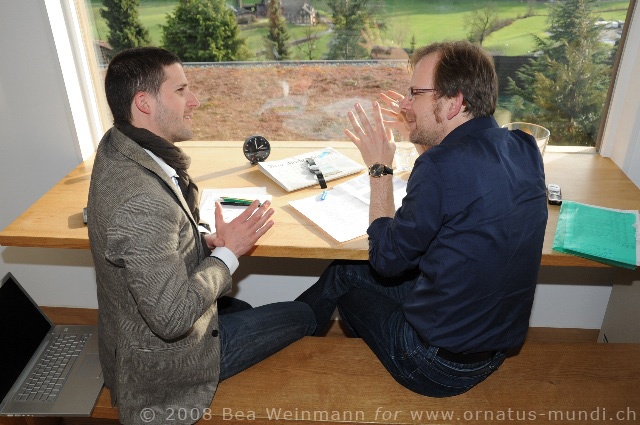
That being agreed on, the next question would be whom to entrust with
the (i) the design and (ii) the further developing, prototyping and finally production. Ludwig Oechslin
had only one answer: Paul Gerber in Zurich is the man
for these tasks!The design of the watch was entrusted to
an industrial designer who never designed a watch before
he was asked to submit a design proposal: Christian Gafner,
who previously earned his merits for example with the design of the
official Swiss Army's sunglasses. These are modularly designed to facilitate
changes of nose-pads, earpieces or protection filters, so that they
are equally suitable for alpinists or pilots.
Gafner therefore was not burdened with common watch designes and startet
from scratch. He proposed an easily readable watch with absolutely no
inscription on the front, but only a small "MIH" at the 9
o'clock position: A subtle hint pointing to ingenious calender mechanism
using only 9 parts. It is intriguing that the MIH is exactly opposite
of the date at 3 o'clock.
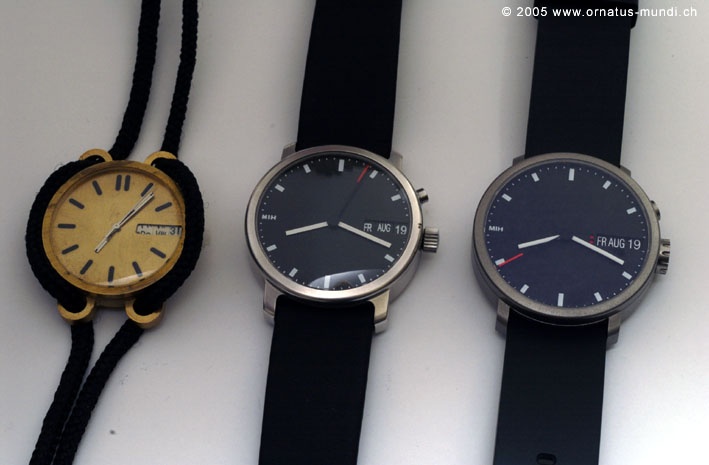
The first design prototype, still in brass. Paul opted for the Valjoux 7750 because it is
able to provide the necessary torque to move the calender plates (on
months with only 30 days, three discs have to be moved simultanously):
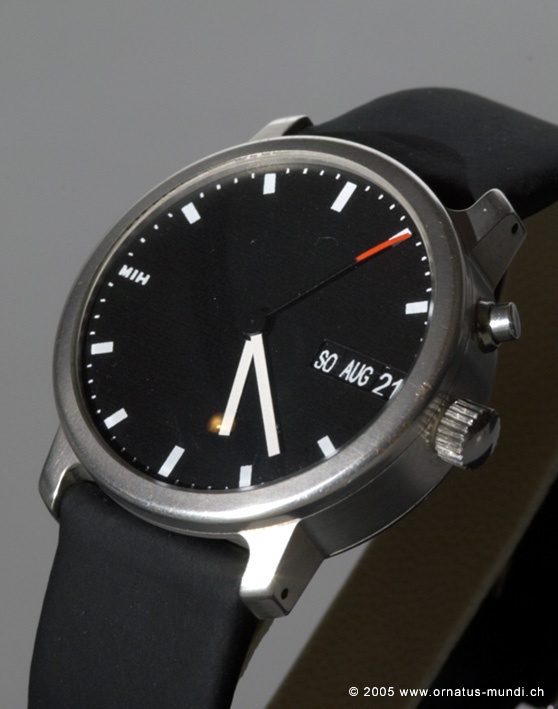
With
this little "MIH" at 9 o'clock the game of internal relations,
hints and symbolisms began. In the end, the watch is more a philosophy
than a watch, the whole design tells stories about the thoughts that went
into it's creation. After several interations, the final watch, housed
in a case made of light Titanium, looked like this, and is full of design intricacies: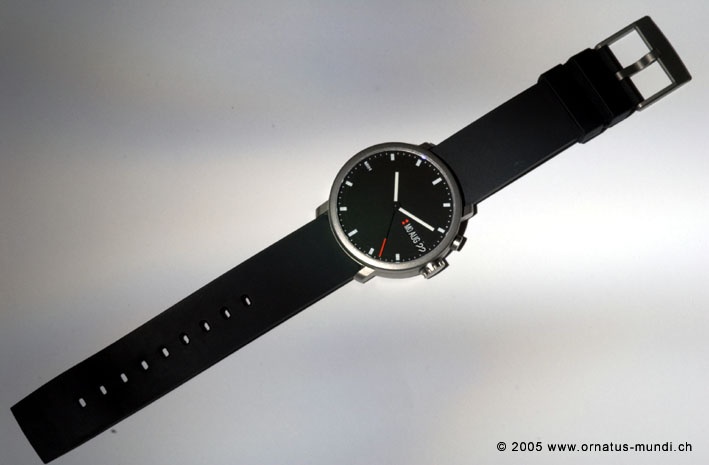
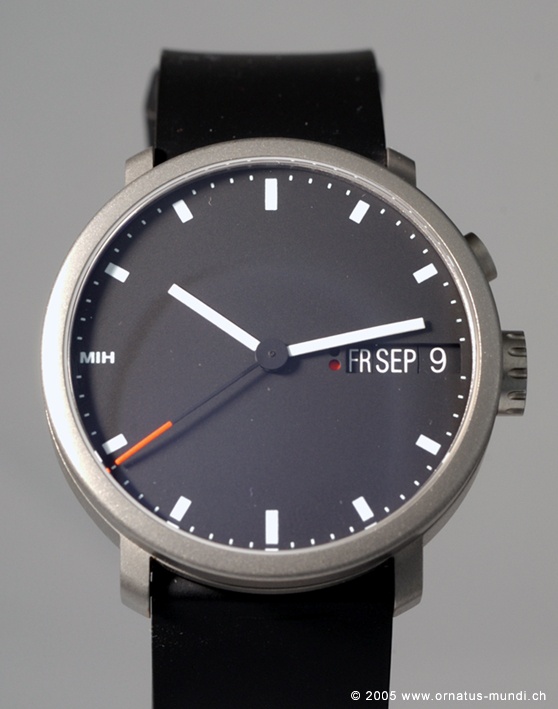 All optical elements are arranged in explainable, transparent relation
to each other, and everything is centered around the axis of the hands,
the central point of this watch:
All optical elements are arranged in explainable, transparent relation
to each other, and everything is centered around the axis of the hands,
the central point of this watch:
- The curvature of the crown, the pusher,
the outer edges of the lugs, and the curvature of the buckle. Even the
width of the lugs corresponds to the width of the bezel;
- The dial has 12 indices
(if one counts the "MIH" and 9 and the date window at 3 o'clock),
representing the 12 hours of each half-day,
also the crown, which features 12 kerfs, and the case-back, which is secured to the case by
12 screws;
- The "MIH" has the exactly
same dimension as the indices at 12 and 6 o'clock, demonstrating the
equalty of each of the 12 hours. As already mentioned, the "MIH"
is at 9 o'clock to hint to the 9 parts comprising the calender mechanism;
- Also, the strap, made of rubber, features 9 holes (which are angled
to perfectly accept the pin) to indicate the same.
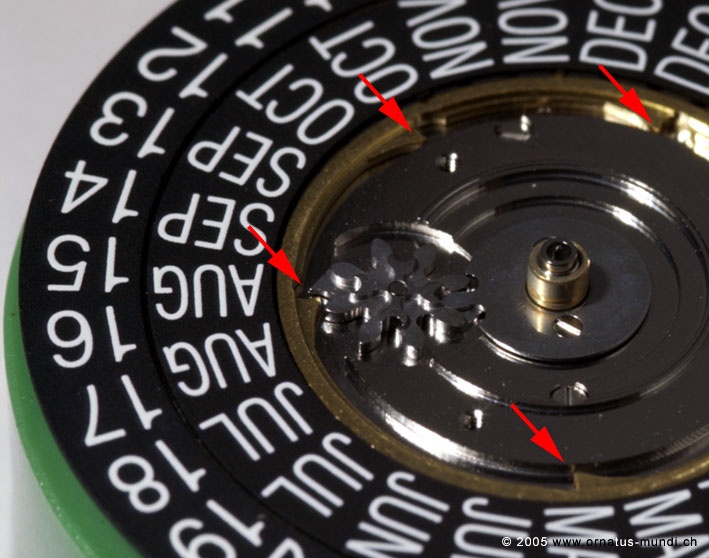
Since the date mechanism is implemented with the help of disks that cover the entire fron plate, the normal chronograph counter axes cannot pass to the dial:
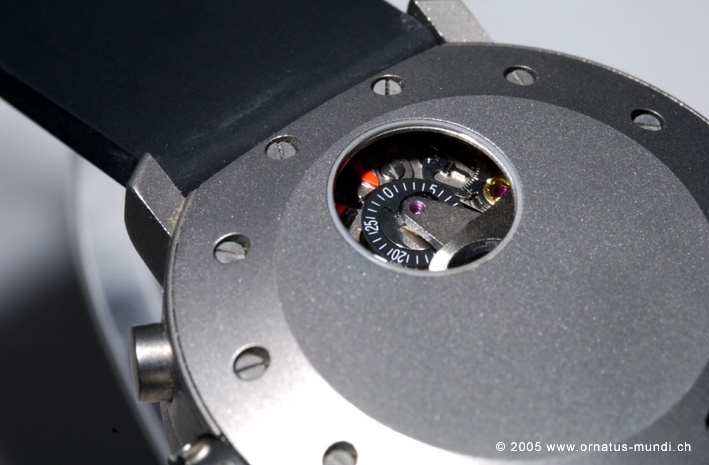
The back reveals Paul Gerber's genial solution for the chronograph problem:
he constructed a 30min disc to be fixed on the 30min-counter wheel:
So far,
a truely mesmerising development, if one follows the long way from the
first prototype to the final product (large image below, left to right). True masters
gave their distinctive input, masterfully wrapped by an artist into a
very appropriate, quite intellectual packaging. No marketing,
no distribution (only available at the MIH and at Embassy!). Not even
the calender or the chronograph mechanisms are patented - everyone is
free to use them, but should mention the authors. A watch to grow with,
surely. A watch that is much more than is seems on the first view.
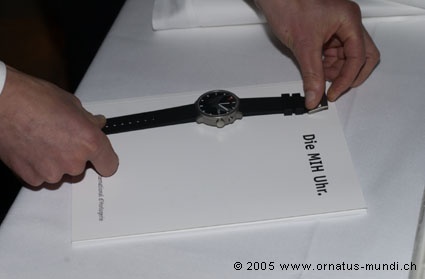
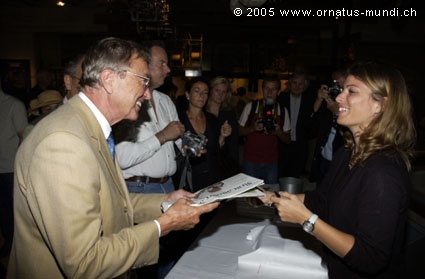
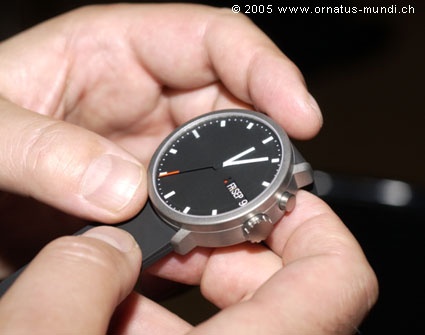
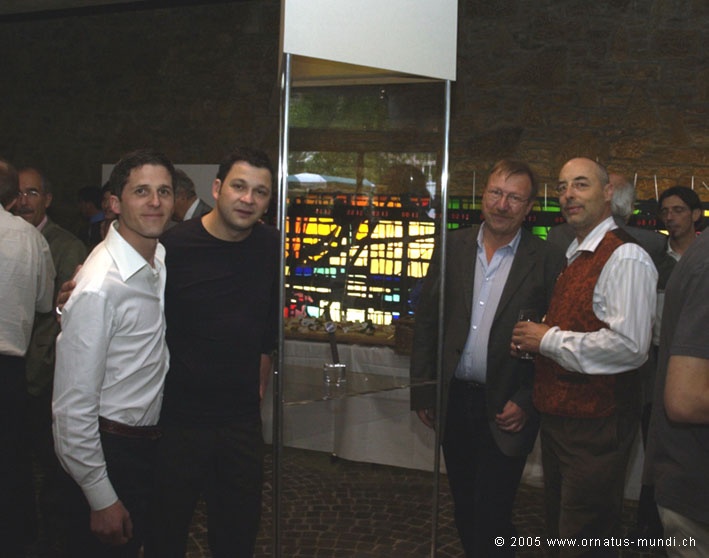
The final watch was presented at the MIH on 9 September 2005, where the first owners were handed over their watches:
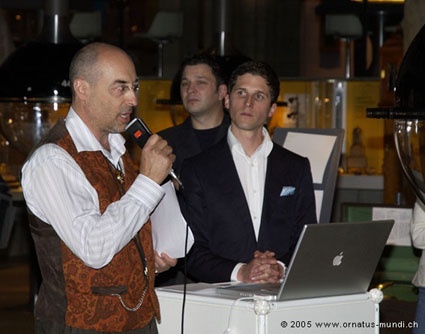
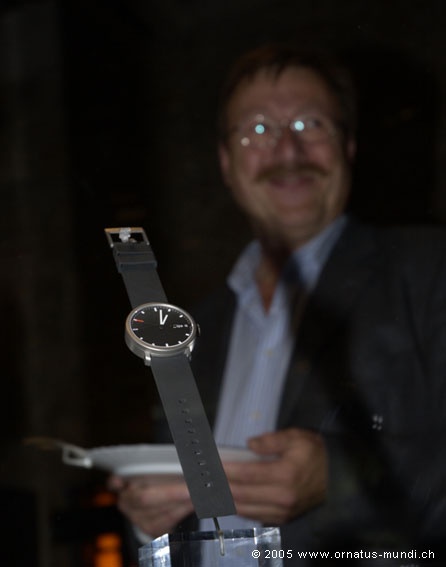
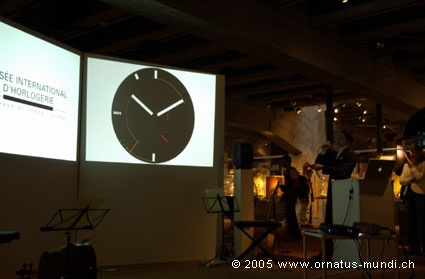
ITS DONE:
Now, five (5!) years have passed - where do we stand now?
The entire concept has no precedent, the construction unheard of and the marketing brave - how would it stand the test of the market? Now, the 5th anniversary gives us some time to take stock.
Sales:
- Up to now, about 800 watches have been sold, equalling to more than half a million Swiss Franks raised for the MIH
- 3/4 of all watches were sold via email contact
- In terms of geographical distribution, most watches have been sold to Switzerland, USA, Singapore, Hong Kong, China (very recent development!), Italy, Germany, UK
Target audience: - The typical customer is male, between 45 and 55 years old
- The watch reaches far out of the typical watch collectors' audience, and includes architects, medical doctors, art collectors and dealers, musicans, IT specialists. Several CEO's of international corporations own a MIH watch!
Amongst the owners are this guy (picture shows him in Oslo, 6 May 1974, shamelessly lifted from the web):
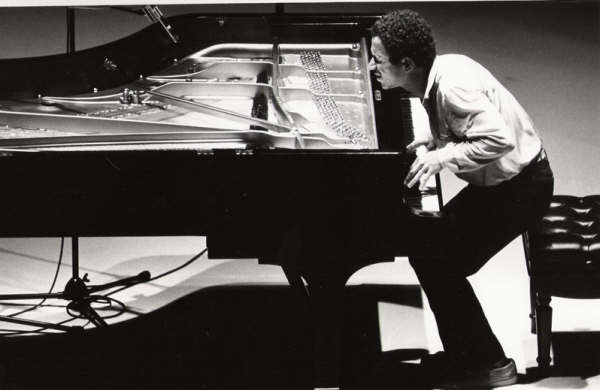
(hint: the well-tempered piano...)
Another MIH watch went to a testpilot for the Eurofighter Typhoon fighter jets (images shamelessly lifted from the web):


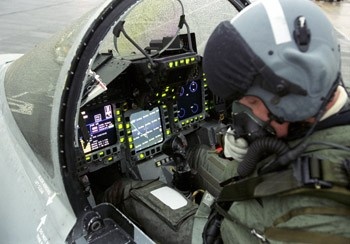
Certainly, an unexpected, unusual watch. Right from the start, I have been approached by many people, most of them not watch aficionados, inquiring about this watch. Distrubing to some, surprising others. And, in some way, it is a very safe watch to own.
A nice story:
Sjoerd van Rooijen, designer of the comics for Ochs und Junior, had his MIH watch left in his summer house. during his absence, thieves made their way into the house and took everything that looked worthwile lifting: mobile phone, wallet... They left the MIH watch, sitting next to the wallet, untouched...
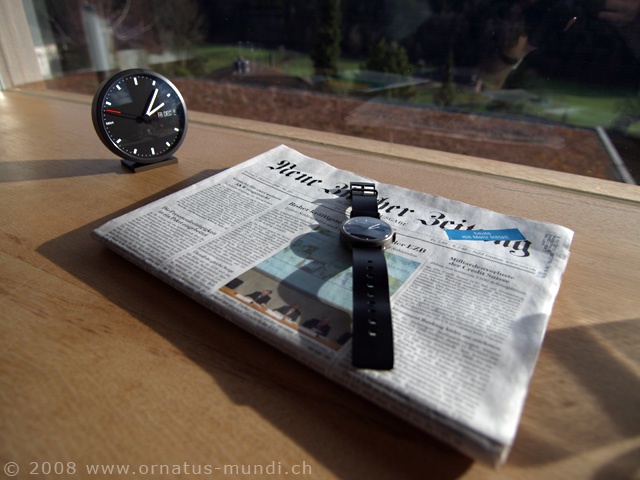
But the MIH watch is much more. It was an experiment, a test-the-waters item. The MIH Watch is a prototype for an even better idea – better because
it's even simpler. It signalled the start of a process that now involves most of the MIH team as well as others under the ochs und junior banner. The OuJ project does not have the industrial design image of the MIH: as a
concept it's whimsical, almost romantic, and it incorporates far more
products – concept watches, one-offs, experiments and timepieces that
are the direct result of Ludwig's solutions. 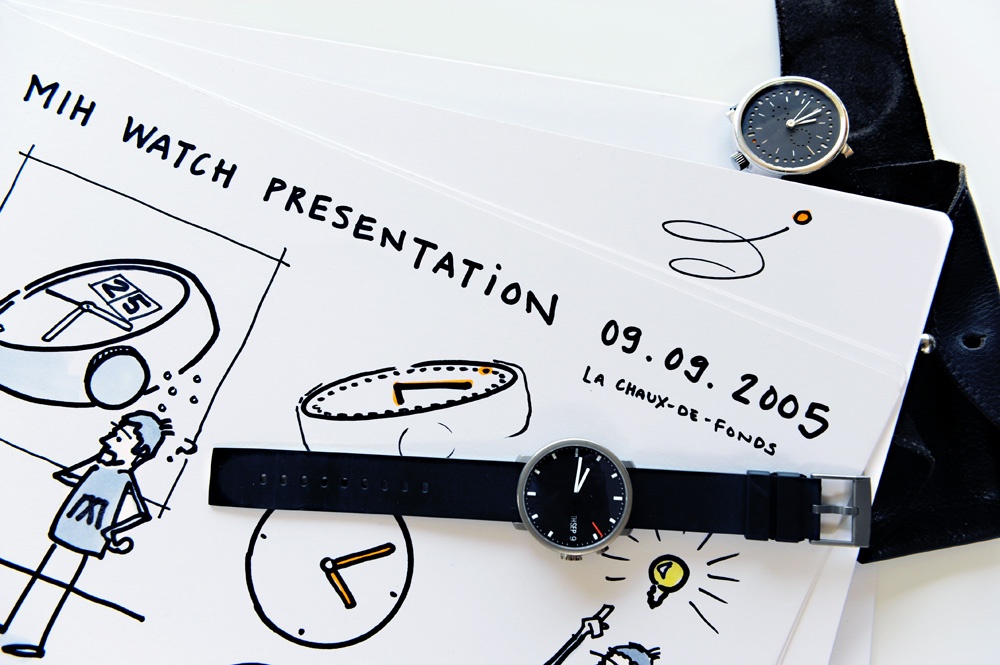
It is a milestone - it paved the way towards the release of unfiltered Ludwig Oechslin creations. That in my view is another important aspect. Perhaps the most important of all!
Thanks a lot for your patience to follow my thoughts!
Cheers and have a safe and pleasant week,
Magnus
(Apologies for the editing. Its not my fault. The forum software obviously cannot use its own features like lists etc. Welcome to the 21st century ;-)!)


