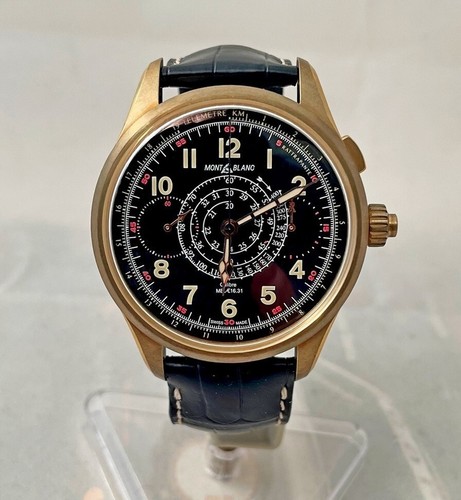
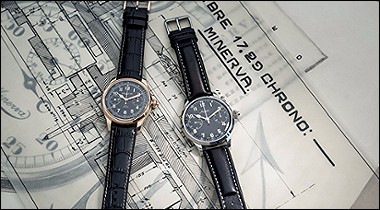
Foversta provides a hands-on review of the Montblanc 1858 Chronograph Tachymeter in red gold, a limited edition of 100 pieces. This article explores how the watch signifies Montblanc's strategic shift towards offering Villeret movements at more accessible price points and expanding its aesthetic range with a neo-retro style that pays homage to Minerva's heritage.
Introduced during the SIAR in Mexico, the 1858 Chronograph Tachymeter symbolizes two significant strategic directions from Montblanc. The first one is to accentuate the trend initiated with the Heritage Spirit Chronograph Pulsograph and which aims to offer the Villeret movements in a more rational pricing environment than the eponymous collection. The second one is the demonstration of the will from Montblanc to expand its aesthetic range through the new 1858 collection that pays tribute to Minerva.
The Montblanc catalog has been until now made of several collections that complemented intelligently but lacked perhaps a fundamental dimension which is nowadays almost indispensable for the success of a generalist brand: the one that embodies the neo-retro style. The 1858 collection offers this opportunity and reflects the substantial work done by Jérôme Lambert since his arrival at the head of the brand. This arrival is recent and yet the change of the catalog structure is clearly noticeable: the Star collection, perhaps previously the biggest carrier of the recognizable elements of the Montblanc image (the star used as a counterweight, the font on the dial) is replaced step by step by the classic and refined Heritage collection while the Timewalker collection is the flag-bearer of the contemporary and even futuristic vision of the brand. The Rieussec collection is growing based on in-house movements while the Villeret collection is evolving more and more towards the exceptional complicated timepieces.
It is interesting to note that this collection is now almost exclusively made of tourbillon watches or pieces with rare complications (like the Metamorphosis or the Chronograph Bi-Frequence), a consequence of the will of Montblanc to offer traditional chronograph movements in Villeret of other contexts. The 1858 Chronograph Tachymeter is the demonstration of this evolution.
The new 1858 collection is intended to celebrate the prestigious contribution of the Minerva Manufacture to the history of Swiss watchmaking. But it is much more than that. It reaffirms the integration of Minerva into the Montblanc Manufacture and the use of Villeret movements in this collection or in the Heritage collection proves that the previous strategy which isolated Villeret movements in a specific collection is in fact over . In addition, it offers the opportunity to Montblanc to enter a new stylistic territory. Featuring luminescent cathedral hands and Arabic numerals, imposing cases, hand-wound movements, the watches of the 1858 collection are inspired by several Minerva pieces of the past and especially by pilot watches. This aesthetic choice is reinforced by the use of the historic logo of Montblanc and creates a kind of link with the first half of the twentieth century and aims to build a legitimacy and a kind of prior history to the recent ambition of the brand. It is, admittedly, very cleverly done.

The 1858 Chronograph Tachymeter is unquestionably the most interesting timepiece of this collection. For a simple reason: while the 3 hands watch uses an Unitas caliber (A somewhat surprising choice for a tribute to Minerva!), the 1858 Chronograph Tachymeter is animated by the beautiful M16.29 movement from the Villeret Manufacture. The choice of this movement has two advantages: its own 38,4mm diameter makes it suitable to the 44mm case that characterizes the 1858 collection. And moreover, it differentiates itself from the M13.21 movement which powers the Heritage Spirit Chronograph Pulsograph presented in 2014.
Montblanc has paid a particular attention this year to propose a radically different chronograph from the one of last year. The case size, the dominant color of the dial, the much more dynamic aesthetic, the monopusher movement, the type of peripheral scale, all these details create a huge gap between the 1858 Chronograph Tachymeter and its previous year cousin. I must admit that I have a clear preference for the 2015 chronograph which displays more character and a dial with a higher perceived quality.

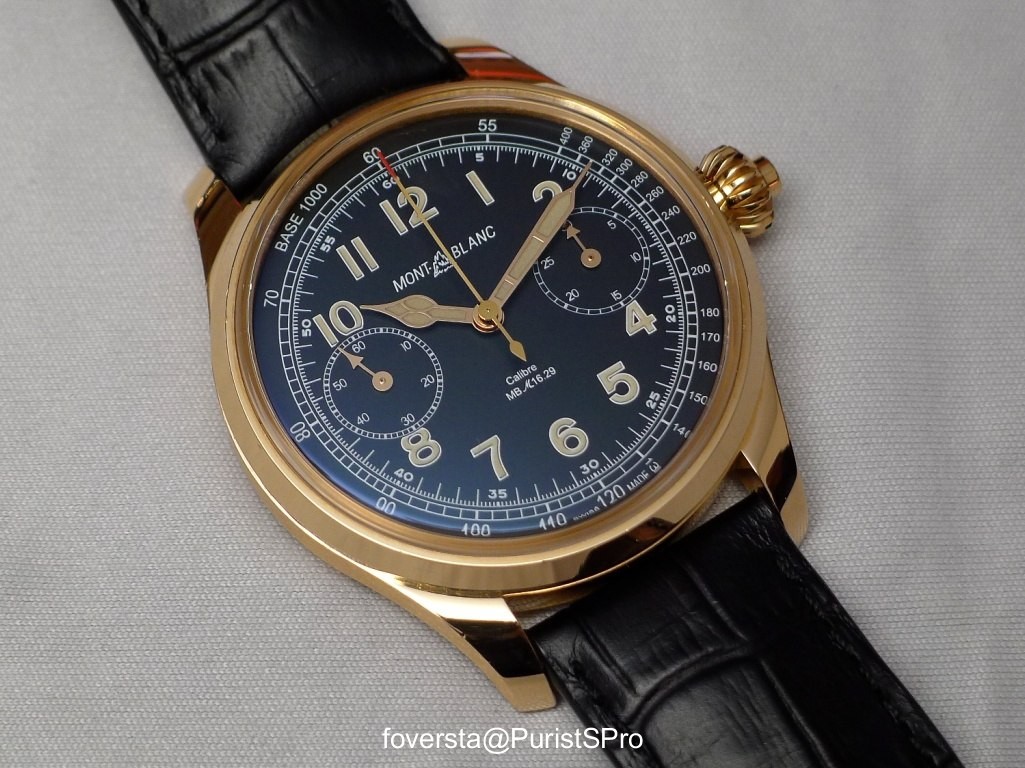
Despite its large size, which is accentuated by the prominent monopusher crown, the 1858 Chronograph Tachymeter offers a sense of balance thanks to the position of the two sub-dials and to the peripheral tachymeter scale that creates an overall harmony. The luminescent numerals and hands blend perfectly and are executed with great care. Everything is neat and clear and the luminescent material was flawlessly applied. However, due to the size of the minute hand, it may overlap some areas of the counter and so it makes difficult the reading of the elapsed time. The only real downside on the dial is inherent in the strategy of Montblanc. The brand wants to make us fully informed that the Villeret Manufacture has integrated its production structure and it displays it. The historic logo is without any doubt appropriate in this neo-retro context but it is quite imposing and I would have appreciated a more discreet size. This doesn't spoil the fun because the dynamism of the design and of the contrast between the red gold case and black dial combined with the power of the inspiration from pilot watches prevail.
The "naked" M16.29 movement:
The case is of course at the level of the ambition of Montblanc and has a diameter to thickness (13.5 mm) ratio which gives to the watch a relatively slender appearance. If its finishes are impeccable, it doesn't feature any real originality. A little touch of audacity at this level would have been welcome. The lugs are rather long but very curved and the watch is well positioned on the wrist ... as long as its size is large enough to bear the case!
But obviously, the main point of interest of the 1858 Chronograph Tachymeter is its M16.29 movement. This movement is a visual marvel mainly thanks to its architecture. Large, generously occupying the case, providing multiple feelings of depth and fine and sensual curves, it is the best of what a traditional high-end chronograph caliber can offer. I find here everything I love about this watchmaking style: an imposing 14.5mm balance wheel oscillating with a low frequency (2.5Hz), exceptional finishes avoiding any unnecessary stylistic effect without forgetting the little extra of the Minerva movements : the arrowhead of the chronograph lever, an extra touch of refinement.

The counterpart of this traditional approach is certainly the lower performance compared to more recently designed movements: due to its frequency, it measures only the 5th of second, the power reserve is rather short (but not ridiculous either with fifty hours), the minutes counter is semi-instantaneous and it uses a horizontal clutch system. But the latter never bothered me on a handwind movement and I almost feel the opposite at the end! I find it visually more beautiful. And what matters the most with this complication is the feelings it creates when used. Thanks to the high quality of the technical and decorative finishes, the start, the stop and the reset of the chronograph are very pleasant and perfectly calibrated. The feeling is sharp and precise. Unquestionably, the M16.29 movement belongs to the category of the top handwind chronograph calibers (or better said: a reference of this category) like the Datograph with a different technical and decorative approach.

The 1858 Chronograph Tachymeter, available in the context of a limited series of 100 pieces, is the true backbone of the new 1858 collection. It imposes its character, its power and the irresistible beauty of its movement. Its presence on the wrist, the contrast between the colors of the case and the dial doesn't make it very discreet. However, it remains extremely attractive. But the main goal for Montblanc is to clearly state that the Villeret manufacture capacities and production will be expressed from now in a more tangible and visible way in the catalog of the brand with prices more in line with the market expectations. This watch is a perfect demonstration of the solid and ambitious strategy from Montblanc.

Please note that some additional pieces will join the 1858 collection during the next SIHH.
Thank you to the Montblanc team for its warm welcome during the 2015 edition of SalonQP.
Pros:
+ A watch with more character than the Heritage Spirit Chronograph Pulsograph
+ The high quality of the finishes of the watch elements
+ The irresistible beauty of the M16.29 movement which diameter matches the case size
+ The sound and the behaviour of the low frequency movement
+ A quite reasonable price for such watchmaking contents (around 30K euros in France)
Cons:
- A brand logo a bit too large
- A sufficiently large wrist is required to enjoy the watch due to its size
- The technical performances of the caliber are lower compared to the ones from more recently designed movements... but it is what creates the charm of the watch and its appeal to collectors!
This message has been edited by foversta on 2015-11-28 00:52:11