Montblanc’s expertise in multilayer dials
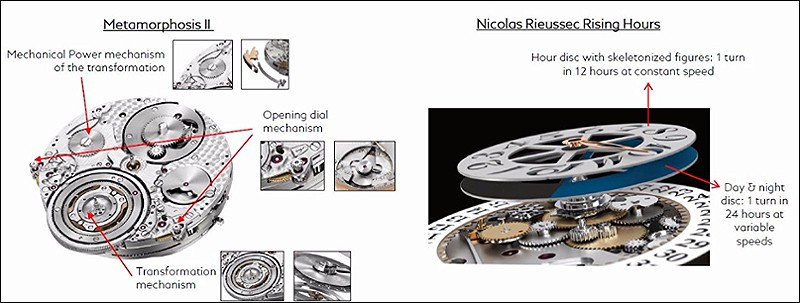
First, let us recap that Montblanc had been
developing watches with multiple dial layers and hence developed a strong
expertise for working on complications by using multiple layers – two examples
demonstrating this expertise are the Metamorphosis II launched in 2014 and the
Nicolas Rieussec Rising Hours from 2012.

 The mechanical beauty of the Nicolas Rieussec
Rising Hour’s multiple dial construction with the day night indicator disc to
highlight the hours as being either in the day or night – this idea is also
used on the Heritage Spirit Orbis
Terrarum .
The mechanical beauty of the Nicolas Rieussec
Rising Hour’s multiple dial construction with the day night indicator disc to
highlight the hours as being either in the day or night – this idea is also
used on the Heritage Spirit Orbis
Terrarum .
The Orbis Terrarum’s Dial Construction
On the Heritage
Spirit Orbis
Terrarum , the multiple layers on the dial are layers of
sapphire crystals. The construction of this multilayer dial is complex and
delicate but the advantage of the sapphire crystal dial is that it is
exceptionally durable, being scratch resistant and also aesthetically pleasing
at the same time with the shades of light blue, dark blue and grey/white on the
dial.

What I like about the dial design, after owning
this watch for 2 weeks now, is that it is simple to read and easy to use,
displaying the time in different parts of the world in an intuitive way. Initially, before collecting the watch, I was
afraid of having buyer’s remorse. I was concerned that a multi-layered sapphire
dial would be difficult to read or use. I was even concerned that maybe the
various layers will scratch or have contact on each other if not constructed
properly, especially when I push the pusher which moves some of the sapphire discs
that make up the dial.
Fortunately, so far, the watch feels robustly
constructed and the pusher feel and the resulting discs movement on the dial is
smooth and gives me a sense of confidence on the construction of the dial and
mechanics of the watch. I sense that the worldtime pusher feel is smoother on
my watch than the prototypes I tried during Montblanc’s Black and White Week in
Singapore back in May 2015.
 This is how it is constructed. At the center of
the dial, the main sapphire crystal dial displays the continents as viewed from
the North Pole which are encircled by the names of the 24 cities representing
the different time zones. The continents are cut out from the rest of the disc
that displays the oceans in a light blue colour. Under the main dial is a disc
showing day and night as well as the 24 hours time zones, which rotates with
the movement mechanism. See above sketch which illustrates this.
This is how it is constructed. At the center of
the dial, the main sapphire crystal dial displays the continents as viewed from
the North Pole which are encircled by the names of the 24 cities representing
the different time zones. The continents are cut out from the rest of the disc
that displays the oceans in a light blue colour. Under the main dial is a disc
showing day and night as well as the 24 hours time zones, which rotates with
the movement mechanism. See above sketch which illustrates this.
UTC/GMT vs Dual Time vs Worldtime – a comparison
Montblanc has all three types of complications
that can report the time from more than one time zone, plus a simpler world
timer.
1. UTC/GMT is a part of their Timewalker collection.
2. Dual
Time in-house complication is in the Heritage Chronometrie
collection.
3. Orbis
Terrarum represents Heritage Spirit
collection (it
is a true worldtime watch where the 24 time zones are synchronized and updated
real time).
In addition, Montblanc offers the Worldtime in their Star collection, but the timezones are not updated real time
(the user has to update the other cities’ time via a crown action).
The illustration below shows the 3 different
offerings from Montblanc.

My personal favorite amongst the three is the Heritage Spirit Orbis Terrarum .
Not only is the worldtime function the most
useful in my view but also the dial shades on the dial are the most pleasing to
me aesthetically. For those who find a worldtime watch too cluttered on the
dial and hence not legible enough, the Heritage Chronometrie Dual Time is another good choice as it is extremely
legible and useful enough if you need mainly to read only two time zones for
travels or working with another city. Personally, for the TimeWalker range,
I prefer their chronographs to the UTC, especially the TimeWalker TwinFly which has a twin flyback feature.
The Orbis
Terrarum Worldtime – how
does it work?
As some of you saw in my incoming post for this
watch, I naively set the home GMT time to be Istanbul initially when I
collected the watch, being a newbie in worldtime watches. Hence I think it is
good to explain how the worldtime function works in this watch for those new to
this complication.
 First step, the home GMT should be defined. To
do this, the name of the city corresponding to the home GMT should be placed at
6 o’clock in front of the red triangle (E in the diagram above). This operation
can be done through the worldtime pusher/corrector (P1) that is between 5 and 6
o’clock (during this operation, every component on the dial will turn together,
i.e. Day and Night disc, Sapphire dial with the cut-out continents, the cities
ring, as well as the local time hour
hand).
First step, the home GMT should be defined. To
do this, the name of the city corresponding to the home GMT should be placed at
6 o’clock in front of the red triangle (E in the diagram above). This operation
can be done through the worldtime pusher/corrector (P1) that is between 5 and 6
o’clock (during this operation, every component on the dial will turn together,
i.e. Day and Night disc, Sapphire dial with the cut-out continents, the cities
ring, as well as the local time hour
hand).
Next, with the crown in the first position, wind
it a few times to get the movement started, afterwards your wrist movement will
do the work, as this is an automatic movement watch.
Next, set local time in the center (the same as
the home time). This operation is done with the crown in its second position
for the hours, and third position for the minutes. The hour and minutes hands in
the center as well as the Day and Night disc will turn until the correct time
is set.
Once the above settings are done, the watch will
run. The Day and Night disc along with the 24 hour ring around the continents
will turn with the movement in order to display the time all over the world in
a synchronized pattern. The sapphire dial with the cut out continents and the
names of the cities will stay at their initial place.
A bonus feature I really like is that it is easy
to see if it is the day or the night at the destination city, thanks to the cut
out continents that are colored white (day) or dark blue (night) due to the Day
and Night disc below the continents. I can also read the Day / Night indicator
on the outer ring which indicates which cities are asleep or awake up the
colored continents just give a more romantic feeling to the dial.
When travelling, the local time can be set
easily. The only step that needs to be performed is to set the local city (GMT)
in front of the red triangle at 6 o’clock (E) again. This operation is done
through the worldtime pusher (P1). Once the destination local city is set at 6
o’clock — the local time hour hand, the
Day and Night disc, the sapphire dial with the cut-out continents and cities —
all will turn together and everything will be in sync without any other
settings needed. I have tried this a few times and am confident of exactly how
it works now – ready to take this on my next business trip (hopefully not to
India as this worldtime like many others cannot handle the 30mins deviation for
India’s time).

The calibre of the Orbis Terrarum
As mentioned, the base calibre is a Sellita
movement base and Montblanc has added its own in-house manufacture worldtime
complication on it. I see two advantages here.
One, the cost is very well managed with a
Sellita base, allowing Montblanc to offer this true worldtime watch at a very
competitive price. This is in line with Montblanc’s vision of ‘Sharing the
passion for Fine Watchmaking’ (you can’t share the passion with many people if
every timepiece is the price of a Montblanc Villeret!).
Two, Montblanc is in control of the development
and manufacture of its complication modules, such as this worldtime module and
the Dual Time module on the Heritage
Chronometrie Dual
Time watch. This allows more control on quality,
production lead time and hence delivery to customers. If Montblanc relies
entirely on third parties for its complications, it may face certain production
risks and we collectors tend to be impatient when we place our orders! 
The illustration below shares some details of
the calibre MB29.20 which is used on the Heritage Spirit Orbis Terrarum . Nothing great on the finishing aspect but
nonetheless, a nice complication at an accessible price.

This ends my two-part series on the Heritage Spirit Orbis Terrarum . Please let me know if you have any questions
or thoughts on this watch.




 ">
">