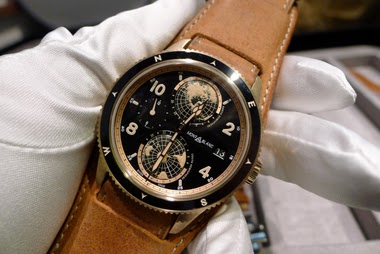
Complications
mkt33 introduces the Montblanc Villeret Régulateur Nautique, showcasing the evolution of the Caliber 16.30 movement. His post delves into the unique dual-hand power reserve complication and the aesthetic changes from its 2009 debut. This detailed look provides collectors with an understanding of Montblanc's innovative approach to haute horlogerie.


The Caliber 16.30 was the first new movement designed by the Montblanc Minerva Institut de Recherche. We saw its debut in the Grande Chronographe Regulateur which was released in 2009.
The 16.30 is an inhouse designed and manufactured movement which features a very unique power reserve complication utilizing two hands. This display is located a 6 oclock on the dial.
This was the release in SIHH 2009

Now this is the release for 2011. The Villeret Regulateur Nautique! It is semi-skeletonized, notice the change in the chronograph register.


The skeletonization of the power reserve complication mechanism is very attractive since this was the main detail for the Caliber 16.30

To simplify, here is a schematic explanation. Imagine that the total power reserve=X + Y

When the watch is running and the movement is full wound (Max), the two hands are on top of each other. As the mainspring unwinds, the two hands move together (still on top of each other) until there is only about Y (12) hours left. From this point onwards, the blue hand stops and the red hand continues for the remaining Y hours. When the watch is being wound up, the red hand will move independently until it reaches and moves under the blue hand (12 hour mark). Continued winding will move both hands (blue hand on top of the red hand) in unison until the full power reserve is reached.
Notice the trademark Minerva arrow on this schematic? It is placed on the end of the power reserve lever...a very appropriate place!

When fully wound, the power reserve hands and arrow lever is in this position 
As the mainspring unwinds, notice have the arrow lever moves through an arc and ends up in this position. This is the point of the power reserve where only twelve hours remain and now the red hand will move independently until the mainspring is completely unwound and the watch stops.

Another interesting change is the move away from a half hunter case to the fully transparent display back on this version

Enjoy, Mike
I'm not a fan of the hunter casebacks because it prohibits the owner from fully appreciating the display back since the hunter lid doesn't open up all the way. It blocks one side of the movement and is a hinderance during photography shootings. I love how Montblanc incorporated the Minerva arrrow into the power reserve hand. Brilliant! It's also great to see more sporty, colorful, and daring dial designs than the usual conservative Villeret designed dials. I hope we see more of these sporty dial
Mike, The movement is beautiful from thee back side but I don't understand the complication of the power reserve. Why the two hands for a job that seems to be done by one? I must be missing something here.... J.
even if it is functionally superfluous However here is a hint at the thought process at Villeret (from an interview with Mr. Schmiedt) It (the cal. 16.30) is based on the 16.29 chronograph movement, but blends it with 2 innovative and useful new functions: a home time indication with connected day/night display and a patented power reserve with a special "emergency" indication. I guess the appropriate analogy is the fuel gauge in my car. Eventhough it has one "needle", a special warning light tu
to be appreciated from the front. The beveled and polished screw heads. The arms of the wheels are also angled and finished too. The perlage, I bet, gives the dial a little pop out in the sun....Iike the way light reflects off the ripples of waves in the ocean. Notice that the dial is made of solid gold plate too! I sort of liked the hunter case eventhough it was so difficult to photograph. Guess I'm greedy, if I were the owner I want to be the only one who can see the movement Best, Mike
Plus the Regulateur Nautique looks awesome in its base! Enjoy, mike
The Regulateur Nautique base has an awesome base! That base is quite a piece of work!
This thread is active on the Montblanc forum with 8 replies. Share your knowledge with fellow collectors.
Join the Discussion →