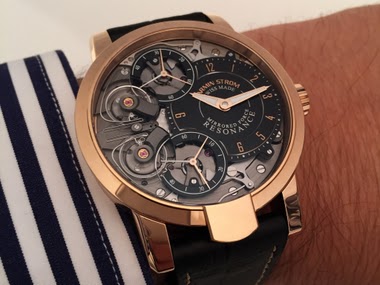
Jrwong23 offers an in-depth review of the Montblanc Villeret Tourbillon Bi-Cylindrique 110th Anniversary Limited Edition, a watch inspired by Montblanc's historic 'Rouge et Noir' fountain pen. This article delves into the intricate details of its movement and the unique 'Mysterious Hours' complication, celebrating Montblanc's haute horlogerie capabilities.
The Montblanc Villeret Tourbillon Bi-Cylindrique
110 Years Anniversary Limited Edition watch was introduced and described in my
part one post. This watch is launched to celebrate the maison’s 110th
anniversary, inspired by the first fountain pen series from Montblanc – the
historic “Rouge
et Noir” – which features a serpent clip. This watch is
limited to only 3 pieces, for diehard Montblanc collectors whom I suspect
commission Montblanc’s writing instrument and Villeret watch ateliers for
bespoke writing instruments and Villeret watches. I know such customers exist
in Singapore and they are indeed connoisseurs of Montblanc highest end
products.
Even though most of us cannot enjoy such an
anniversary watch, we can still appreciate the movement and innovation that
powers this watch. The Bi-Cylindrique tourbillion coupled with the mysterious
hours in the Montblanc Villeret M65.63 movement was already in production. Here
is a picture of the red gold version, limited to 18 pieces. There is also a
white gold version and I know of people who have commissioned their own bespoke
version of this watch from Montblanc Villeret (different decoration techniques,
in platinum, etc).

Mysterious Hours
Let me first start with the “Mysterious Hours”
complication of this watch, the appetizer of the movement.
The mysterious hours are inspired by the
“pendules mystérieuses” whose hour and minute hands appeared to float freely in
mid-air. How this works is that these hands are mounted on crystal glass discs
driven by external gears. They rotate as time passes.

The movement is positioned in the case above,
below or adjacent to the aperture for the discs, and transmits power to the
gear rim on the crystal glass discs out of sight, behind the dial. This may
explain why the movement and hence the watch is not designed to have a sapphire
case back as most of the animation and excitement is on the front of the watch
and dial.
The watch displays these “heures mystérieuses”
with regate-shape hands floating mysteriously above the dial, coupled with
Roman numerals and rhomboid indexes on a mirrored surface.
What is also interesting from a technical design
standpoint is, unlike the original mysterious hour clocks, this timepiece from
Villeret doesn’t have any other dial (all key parts are exposed under the
crystal) and therefore it ‘solves’ the mystery by revealing the hidden
mechanics and parts, which have long been known among watch connoisseurs.
This unveiling is attractive to watch collectors
interested in the mechanical aspects of the mysterious hours, because we can
now admire both the elegant floating time display and the clever mechanism that
makes this work.
The Tourbillon Bi-Cylindrique
The core of this movement will naturally be the
bi-Cylindrique tourbillon and I will share the details here.
But first of all, let me share a video I took of
this movement when I saw the red gold version of the Montblanc Villeret
Bi-Cylindrique Tourbillon launched a few years ago.
The movement is the in-house, hand-crafted,
manually-wound Calibre MB M65.63 with a one-minute tourbillon and a double
cylindrical hairspring. This calibre is composed of 284 components and has 46
hours of power reserve.
A tourbillon is one of the more complex
complications to produce, even though we know there are more “generic” ones
that are available at a lower costs these days. Here we are not talking about a
generic looking tourbillon. What we have here is a very large tourbillon with a
bi-cylindrical hairspring. This naturally demands even more skill and expertise
to manufacture and finish.
All of its 95 components are hand-bevelled,
chamfered, angled, polished and decorated in-house by Montblanc’s master
craftsmen at the Villeret manufacture, following the same techniques of
decoration as those used centuries ago. This aspect of the Villeret manufacture
at Montblanc is already legendary and some of us have heard of stories where
the watchmakers, trained by the previous center director, Mr Cabbidu, would go
out to the forest to “hunt” for the right kind of wood to help them complete
the finishing of the parts!
For perspective, it takes a whole week to
hand-bevel and hand-polish the tourbillon bridge alone, which is shaped into a
double infinity symbol. This level of
craftsmanship is extremely rare today and only the most experienced watchmakers
and craftsmen have the knowledge to produce components at this level by hand.
Even as I am writing this post, I am hoping we can all visit the Montblanc
manufacture at Villeret one day – imagine a PuristS outing there!

This picture shows the double-infinity
tourbillon bridge on the watch.
Now, let’s dive deeper into the mechanics of the
bi-cylinderical tourbillon. The large escapement of the Villeret Tourbillon
Bi-Cylindrique 110 Years Anniversary Limited Edition is composed of a
bi-cylindrical hairspring that was developed by the engineers and master
watchmakers at the Montblanc Manufacture in Villeret some years ago.
In the old days, unlike their flat counterparts,
cylindrical balance springs were regarded as the crème de la crème of
chronometric excellence and performance. They were installed only in the finest
and most premium of marine chronometers. Needless to say, accurate measurement
of time were extremely important for seafarers in the old days, especially for
those long trips on the high seas.
Even today, a cylindrical balance spring
continues to represent precision in timekeeping. Similar to a conventional flat
balance-spring, a cylindrical balance-spring is a concentrically wound elastic
metal wire. However, instead of being wound side-by-side, at increasing
distances from a common centre and all on the same plane, a cylindrical balance
spring is wound around a vertical axis, with each turn positioned on top of the
next, and with each one having the exact same distance from the centre.
This construction helps to eliminate any
eccentricity of the centre of gravity, which has always been the Achille’s heel
of the conventional balance-spring. This improves the precision and performance
of the timepiece. The terminal Philips curve contributes significantly in
improving the regularity of the breathing, further reducing isochronism error. It is important to note that one big
challenge for Montblanc’s watchmakers was to miniaturize this type of
hairspring and to install it in the tourbillon system of a wristwatch (much
smaller than a traditional marine chronometer).
A visual recap: the Montblanc Tourbillon
Cylindrique Geosphères launched in 2015 also employs a Cylindrique hairspring
(but not a bi-Cylindrique one).
Montblanc has equipped its Villeret Tourbillon
Bi-Cylindrique 110 Years Anniversary Limited Edition with not one, but two
cylindrical hairsprings positioned concentrically, one inside the other, each
having a different diameter, but both with identical torque. The springs move
in opposite directions; while one spring expands, the other contracts, further
optimizing isochronism and providing ultimate precision.
In the Tourbillon Bi-Cylindrique watch, the
tourbillon is positioned prominently at 12 o‘clock, where it revolves in a cage
of its own, making a full rotation of its axis every minute. From a design
perspective, the cutout section of the dial in which the tourbillon is located
is the same size as the actual time display, which creates a nice sense of
balance to the eyes.
 Another very interesting point to note is that
the tourbillon cage contains one of the largest balance wheel with a diameter
of 14.5 mm; it has a high inertia at 59 mg/cm2, a weight of 1.010 grams, and a
traditional frequency of 2.5 Hertz (18,000 bph). In addition, the tourbillon
has three mobile compensating weights, each featuring the Minerva arrow, which
can be regulated by the watchmaker to obtain perfect equilibrium.
Another very interesting point to note is that
the tourbillon cage contains one of the largest balance wheel with a diameter
of 14.5 mm; it has a high inertia at 59 mg/cm2, a weight of 1.010 grams, and a
traditional frequency of 2.5 Hertz (18,000 bph). In addition, the tourbillon
has three mobile compensating weights, each featuring the Minerva arrow, which
can be regulated by the watchmaker to obtain perfect equilibrium.
See below for a visual illustration of the
points I wrote above.

This ends my sharing of the movement details
within Montblanc Villeret Tourbillon Bi-Cylindrique 110 Years Anniversary
Limited Edition. I hope you enjoyed it! Perhaps one day, we can all visit the
Montblanc Villeret manufacture together and compare the Tourbillion
Bi-Cylindrique, ExoTourbillon and the Tourbillon Cylindrique Geosphères side by
side.
Cheers
robin
This message has been edited by jrwong23 on 2016-04-23 22:28:40 This message has been edited by jrwong23 on 2016-04-23 22:32:00