Review
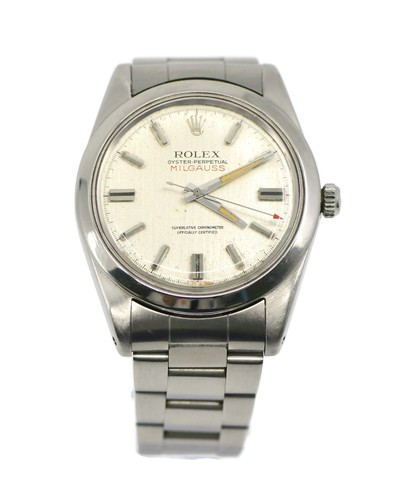
Baron - Mr Red provides a comprehensive look at the modern Rolex Milgauss, tracing its anti-magnetic lineage from the 1950s references 6543 and 6541 to the contemporary 116400. He offers a personal review of his own 116400, highlighting its unique design elements and its significance in Rolex's specialized tool watch history.

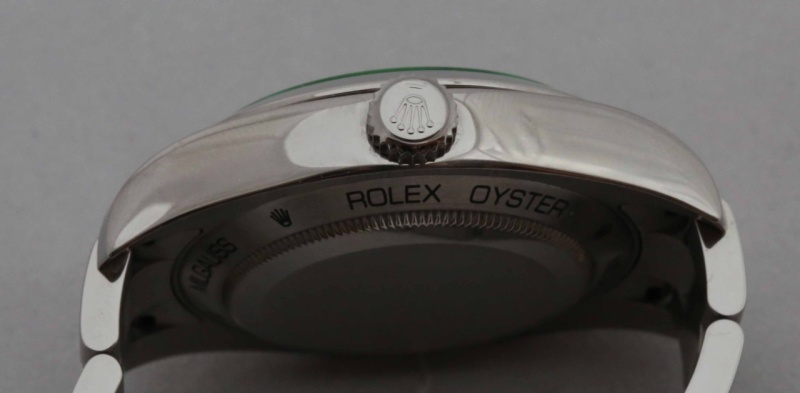


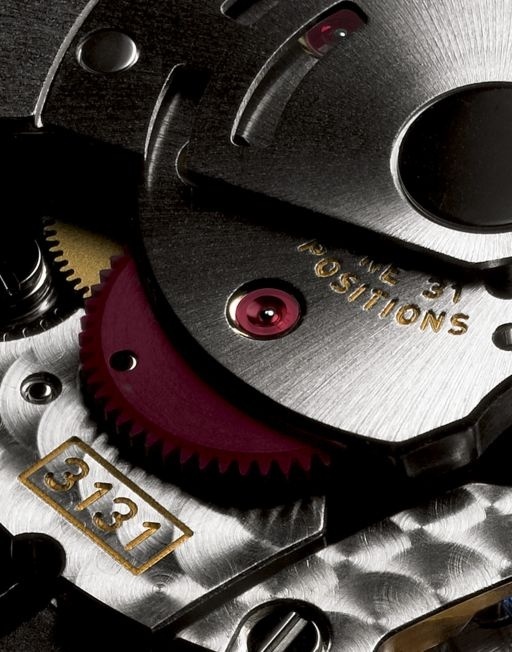
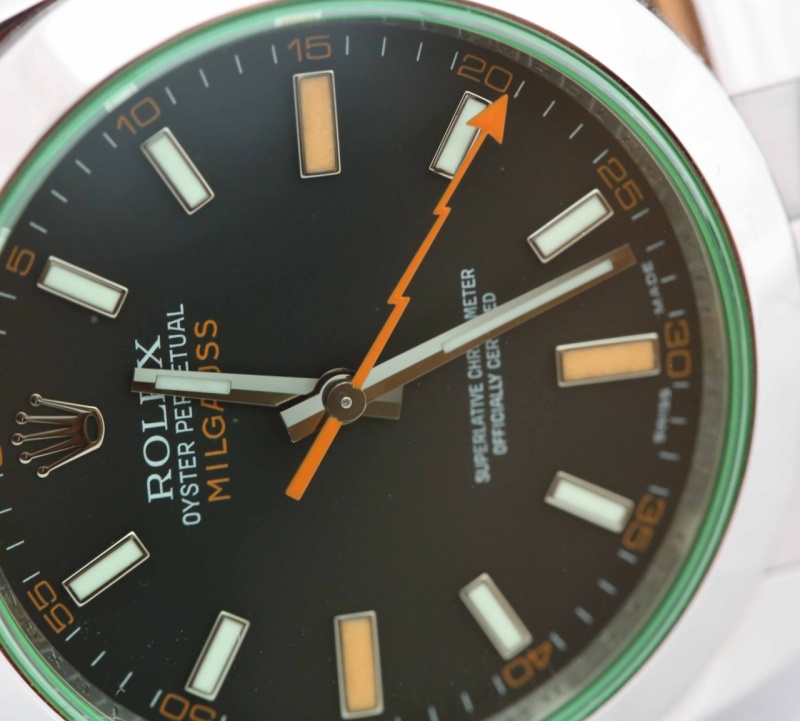

Rolex have, over the years, manufactured watches for very specific uses. Diving watches. Explorers watches. In the mid-1950s, the name GMT-Master was registered, and with it came the Aviator’s watch. It was also at this time that Rolex took an unusual twist. The Milgauss. This watch was created for scientists and laboratory professionals who needed to measure time in an environment where there was, quite often, the presence of very strong magnetic fields. The Milgauss was manufactured in steel and was guaranteed to work in magnetic fields up to 1000 Gauss. It is from this that the name of the watch was derived…Mille Gauss. CERN were one of the very first to guarantee the watch’s ability to withstand the magnetic field.
I have read in a number of books that the Milgauss was first introduced in 1954. It is probable that the first reference (6543) was announced in the Basel Fair of 1954, but was most unlikely to have been available at that time. Further, this first reference, 6543, was manufactured in such small numbers (believed to be just 88), that it is hard to say this was the official launch. According to Rolex, the first Milgauss was launched in 1956. This almost certainly refers to the second series of Milgauss, the 6541. Both 6543 and 6541 housed the caliber 1080.
In 1964, Rolex released the reference 1019, using the calibre 1580. I plan a review of the 1019 for later in the year. It is certainly one of the watches that sit very high on my wish-list. The 1019 stayed in production until 1988. There was then a gap. A huge gap, in fact, until 2007 when Rolex decided to revive the Milgauss. And it is this revival that I want to look at now. In 2007, Rolex announced a new Milgauss model, reference 116400. The new reference came with a 40mm diameter (the 1019 being 38mm). It is equipped with a calibre 3131 and available in either black or white dial, with the second hand in orange and bearing the shape of a lightning bolt. The lightning bolt was a tribute to a feature on the 6541. To my mind, the 116400 is still my favourite modern Rolex in production. I think it is actually a superb watch from so many perspectives. I have owned my 116400 for over a year so feel comfortable giving it a review.

First of all, what do we really mean by anti-magnetic? According to the German Industry Norm, a watch is considered anti-magnetic if it can keep its accuracy +/- 30 secs when exposed to a magnetic field of around 60 Gauss. That puts into context the degree to which the Milgauss can cope with exposure to extreme magnetic variation.
The modern Milgauss houses a “Faraday Cage”. A Faraday Cage is an enclosure formed by a conducting material that causes the electric charges within the cage’s conducting material to be distributed away from the inner cage. A cage within a cage.

As can be seen from the picture, the shield inside the Oyster is labelled with the letter “B”, with an arrow above. This is the symbol for magnetic flux density. I am beginning to sound like Doc from "Back to the Future!" The shield is made from ferromagnetic alloys that surround and protect the movement.
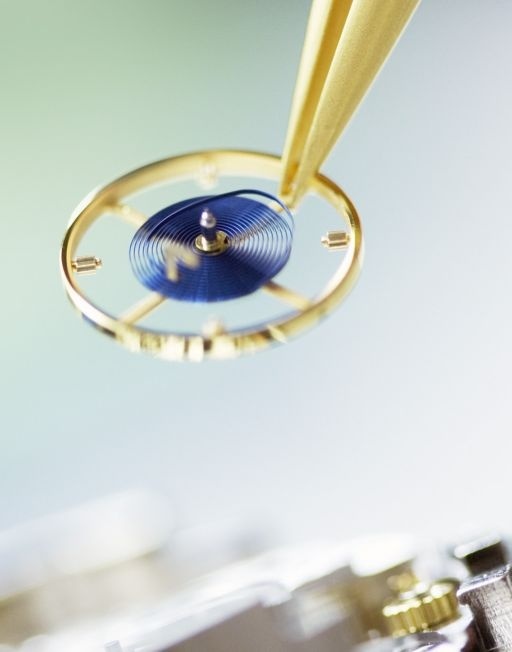
The movement itself also benefits from the innovations that Rolex developed (mentioned in one of my blog posts) related to the use of innovative paramagnetic materials, including the blue parachrom hairspring.


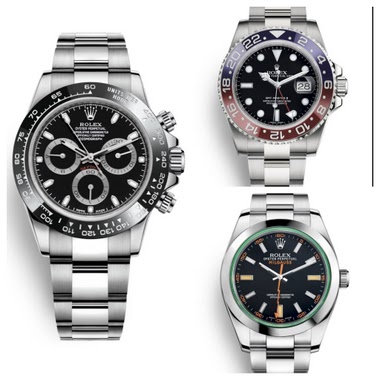
As previously mentioned, there are three different versions of this Milgauss. There is a standard white or black dial. The third version, which I have the pleasure of owning, is called the Glace Verte model (GV). This particular version has a green tint to its sapphire crystal. Lets be blunt….. such a feature is so out of character for the typical Rolex that one wonders how it ever happened. Further, it may be that the nature of the tinting process prevents the Rolex coronet being laser-etched into the crystal at 6. If anyone has a GV that has the security etching, please let me know.


When I am asked what modern Rolex do I think it is worth owning, I have to say that the Milgauss 116400 comes at the very top of my list.
The Rolex Milgauss reference 1019 is a specific iteration within the Milgauss model line. This reference is distinguished by its particular configuration and production period.
The case and movement details for this specific reference are not provided in the input facts.
This reference appeals to collectors interested in the Milgauss series. Its position within the broader Milgauss lineup is defined by its reference number and specific characteristics.
As of today, 13492 Rolex listings are live on the eBay market and 1886 collector listings on the WatchProSite marketplace.
......such a fun watch to write about.
The Milgauss... Not loved during its lif, admired and sought after since its death, like major artists... A reference to get for every Rolex Fan. At least a 1019, and a 116400 ( GV if, IMO, the mosr desirable because of its unique crazy look ). Ok, the 6541 is the one ot get, but I won't sell my house for it. The 1019 is one of my targets, but like the 1655, it takes time to find mine. A superb article to save as a reference. Best and thanks, my friend! Nicolas
....1st degree honour for your essay on Electromagnetism! Thanks for the write up Joe! Makes me desire the Milgauss.
And yes, I now know what a Teslar is!
It's growing but doesn't mean I'll have loads. I think around 14 is a good number and I have to try them all before settling down with my favourite 14. Unfortunately...I don't think the "normal" 1665 is part of them....next stop: Daytona Beach
This thread is active on the Rolex forum with 36 replies. Share your knowledge with fellow collectors.
Join the Discussion →