Tony C. shares a compelling personal narrative about his 'double-dip' experience, reacquiring a Ulysse Nardin 1846 Marine Chronometer. This post delves into the emotional and intellectual journey of collecting, highlighting the enduring appeal of certain vintage references.
Without getting too philosophical, it’s probably safe to say that most of the lessons learned during the process of collecting watches over a long period of time are applicable to other aspects of one’s life – and vice versa. So, when, for countless years, I dismissed as silly those who admitted to having again bought watches that they had previously owned, I should have known not to throw stones. Yes, it took me a while to join that “silly” group, but join it I have. (Actually, I have not purchased the
exact same type of watch that I once owned, but it’s surely close enough to count.)
In my early years of collecting, 1996 to be precise, I found myself attracted to the (then) newly introduced Ulysse Nardin 1846 Marine Chronometer watch. I even came close to acquiring one, but ultimately did not, as even at that early stage I was gravitating more strongly towards vintage watches. But my attraction to that model led to an interest in vintage UN watches, which in turn led to the acquisition of one of their hi-beat chronometers.
I liked it quite a bit, but a few years later, as I had my sights set on some other watches, I sold it to an enthusiastic UN-centric collector. And while I wouldn’t say that it was on my mind very often during the ensuing years, it is one of my favorite watches that I have sold.
So – talk about serendipity – when I happened to check a sales forum recently, someone had just posted a very similar model for sale, and I jumped at the chance, narrowly beating out another (apparently eager) buyer. The reason that I jumped so quickly, though, is that this version is (to my taste) even nicer than the one that I had owned previously.
During the 1970’s, when many watch manufactures were understandably concerned about the threat that quartz accuracy posed to their mechanical watch businesses, some of them developed hi-beat movements in efforts to push the boundaries of mechanical movement accuracy. Some of those high-beat movements were developed in-house, while other manufactures, including Ulysse Nardin, used ETA movements as a base.
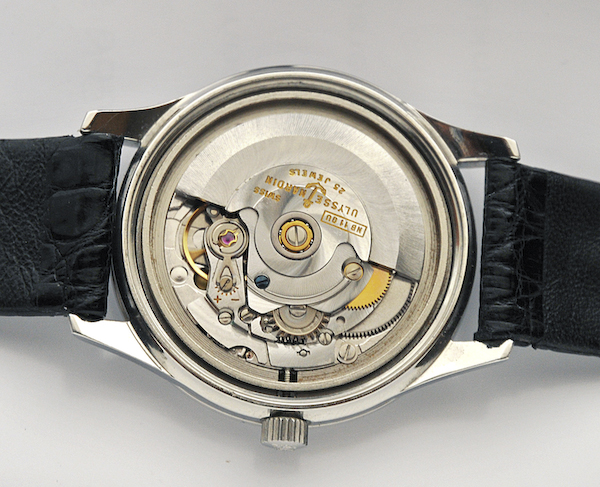
In the case of the UN 36000 Chronometers, the cal. ETA 2826 was used as a base, and the finished movement was designated cal. NB 11 QU. It features 25 jewels, a screwless Glucydur balance, a self-compensating flat hairspring, Incabloc shock resistance, and fine regulator adjustment by eccentric screw (reference source: Heinz Hampel’s
Automatic Wristwatches From Switzerland, pg 99). According to a helpful source at UN, only 1,000 of these movements were produced, though they were placed in a wide variety of case types and styles.
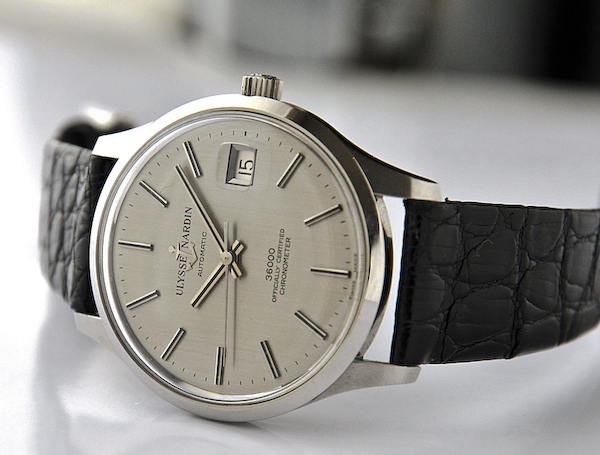
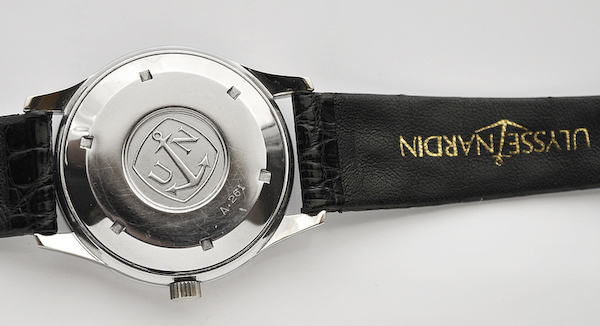
Given my preference for clean design, I am very fond of this particular version. The case measures 36.5mm (excluding crown), and features a nice contrast between the mirror-polished bezel and brushed lug finish. The screw back includes a relief of the classic UN logo.
The vertically brushed grey dial is both attractive and high quality. The applied markers and hands both benefit from contrasting black inserts. The iconic UN anchor is also applied, which is particularly pleasing to me as on my previous version (and the majority of those that I have seen) it was printed.
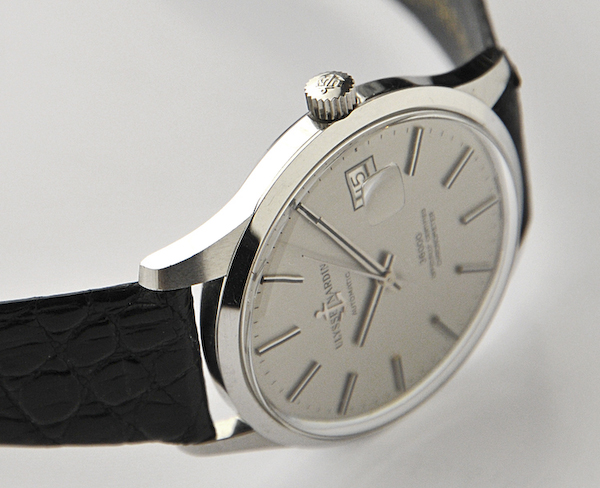
The crystal features one of the best executed magnifying lenses over the date window that I have seen. The beauty of it is that the bulging portion is placed below, rather than above the top of the crystal, so that the profile of the watch remains smooth and clean.
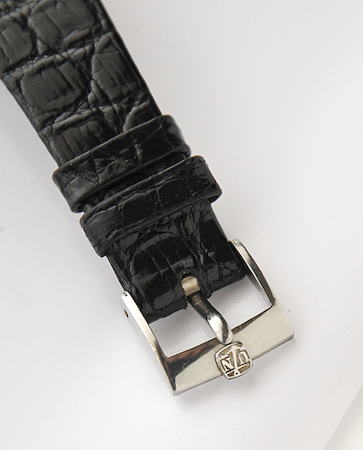
Everything about this circa 1980 watch is original, including the crown, strap, and rare buckle. And as a final note, this was the first time that I have purchased a watch from someone whose photos I am unlikely to be able to improve on. So thanks to the seller for these fine shots!
Regards,
Tony C.