A chronometer is a chronometer is NOT a chronometer
Marcus Hanke's thoughts on the lastingness of COSC chronometer certificates
Some
of us would never admit of being nit-picky about their mechanical
watches' accuracy. Astonishingly, it is observalbe that, the more
expensive the watches are, the less important the accurate display of
the time of the day seems to be. Tourbillons, repeaters, perpetuals are
admired with awe, the question: "How many seconds is it off per day?"
is never asked; even if it was, it would be answered shortly: "If I
wanted the accurate time, I would have bought a quartz watch for ten
bucks!" Just imagine: We celebrate a moonphase display that is accurate
to one day per 250,000 years, but have no problem if the mechanical
movement it is based upon is off by a mere 29 years in that period! As
a principle we can state that the more complications are collected in a
watch, the less accurate it is expected to be.

Consequently,
it is not surprising that the - relatively few - real fans of accuracy
in mechanical watches are concentrated in a class of watches with only
few complications; mostly, the display of hours, minutes and seconds is
enough, the date already is often considered pure luxury. Within this
class, the designation "chronometer" attributes a certain status of
nobility; if not for the wearer, then for the watch. Chronometers are
watches with movements certified to be accurate within a certain set of
tolerances. The inscription "officially certified chronometer" even
makes us pay substantially more than for the same watch without
chronometer status.

"On
my wrist since four months, and only two seconds off!", better even:
"Worn since 1991, never seen a service, and still only one second
behind per day!" Statements like these are not rare among chronometer
owners. and of course met with appropriate admiration by wearers of
less accurate watches. Until very recently, I, too, was proud of such
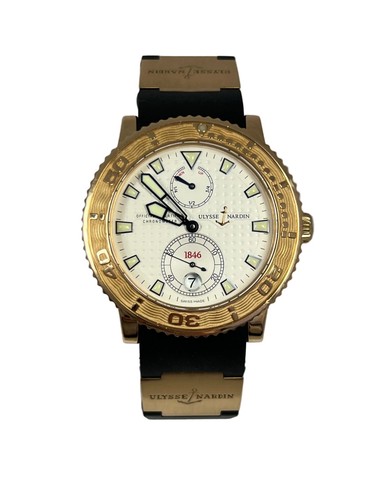
an extremely accurate timepiece, my Ulysse Nardin Marine Diver.
Acquired
in 2001, frequently abused by wearing it under all conditions,
including doing work with various powertools, fallen onto the wooden
floor at least three times, never serviced, and it still gained but 1.5
seconds per day after more than seven years! This value was measured
against a radio-controlled clock, with the watch worn on the wrist
24/7. Wow, what a great value! I hope that you out there, mere
not-highly-accurate-watch-possessing mortals are appropriately
impressed!


When
I purchased a new certified chronometer about a year ago, I submitted
it to a timing test that I normally conduct only rarely. As I had
written frequently in my long-time experience test reports, I am
satisfied with the one minute per week performance, resulting in a
deviation of 8.6 seconds per day. This is not a great value, but one
that has proven to be sufficient in everyday practice. To be fully
satisfied, though, the watch's performance should be twice as good, so
that it needs two weeks to be off by a minute. Any better value is
great, but would not stimulate me to celebrate it with a bath in
champagne (of myself, not the watch!).

The
"new" chronometer and occasion for my check of the "old" one. This new
one, by the way, performed as it could be expected from a new watch.
But
a new chronometer deserves some more effort, so I submit those watches
to a test procedure similar to that executed by the "Contrôle Officiel
Suisse des Chronomètres", short: C.O.S.C. Contrary to the popular
belief, the accuracy of a mechanical watch movement cannot be measured
from its daily deviation alone; especially not when the watch is worn
on the wrist, and therefore subjected to countless position changes,
sometimes temperature changes, too.

The Marine Diver with its COSC chronometer certificate
Since
Earth's gravitation does affect the interaction of all the wheels and
pins, most notably the oscillation of the balance wheel, it is also
easily understandable that the system's accuracy varies with its
changing positions. Thus, a - really bad - watch movement that gains
one minute a day when positioned horizontally, and loses a minute in
the vertical position, will appear to be spot on accurate when
positioned vertically for twelve hours and horizontally for another
twelve; the massive error simply compensates itself. Another watch
movement, that gains 4 seconds in the horizontal position and loses 6
seconds vertically, will show a 2 seconds deviation after such a "test
period", and will consequently appear to be the inferior movement, in
spite of its - objectively - excellent performance.
Therefore,
the watch's accuracy on the wrist does not tell the entire story. As a
consequence, the C.O.S.C. tests the movements submitted by the
manufacturers for two days in every position, plus at three different
temperatures. The two days' intervals are necessary to check the
movement for substantial fluctuations of the movement within the same
position.
So when I get a new watch that is sold with the
assumption to offer a good accuracy, as certified chronometers normally
do, I submit it to a test procedure similar to that of the C.O.S.C.:
The watch is fully wound once a day, and placed face up, face down,
crown right and crown left for two days each. Once a day, at about the
same time, the values are compared with the radio-controlled clock.
Then I place the watch in the refridgerator for three days (the first
day goes without checking the performance, to give the watch some time
to acclimate to the new condition). Since I do not have an oven that
would keep the watch at 38 degrees Celsius for a prolonged time, I omit
the high-temperature test.
I spontaneously decided to let my
favourite, hyper-accurate Marine Diver join the new chronometer in the
test procedure, so the new one could learn from the expereinced one how
to keep excellent time for many years.
Unfortunately,
the results of the latter caused, to say the least, a certain
disillusion: Not only did the deviation between the various positions
vary for up to 24 seconds (+ 6 seconds face up, - 18 seconds crown
left), but especially when comparing the two 24 hours intervals within
the same position, there were differences of up to 13 seconds!
Could
it be that seven years without service, abuse with tools, such as power
drills and orbital sanders, drops onto the floor, countless hits and
bumps left their traces without myself noticing it? What a shame, and I
am considering myself knowledgeable about watches????
Off I went
to my nearby watchmaker, who placed the poor Marine Diver onto his
demagnetizer. A first check there showed the watch to be badly
magnetized, and the watchmaker needed six or seven demagnetizing pulses
until the instrument showed the field to be neutralized. My
satisfaction was of only short duration, though: The following days
showed the watch to gain some fifteen seconds per day, on the wrist,
and still massive variations when left on the table in changing
positions.
With my grand self-delusion shattered to pieces, I
had no other choice than sending my Marine Diver for a factory
overhaul. After I received it back, I wanted to enjoy the piece on my
wrist, and therefore did not spend the eleven days necessary for a full
timing test. Only three days were dedicated to a quick test, two days
face up, and one day crown right. the decisive value was the variation
within one position, and that was down to a second, and the variation
between the two positions (normally, the single position's average
values are taken there), and this was down to four seconds. On the
wrist, the watch now gained two and a half seconds per day, so it was
worse than before the service - seemingly.
But, as always in life: What seems to be simple, is not. Accuracy is accuracy is NOT accuracy ...
Marcus