Marcus Hanke delivers an in-depth experience review of the Ulysse Nardin Sonata Silicium, a pioneering timepiece that integrates silicium not only in its escapement but also in its hairspring. This article explores the technical innovations and historical context of Ulysse Nardin's commitment to new materials, offering a comprehensive look at the Sonata Silicium's significance in modern watchmaking. The discussion highlights collector experiences and technical debates surrounding silicium's impact.
A Crystal Melody
An experience review on the
Ulysse Nardin “Sonata Silicium”
by Marcus Hanke
(c) text and pictures, if not noted otherwise: Marcus Hanke and PuristSPro, September 2009


Accepting
a somewhat battered watch from another persons’s wrist is not the
ordinary way of how an experience test for PuristSPro normally begins.
Yet things are entirely different if this other person is Pierre Gygax,
technical director of Ulysse Nardin, and the watch in question is the
first prototype of the Sonata Silicium, the first series production
watch featuring not only anchor and escapement wheel made from
silicium, but also the hairspring.
The
introduction of silicium into the production of mechanical watch
movements is firmly connected with Ulysse Nardin: In 2001, the
horological world was surprised by the presentation of the “Freak”,
Ludwig Oechslin’s concept of a “simple watch”. It abandoned such
traditional components as hands, dial and even the conventional watch
case, by designing the movement parts to fulfil these purposes
themselves. The “Freak” was the first watch incorporating moving
components made from silicium, and became Ulysse Nardin’s “test bed”
for all technical innovations since. The company continued to invest an
enormous effort into the development of new materials for watch
movements, including experiments with parts made from nickel, “grown”
in countless layers by means of the so-called LIGA process, and even
hairsprings made from synthetic diamond.
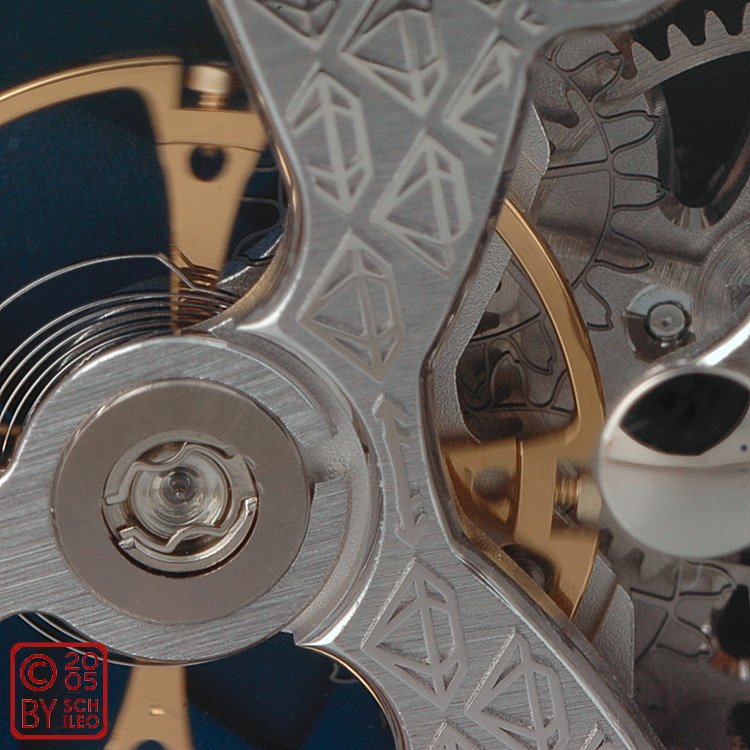
The Freak "Diamond Heart" had escapement wheels from synthetic diamond grown in layers
The
main focus of interest, though, rested on the capabilities of silicium,
by partnering with several leading edge companies, trying to push
forward the abilities of the DRIE manufacturing process, that enables
the etching of complex-shaped silicium parts by means of advanced
masking procedures. It is important to state that the intention behind
these efforts was never to introduce “yet another material”, in order
to have something unique, and exploitable for marketing purposes. The
reason for the research, and for the fact that other companies, too,
slowly are discovering the material’s importance, is the future
prospect of the watchmaking business. Until the late 20th century, the
service infrastructure necessary to keep all the mechanical watches
running, was mostly based on independent watchmakers and those employed
by small jewelers and watch-sellers. However, the training on the job
was largely discontinued, and many watchmaking schools closed their
gates. Meanwhile, even the watchmaking companies themselves have
difficulties to fill their ranks with able watchmakers, and started
their own training courses.
In
order to keep the mechanical watch alive, it is essential to make it
even more reliable, to improve the longtime stability of its
components, and thus reduce the necessity to have it serviced.
Especially the fast-moving parts of the escapement, oscillating up to
28,800 times per hour, and absorbing up to 65% of the energy delivered
by the mainspring, can profit greatly from silicium parts, with their
low mass, resulting in lower stress on pins and wheels responsible for
the energy transfer to the escapement, and their low friction, needing
no additional lubrication at all.
Furthermore,
lower mass and friction lead to a smaller loss of energy, permitting
larger amplitudes of the balance, which again assures a generally
higher level of accuracy over a longer time period.
The
last of the escapement parts to be realized in silicium, and also the
most difficult one, was the hairspring. A silicium hairspring has some
striking advantages over the conventional one, made from Nivarox, an
alloy of iron, nickel, chrome, titanium and beryllium: Contrary to the
latter, a silicium hairspring is completely immune against magnetic
influences, and can be produced in an optimized shape, while the
metallic hairspring is always made from a wire with steady thickness.
Already
shortly after the release of the first “Freak” and its silicium anchor
wheels in 2001, Ludwig Oechslin and the International Museum of
Horology (MIH) conducted several trials with early prototypes of
silicium hairsprings. Dr. Oechslin published his results here at
PuristSPro (please click here
to access the article). Back then, the main problem was the rather poor
performance at low temperatures, and the material’s rather poor
stability regarding quick temperature changes.
However,
in the years to follow, Ulysse Nardin greatly improved the attributes
of its silicium components, and finally, with a material dubbed
"silicium 1.1.1" at hand, trusted them enough to release the first
series production movement with not only anchor wheels made from
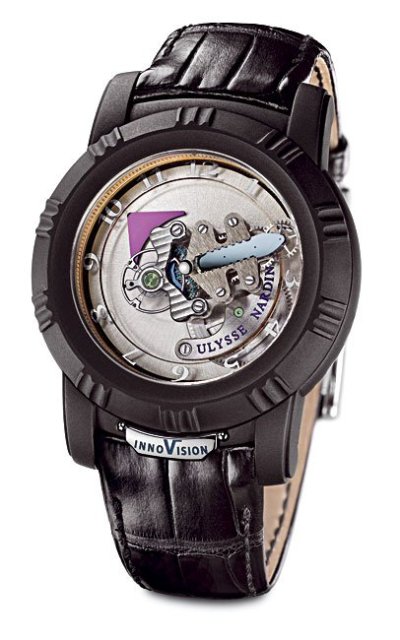
silicium, but also its hairspring (the "Freak" derivate "InnoVision" - click here -, presented in 2007 and featuring a silicium harispring, was not a real series production watch).

Not
only that it is widely acclaimed for its innovativeness and uniqueness,
made the "Sonata" a logical choice for the first escapement completely
made from silicium; but also the fact that, unlike the "Freak", its
cal. UN-67 movement employs a classic Swiss anchor escapement, that is
the absolute standard for mechanical watch movements since many
decades. As a consequence, the development goal of the "Sonata
Silicium" was to prove that it is not absolutely necessary to develop
completely new escapement types for silicium escapements. In the
contrary, even conventional Swiss lever escapements should be able to
profit from the better performance and attributes of silicium.
This
is the story behind the “Sonata Silicium”, when I received the offer to
conduct an experience test with its first functional prototype. When I
got the watch, it had already been submitted to some rough treatment by
Mr. Gygax, reflected by a few more than superficial scratches and dings
in the white gold case. Consequentially, his reply to my question, what
I am allowed to do with the watch, was: “Whatever you normally do with
your watches. This prototype is to prove that the silicium escapement
is functional under all everyday conditions, without having to worry
about the watch.” Well, thanks, I will obey with joy ...
Its
prototype status is also the reason why several components of my
“Sonata Silicium” were not identical with the production watches, and
the finish, especially of the movement, did not meet the high standards
realized in the series production.
1. Case, crystal and crowns:

The
Sonata is cased in an 18k white gold body that leaves a lighter
impression than its pure dimensions would suggest: 42mm in diameter,
its outlines are structured by the curved guards of the crowns and the
integrated two pushers for the adjustment of the hour hand. Its bezel
ring is concavely curved, reducing the risk of catching scratches and
dings (which, however, you can apply if you only try hard enough). At 6
o’clock, the serial number of the case is engraved in a nice, script
font, matching the style of the “Sonata” print on the dial. Since for
the silicium prototype, the case was simply taken from the shelf, its
serial number is of course without any meaning. The lug design is
dominated by the step on the outer side, which also makes their
dimensions appear less massive. Generally, the case design, that in
later years was also adopted for the perpetual calendar, and is
meanwhile simply called the “Sonata-design”, expresses a certain
Italian lightness, perfectly matching the theme of a melodic watch.

The
“main crown” at 3 o’clock is wearing the bright blue enamel insert with
the anchor logo, protected by a layer of sapphire crystal. It is rather
easy to be gripped and pulled into its various functional positions.
Also hand-winding the watch is not difficult. The other crown, located
at 9 o’clock, is combined with a pusher and serves the purpose of
winding the alarm’s mainspring, while the pusher toggles the alarm
function “on” and “off”. In spite of the prominent crown guards, even
my clubby fingers have no difficulties winding the alarm mechanism.
Two
pushers at 4 and 8, cleverly camouflaged as extensions of the crown
guards, and engraved with “+” and “-“ symbols, permit the adjustment of
the main hour hand in hourly increments.
The
display back is secured by five screws. Two flat sapphire crystals, the
frontal one being treated to reduce reflections, are firmly and cleanly
inset with their gaskets.
2. Dial and hands:
In
its richness, the multi-layered dial would really earn a chapter for
itself. A large part of the area shows the dial-facing side of the
movement’s base-plate. Like the whole movement, it is galvanically
plated in a metallic-grey colour, matching the silicium’s own colour.
Vertical stripes result in an always-changing play of light
reflections. The upper dial plate of the prototype, located in the
center, is again taken from the standard “Sonata”, while the series
production “Sonata Silicium” here has a plate of polished silicium, as
shown on the timepiece presented at the Basel fair in 2008. As I have
been informed, it is easier to produce many small parts in silicium,
than to find a large part, that is absolutely even in surface. This is
one of the reasons why the “Sonata Silicium” is so exclusive.

A
large part of the dial surface, though, is filled by the two windows of
Ulysse Nardin’s own patented big date, a small hand indicating whether
the alarm mechanism is active or not, and no less than three subdials,
showing the home time on a 24 hours dial (at 6 o’clock), the alarm time
set, exact to the minute (at 2), and finally the countdown timer,
indicating the time left until the alarm goes off (at 10). The latter
two subdials are attached to the baseplate by means of visible,
perfectly blued screws.
At
the position between 7 and 8 o’clock, the dial shows a strange circular
cutout, spanned by a delicately curved bridge. Held in place by a ruby
bearing, the so-called "regulator" is working here. The hammer that is
striking the Sonata's chime is powered by a separate spring barrel.
When the alarm is activated and the spring fully wound, the alarm
function is blocked by a lever, until two disks located behind the
"countdown" display (one for the hours, the other for the minute
setting of the alarm time) together give free the lever and thus
release the spring tension. Yet as metal springs do, the energy level
released is high at first, but then gradually sinks down to zero.
Without any kind of braking mechanism, this would make the hammer
striking very quickly at first, becoming slower and slower, as the
energy output dwindles, until fading away in some very slow and faint
strikes. Therefore Ulysse Nardin uses a regulator, which is applying a
brake to the alarm's spring barrel, permitting strikes only in a fixed,
predefined interval, and slowly reduces its effect according to the
reduction of the energy supply from the spring. The small cutout on the
front permits a nice view on its operation.

The
rehaut ring between dial and crystal is bearing the faceted and
rhodium-plated hourmarkers, together with luminous spots for nighttime
legibility.
When
the “Sonata” was originally released, its hour and minute hands stirred
some discussions and immediately polarized the opinions: Some people
disliked their curved outlines, respectlessly calling them “moustache”,
others loved it, embedding their design into the general melody theme
of the whole watch. Meanwhile, they are generally accepted, and nobody
questions their practical value, since their unique shape prevents the
prolonged obstruction of the view on any of the additional indications
and subdials. The hands of the silicium prototype were the wonderfully
blued ones of the standard silver-dial “Sonata” variant, which, in this
case, do not offer a good contrast over the grey dial. However, the
production “Sonata Silicium” has silver-white hands with matte finish,
that are perfectly legible at even a quick glance.
3. Movement:
Of
course, the movement is the true highlight of this watch, and the
“raison d’être” of the “Sonata Silicium”. At first glance, the most
apparent difference between this movement and the standard cal. 67 of
the “Sonata Cathedral” is the finish. While the standard movement is
rhodium-plated and therefore shines in a silver finish, the “Silicium”
is treated with a metallic grey finish, which, as already mentioned,
perfectly complements the various silicium parts of the watch.

The
only less than enthusiastic comment I am able to leave on this watch,
though, is the presentation of its unique silicium escapement, or
better, the complete lack of any kind of presentation. For somebody not
perfectly familiar with the technical specifications of the “Sonata”,
the different escapement remains practically undisclosed, if there
weren’t the various other hints on case and dial. The reason for this
is the development goal I already mentioned above: proof that standard
Swiss lever escapements can be replaced by silicium escapements. It was
tried to embed as few as possible changes to the standard "Sonata"
movement, and therefore the valuable escapement did not get a real
showroom. I understand the logic behind this step, but still, I would
have preferred a more "flashy" presentation. But then, I am also a fan
of dial cut-outs for tourbillons, and barely a true purist in this
respect.

While
at least the knowing eye is able to spot the changed balance with its
four adjustment screws integrated in order to prevent air disturbances
as much as possible - adopted from the "Freak" -, the silicium
components are hidden under the massive balance cock:
a. the escapement wheel

b. the anchor with integrated safety pin,

c. the roller with integrated impulse finger, and

d. the hairspring.

The
silicium hairspring is of course the movement's real heart. The use of
a cheap microscope permits to spot the most apparent difference with a
standard Nivarox hairspring: The metallic Nivarox is a wire, and thus
circular in its cross section, while the silicium hairspring is
rectangular in profile, with sharp, clearly defined edges.

Standard Nivarox hairspring with circular cross section

Silicium 1.1.1 hairspring, with rectangular cross section
Further worth mentioning is the silicium inlay in the rotor, replacing the enamel one of the standard “Sonatas”.
4. Functions:
The
main reason to acquire any of the “Sonatas” is most certainly their
wealth of unique functions, offered by no other mechanical timepiece on
the market. Topmost on the list, and indicated already by the name
“Sonata”, is the alarm function.
Mechanical
alarm watches are an old concept already, but the best sound these
timepieces can emit is a more or less noisy rattle. The only beautiful
sound was hitherto produced by repeaters, or sonneries, very expensive
and delicate watches that make use of tiny hammers striking on coils
that are bent around the movement. The “Sonata” is the first alarm
watch employing the same system, and as a consequence produces a
wonderfully clear and melodious chime. An additional advantage of the
“Sonata” is its regulator. Working as outlined above, it permits a very
long duration of the alarm sound. While conventional alarm wristwatches
fade away after less than half a minute, the beautiful striking sound
of the “Sonata” goes on for more than a full minute, under the
condition that its spring barrel was fully wound.
Here is a video of the "Sonata" striking, made by Dave Piccione: ( click here
to see the video). Please note that the watch in question belongs to
the first production series, while the succeeding "Sonata Cathedral" is
still a bit clearer and louder.
The
common problem of all alarm or repeating wristwatches is that they are
not very loud. This is a result of simple physics. Unlike striking
pocket watches, wristwatches have but a small space of resonance, which
is further compromised by the dampening effects of the wrist it is
attached to. The “Sonata” is no exception in this respect, despite its
rather large case. Maybe a few more decibel could be squeezed out by
changing the movement design and placing the chime on the upper side,
or by experimenting with different case materials (steel and titanium
are said to have a slightly positive effect on the sound level), but in
general, I doubt this would really overcome the basic physical
restrictions.

However,
I had not expected the “Sonata” to be so faint in everyday experience.
Or, at least, this was what I suspected it to be. Of all days I used it
to wake me up, be it strapped to my wrist, or placed on the bedside
table, on porcelain plates or crystal glass, only three times it was
really able to wake me up. On all three occurences, I was resting with
the watch (strapped to the wrist) located more or less directly under
my ear.
The
first indication of something being not okay with myself, was my wife
waking up from the “Sonata’s” chime almost every time, in spite of
sleeping on the far side of the bed. The decisive hint came later, when
I had set the “Sonata” to remind me of a meeting. When it went off
during a lecture, I did not notice anything but the apparent reaction
of my students sitting in the first two rows. It was clear that, unlike
myself, they had heard the “Sonata” striking. Later I repeated that
experiment with my office staff, unfortunately with the same result. So
I visited an otologist, who confirmed my suspicion: In a rather limited
frequency range, my hearing is massively compromised, and as bad luck
goes, this is exactly the frequency of the “Sonata’s” chime. Much to my
dismay, I have thus to admit that while I love the “Sonata’s” alarm
function for its innovativeness and the clarity of its tone, my
physical handicap makes me unfit for this watch as a wearer. By the
way, I had asked the doctor if my problem is the result of the
reduction of audible frequences that is the normal consequence of the
aging process, but it is not. His diagnosis also explains why I have
difficulties following certain conversations when there is a lot of
surround noise.
The
“Sonata” is not only noteworthy for its alarm chime, but also for its
ingenious way how it permits setting the alarm time up to 24 hours in
advance. Normally, all 12 hours-based dials only offer the possibility
to set an alarm time within the next twelve hours. So if the wearer
sets the alarm time of 8 o’clock at 5 o’clock in the afternoon, the
alarm goes off at 8 in the evening, regardless of whether the user had
intended it to go off at 8 in the morning. The “Sonata” is different in
offering not only a small 12 hours-subdial for setting the alarm time
accurately to the minute, but the additional countdown timer informs
whether this alarm time is reached during the next evening, or the next
morning.

Adding
another important possibility, the countdown function is also coupled
with the quick adjustment of the main hour hand. Consequently, the
countdown dial immediately reflects any changes executed by pressing
the “+” or “-“ pushers on the case sides. All this, the alarm function,
countdown timer and quick setting of the local time zone, is combined
in what is among the best mechanical travel watches of the world.
5. Performance:
Of
course my highest interest was dedicated to the “Sonata Silicium’s”
performance at low temperatures, since this was the field in which
Ludwig Oechslin found the first generation silicium hairspring to cause
too large timing variations, together with a certain brittleness. Since
my household test equipment is not nearly as sophisticated as that of
the MIH, Ulysse Nardin or the Swiss Chronometry Society COSC, all I
could do was placing the poor watch in the refrigerator for three days,
where it was stored at a constant +7 degrees Celsius. The results were
convincing, in that - after having been brought down to the low
temperature - the watch lost the same second per day that it had lost
in the same position at room temperature. As already said, this test
was far from being scientific, but enough to prove the development
effort Ulysse Nardin invested into the material. Unfortunately, I do
not have an oven permitting me to keep the “Sonata” at a constant +37
degrees for several days, so the high temperature test had to be
dropped, and I readily admit Mr. Gygax’ word that under these
conditions, too, the silicium escapement performs as it should.

The
same applies to all other everyday situations, be they of rougher
nature, such as bumps on the doorway, or even a collision with the
wooden floor, that left the “Sonata” completely unimpressed. I did
never have the impression to wear a delicate complication that was best
stored safely in a vault; in the contrary, the “Sonata Silicium’” has
all the ruggedness a companion needs in normal life.
However,
when I played with the idea to test the silicium escapement’s claimed
absolute neutrality against magnetic fields in my wife’s 3 Tesla
magnetic resonance tomograph, I was glad to ask Ulysse Nardin’s
technical department before; what I nearly had forgotten was the fact
that besides silicium, gold and brass, still enough watch parts are
made from steel, such as screws, pins, hands, and so on. After the
exposure to the magnetic field of an MRI, a worthless heap of scrap
would have been all that was left from the watch ...
6. Conclusion:
I
have to admit, that, originally, I was a bit skeptical when looking at
Ulysse Nardin’s firm dedication to the silicium technology. What I was
missing was the clear answer to the “cui bono?”-question: who profits
from this new technology? Does it make watches more accurate, I asked;
do they become cheaper? After several discussions with Rolf Schnyder
and Pierre Gygax, though, I became convinced of the advantages of using
these new materials in modern watch movements. More even, I think that
- together with other improvements in the energy path of the movements
- silicium is one solution to a problem that will become really serious
already during the next decades: To survive in the future, mechanical
watches need to become much more service friendly, if possible even
service free for an extended period of time, say, for about ten years.
This of course does not only include simple watches, but also
complications, such as chronographs, perpetual calendars, or alarm
watches.
One
of the most frequent arguments brought forward against silicium
technology, is the current problem of remanufacturing parts for old
watch movements. It is correct that many old watches and clocks are
revived by able watchmakers, able to produce missing or damaged parts
from scratch, mostly from brass or steel. I agree that it is certainly
not possible to cut a silicium toothed wheel with a knive. However,
when the music compact disc was introduced, there were only four
facilities able to produce CD’s in the world. All music labels had to
wait for free schedules at Denon or Sony; and today? Every cheap
computer is able to burn CDs, DVDs, now even Blue-Ray discs. How can we
exclude the possibility that, in a few years, workshops will be able to
reproduce nano-technology parts on their 3D-silicium printers?
The
“Sonata Silicium” offers us a glimpse into the immediate future, and
does a really great job in using its new technology to its very
advantage. Already the first operational prototype I was privileged to
wear worked without any troubles and accurate under all conditions I
exposed it to. Aside from that, the “Sonata” itself, even with
conventional escapement technology, is an absolutely wonderful
timepiece, with great functions, easy to use, and - despite their
complexity behind the “curtain” of what can be called a dial - almost
fool-proof to operate. That my ears are too faulty to hear it in its
full clarity and volume is not the “Sonata’s” fault.

Copyright September 2009 - Marcus Hanke & PuristSPro.com - all rights reserved
PuristSPro Homepage
Comments, suggestions, and corrections to this article are welcome. 
This message has been edited by Marcus Hanke on 2009-10-03 16:52:56 This message has been edited by Marcus Hanke on 2009-10-12 05:10:54