
MTF
[PuristS]
13383

Admiring the Great Astronomical Clock of Besançon: Marcus Hanke
|
Admiring the great astronomical clock of
Besançon
presented by Marcus Hanke © text and pics: M. Hanke, 2004 |
|
ll Throughout the
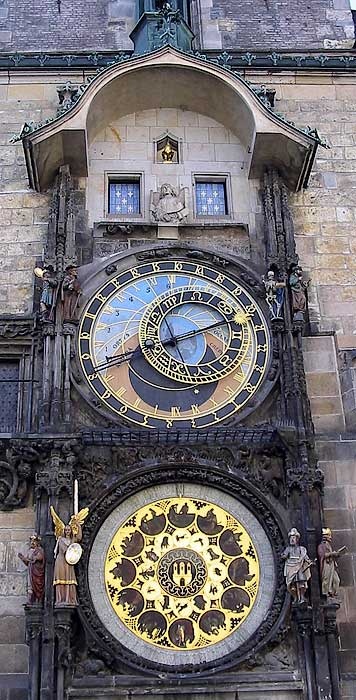
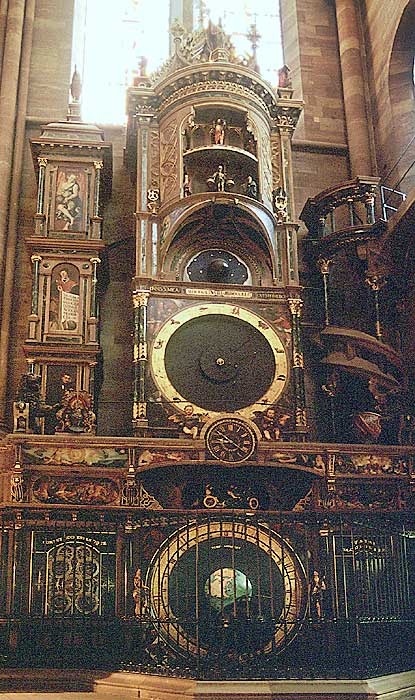
history, astronomical clocks expressed very specific philosophies or dogmas. The
huge public clocks of the late Middle Ages and the early New Age, mostly erected
easily accessible in the cathedrals, served educational and religious purposes.
They should demonstrate to the people how God created the cosmos as a huge and
perfect clockwork, while the Holy Church had the key to its understanding,
showing Earth's and the people's place in the cosmos. Later, the wealthy cities
contestet this monopoly of time and cosmos successfully, and the astronomical
clocks were moved from the inside of the cathedrals to the outside of the city's
towers or townhalls. their character, as placing the cosmos in their centres,
was left unchanged. Thus, the common layout of these wonderful timepieces
concentrated onto astronomical displays, be it an astrolabe or a planetarium,
with the time display itself not being the dominant element.
In the cathedral of
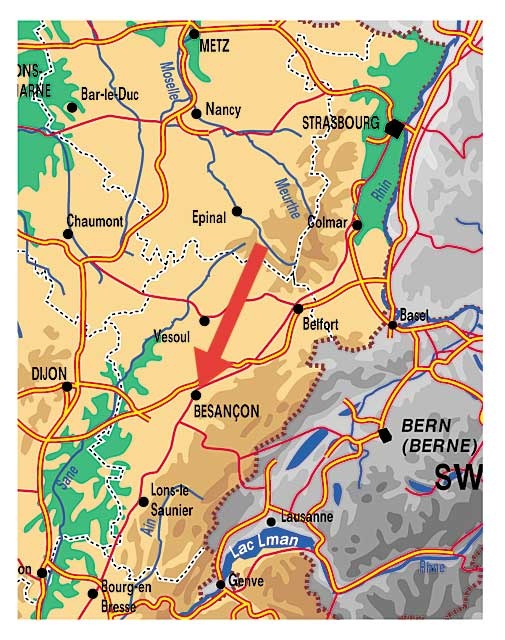
Saint-Jean in the French town of Besançon, capital of the region Franche-Comté,
however, we find a most magnificent and world famous astronomical clock,
representing an entirely different philosophy. Before going into detail on this,
some historical background is needed.
It is well known,
that the Swiss horological industry, especially in the Geneva region, was
introduced by French refugees, mostly protestants fleeing from the policy of
catholic restoration after the revocation of the Edict of Nantes in 1685. A
second wave of talented and most welcomed refugees reached Switzerland during
the turmoil of the French Revolution in 1789. Far less known, however, is that
the centre of the French watchmaking industry in the French Jura was founded by
Swiss refugees. In the aftermath of the French Revolution, Napoleon invaded
Switzerland and installed a centralist regime, dissolving the old cantonal
constitution. This was followed by a period of unrest and religious conflict,
during which many watchmakers sought their safety in France, especially in the
region of Besançon. Around 1900, two thirds of all French timepieces were
produced in this city, which secured more than 12,000 jobs. When the old clock of
the town's cathedral Saint-Jean stopped working in the 19th century, it was of
course a matter of tradition and honour to succeed it with a very special
timepiece, nothing less than the most complicated clock in the world. Cardinal
Mathieu ordered this work to be done in 1858, but there was barely a progress.
Finally, Auguste-Lucien Vérité, who was not a local clockmaker, but came from
Beauvais, was contracted to complete the piece. Vérité rebuilt the clock almost
from scratch, in his own workshop in Beauvais, which of course was seen as a
serious disgrace in Besançon, which considered itself the nation's clockmaking
capital. The clock was
installed in the cathedral in 1860, but nonetheless the work on it continued
until 1863. Since then, it has been reorganised and restored twice, the last
time in 1966. Immediately after the completion of his work in Besançon, Vérité
constructed an even larger clock, with very different appearance in the medieval
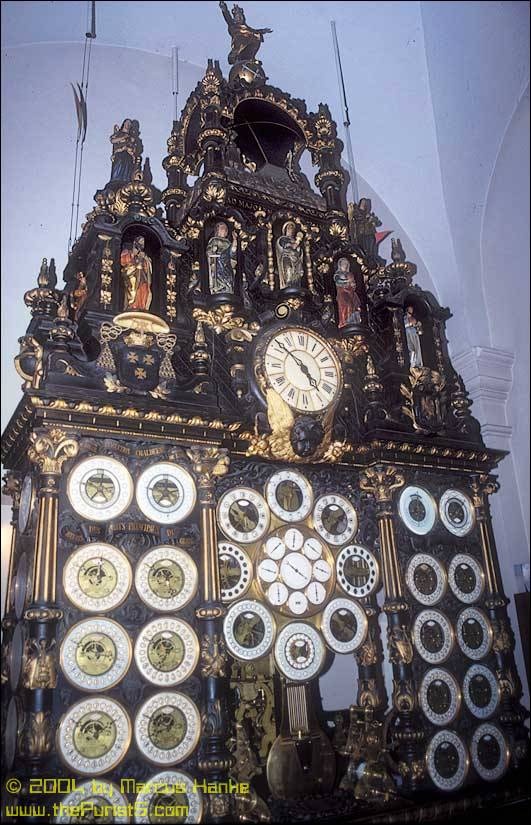
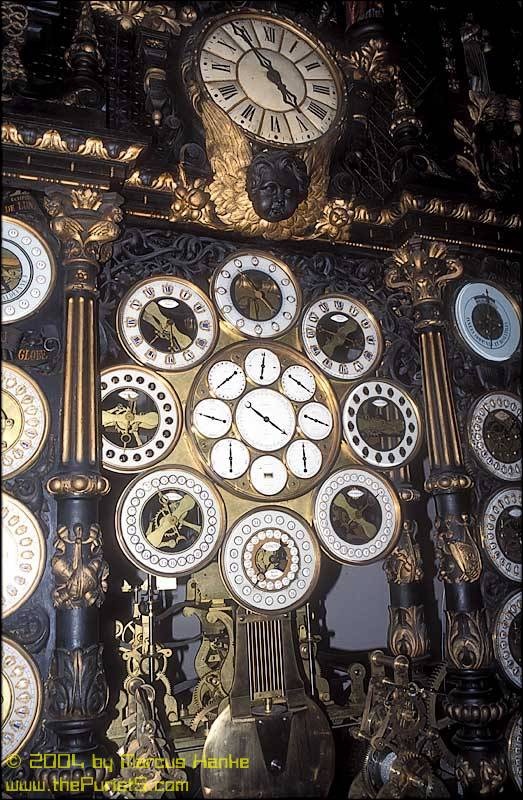
cathedral of his hometown Beauvais. After this historical introduction, let's have a look at the mechanical marvel: The clock is 5.80 metres high and 2.5 metres wide. Contrary to the famous medieval public clocks, and even to Vérité's subsequent work in Beauvais, the clock is not located in the cathedral's aisle, but hidden upstairs, in a room of the large spire.
Also the appearance is very different from the aforementioned clocks: the only display typical for other astronomic clocks is an orrery, an astrolabe is missing. Even the orrery is not placed in the centre, but squeezed into a small compartment in the clock's base, barely visible for the visitor. The focus of this clock cleary is a scientific one, concentrating on the Earth and its movement, with the cosmos around being but a decorative element.
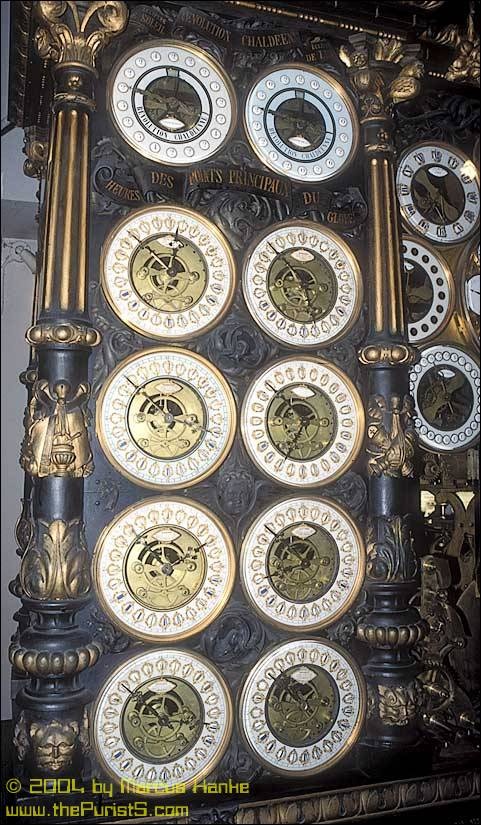
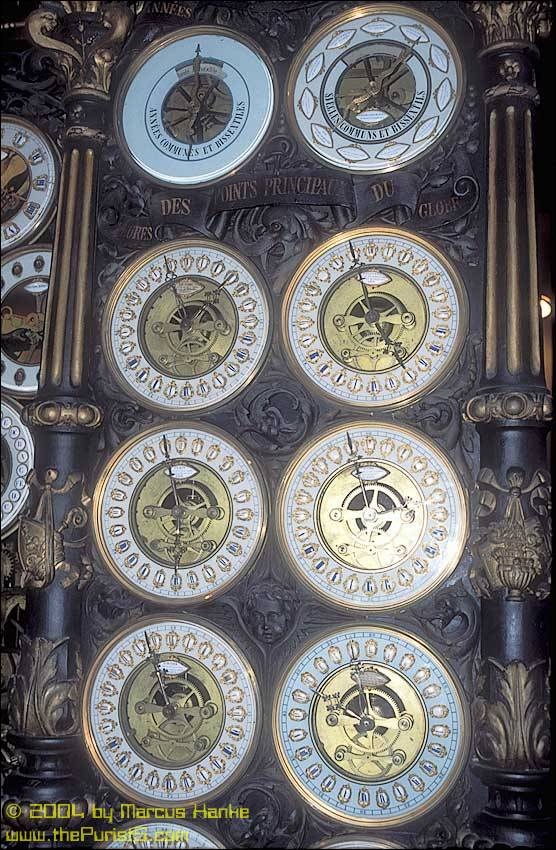
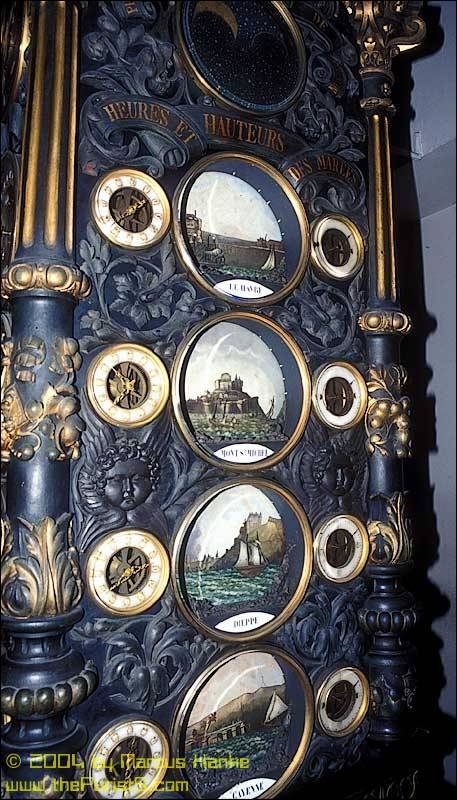
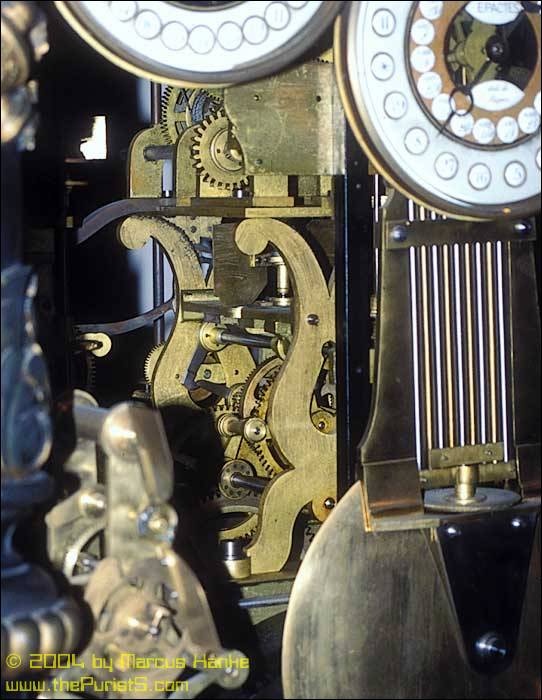
Instead of astrolabe and tellurium, the clock features 70 dials, showing 122 indications; among them the local time of 17 places over the world, times and height (!) of the tides in 8 different French ports, perpetual calendar, leap year cycles, times of sunrise and sunset.
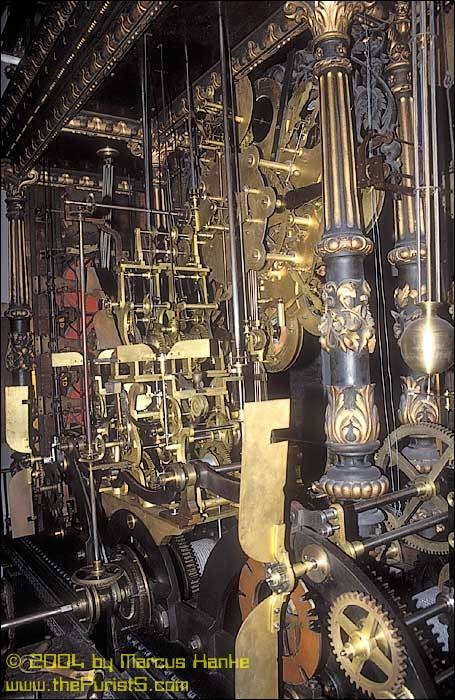
All this is driven by
a mechanism consisting of more than 30,000 pieces, which also transfers the time
to the cathedral's tower clock.
Altogether, the clock
leaves a technical, engineered impression. Not astronomic education, but concise
reference seems to be the primary motivation behind the clock. The spectator is
more reminded of a mighty control panel with gauges, found in Capatin Nemo's
submarine. We are confronted with a representative of the industrial age, not of
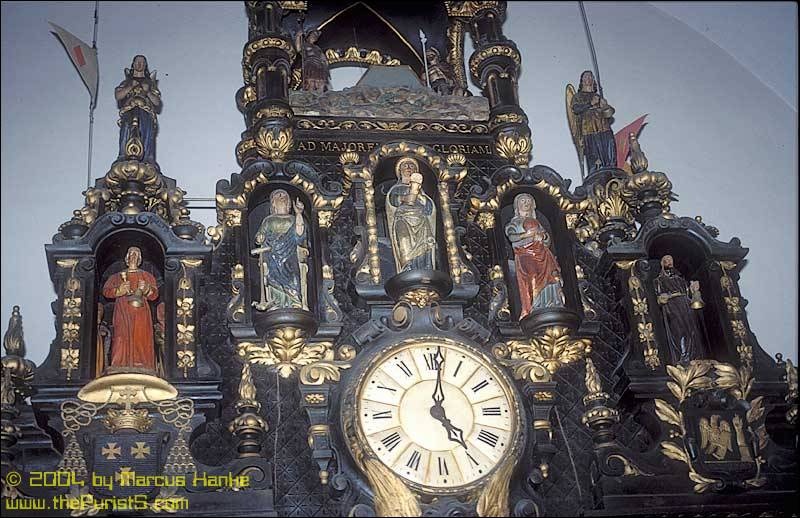
the medieval spiritual world. Therefore, the large groupe of 21 automatons on
the top does somehow mismatch the clock's style. Every full hour, the
jacquemarts move, with a deviation of less than a second per
day.
This clock alone
makes Besançon a place worth a detour, yet the rest of the town is attractive as
well. So whenever you find yourself in or near the French Jura, remember
visiting the Saint-Jean cathedral, and the magnificent clock of Maître
Vérité. |
Admiring the Great Astronomical Clock of Besançon: Marcus Hanke
