
foversta
[PuristSPro Moderator]
20814

Hands on review of the Parmigiani Bugatti Type 390
The link between Parmigiani Fleurier and Bugatti is the longest partnership ever between a watchmaker and a car brand. For more than 13 years, exceptional watches with original shapes have been released to celebrate this partnership and have been designed to transcribe the mechanics of supercars into a world of watchmaking. The problem is that this partnership was never really put forward by Parmigiani Fleurier and finally, few people are aware of its duration and its relevance. In the context of its new strategy, Parmigiani Fleurier has finally made the decision to benefit from it.
This is an important decision for the Manufacture because it demonstrates its willingness to communicate on a much more marked way about its technical and innovative capabilities. With the launch of the Toric collection this year, a refocusing of the collection and the come-back to the front of the stage of Michel Parmigiani, Parmigiani Fleurier is now more present, more visible and in a sense ... comes out of the state of drowsiness in which the brand had settled a few years ago. The very good news is that the latest watch from the partnership with Bugatti, the Type 390, is worthy of this ambition.
The Type 390, inspired by the Bugatti Chiron, is for me the most successful watch of this long lineage. This is not because it is the first to feature a tourbillon even if in this case it is relevant. There are two main reasons that make me particularly appreciate this watch. The first is practical: it is the most legible of the collection. The second is technical: it unveils the first fully coaxial movement and in fact it offers a total coherence between aesthetics and mechanics.
But what is a full coaxial movement? It's very simple: all the organs of the movement are organized around the same axis. If we had to find a culinary comparison, it would be the following: a classic movement is like a pizza with the ingredients spread over the bread dough (the plate). The coaxial movement of the Bugatti Type 390 is like a skewer, the ingredients succeeding one another. So if it's easy to explain, it's a lot more complicated to achieve because the movement components have to be redesigned and optimized to become compatible with such an architecture. And the most delicate point is the transmission of energy between all these components.
The upper opening of the watch allows to observe this architecture. The first elements that stand out are the two barrels mounted in series and connected to each other thanks to a rounded triangular shape for greater efficiency. On the right of this double barrel, when you watch the movement from the time display, is located the power reserve indicator protected by a glass of extreme finesse. The power reserve is 80 hours for a 4hz frequency. The double barrel has the role of improving the torque rather than actually increasing the power reserve. The movement has a huge reserve of energy because, beyond the flying tourbillon, it only has to manage a simple time display.
This energy however requires control for better accuracy and stable behavior all along the power reserve. This is the role of the 3-level planetary gear system located on the left of the double-barrel. Its role is to transform the combination "strong torque - slow speed" into a combination "low and constant consumption - fast speed" to feed the regulating organ. This gear system incorporates the smallest ball bearing ever made. On the far left is the regulating organ and therefore the flying tourbillon which brings a touch of magic, but not only. From at least the theoretical point of view, it is logic to find a tourbillon since the regulating organ is often in a vertical position ... as with a pocket watch. However, and this is the main complaint I make about the cylindrical architecture of the movement, the tourbillon is not visible when the watch is worn unless I make my wrist tilt. It is obviously a pity especially in the case of a flying tourbillon which is the most pleasant to observe.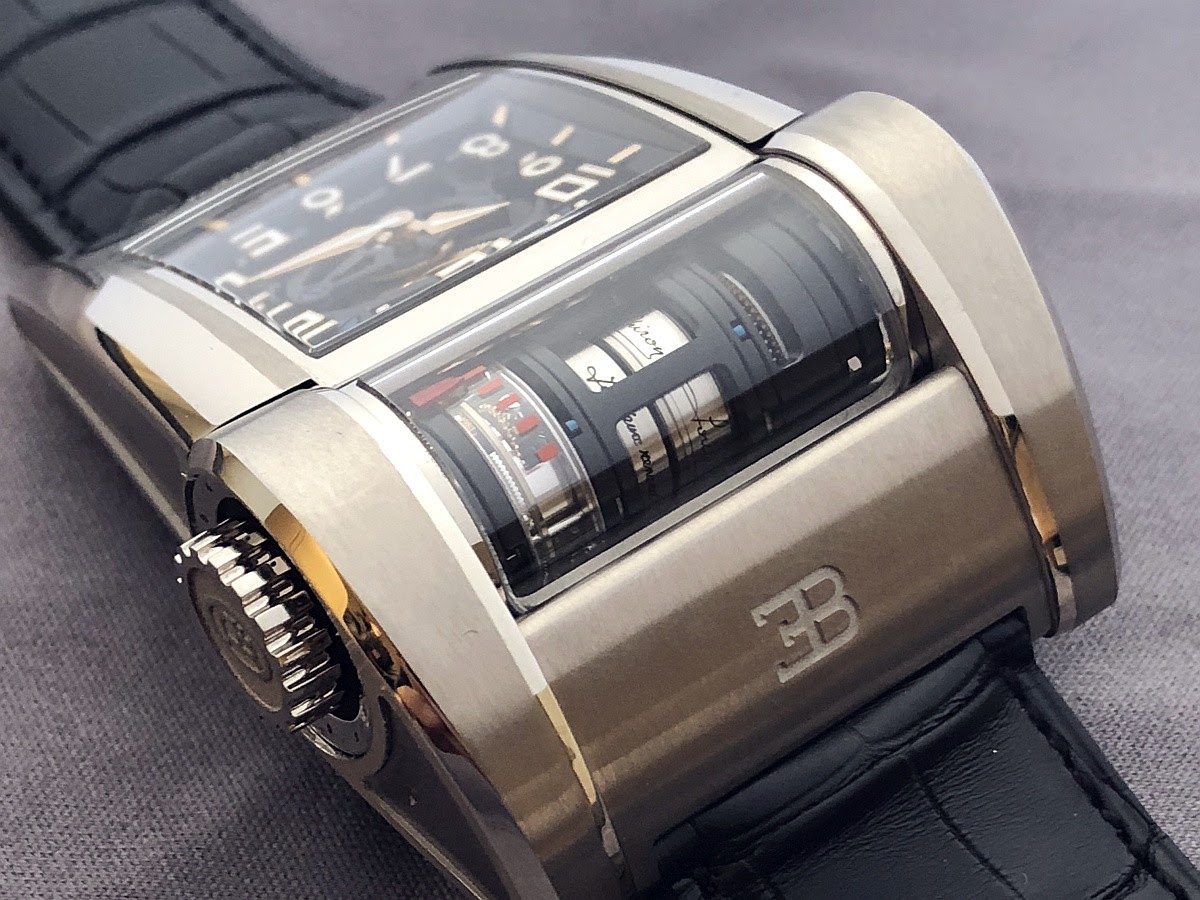
At this stage remains the question of the transmission of energy to the display system. As the design of the watch suggests it, the dial is positioned perpendicularly to the movement. A worm screw ensures the connection between the movement and the wheels dedicated to the display.
The movement of the watch is therefore both innovative and astute. And above all it is worthy of the Bugatti Chiron by the feeling of power it releases and by its lay-out. It was necessary that the watch would be aesthetically accomplished. And it is very fortunately the case: it is my favorite Parmigiani Fleurier Bugatti and by far in this respect. First of all, the watch is very legible because the time display in right in front of our eyes ... which was not the case of the Type 370 which required us to constantly move the wrist to find the right reading position. The dial has a generous size and the "skeleton" approach does not harm, quite the contrary. It reinforces the technical dimension of the watch and the shapes of the bridges draw the figures. In addition, the contrast between the hands, the indexes that are covered with luminescent material and the dial is frank. The watch offers a similar show (which puts the spotlights on the worm screw) by turning it over and I really like the contemporary and flawless treatment of the finish of the movement.
The crown is located to the right of the cylinder. Just turn it slightly by pressing it to make it go out and you can proceed with the time setting and the movement winding. This last is relatively soft and satisfactory considering the two barrels and the power of the movement.
The Bugatti Type 390 has an imposing size (42.2 x 57.7mm), accentuated visually by the top position of the cylinder. It is also heavy (the version I tested has a white gold case) but Parmigiani Fleurier has worked particularly on the wearing comfort thanks to a clever system of articulation of the case on 12 degrees so that the watch can be firmly placed on the wrist , helped by the efficient folding clasp. Despite this efficiency, the problem of thickness remains with a maximum case height of 18.4mm: the watch will have difficulty to go under a sleeve.
This difficulty is in the end anecdotal. Just like a supercar, an exclusive and original watch generates some constraints! But the pleasure is only tenfold. The objective that Parmigiani Fleurier had set for itself is achieved: the Bugatti Type 390 provides strong emotions, thanks to its design, its weight, its volume. And I love it a lot. While I was not really convinced by the previous models, I find the Bugatti Type 390 much more accomplished and consistent. The fact that the practical aspect has not been put aside is an excellent proof of the maturity of the project. In addition, as a flag bearer of the manufacture's capabilities, the watch will be accompanied by a personalization program to be unveiled during the next SIHH. To date, 10 pieces in white gold and 10 pieces in pink gold are planned to be produced. But other versions in titanium or platinum will be available later in obviously very modest quantities: the total number of watches will be substantially under one hundred. This limited production corresponds to the price of 295,000 euros for the gold versions and 270,000 euros for the titanium version. In any case, even if this watch is dedicated to an extremely narrow customer segment, it is for me a great pleasure to see the Parmigiani Fleurier manufacture gain dynamism and visibility.
Thank to the Parmigiani Fleurier Salon of Paris Palais Royal.
Pros:
+ an unique architecture of movement
+ the flawless quality of the execution
+ the time legibility
+ the wearing comfort and the easy handling of the crown
Cons:
- the position of the tourbillon makes it hardly visible when the watch is worn
- the thickness remains high


Hands on review of the Parmigiani Bugatti Type 390

Great post 👌🏻
Thanks for your feedback.

Pizza vs skewer - what an immediately understandable way to discribe movement architecture!

