
alex
7312

History of Vacheron Constantin's original time displays
VACHERON CONSTANTIN?S LONGSTANDING AND SUCCESSFUL TRADITION OF ORIGINAL TIME DISPLAYS
Watchmakers have long sought novel, unorthodox ways of expressing the time of day on their timepieces. From the early days of the pocket watch, they have ceaselessly sought ways to improve upon the classic functional display of the time by means of a pair of hands rotating around a dial. A variety of mechanical systems providing auxiliary or more sophisticated functions soon appeared. Many of them concerned the actual display of the time and date, an area where Vacheron Constantin has excelled ever since its foundation in 1755. The company?s history includes not a few inventive mechanisms affording an original expression of hours and minutes.
As early as 1825, it had turned out a jumping-hours design with off-centered minute circle. Until very recently available in wristwatch format, this striking development was joined the very next year by one that also featured a repeater mechanism striking hours and quarters. Later on, rotating minutes and and day-and-date calendars were added to the jumping-hours display. During the first decades of the 20th century, Vacheron Constantin?s watchmakers were also to explore so-called ?mysterious? watch faces showing the time by means of graduated rotating discs.
In 1930, Vacheron Constantin went a step further with its so-called ?Arms Upraised? pocket watches. This design featured a ?retrograding? or snapback time display actioned ?to order? by means of a pushpiece of the back of the case. The time was displayed by the arms of a tiny figure pointing to the hours and minutes inscribed on either side of the dial.
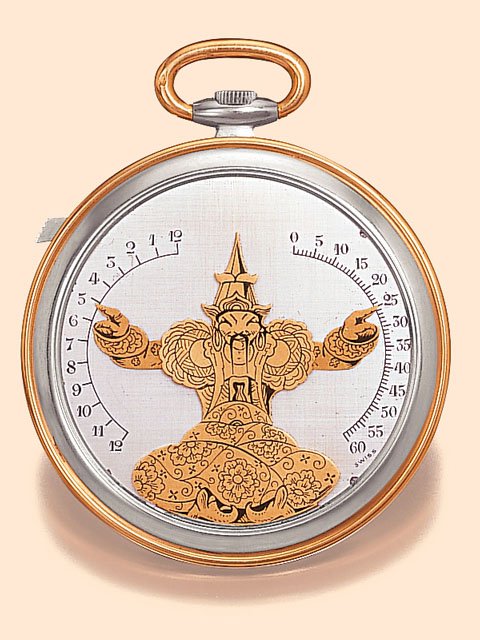
(arms upraised representing a Chinese Mandarin-scan courtesy of Antiquorum)
This unusual type of display has remained current at Vacheron Constantin down to the present day. In 1994 a memorable design incorporated the ?Arms Upraised? idea but this time in a wristwatch, i.e. a far smaller volume. Conceived in homage to the celebrated humanist, geographer and cartographer Gerardus Mercator (1512 - 1594), it featured a twin ?retrograding? and diverging display of the time composed of a pair of hands sweeping over sectoral hour and minute tracks on a dial in multicolored champlev? enamel depicting a hemispheric map of the globe. Joined at a point directly under 12 o?clock much like the twin ?legs? of a compass such as Mercator made constant use of throughout his life and even adopted as his signature, the two hands provide an instantly readable display of the time.
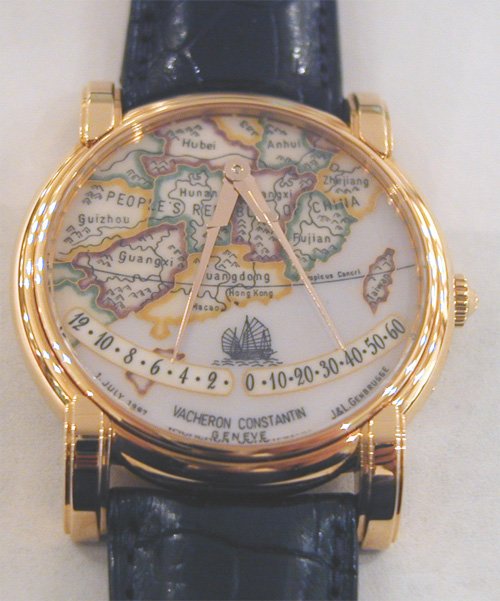
(Mercator with enamel dial representing Hong Kong)
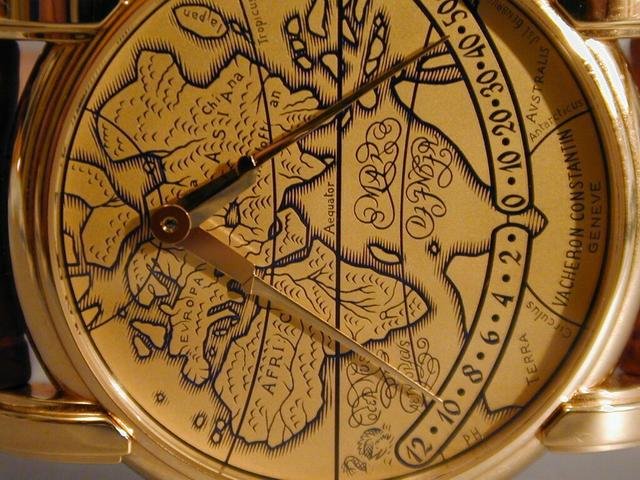
(Mercator with engraved dial representing Europe/Africa/Asia)
This distinguished design was followed by the heure Sautante and the Saltarello, with snapback minutes and jumping hours.
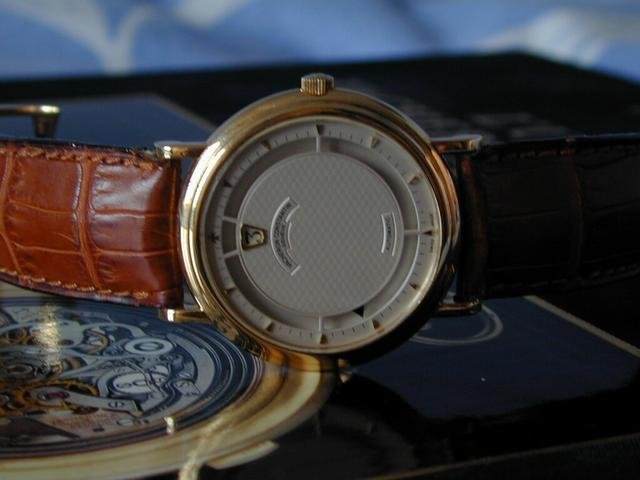
(Heure Sautante)

(Salatrallo)
THE FINE ART OF ENAMELLING : AN ANCIENT CRAFT AND A STUDY PATIENCE
Neither coffee, tea nor of course tobacco. Stimulants of any kind are out of the question. The hand must remain ever steady and its every movement totally predictable and accurate. That is the first lesson in discipline any enameller learns to abide by. For discipline is the key to what is surely one of the most demanding of all crafts. Perhaps only the manuscript illuminators of medieval Europe practiced their art under somewhat similar conditions.
The artist commissioned to design and enamel the dials of Vacheron Constantin?s Patrimony watches honoring famous explorers begins by tracing with a sharp metal point the outline of his subject on a sheet of 22K gold barely half a millimeter thick and a little more than two dozen millimeters across. In some cases, he may use a graver to carve barely visible recesses in the workpiece to hold the enamel.
Under strong binocular magnification, using a paintbrush made of one or two marten hairs, he will then deposit a few droplets of enamel of the right color on the dial. Colors must imperatively be applied in a strict, predetermined order.
That done, the workpiece will be fired in a kiln at 700? - 800? Celsius (1290? to 1470? Fahrenheit). After cooling, it is smoothed, in some cases with powdered corundum, then meticulously polished. More enamel will now be applied, fired, smoothed, polished and so on ? up to thirty times per dial. Firing times must calculated with great exactness according to the type and quantity of enamel applied, so precise firing times are understandably one of an enameller?s best-kept secrets. At the end of this elaborate process, a coating of transparent flux is applied and the workpiece is fired yet again, this time to 900? C (1650? F). After cooling, the dial is smoothed and polished one last time and delivered to the watch assemblers.
This lengthy and meticulous procedure is hard on the nerves. Brittle and quirky, cooling enamel may unexpectedly shatter as it leaves the kiln. The heat-loss process must perforce be slow, careful and regular since sudden temperature changes can, in an instant, destroy countless hours of painstaking work.
The two parts of every Patrimony dial have to be enamelled in tandem with the same colors, firing times and so forth in order to ensure their absolute uniformity. Yet, by the very nature of this craft process, each dial remains forever a unique, individual work of art, with a value to match, for ?the same is never quite the same?.
Vacheron Constantin is today the only watch house to commission such elaborately enamelled dials. As the heir to the most ancient and precious craft lore accumulated over the centuries by Geneva?s premier makes, the world?s oldest full-fledged watch manufacturer, in uninterrupted activity since its inception, takes no little pride in nurturing this gift from the past, in the knowledge that it is perpetuating a rare treasure: the age-old sister crafts of true art.
ZHENG HE (1371 ~1434) THE EXPLOITS OF CHINA?S GREATEST MARINER
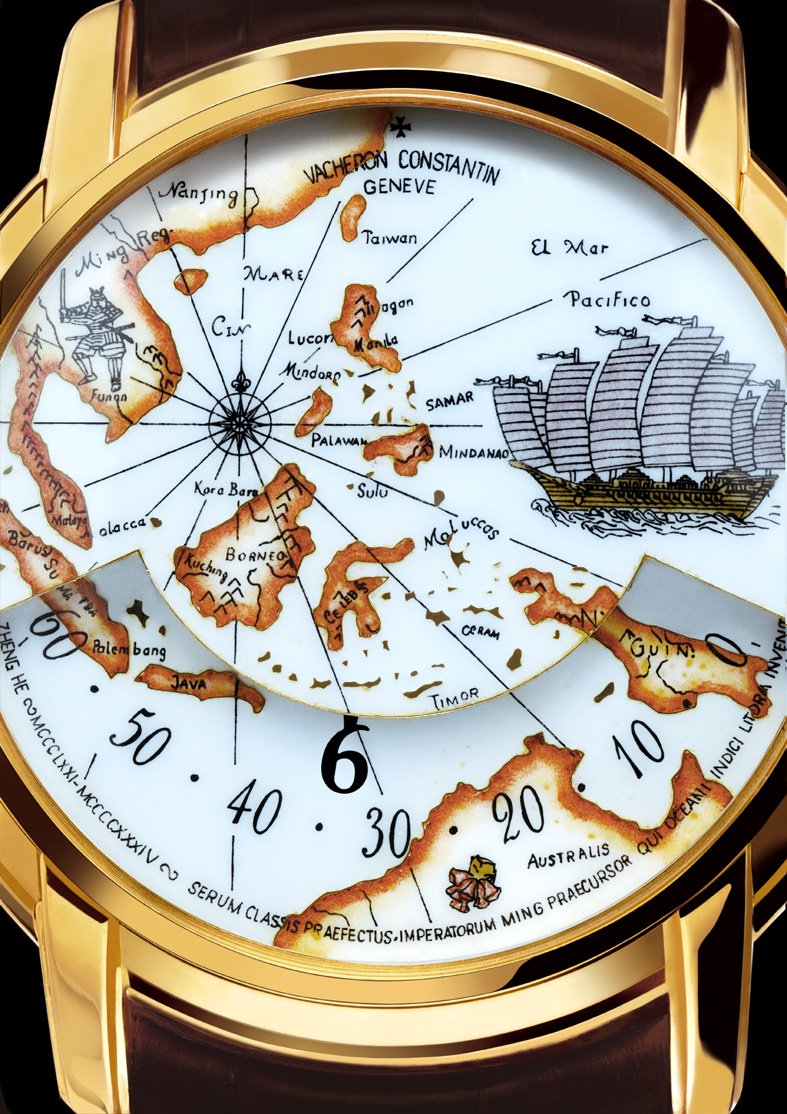
At a time when Europeans still set store by sailors? tales and ancient fables, the Chinese had conquered the seas. Having invented the compass and devised amazing navigational aids, they learned to navigate far and wide, guided by the Southern Cross and the Polar Star. Time they measured by burning graduated incense sticks. The peculiar segmented structure of bamboo inspired its shipbuilders to invent the watertight compartment. In the early years of the 14th century, Chinese maritime expeditions began in earnest. The Ming dynasty built one of the most powerful fleets in history. It comprised 62 huge multimasted junks and 100 lesser vessels, carrying nearly 30,000 men. This impressive armada was commanded by a towering figure of seafaring, admiral Zheng He (Cheng Ho). Captured and castrated when still a youth, he was placed in the service of a ranking member of the imperial family and given the name San Bao, meaning ?Three Jewels?. In addition to the crew, the fleet included scientists, State officials and interpreters in all the languages spoken along the coastline of the Indian Ocean, from Vietnamese to Arabic. A full century before the first Europeans navigators explored this part of the world, Zheng He?s fleet had already been there seven times, making something like forty contacts with local powers from south-east Asia to Africa to the Arab world. Among other wonders, Zheng He once returned to China with a giraffe, a gift from the sultan of Malindi, in what is today Kenya, to the emperor. The presence of this ?Celestial Unicorn?, as court officials called this strange beast, in the imperial zoo was considered a sign of auspicious fortune. From Indochina, Malaysia, Ceylon and India to the Persian Gulf, Somalia and even faraway Mecca, Zheng He is remembered as an unusually talented navigator and an inspired explorer.
FERNAND DE MAGELLAN (1480 - 1521)THE FIRST CIRCUMNAVIGATION OF THE GLOBE
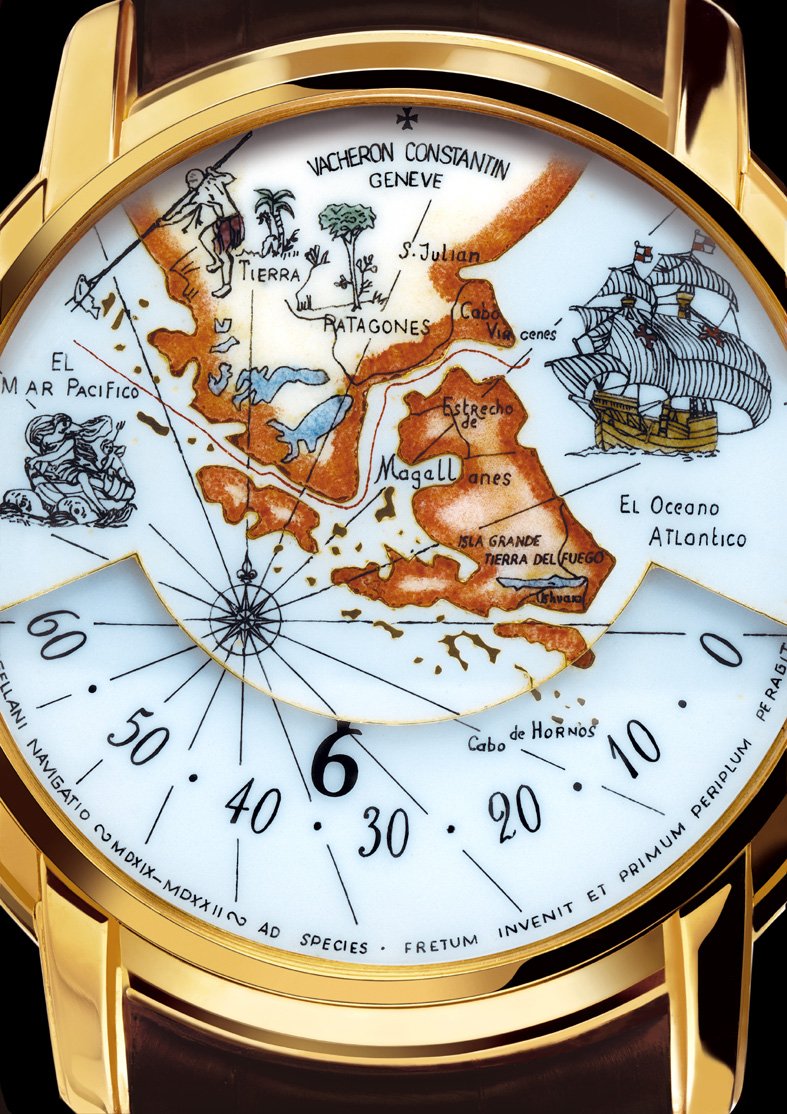
September 20, 1519. Commanding a fleet of five ships manned by 300 men, Fernand de Magellan sailed from the port of Seville, westward bound for the Spice Islands (today the Moluccas, part of Indonesia). Spurred by his studies and early experience, Magellan dreamed of reaching far-off Asia by sailing to the south of the landmass discovered by Christopher Colombus ? no mean feat at the time. The ships reached Brazil, anchoring off what is today Rio de Janeiro, then travelled south to Patagonia. Surviving mutinies, quarrels, shipwrecks and disease, Magellan sailed on, buoyed by his enthusiasm and determination. He eventually discovered and navigated the straits that today bear his name, sailing along a coast dotted by native campsites which he called Tierra del Fuego (Land of Fire). He again reached the open sea, so marvelling at its calm expanses that he named it Pacific Ocean. Having reached the Philippines in 1521, he died during a battle with a local tribe. Only one of the five ships, with eighteen men and a hold full of spices, was to complete the journey back to Spain. It was the first vessel ever to have sailed all the way around the world. Over and above his dreams of exotic treasures, Magellan?s voyage demonstrated conclusively that the earth was indeed a sphere.