
foversta
[PuristSPro Moderator]
20814

Opus V, UR-202S: a comparison of two Baumgartner's watches.
Felix Baumgartner is without any doubt one of my fav watchmakers. He didn't invent the wandering hours display but with Martin Frei, he redesigned it, went beyond the system created by the Campanus brothers for their clock more than 3 centuries ago by adding animated elements, satellites, telescopic hands... And moreover, he built reliable and efficient time display modules. One of his masterpieces is without any doubt the Harry Winston Opus V. The Opus V was unveiled in 2005 and is considered as one of the top watches of the past decade. It was a sort of proof of the skills and of the innovation coming from the young independant watchmakers.
When I saw the White Shark for the first time last year, I immediatly made a connection with the Opus V. I believe the main reason why was the colours atmosphere of the White Shark, very different from the other Urwerk... and quite close to the Opus V one. I had the chance to handle both watches and I would like to propose you a comparison between them. To be more precise, I will not compare the Opus V with the White Shark but with the UR-202S which is basically an evolution of the White Shark with a metal bracelet and stripes on the dial.
I) Context
The Opus V can be defined as a link between the 10x and the 20x collections of Urwerk. The project with Harry Winston allowed to Felix Baumgartner to work on a more ambitious time display. If the 10x watches were using 3 round satellites, the will from Felix Baumgartner was to create a new system, still in the context of the wandering hours, but which would have a different visual impact. The key idea was to use 3 satellites, very similar to small dices and telescopic minutes hands: this type of hand is mandatory if you want to design a watch with a minutes scale with straight lines. With a crescent-shaped minutes scale, you don't have this requirement: the hand is always at the same distance from the scale due to the circular behaviour of the central caroussel. The use of telescopic hands is much more demanding of energy and the Peseux 7001 which powers the 10x collection is not powerful enough to animate the display module.
The Opus V: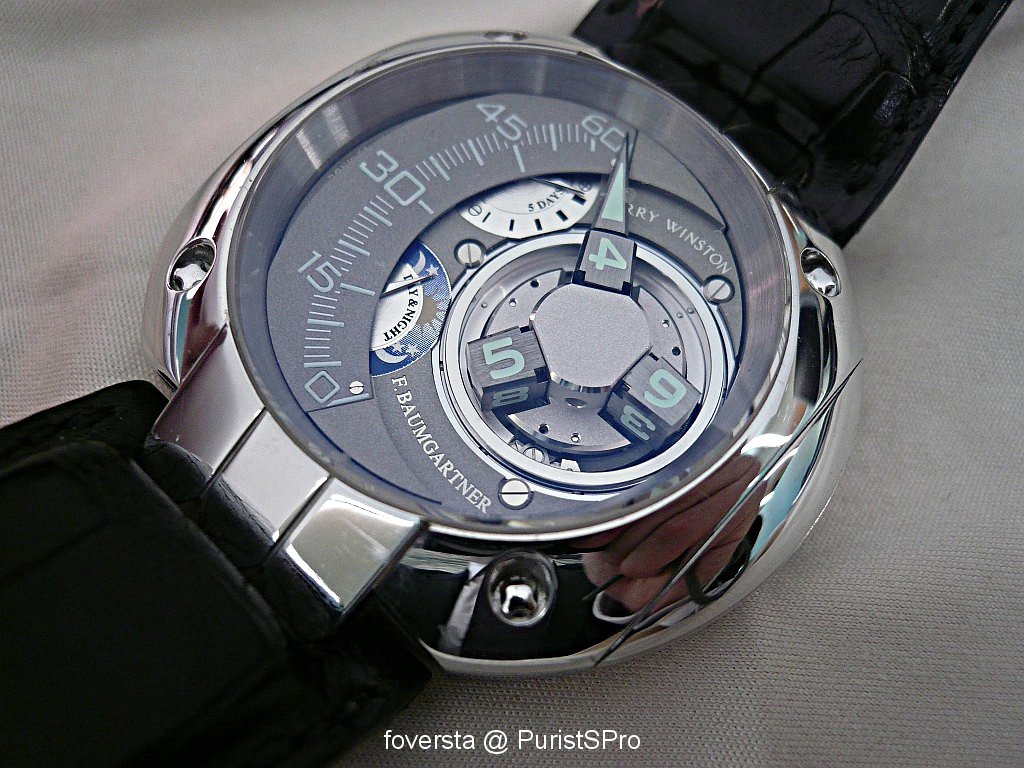
The ideas were set and the Opus V gave the opportunity to work on different fields like the animation of the 3 satellites and the use of the Lajoux-Perret Handwind Caliber (with a power reserve of 5 days) as a base.
Similar satellites and the same base caliber were after used by Urwerk for the first watch of the 20x collection, the UR-201 The Opus V was the project which supported a lot the development of the 201.
We are now 5 years later. In 2010, Urwerk presented a LE of 12 watches, the White Shark. The White Shark is a strange animal in the Urwerk collection due to its colours, its very metallic "look and feel". When we compare it with other watches of the 20x collection, it looks brighter, more luminous, perhaps with a more optimistic message behind. Some 201 and 202 with their black atmosphere were very close to make us think about Darth Vader's helmet. I would say that the black 20x are Empire watches... while the White Shark is more Rebels related. Take sides!
The UR-202S was presented at the 2011 Basel Fair. And maybe the person who can speak the best about it is Martin Frei because the UR-202S is a true designer achievement. S means stripes due to their presence on the dial. But I would say that S could mean steel due to the superb bracelet in metal. S could also mean snake due to the design of the whole... Martin Frei thinks that with the bracelet, the design of the UR-20x is finally accomplished. It is impossible not to agree with him: the bracelet is perfecly integrated into the whole design, it seems to be a logical extension of the case.
The UR-202S:
II) Base of the movement
As I said before, the Opus V module is powered by a handwind Lajoux-Perret with a power reserve of 5 days.
The UR-202S is an automatic watch using a GP3100 as a base caliber. The winding system is connected to the two turbines which can be found on the caseback. The purpose of these turbines is to regulate the winding efficiency of the movement. 3 positions are chosen through a small lever: stop (the winding system is stopped, the watch becomes a pure handwind one, sport: the winding efficiency is reduced if the owner of the watch moves a lot and free: the usual efficiency for a normal life.
In this field, the UR-202S is much more complex than the Opus V but at the opposite, the larger power reserve of the Opus is a good point if we need to leave the watch for a few days.
III) Time display
They look so similar, based on the wandering hours display. They are actually very different even if they share in common the 3 satellites.
The Opus V has only one minute hand which is not telescopic but retrograde. At the 60th minute, the minute goes back at the beginning of the scale in front of the right figure of one of the three satellites.
The big retrograde hand of the Opus V:
With the UR-202S, each satellite has its own telescopic hand: there is no retrograde system here, everything moves continuously. In one sense, the watch seems "quieter" than the Opus V.
6 years later, I still think that the Opus V remains on top of the hill of the innovative type displays: the way that the watch combines a retrograde hand with 3 satellites is absolutely gorgeous. The UR-202S is of course also very impressive but there is no fast animation. We are in a different time frame here, a more relaxed atmosphere...
With the UR-202S, each satellite has its own telescopic hand:
IV) Complication
The UR-202S features two additional complications: a complex night&day indicator with 4 sectors (night-transition-day-transition) and a moonphases display. There is no additional complication on the caseback dedicated to the turbines and their lever.
The Titanium caseback of the UR-202S with the turbines and the lever:
The Opus V shares a common complication dial side: the night&day indicator. But there is also a power reserve indicator which is very useful in a context of a handwind movement with a large power reserve.
On the back, the Opus V gets a service indicator, a sort of odometer which measures 5 years of working. It is obviously a slow complication which finds its right place on the back (the UR-203 gets it front side which is not a good idea IMHO because it is not a "fun" complication).
The Odometer of the Opus V:
Both watches have a good selection of interesting complications which suit them well.
V) Case
This is a very important topic. The Opus V was created in a Harry Winston context while the UR-202S celebrates the famous Hammerhead design. The work on the Opus V case was realized taking into account some constraints in order to give a Harry Winston identity. For me, it's clear: there is a before and an after Opus V. The Opus V really launched the trend of large cases for independant & innovative watches. Look at the previous 4 Opus and the next ones: things really changed.
The unique case of the Opus V:
The Harry Winston influence is found in the 6 arch-shaped elements at "6 and 12 o'clock" if I may say so. The crown is not visible, hidden on the caseback. We have the feeling that the Opus V was designed like a very curvy pebble.
Feeling is totally different with the UR-202S: the case design is very sharp, very geometric with a big crown visible on top of the case.
Both watches are bulky with a 46.6mm x 43.5mm size for the UR-202S and a 50mm diameter for the Opus V.
Ready to bite, the UR-202S looks like a snake:
The Opus V was created with platinum and PG cases while the UR-202S is available with stainless steel with or without AlTiN coating treatment (with titanium on the back). The bracelet was developed in partnership with Maspoli and only 50 will be produced. They are made of 22 links, only 6 of them are identical.
The Maspoli bracelet:
VI) Comfort on the wrist
For me, it is a clear win for the UR-202S. Even if the UR-202S has a stainless steel case, it is a very heavy watch like the Opus V. But thanks to the bracelet, the overall weight is better spread all around the wrist and the watch is very well put in place. You can shake the hand, the watch doesn't move. Feeling is not exactly the same with the Opus V: the weight seems to be very concentrated into the case, especially when you have the platinum version on the wrist. So sometimes, the Opus can sligthly slide which causes unpleasant feelings. If you have a small wrist, forget it. The UR-202S is maybe more accommodating thanks to the bracelet.
The bulky case of the Opus V:
Funny point is that when you wear the UR-202S, you have the regular tendency to wind the watch: it is so easy to do it with the thumb due to the size and the position of the crown. This is not possible with the Opus V due to the hidden crown.
The big crown on the top of the UR-202S: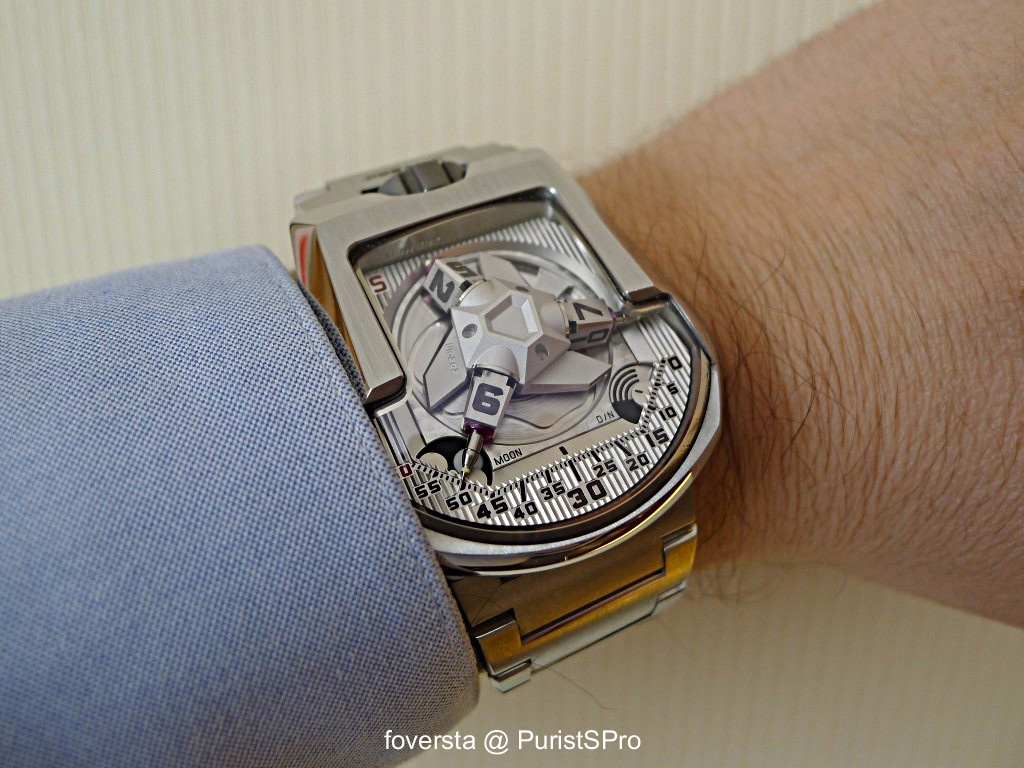
A specific remark can be made about the Opus V: you feel the change of hour when the minute hand jumps. You don't need to look at the dial, you know when a new hour starts! As the satellites move continuously with the UR-202S, we don't have a similar experience with this watch.
VII) Readability
Each watch has its advantages and drawbacks. The Opus V has a very readable scale and a longer minutes hand. But the scale is located left side of the dial which obliges to fully drag the shirt to be able to read the time. Moreover, the first and last 5 minutes are not graduated.
Nice coincidence, it is exactly 5:05 on this Opus V:
The UR-202S has a horizontal minutes scale: with habit, you can guess what is the current time even if you don't see the hand below the shirt. The trick is to use the position of the next satellite. When it is close to the right-angle corner of the case, it is roughly 15 minutes before the beginiing of the next hour. So we are more or less around the 45th minute of the previous hour of the one displayed on the next satellite. Don't do it before this position because the satellite will not display the correct hours figure on it. The stripes on the dial are very nicely made and bring a technical touch. But we can't say that they improve the readbility. Frankly speaking, I found the UR-202S less convincing than the White Shark on this topic.
The minutes scale and the stripes of the UR-202S:
VIII) Conclusion: two sides of Felix Baumgartner's talent
There is an obvious link between these two watches and we easily find the Opus V inspiration in the UR-202S. But I wished to give you the proof that, despite being created by the same watchmaker, these two watches are radically different: design, complications, time display, movement, they actually don't share a lot of common points expect the colours atmosphere, the satellites and the wandering hours context.
The Opus V is a radical watch with maybe a more demanding system (retrograde minutes hand) while the UR-202S can be considered as the outcome, in both design and technical perspectives, of the development by the Urwerk team. The Opus V is a mythical watch because it brought a lot of innovation and unusual features when it was released in 2005. Obviously, the UR-202S is less surprising, it is more a logical evolution of the previous Urwerk watches and it can be considered as more "mature" and easier to live with.
But with any of these watches, you will enjoy a lot the work by Felix Baumgartner, maybe the most impressive sides of his talent are the magic emanating from the modules and the harmony between the design and the time display systems.
Fr.Xavier
Opus V, UR-202S: a comparison of two Baumgartner's watches.

Excellent comparo!

A thorough comparison...
thx for this!

Excellent review!

Thanks Fx ...

Beautiful post... thank you for all

Well done, Fx

Excellent review FX. The Opus 3 shoew the world that high watchmaking and
Thanks Alex.
