
foversta
[PuristSPro Moderator]
20814

Pre-Basel 2012: Harry Winston Histoire de Tourbillon 3
Foreword: the pictured watch is a
prototype and some small details may change in the final
version. The small
Seconds marker located inside the Tourbillons housing is
missing.
For me, on the main interests I
find in Harry Winston is the ability of the brand to offer in less than
one year watches like the Midnight Automatic or Histoire de Tourbillon 3
despite a very limited yearly production. In one hand, we have a slim,
simple and elegant watch. On the other hand, we have a superlative,
complex and bulky timepiece.
The purpose of the
Histoire de Tourbillon collection is to design original watches around
the fascinating complication of the Tourbillon and to put it under the
spotlights. The watch presented in January 2012 is the third of the
collection and we can find common points in these three
watches:
- they use complex Tourbillon systems, each
time different
- their cases are large and thick
- the
time displays are unusual.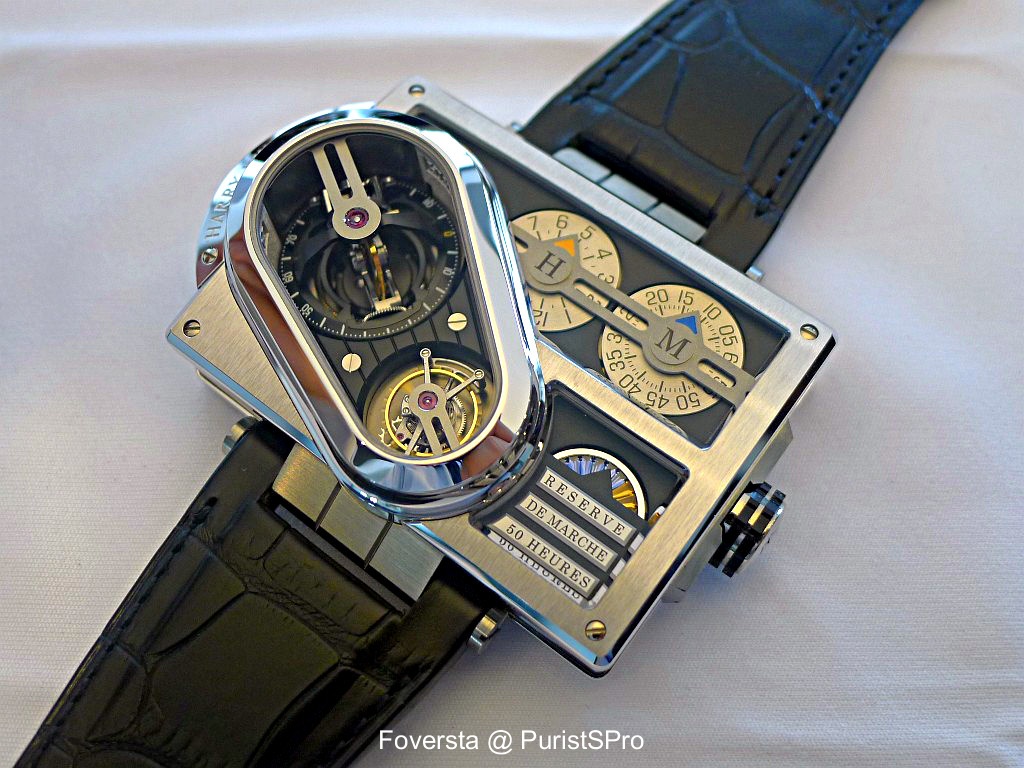
But despite these common points, each
Histoire de Tourbillon brings an aesthetical "break" when compared with
the previous ones. It is obvious when we discover Histoire de
Tourbillon 3. The case shape, an imposing rectangle, is very original in
the context of complex Tourbillons watches. They are not the first
Harry Winston steps with such type of case because, if you remember
well, the Tourbillon Glissiere was housed in a rectangular case in
coherence with the winding system of the watch. The root of this case
was the Avenue Squared one. Howerer, Histoire de Tourbillon 3 and
Tourbillon Glissière cases can't be compared. Histoire de Tourbillon 3
enters a new dimension, a dimension of excess.
We could spend
hours describing Histoire de Tourbillon 3 but at the end of the day,
only the feeling of immoderation would remain. Histoire de Tourbillon 3
was not designed to be a quiet watch. Its weight, its size, its
thickness create bold opinions: you love it, you hate it but you will
never be indifferent.
The most interesting points about it are
coming from the observation of three contrasts:
- the
contrast between the size of the watch and the discreet time display.
Time display is secondary here, the Tourbillons are the main players of
the show.
- the contrast between the rectangular shape of the
case and the curvy housing in which the Tourbillons are
inserted
- the contrast between the bulky design of the case
and the very delicate behaviour of the
Tourbillons.
When I saw the Histoire de Tourbillon 3
for the first time, there was any doubt in my mind: the whole watch was
created to create a stage on which the three Tourbillons would play
their roles. Look at the time display. There are no moving hands, only
rotating discs in front of markers (hours on the left, minutes on the
right). Discs are moving clockwise. Seconds are displayed through the
rotating scale around the Double Tourbillon. But be careful! It is a 120
seconds scale. Please note that the tiny yellow seconds marker is
missing on the pictured Prototype.
Power reserve display is
similar to the time functions. But, "Harry Winston oblige" and to give a
precious side to the watch, the disk is set with sapphires and
citrines. There are 17 gemstones on it. The first 11 ones are blue
sapphires (from dark to pale). When one of the six yellow citrines is in
front of the marker, time is coming to wind the watch. Power Reserve is
about 50 hours.
Yellow and blue: these colours are very
familiar to us! They are the same ones used on the Histoire de
Tourbillon 2 for the time display.
I like a lot the coherence
between the power reserve and time displays, they are all together in
harmony. However, I would have opened more the "dial" to make more
visible the power reserve disk. The gemstones are so nice that they
should have deserved a larger view. And I find the text "Reserve de
Marche 50 heures" too large.
Anyway, the truth is
that it is not very important. We quickly forget what's going on the
right side of the watch. Our eyes are attracted by the huge housing
dedicated to the Tourbillons. In a sense, the shape of this zone makes
us think about the way the chronograph subdials are linked together on
the Z2 dial. Its diagonal positioning contributes to bring dynamism on
the overall design of the watch.
How many
Tourbillons do we have? Actually, we have three cages (one double + one
single) and two regulating organs.
As usual with the
Histoire de Tourbillon collection, CompliTime developped the movement in
partnership with Harry Winston. So even if they are impressive, the
features of the Tourbillons are not that surprising if we consider them
separately:
- For the double Tourbillon: One
Tourbillon carriage rotates every 40 seconds while the second carriage,
the outer one, located on a perpendicular axis to the first makes a full
revolution every 120 seconds. These are the features of the Double
Tourbillon of the Histoire de Tourbillon 2 if you remember
well.
- For the single Tourbillon: it has an unique axis and
does a full revolution every 36 seconds.
The
hypnotizing Tourbillons (again, the watch is a prototype and the tiny
yellow Seconds marker is missing):
Of course, these two groups of regulating organs are linked together through a differential gear to average the performances of both. So Histoire de Tourbillon 3 can be considered as a step further in complexity after Histoire de Tourbillon 2.
I will be frank with you: in terms of chronometric objective, I don't really see the point to average the performances of a double Tourbillon with a single one even if averaging different systems is a good idea. I would have understood better with two doubles. Anyway, the result is a true joy for our eyes. I spent a lot of minutes watching:
- the behaviour of the double Tourbillon
- to compare it with the single Tourbillon one
- to compare their relative speeds.
It is, without any doubt, a fascinating and hypnotizing show and as I told you before, I was totally forgetting the time display while staring at them.
When we turn over the watch, we discover the movement bridges side. Its layout is similar to the front side: a large circular side below the Tourbillons and the other side below the functions displays. There is nothing special to be added, even if the layout is very technical, the show is located front side, not back side.

Time is coming to put the Histoire de Tourbillon 3 on the wrist. How can I describe the feeling? The watch is heavy, thick, massive. But thanks to the large strap and its impressive buckle, it didn't move on the wrist even when I shaked my arm. Good point.
If you expect to hide it under your shirt sleeve, forget this idea at once: it is impossible. You have to consider that the case dimensions are 65 x 45,9mm. Being rectangular, the feeling of size is even stronger than with a round watch. Finishings of the WG case are impressive, especially of the Tourbillons housing on polished WG. The contrast brought by the satin brushed Zalium casesides is nice too. The Tourbillons housing adds some extra mm to the overall thickness but in the context of the bulky case, it doesn't give any impression of unbalanced design. You will notice the triple-arch elements by the strap which give a touch of Harry Winston DNA.

There is something strange with the Histoire de Tourbillon 3. Despite its massiveness, it has a special charm. The watch is not wearable on a daily basis due to its size and thickness but it remains comfortable thanks to the excellent positioning on the wrist. And the behaviour of the Tourbillons creates a special atmosphere which tries to bring something light and aerial to balance the heaviness of the case.


I can't consider it as a beautiful timepiece: it is too excessive to deserve such adjective. But there is a sort of alchimy inside which works very well and which leads to an unusual result. The Histoire de Tourbillon 3 provokes a lot of opposite emotions at the same time: it is maybe the source of its charm, I was a bit disturbed by it being shocked, seduced, surprised at the same time! I can't remember another timepiece with so many reasons to feel strong emotions simultaneously. A true Tourbillon of emotions!

The Histoire de Tourbillon 3 is available in a LE of 20 pieces with WG and Zalium case only.
I would like to thank a lot the Harry Winston team for the warm welcome at the Manufacture.
Fr.Xavier