Collection
Mark in Paris offers a compelling historical context for the Patek Philippe 5170G, positioning it as a true heir to the brand's legendary chronographs. His analysis highlights how the 5170, despite initial challenges following the iconic 5070, draws inspiration from vintage references like the 130, 1463, and 1579 to establish its own significant place in Patek Philippe's lineage. This article provides valuable insights into the design philosophy and historical continuity that define this important reference.
Slowly but surely since the first yellow gold reference, the Patek Philippe 5170 reference is building its pedestal next to the previous chronograph-only 5070 reference in the heart of Patek customers.
After several years when the collectors got used to seeing, reading about or wearing the 5070 model, it was a difficult task to come up with, especially with such a significant change in terms of aesthetics but also regarding the new in-house CH 29-535 caliber which replaces the Nouvelle Lemania-based CH 27-70 caliber.
The reason why I'm writing this is that I want to underline the fact that this reference is very true to the historical Patek Philippe timepieces which participated in creating the legend of Patek's chronographs and, in that matter, that it is for me a very important and attractive model today and for the future.
From the mid 1930's to the late 1960's, there were many different versions of these chronographs from the first 130 to 1463 or 1579 references. As you can see here below, it is easy to find what inspired the 5170J and 5170G models.
5170J inspiration - Here below a very beautiful 130 Reference in YG (thin lugs usually are found with gold cases):

Source: Antiquorum
This one is very close to be the one which inspired the current 5170G (here below 130 ref. in steel, thus larger lugs):

Source: Antiquorum
For instance, the lugs were larger on some versions (usually steel ones) or much thinner, but I find the current ones perfect regarding today's standards (large).
Specific scales with thin lugs (533 reference here, which has a thin and "flat" bezel instead of concave for the 130 reference):

Source: Antiquorum
The 5170J is the heir of the "batons" Roman numerals models whereas the 5170G silver dial is the successor of the Breguet Arabic numerals versions. 99% of the pieces I could see had a pulsometric or tachometric scale (which I like a lot in these Patek chronographs).
The 5170J launched in 2010 and discontinued when the G reference was unveiled:

Here below a 130 reference with a "Mile" scale (instead of usual Km):

Source: Antiquorum
They were rarely available with a
"railroad" scale only (2 examples of 130 reference here below). It looks very pure and more elegant that way (this is the choice they made for the 2015 black dial 5170G I'll talk a little about later):

Source: Antiquorum

Source: Antiquorum
Thus, the 5170G's dial layout is particularly well inspired: I find it elegant, the contrast between printings and the dial is not too strong and it is not cluttered nor empty.
The pushers are also beautiful and have been widened a little to match today's proportions. Note that we still have the polished pushers sides.

The bezel existed in a slightly concave, flat or slightly inclined versions, depending on the references. The 5170 is opting for the latter one which is imho a very good choice as the concave shape is already available for other cases (5970, 5270...) and that a flat inclined one may seem purer and less subject to fads. It is difficult to find the same inclined bezel in older references except maybe the 1463 or 1579 references which are quite close.
The 1579 reference with a flat inclined bezel (and faceted lugs for this reference):

Source: Antiquorum
... compared to a concave bezel (and rare hour hand bu the way):

Source: Antiquorum
You may start to see now how much interesting are these 5170 J and G when looking back at Patek Philippe's history.
The 5170G with its opaline silver dial is, I think, the chronograph to possess from the current collection, even more so (still my own perspective) than the new black dial version, even if this latter color is rarer and may be worn as a sportier model. It is really a matter of taste. The black one fulfills another type of need as it integrates a bit of our modern world standards.

Compared to the J reference, we can feel a very different philosophy with that G reference: the classic version versus the 2010's elegant chronograph.
Now, a watch doesn't have to be similar to its ancestors to be worth of interest as long as it respects and carries forward the brand's DNA. But nevertheless, the 5170, in all its versions, is a unique modern representative of these historical timepieces and will be hard to beat in that field.
Maybe the
one variant still missing in terms of dial layout is this 530 reference version (Arabic at 12 and 6 o'clock, concave bezel):

Source: Antiquorum
Or this 533 reference (nails instead of "batons", flat bezel):

Source: Antiquorum
Or this 130 reference with sector dial (and the Steel larger lugs):

This leaves many possibilities for new versions with a great attraction power.
There are so much more dial layouts in the pictures archives on the net but one thing they have in common (at least for most of them) is the elegance and the sense of proportions.
Of course, this is a matter of taste and is depending on how we've been influenced by our past experience in that field. That's why it is such a challenge for a brand with such a legacy to introduce its name in the present, in modernity, while pleasing older and newer clients at the same time.
We'll have a look later at the new Patek Philippe 5170G black dial reference but I wanted to make this article first, in order to appreciate its characteristics in a better way.
I hope that you enjoyed this historical overview of Patek's current chronograph only references. Please react if you feel like it about this 5170!
Cheers,
Mark

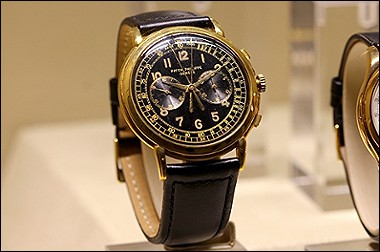
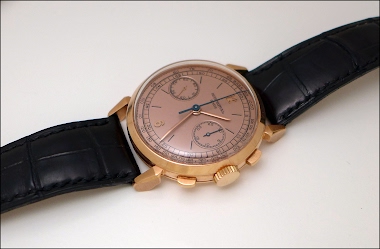
The Patek Philippe Reference 130 is a significant chronograph model, notable for its classic design and the various configurations in which it was produced. While many examples feature a standard chronograph layout, specific iterations, such as those with split-seconds functionality, represent a higher echelon of horological complexity within the reference. The model is recognized for its balanced proportions and the legibility of its dial, making it a favored choice among collectors seeking vintage Patek Philippe chronographs.
This particular example of the Reference 130 is distinguished by its yellow gold case, measuring 33mm in diameter. It houses a manual-winding movement, typical for chronographs of its era, and is fitted with a crystal, likely acrylic or sapphire depending on the specific production period and any subsequent servicing. The case construction and movement finishing adhere to Patek Philippe's high standards for precision and durability.
Collector interest in the Reference 130 is driven by its historical importance as an early chronograph from the brand and the rarity of certain dial and complication variations. The presence of unique characteristics, such as Breguet numerals, specific dial signatures, or the absence of a tachymeter scale, can significantly influence its appeal. The reference appeals to those who appreciate the foundational designs of Patek Philippe's chronograph lineage.
But I must confess that I prefer the 5170 to the 5070... especially the 5170G with the black dial. The 5170 is more classically sized, far more balanced, and just feels and looks more "Pateky"! Of-course, that's just my $0.02 ;) Thank you for a great write-up. Cheers, Kamy
And I don't believe that there is a clear winner in the 5070/5170 story. They are so different that it is really a matter of taste at the end. Fx
You're not the only one to share that feeling, it is interesting to know and learn what for you makes the difference. Thanks! Cheers.
I think the 5170 is and will be significant as it houses, I believe for the first time, an in-house manually wound chronograph caliber. A significant historical milestone, don't you agree? Much regards, Kamy
and this is one of the main elements I'm attracted by when dealing with the 5170 and 5270 references. I like knowing that all the elements of a watch have been thought and designed by the brand's crew (even if I also like the old 27-70 of course). Cheers.
It is all a matter of taste, and vive la difference. ;) Seriously, the big no gos for me are: The 2 subdials which are floating under the 3 / 9 line. The less nicely decorated movement ( no inward anglages ) The hands which are much nicer in the 5070. The dial, which is much more my taste in the 5070. The size of the case is more my taste with the 5170, but I prefer the shape of the 570 one. Best, Nicolas
This thread is active on the Patek Philippe forum with 28 replies. Share your knowledge with fellow collectors.
Join the Discussion →