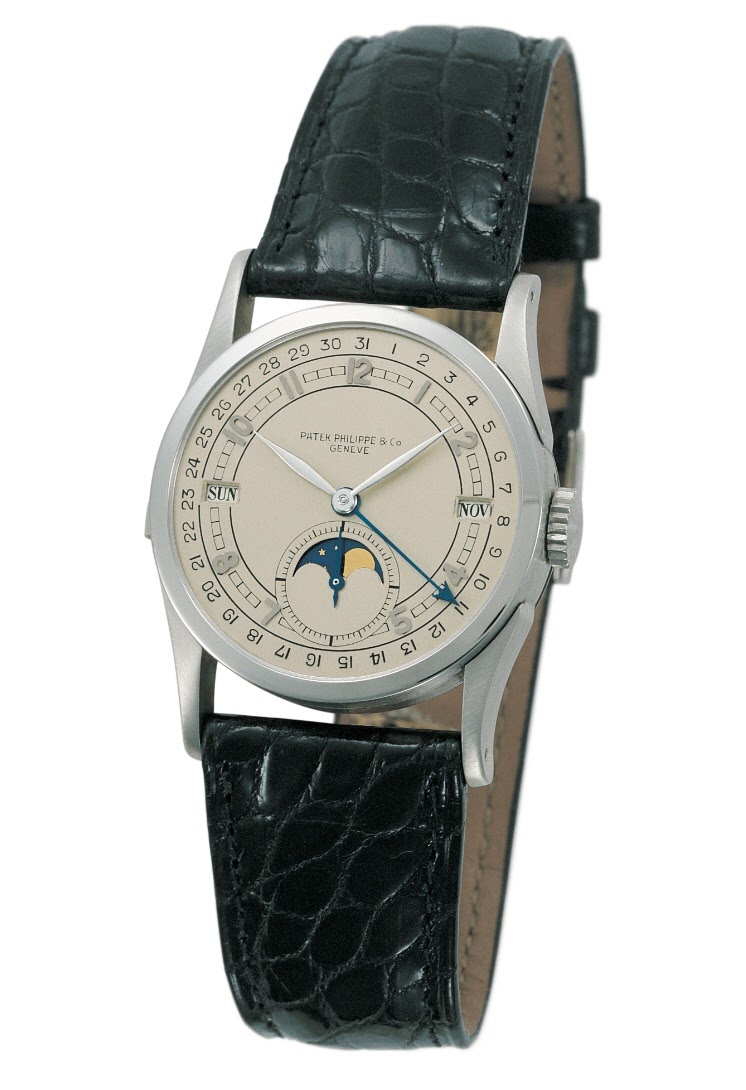
Miranda presents an in-depth look at the Patek Philippe Ref. 541, movement 198.340, hailed as 'the most important wristwatch ever made.' This article explores its historical significance as the first true grand complication, its record-breaking auction prices, and its pivotal role in igniting the watch collecting boom.
Credit: Patek Philippe
Started in 1930, the movement was finally cased in a platinum calatrava 31mm case diameter
It was the first true grand complication, setting the way forward for future complications
It broke the record at auction twice, first in 1981, when the record price was acclaimed as being the catalyst for watch collecting boom
Then broke the million dollar barrier
Here is the extract from the Antiquorum catalogue - because I can not put it anymore succinctly than the original description!

The catalogue put its importance into perspective
Notes
This watch is published in "Patek Philippe Wristwatches", pages 240 - 241. This amazing work of art by Patel< Philippe, of very high quality, is considered as one of the most significant and representative pieces of 20th Century watchmaking. A masterpiece of horological engineering, execution and creative skill. This watch is also published in "Watches " by George Daniels and Cecil Clutton and it is the only prestige wristwatch illustrated in this "bible" of horological literature. This watch was formed in the Bloomfield collection, San Diego, CA. This piece was sold by Antiquorum on 4 October 1981 for the amazing sum of SFr. 185 ' 000. This price and this record triggered the outbreak of the collectors' wristwatch market. As a comparison with some of the most collectable wristwatches, hereunder are their 1981 estimates: - Patel< Philippe astronomic gold wristwatch with perpetual calendar and moon phases, Ref. 1526: SFr. 16'000 - 20'000 - Patel< Philippe astronomic gold wristwatch with square button chronograph, register, tachometer, perpetual calendar and moon phases, Ref. 1518: SFr. 25'000 - 30'000 (This particular example is extremely rare with a "Champagne" dial !) - Patek Philippe self-winding gold wristwatch with enamel dial, Ref. 2526: SFr. 3'800 - 4'200 - Patek Philippe gold waterproof wristwatch with round button chronograph, register and tachometer, Ref. 1463: SFr. 5'500 - 6'500 - Patek Philippe gold wristwatch with split-second chronograph, register and tachometer, Ref. 1436: SFr. 13'000 -16'000 - Breguet No 2926, unique Art Deco platinum, "Perpetuelle a Masse", self-winding wristwatch with date and power reserve indicator: SFr. 9'000 - 12'000. This watch, lot 172 of The Art of Breguet" sale in April 1991, by Antiquorum, so ten years later, was sold for SFr. 126'500! This comparison fully demonstrates the extraordinary price reached by this exeptional wristwatch in 1981. It is the first time since 1981 that this watch reappears on the Auction Market and since then wristwatches have enjoyed an ever increasing fascination for collectors all over the world.

It is quite remarkable to have made such an unbelievably complicated piece to n such a small diameter
At a time when there was no CAD
9 Years in the making, it is a unique piece in horological history
And totally priceless -
you can see this piece in the Patek Philippe museum
Thank you to Patek Philippe UK and Geneva for the rare pictures
Best
Imran
About the Patek Philippe Grand Complications Ref. 1436
The Patek Philippe Reference 1436 is a split-seconds chronograph, a complication that allows for the timing of two separate events simultaneously or two intervals of a single event. This reference is notable for its relatively long production run and the variety of case materials in which it was offered, indicating its enduring appeal among collectors of complicated timepieces. It represents a significant example of Patek Philippe's early 20th-century chronograph production, preceding later, more complex multi-complication watches.
Crafted in 18k yellow gold, 18k rose gold, or platinum, the case measures 33mm in diameter. The watch is powered by a manual wind movement, the Caliber 13''', which is visible through the solid case back. The crystal protecting the dial is acrylic, a common material for watches of this era. The fixed bezel frames a silver dial, which often features applied hour markers and various scales depending on the specific execution.
This reference appeals to collectors seeking a classic split-seconds chronograph from a prominent manufacturer. Its variations in case material and dial configurations, including those with Breguet numerals or retailer signatures like Cartier, make individual examples highly sought after. The absence of a tachymeter scale on some versions further distinguishes them, highlighting the bespoke nature of certain commissions during its production period.
Specifications
- Caliber
- Cal. 13'''
- Case
- 18k yellow gold, 18k rose gold, Platinum
- Diameter
- 33mm
- Dial
- Silver
- Crystal
- Acrylic
About the Patek Philippe Complications Ref. 1463
The Patek Philippe reference 1463 is a significant chronograph model, notable for its water-resistant case design, often referred to as the "Tasti Tondi" due to its distinctive round chronograph pushers. This reference stands out as one of the few Patek Philippe chronographs of its era to feature a screw-down case back, a design element that provided enhanced protection against dust and moisture, distinguishing it from many of its contemporaries with snap-on backs. It represents a blend of traditional chronograph aesthetics with a more robust construction.
This reference typically features a case diameter of 33mm to 35mm, though some examples can be found up to 38mm, crafted in various precious metals including yellow gold, rose gold, and stainless steel. It houses a manual-winding chronograph movement, specifically the Caliber 13''' CHR, which is based on a Valjoux ébauche but highly finished and modified by Patek Philippe. The crystal is typically acrylic, and the dial configurations vary, often featuring two subdials for constant seconds and a 30-minute counter.
For collectors, the reference 1463 is highly sought after, particularly examples in stainless steel or rose gold, which are considerably rarer than those in yellow gold. Its robust construction and classic chronograph layout appeal to those who appreciate vintage tool watches as much as haute horlogerie. The "Tasti Tondi" pushers are a defining characteristic, contributing to its unique identity within Patek Philippe's historical chronograph offerings and making it a cornerstone for many serious collections.
Specifications
- Caliber
- CH 13-130
- Case
- 18k white gold
- Diameter
- 33mm
- Dial
- Silver
- Water Resist.
- 30m
- Crystal
- Acrylic


