Innovation
Dje introduces the Patek Philippe Ref. 5550P, a groundbreaking timepiece featuring the GyromaxSi balance and Oscillomax escapement. This article delves into the historical evolution of watch oscillators, from Huygens' spring to Breguet's terminal curve and Guillaume's invar alloy, setting the stage for Patek Philippe's latest advancements in precision horology.


Patek Philippe 5550P with GyromaxSi balance and the Oscillomax escapement! Tuesday the 5th
of April 2011 was a very special day for watchmaking's history.
The basic
principle of the watch calibre as we know it today begun its long evolution as
far as 1675 with the invention of the "spiral" or spring by
Christiaan Huygens. The Huygens spring was supposedly oscillating in an
isochronous way, what is the aim of a precise regulator.
That was in
fact not the case as you know and the invention of a specific terminal curve by
Abraham-Louis Breguet in 1795 was supposed to allow a concentric development of
the beating spiral. The scientific parameters of this curb were later
calculated by Edouard Phillips, hence the name "Breguet spiral with
Phillips terminal curb" for the spiral still used in some of the
most prestigious watches (like the Patek Philippe tourbillon or chronograph
watches). These spirals are developing concentrically as expected, avoiding any
lateral force on the balance axis that would disrupt the precision of the
oscillator.
The next step
came in 1897 when Charles-Edouard Guillaume invented the "invar"
alloy that allowed to avoid the influence of the temperature elevation on the
balance and the spring. The very low thermic dilatation coefficient of the
invar material allowed a better preservation of the isochronism even in
changing ambient temperatures.
The oscillators
saw little evolution then except perhaps the use of free-sprung balance wheels
such as the Gyromax balance launched by Patek Philippe in 1949-51 and still used in nearly
all current Patek Philippe wristwatches.
The quest for a
lasting precision of the modern timepieces was still limited by interferences
caused by the necessary lubrication, specially between the parts composing the
complete oscillator, by the lasting effect of temperature, by the imprecise
dimensions of the parts at such a small level of scale, by the magnetic fields,
by the distribution of the weight and inertia in the moving parts , by the
effect of small or larger shocks on the oscillator, among other possible
sources of problems so you can imagine that it was still a perfectible field
even if a simple mechanical ETA calibre can be quite precise today if correctly
regulated.
Following its
tradition of innovation and its aspiration for excellence Patek Philippe
launched nearly ten years ago the Patek Philippe Advanced Research program. We
saw the first result in 2005 with the launch of a new Patek Philippe escape
wheel in Silinvar, an oxidized silicium invented by a joint group of the CSEM
(Centre Suisse d'Electronique et Microtechnique), Rolex, ETA and Patek
Philippe. This new escape wheel was patented (#EP05006186) and issued in the
first Patek Philippe Advanced Research watch reference 5250. The interest of
this escape wheel was that it didn't need any lubrication and was
consequently much more reliable.
2006 saw the
launch of the second step named Spiromax, a Silinvar flat spiral that allows a
better isochronism as it develops concentrically thanks to its specific and
totally new Patek Philippe terminal curb that could not be produced if not made
in Silinvar. It is also amagnetic and temperature compensated. It adds an
integrated stud attachment and an integrated self centered collet, consequently
avoiding any disruptive effect due to the attachment. Thanks to its very low
weight (mass three times smaller) it is also less prone to be influenced by
gravity and centrifugal forces. Finally it is also three times flatter (0.12mm
thick) than a Breguet spring with an overall better result. The Spiromax was
first launched in the limited reference 5350, associated with the Silinvar
escape wheel.
The Pulsomax
escapement seemed to close the series in 2008 with a new Silinvar anchor and an
evolution of the Silinvar escape wheel, associated with the Silinvar Spiromax
spring. It was the first escapement entirely conceived by Patek Philippe. The
Pulsomax, still a Swiss lever escapement, was bringing a much more precise geometry
and an enhanced efficiency in power transmission on top of all positive aspects
shown by the former steps (absence of lubrication, antimagnetism, hardness,
lightweight, temperature compensated, …). The Pulsomax was first launched
in the limited reference 5450 and very recently in the Grand Complication 5208,
letting maybe some think that Patek Philippe had ended the work.

Well in fact
the three first steps were just the beginning of a new chapter. What makes Mr
Stern, honorary president of Patek Philippe, Mr Nico de Rooij, IMT (Institut de
Microtechnique) director and vice president of CSEM SA, Mr Patrick
Aebischer, president of the EPFL, Ecole Polytechnique Federale de Lausanne, and
Mr Philippe Gnaegi, Conseiller d'Etat du Canton de Neuchatel be so happy?
Let's say
they are happy to announce the creation of the Patek Philippe Chair dedicated
to the application of new micro and nanotechnology to watchmaking. At the same
time they also confirmed the launch of a new complex in Neuchatel for the IMT
that will unite 500 to 600 scientists working on microtechnique, in
collaboration with the EPFL. To be associated to this huge project is a way for
Patek Philippe to perpetuate its tradition of innovation and to relaunch the
fundamental research in the horological branch, as expressed Mr Philippe Stern.

In fact you may
have already understood that Patek Philippe already has had ten years of
experience with the CSEM, where all Patek Philippe Silinvar parts have been
created and produced so far. This trusty collaboration is wished to last and
the technical prowess that was presented that day was an example of what is
coming.
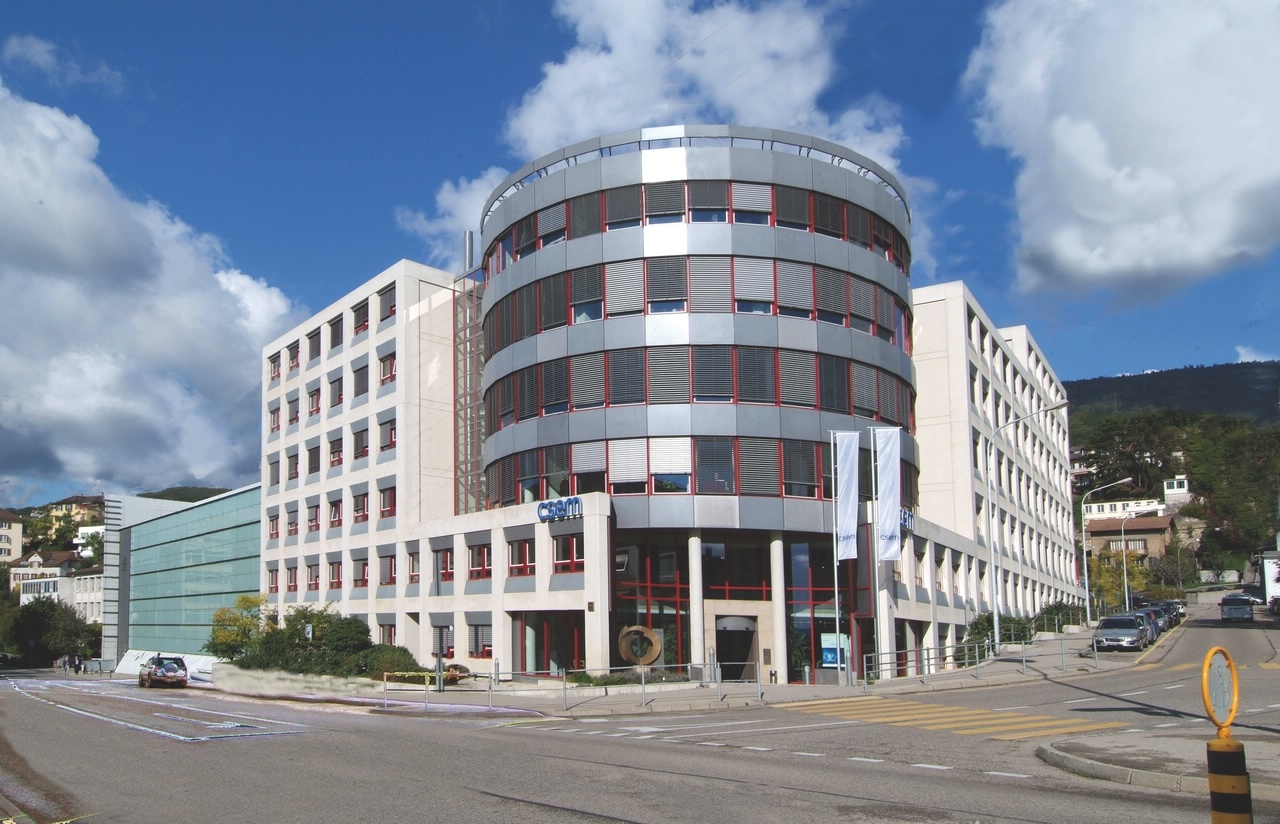
Here is above
the entry of the CSEM in Neuchatel.
We had the
opportunity to visit some laboratories of the CSEM and I can tell you that the
visit of the quality control was impressive. Using X ray technology but also
microcospic observation the quality control is able to test parts, evaluate
defects, and suggest treatments to annihilate them. The precision of vision is
down to the atomic scale and one of the tools used gave a Nobel Prize to its
creator in 1986.
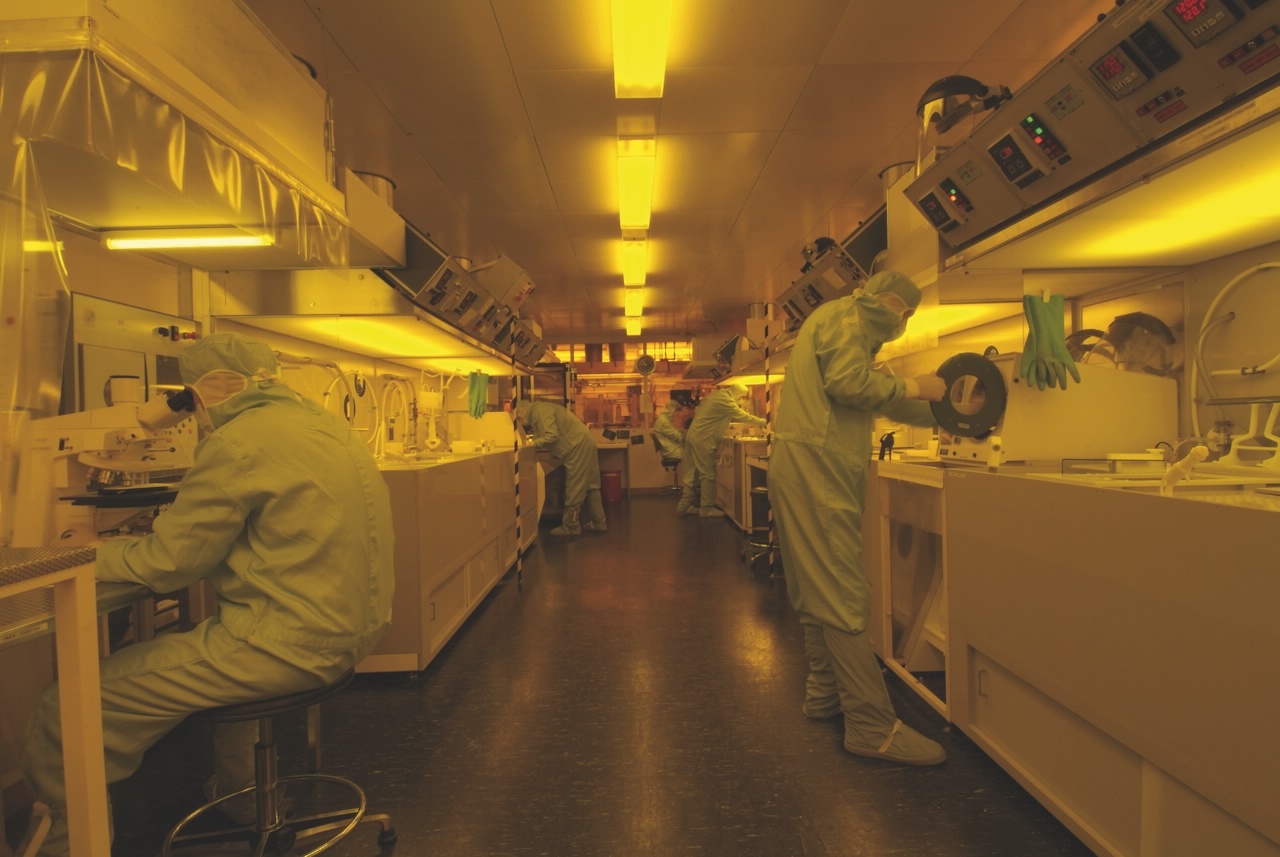
You can see
below the clean room where all Patek Philippe Silinvar parts are made. It will
help you understand that we're going beyond traditional watchmaking here.
The image below shows you the full set of innovations integrated in the Oscillomax ensemble. The Spiromax, the updated Pulsomax and the new GyromaxSi all together constitute a fantastic improvement to annihilate the traditional problems encountered by Swiss lever escapements. The quest for lasting precision is taken to a whole new step.

The table below
shows the result on a calibre 240 torque curb. When a traditional 240 is nearly
stopped after 48 hours of power reserve, the Oscillomax 240 has lost only 10%
of its torque and still has 22 hours of power reserve. The increase and
progress in efficiency is huge.

If you wonder why the result shown is about a calibre 240 while all former Advanced Research models were based on a 324, it's time to confess that there is also a new watch today.
The calibre 240 is well known for its use in
the slim perpetual calendar models. That's where we're going today.
You'll soon see the new watch but
please take a few more seconds to see the reason for the very complex teeth on
the new escape wheel.

Thierry Stern
was really happy looking after this conference, as much as Philippe Stern
seemed so and expressed it claiming " c'est genial".
In fact if
Thierry Stern said to me that they don't want to go too fast, they
don't feel it's a race, they still want first and foremost to
improve, get more reliable. That's why they think that the Silinvar will
remain in the oscillator, where it's really useful for precision and
reliability.

For them
it's not a race as they are not interested in chronometry contests,
except those they do in-house, as Philippe Stern expressed to me.

Here is below
the best view on a tri-dimensional oscillomax. What you have to imagine and
understand is that the profile of the fork and teeth are totally developed to
optimize energy transmission without disruptive shocks. As you can understand
such profiles would not be possible with traditional materials.

We're
reaching the level of nanotechnology now, with a geometrical precision that is
far beyond the lubrication problem that begun it all with silicium.

The image below
will show you how the fork extremity is protected in case of shock.

As we are all
mainly watch lovers here the time has come now to have a look at the
extraordinary timepiece that will use the Oscillomax ensemble for the first
time.

The new Patek
Philippe 5550P is basically a 5140P equipped with an Oscillomax and a new dial.
The new calibre iteration 240 Q Si takes advantage of the Oscillomax
improvements to increase its power reserve to 70 hours. In strict use that
means that an owner can put the watch fully wound on a Friday evening and find
it still working on a Monday morning, what was not possible so far without a
winder.

In fact
there's a paradox in seeing a very classic watch adopt such a modern
technology. I think it is totally logic if you integrate the fact that the
watch worn by Philippe Stern is generally a 3940 that he sees as a practical
watch. The magical charm of the perpetual calendar, related to the long term
precision, will be here associated with the quest for the immediate precision.

You'll
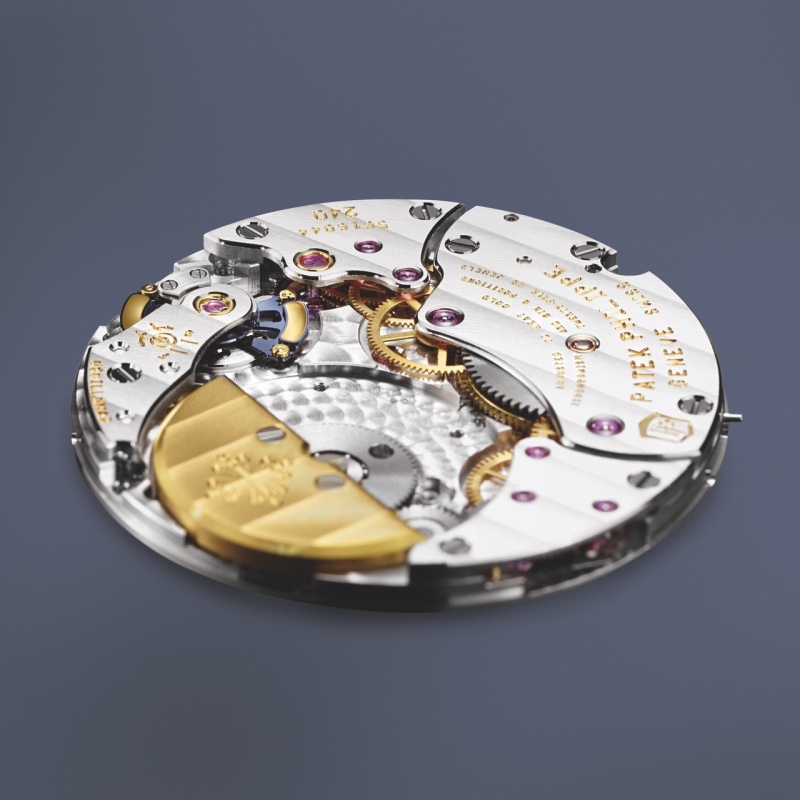
see below pics of a prototype calibre with a transparent escape wheel bridge.
The Oscillomax pieces are quite visible here. Of course you'll have to
wait a little more to have such view in your own watch, but you may be tempted
to look at your calibre 324 and calibre CH 28-520 if produced less than a year
ago as the Spiromax, the Silinvar spring, is the first generalized
implementation of the series. It should be installed soon in all calibre 215
and 240 too.

Silinvar parts
can be identified by their form or by their blue colour resulting form the
oxidation that transforms silicon in Silinvar.

No doubt that
the 300 watches reference 5550P will be most sought after. If you are tempted
to apply I can give you an advice. Thierry Stern hopes these watches to be worn
and not kept in a safe, as they are also prototypes of the future. They should
be sold around the same price of the current 5140P. For Mr and Mr Stern there
is no reason to increase the price because of the silicium parts.

Of course some
may think that this watch of the first chapter of the future should have had a
more modern look. I can just tell I would love to wear it. It's
innovation for a result and not for communication. Imagine the pleasure of the
banker, or grand father, or young worker who will hide his prototype watch
under a very discreet and classical design. Patek Philippe is about innovation
in content, not innovation in looking.

The silvery
grey dial with a vertical satin finish perfectly complements the platinum case
to emphasize the readability of the pink gold markers. The watch is indeed
extremely legible. The choice of finishes gives to the watch a much informal look
in my opinion.

The watch
obviously keeps the well known thinness of the 5140 series. It is a watch
filled with content, but thinly used. This characteristic remains an essential
principle for Patek Philippe. Their watches are created to be as thin as
possible.

You've
obviously noticed the luminous hands and markers. At last a perpetual calendar
I could sleep with!

That reminds me
of this phrase: to change everything so that nothing changes!
This watch is
still an extra thin automatic perpetual calendar. It is now also an ultra
modern time tool with 17 patents applied.

I take this
opportunity to show you one face we rarely get to see. It is no less beautiful
than the back, no?

I can just hope
to see some of you here have the chance to get one and share from time to time
with us the pleasure of reporting their "live" testing.

I hope you
enjoyed it. I enjoyed to witness of this memorable day.
Cheers
Dje
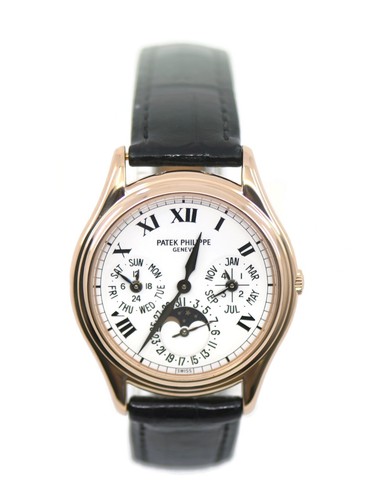
The Patek Philippe Reference 3940 is a perpetual calendar wristwatch that was introduced in 1985, succeeding the Reference 3450. It is notable for its relatively slim profile and the integration of a perpetual calendar complication in a refined case. This reference became a cornerstone of Patek Philippe's complicated watch offerings for nearly two decades, establishing a design language for subsequent perpetual calendar models. It represents a significant period in the brand's modern history of complicated timepieces.
The watch features a 36mm case, typically crafted from yellow gold, rose gold, white gold, or platinum. It houses the self-winding Caliber 240 Q movement, which is known for its micro-rotor construction, contributing to the movement's thinness and allowing for a slimmer case profile. The movement provides a power reserve of approximately 48 hours. The dial is protected by a sapphire crystal, often accompanied by an interchangeable solid case back and a sapphire display back.
Reference 3940 is highly regarded by collectors for its classic proportions and the enduring appeal of its perpetual calendar display, which includes day, date, month, leap year cycle, and moon phases. It was produced in several series, with subtle variations in dial layout and typography, making early series examples particularly sought after. The reference is considered a benchmark for perpetual calendar watches and remains a significant piece for those appreciating traditional horological complications.
No message body
nt
This one is no exception Thanks for sharing regards Marwan
nt
The new escapement wheel has an incredible profile with interesting contact points with the specially shaped lever. Absolutely amazing, all this information will take some time to digest, but definitely an incredible watch! I even like the color.
nt
2,837 Patek Philippe listings are live on the eBay market and 1721 collector listings on the WatchProSite marketplace.
This thread is active on the Patek Philippe forum with 96 replies. Share your knowledge with fellow collectors.
Join the Discussion →