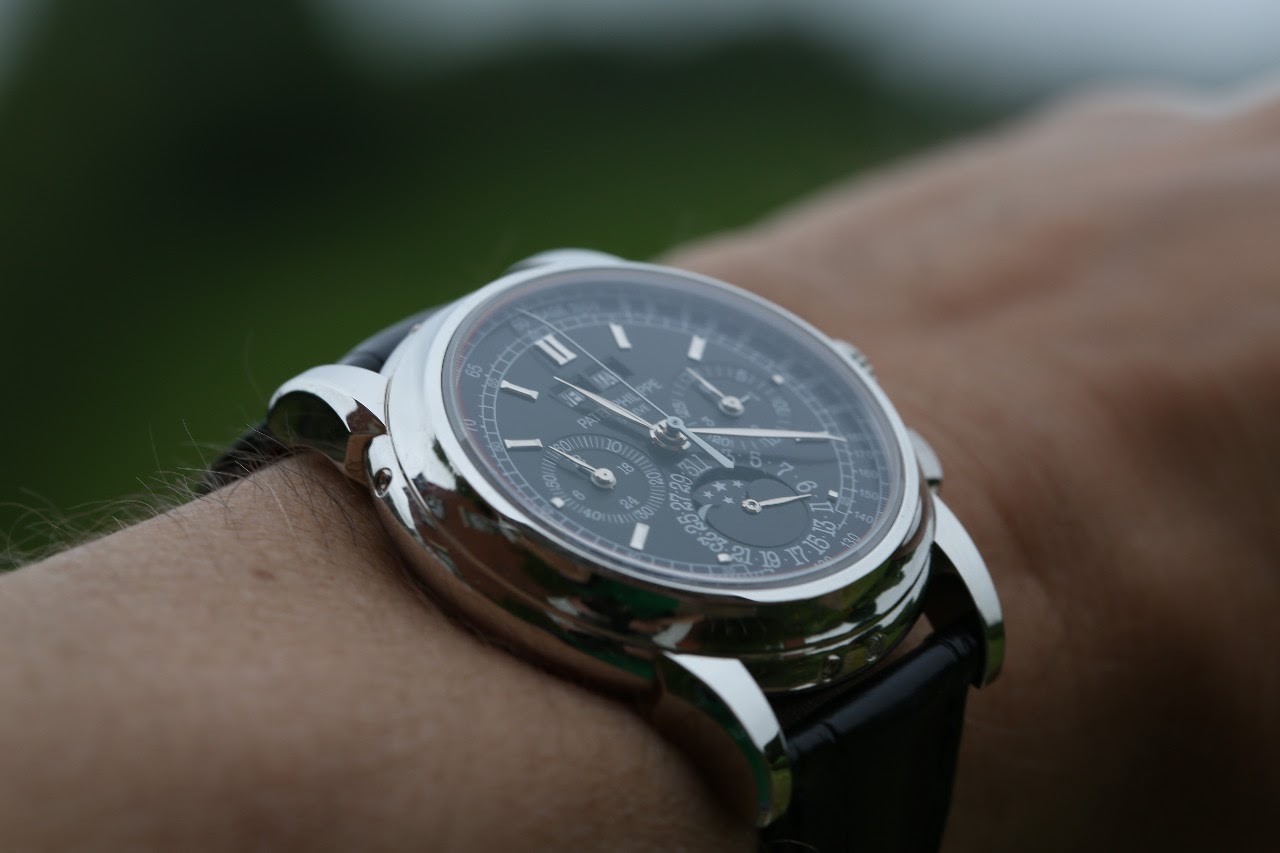
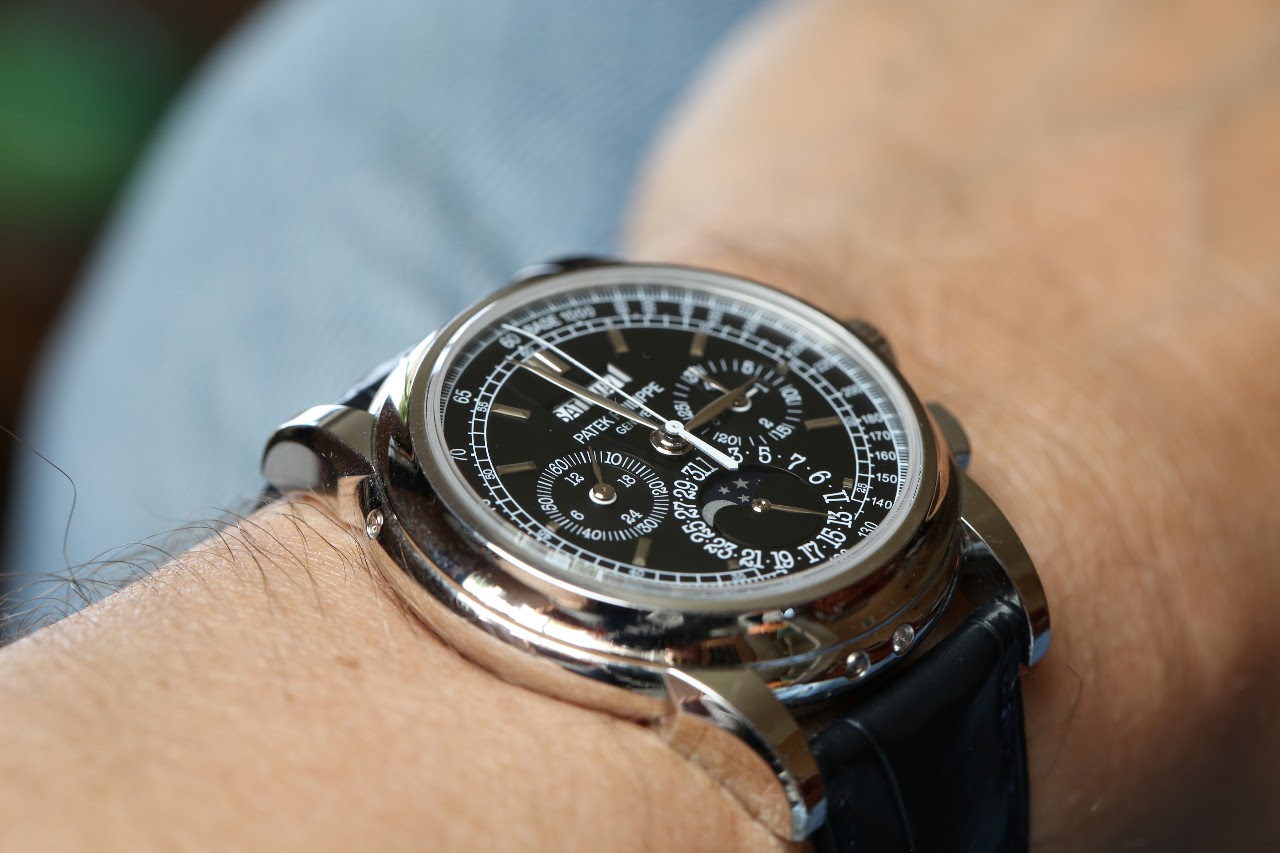
Baron - Mr Red explores the 'cult status' of the Patek Philippe Reference 5970 perpetual calendar chronograph, drawing insights from the Patek Philippe magazine. He dissects the factors contributing to its desirability, from its historical significance as a successor to iconic references to its modern dimensions and movement.
The most recent edition of the Patek Philippe magazine (Volume IV, Number 3) provided a fascinating article about the Reference 5970. The article described the 5970 as a watch with “cult status” representing the ‘quintessence of complicated watchmaking at Patek Philippe.” That is high praise indeed.
Many have argued that the perpetual calendar chronograph is the most important watch in Patek Philippe’s history. I think the origins of this type of thinking stem from the vintage classics; 1518 and 2499. These vintage references are icons. Indeed, many vintage collectors maintain that the 2499 is the most perfect watch ever made. It is in this context, that the 5970 needs to be seen - a modern day variant on a true classic.
According to the article in the magazine, Thierry Stern was tasked by his father with designing a modern day variant of the perpetual calendar chronograph to replace the 3970. As reported, Thierry Stern was told of the 3970 that “it’s a beautiful watch, but now you have to find a new design.” According to Thierry Stern, the 5970 that he designed reflected “all the passion, respect, and knowledge that I had for Patek Philippe.” So, in this sense, the 5970 represents an important historical moment, where father passes to son a key responsibility. That is certainly one factor behind its “cult status.”
The second factor that seems relevant in understanding this “cult” nomenclature is its rarity. Of all perpetual calendar chronographs, the 5970 has had the shortest production run. Produced from 2004-09, with the 5970J produced for just one year and the 5970P for just two years (G and R from 2004-7). Estimates vary to how many of each metal were made. Christies John Reardon is on record as stating a total production of around 2800 watches. It is truly difficult to split this into specific metals, but I think it is reasonable to assume that the white and rose metals are the most common, with 1000-1250 in each. I think the platinum version is likely to have 300-500, whilst the most rare is the yellow gold with 100-300. Whilst the 5970 has the shortest production run, the absolute numbers produced are higher than some of its vintage predecessors. For example, reference 1518 saw only 281 watches made. The 2499 saw only 349 watches made. The 3970, however, has production in excess of 4000 watches in total.
The third factor, for me, that makes the 5970 so desirable is its case dimensions. At 40mm (and 13.5mm deep), the watch has a very modern approach. Compare this with the 1518 (35mm), 2499 (36.2-37.7mm) or 3970 (36mm). I think it is also important to mention the depth. The 5970 sits prominently on the wrist courtesy of its depth. It is a trait that distinguishes it from all the prior perpetual calendar chronographs. So, crucially, the 5970 is a watch that is an absolute joy to wear.
The fourth factor, for me, is the 5970’s echo of the 1518/2499. The 1518 had square pushers. Both the 1518 and 2499 had the tachymeter. The 5970 echoed both these traits. Similarly, the dial symmetry is very authentic to the original. When one looks at a 1518 and a 5970 side by side, one sees a truly modern but genuine representation of the original classic - a watch that captures the true spirit of its original ancestor.
The final factor behind the “cult” image is the movement. I am going to quote the magazine here as it does an excellent job in capturing the issue.
“There is no doubt that the aesthetics of the Lemania chronograph ebauches add considerably to the appeal of those Patek Philippe perpetual calendar chronographs that use them. The harmonious and dignified lines of the bridges and levers provide a blank canvas on which to display the decorative techniques of haut de gamme Genevan watchmaking, and the reliability and durability of their design made them the chronograph movements of choice for as long as they were available. Patek Philippe’s in-house chronograph movements are far more technically advanced and are extremely captivating aesthetically, but there is a great deal of historical importance attached to the fact that the 5970 was the last Patek Philippe chronograph to use a Lemania ebauche.”
So, one can argue that the in-house movement is more advanced, but it is hard to argue that it is "better". In the same way that the engine of a modern DB11 is significantly more advanced than the engine of a DB5, one cannot say the former is “better” than the latter as appreciation is a multi-dimensioned phenomenon.
Perhaps there is a final final factor. Cohesion. It was once said that a camel was an animal put together by a committee. It is so often the case that, notwithstanding all the technical and design expertise that is available, when one puts together all the parts of a watch, it just doesn’t work well. Similarly, every now and then, design and expertise can come together in a synchronicity that produces something quite extraordinary. I think that is a very good synopsis for the 5970, and just why it is described as having "cult status".

About the Patek Philippe Grand Complications Ref. 2499
The Patek Philippe Reference 2499 is a highly significant perpetual calendar chronograph, representing a pivotal model in the brand's history of complicated wristwatches. It succeeded the Reference 1518 and introduced a larger case diameter and updated aesthetic, establishing a design language that would influence subsequent perpetual calendar chronographs from Patek Philippe for decades. The reference was produced in four distinct series, each with subtle variations in dial layout, pusher style, and case construction.
This reference typically features a case crafted from precious metals, most commonly yellow gold, though examples in rose gold and platinum are known. The case diameter is generally 37.5mm, housing a manual-wind movement, specifically the caliber 13''' Q. This movement integrates a perpetual calendar mechanism with a chronograph function, offering indications for day, date, month, leap year, and moon phases. The crystal is typically acrylic for earlier series and sapphire for later iterations.
The 2499 is highly sought after by collectors due to its rarity, complexity, and historical importance. It is considered a benchmark for vintage complicated Patek Philippe watches and represents the evolution of the perpetual calendar chronograph from the mid-20th century. The variations between the four series provide distinct collecting opportunities, with each series possessing unique characteristics that appeal to different connoisseurs.
Specifications
- Caliber
- 13''' Q
- Case
- 18k white gold
- Diameter
- 37.5mm
- Dial
- Silver
- Water Resist.
- 30m
- Crystal
- Sapphire
About the Patek Philippe Grand Complications Ref. 3970
The Patek Philippe reference 3970 is a perpetual calendar chronograph, a complication central to the brand's heritage. It succeeded the highly regarded reference 2499 and served as a bridge to the later reference 5970. The 3970 was produced over an extended period, allowing for several series and subtle variations in its design, making it a significant model for collectors interested in the evolution of Patek Philippe's complicated wristwatches.
This reference features a 36mm case, commonly found in 18k white gold, yellow gold, rose gold, and platinum. It is powered by the manual-wind caliber CH 27-70 Q, based on a Lemania ébauche, which offers a power reserve of 60 hours. The watch is fitted with a sapphire crystal, protecting a dial that typically includes subdials for the chronograph, perpetual calendar displays, and moon phases.
The 3970 appeals to collectors seeking a classic Patek Philippe perpetual calendar chronograph with a traditional aesthetic and a historically important movement. Its long production run from 1986 to 2004 means that examples from different series, such as the first, second, and third, exhibit minor differences in dial layout and case details, providing distinct collecting opportunities within the reference.
Specifications
- Caliber
- CH 27-70 Q
- Case
- 18k white gold
- Diameter
- 36mm
- Dial
- Silver
- Water Resist.
- 25m
- Crystal
- Sapphire