Complications
small-luxury-world initiates a compelling discussion on the Patek Philippe Caliber 240, a movement with a rich history dating back to 1977. This thread delves into its enduring relevance and versatility within Patek Philippe's diverse collection. The author prompts the community to consider whether its age and widespread use are strengths or potential drawbacks in modern haute horlogerie.
… born in 1977 (!) and still one of the center pieces/workhorses in the current collection.
Good or bad?

Some thoughts:
- Reliability? Proofed.
- Beautiful in the (classical) quality of workmanship and finish? Proofed.
- A good base for adding complications, which are still looking “thin” afterwards? Proofed.
- A good base for testing innovations? Proofed.
From time to time we have discussions that some are not
happy with the small size (for today)
or that it is used in so many different watches
– in different price ranges.
Variations of the caliber 240 which are available in the current collection:


The “simplest” version may be small for today (at least for
some), but the younger/bigger brother caliber
260 is already
“tangible” and could be a very nice successor. Could this be
the future?

HU=Heure universelle; one of the most charming complications in the collection and a love affair for so many PuristS.

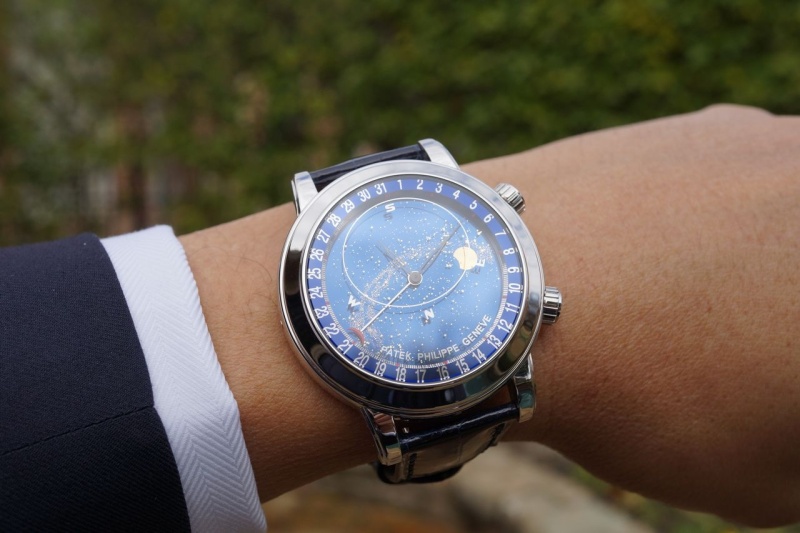
LU CL C=Phase de lune Ciel Calendar; pure romance and a feast for the eyes.
On top the watch is wearable with a 42mm case, isn´t it?

Does the complete movement look tiny or small? No, not at all.

PS C=Petite seconde Calender; an useful and affordable complication in the world of Patek Philippe.
Nothing more, nothing less.

Q=Quantieme perpetuelle; probably the most addictive
complication for a lot of Patek Philippe collectors,
which is (somehow!)
affordable for a “wider” target group. To reach a total height of 3.88mm
(movement including
perpetual calendar module), 2.4mm for the base movement
doesn´t hurt. Therefore the caliber 240 was actually
“born” and therefore it
still works perfect, doesn´t it?

SQU=Skeletonized; a very special version which asks for exceptional skills and a sophisticated taste.


Personal conclusion:
Even after so many years I still see a (strong) future in
the Patek Philippe collection, especially when “bigger” complications
have
to be added or for some very classical watches. But I also mentioned before
that I hope to see more watches with the
new caliber 260. Is it really a
successor or could it be even better as a new brother, a new member in the
family?
So, now it is up to you. Good or bad?
Looking forward to your thoughts!
Oliver
It is what I consider to be a great movement. Now, what I am not pleased with is to see the same movement ( or almost ) on a simple Calatrava AND in a watch like the Celestial. Ir is not a question of size, well, not mainly, it is just the perception I have of a brand like Patek, which claims for excellence. It is ok for a Panerai, or a Rolex, not for Patek. Ok, they can use ( a bit ) the modular conception ( QP or WT or Moonphase ) but in a 200 000 Eruos watch, I am expecting something else. So
to get that specific reply from you my friend? We all read about it before :-) Celestial - what in specific are you missing in that case or does it just have to be the latest and fanciest kid on the block? Oliver
Why I didn't get, and won't get a Langematik Pepetual? Because it houses the same Cal than the Langematik Anniversary, with a module. Why won't I get a patek QP? For the same reason: I already own a 5110P, so the same Cal 240 with a different module. Why will I not get a Celestial ( if I ever could? ) Because I don't get why such an horological brand such as Patek dare housing the same Cal for such a prestigious watch ( with a different module ) than the watches above mentionned. For brands such
and mostly it is because of three reasons: - the movement is so incredibly slim taking into account that it's an automatic movement - being an automatic is handy but thanks to the micro rotor, the movement looks nearly as interesting as a manual one - reliability. I would be happy to see that slowly and steadily the current references would get the upgraded 260 movements that represent even better our century. Can anybody show another manufacturer with a base movement that would be the base for
The thin 240 caliber with its micro-rotor started my love for Patek Philippe over a decade ago. 1. It was the first micro-rotored movement from a large Swiss watch company that I noticed (Piaget actually came up with the very first micro-rotored watch movement before the Patek Philippe 240 caliber, but I noticed the Patek Philippe first). 2. It was cleverly thin. 3. The seconds dial was uniquely and attractively offset (on the 240 caliber, the seconds hand will normally be placed at the 4 o'cloc
... but on that specific point, i almost agree with him...! About the celestial, its such a majestic and fantastic piece, so highly priced, AND with big case for a Patek... 43mm ( not 42mm as mentioned in the post ) that i really don't understand why patek didn't dedicated a caliber for that model. I think it has more to do with economics. If dedicating a caliber for it would have made it even more expensive, than, no, its ok, 240cal is just fine :) Reminds me of the 5950A, 400k for a double spl
This thread is active on the Patek Philippe forum with 62 replies. Share your knowledge with fellow collectors.
Join the Discussion →


