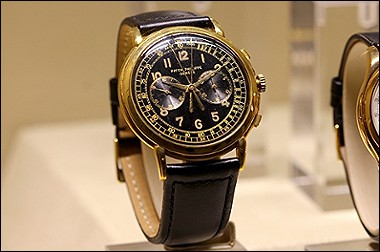
Complications
Dje’s insightful post delves into the core appeal of Patek Philippe, moving beyond aesthetics to explore the profound role of calibers in a collector's appreciation. This discussion challenges readers to consider whether the movement's technical mastery and historical significance are as compelling as its visible beauty. Dje prompts a fascinating debate on what truly drives the passion for Patek Philippe timepieces.
What makes a difference between a Patek Philippe 5196G and a 5078P? Is there any serious reason to find one of these watches more beautiful than the other?
I ask this question because you've apparently admitted in part three that the beauty of your watch was a solid and major reason why you bought it. It was of course an obvious reason but it was still necessary to propose it and let you answer it your way. I appreciated that way.
Now we can possibly agree that depending on our tastes, we're entitled to choose either the 5196 or the 5078 as the most beautiful watch. The decision takes into account all that is visible, the case, the dial, the hands, the strap, the buckle, and, and, and the back of course!
As we don't always look at the back, it can be quite secondary. It can also be primordial when it shows a view on a calibre as exceptional as a machinery of high complication. And that leads us to another aspect of our quest: we love watches for their calibres or not?
Patek Philippe is of course a true manufacture. When we talk about manufactures that means not just that they make their own calibres, but very certainly that aspect is the first on we think about. When we look back on Patek Philippe's history we think of many references, but we also visualize calibres of exception, be they the simplest ones to the most amazing complicated pocket watches.
In the recent years the Grand Complication range has extended a lot and that's only logical IMO after the launch of such a piece as the Calibre 89 in 1989. Developing such a calibre was an homage to history and historical pieces but also the demonstration of the highest level of capacity to imagine, conceive, develop and produce calibres more and more complicated. This time has happened when CNC machines spread too and allowed an easier production of complicated pieces.
Even with such machines, Patek Philippe has remained a master in calibres as they developed thin calibres and avoided the easiness of making clock calibres on the wrist. This has allowed to remain faithful to their style and make watches remaining more beautiful than just impressive.
Even on the more accessible side of the calibre choice Patek Philippe has worked a lot and the Advanced Research series are a proof of this work. The new reference 5235 launched this summer with a new calibre of high appeal is also a sign that calibres remain at the core of the watch development.

Who has never been stopped by the simple beauty of a highly finished masterpiece like the one above?
This hand wind tourbillon minute repeater wristwatch calibre, here apparently sporting a larger plate on the top side probably for a perpetual calendar version, may equip a 5016, a 5216 or a 5207 (a 5002 would necessitate cathedral gongs). These watches may be beautiful and impressive, the main reason they are chosen is their calibre. To a variable degree, that is always the case for complicated watches whose design is always related and a consequence of the calibre housed.
Calibres are also possibly the most important aspect of differentiation for watches, at least for real watches. We should keep that in mind when we look at the new watch market and the huge number of mechanical watches using the same calibre or calibre family. The ETA 2824 or 2892 and family may be excellent calibres, they clearly can't provide what we look for in a Patek Philippe watch.
A calibre is a work of the highest craftsmanship, somewhat a work of art in some cases. It gives content, usefulness, interaction with the wearer, fascination. It obeys physics, and embodies it. A complicated calibre by the fact that it works in spite of little hope of such outcome considering the difficulty, extensive and precise labour, incredible precision asked, is a permanent enjoyment. A superbly decorated calibre is another enjoyment as the level of finish that can be attained is the sign of the ultimate achievement for men's tools and toys (and we're ready to share them with women too).
In fact such calibres remind us that men can beat the iron not just in wars but also in measure. Man can elevate himself high above his mortal situation in many ways, summarizing the passing of time in such little volume being one way to stop it in some way.
Why do we love Patek Philippe watches? For their calibres of course, I dare say! Who wants to say no?
Of course you can individually consider calibres to be secondary in your love. But really?
What made the prestige of Patek Philippe? What makes it today? Patek Philippe watches have a heart and a brain. They together are named calibre!
Do you want to write about your Patek Philippe calibre?
Cheers
Dje
The Patek Philippe Sky Moon Tourbillon reference 5002 stands as a highly complex double-faced wristwatch within the brand's grand complication offerings. It integrates a significant array of functions, distinguishing it as a flagship model for collectors interested in horological complexity and traditional craftsmanship. The reference is notable for its comprehensive display of astronomical indications alongside traditional timekeeping and calendar functions.
This timepiece features a case crafted from precious metal, housing a manually wound movement. The watch is equipped with a sapphire crystal on both the front and reverse sides, allowing for observation of the intricate dials and the movement. Its substantial case dimensions accommodate the complex caliber, which includes a minute repeater and a tourbillon, alongside multiple calendar and astronomical displays.
As a grand complication, the reference 5002 appeals to collectors seeking Patek Philippe's highest level of mechanical artistry. Its dual-dial presentation and extensive complication set, including a perpetual calendar with retrograde date, sidereal time, and a sky chart, position it as a significant piece for those focused on technical achievement and the brand's heritage in complex watchmaking. The limited production and intricate nature contribute to its collector relevance.
I appreciate a lot the Cal 240, for its micro rotor, its decoration, and its acceptable level of finish... I appreciate it in some Calatravas, in the World Time, the 5712, even in the Perpetual... BUT to see it in the Celestial??? This last watch would have deserved a bigger movement, and a different one, in such a category. Excellence or Rationalization? Some said that the Calibre in the 5196P was too small and lacking of interest. I'm less disturbed, even if I would have preferred a bigger mov
I have the greatest appreciation for Patek's vintage movements (my personal favorite being caliber 27-460) and complications. I am a bit troubled, however, by some of the base calibers themselves. It puzzles me that Patek took so long to get the caliber 315/324 to a 28,800 beat rate. It's not that I think there's anything wrong with 21,600 vph, but since it seems to be generally accepted that Patek wanted to use the higher beat rate, what was it doing selling the lower one for decades? The compa
Certainly, the top of the range PP calibers are to die for, but at what cost? The 240 is a very, very pretty, cool designed caliber. It looks like a machine from the past. It is very open, showes some wheels and it is very, very slim. As Nicolas is saying: in the Celestial it looks a bit odd, but the low building height must have been a reason to have choosen it and still have a decently slim watch with the extra modules and dials that the Celestial needs. In my Ellipse's case: a match made in h
As you know I collect vintage but over time I have decided to focus on 2 main calibres ref 9-90 and12-600. Each special in its own way. Both are in house made at a time when design an d construction were possibly not restricted as much by financial constraints, Leading to what is thought to be the best and oft described as most over engineered movement the 12-600 auto. I just love the guiloched rotor made of 22ct gold. The 9-90 powers most of the rectangular pieces made in the 50's and 60's. Mos
Great movements indeed. 12-600at; the visual impact of this movement unmatched. 9-90; simply the best form movement made to date. Great choices my friend. Best, Arthur arolex
No message body
This thread is active on the Patek Philippe forum with 19 replies. Share your knowledge with fellow collectors.
Join the Discussion →