Baron - Mr Red's insightful post delves into the profound influence of Patek Philippe's historical references on its modern creations, using the 5070 chronograph and its predecessor, the Reference 2512, as a prime example. He argues that understanding this evolutionary 'DNA' is crucial for appreciating contemporary Patek Philippe watches, moving beyond simplistic comparisons of 'better' or 'worse.' His analysis encourages a mutual appreciation for both modern and vintage pieces, recognizing their inseparable connection through a rich heritage.
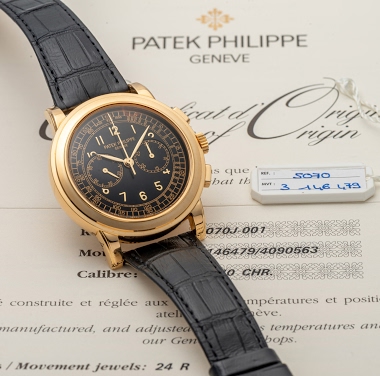
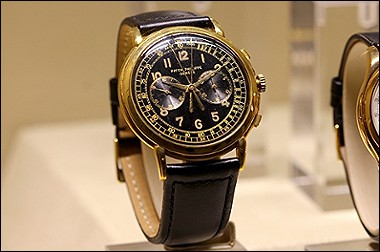
When we look at new models released by Patek Philippe, more often than not the inspiration for the new model comes from a prior reference. From my perspective, to really understand a modern watch one needs to see how it evolved. Take, for example, the 5070 chronograph. When I was at the museum a couple of years ago, the Reference 2512 was highlighted as being the inspiration for the 5070. The 5070 was Patek's first simple manual would chronograph for over 40 years. The introduction of the watch was seen as a very bold move. In the following image, I combine the Reference 2512 split second (believed to be a unique version) and the 5070J, which can be said to be the most directly-related model of the four 5070 metals.

The DNA is not stolen from the past, but borrowed. Look how the sub-indices cut into the numerals. Look at the style of the bezel. The pushers. Yellow gold and black dial. It really is borrowing heavily from the DNA of the past. I thought the above image was fun to reproduce just to show it. Modern Patek Philippe watches are more than the sum of their parts because of the history on which the watches are built. That history plays a big part in giving a watch its character and personality. Patek have been at the horological top table for most of the last 100 years. So, when a modern watch is developed, it owes its perceived status to that rich heritage.
For me, when we look at modern watches and decide to call them "better" or whatever comparative is used, i think we miss the point. Recently, a member here described the 5970 as having a relatively mundane appearance. Its movement was described as relatively uninteresting. Further, it was argued that to go for a 5970 the only reason would be the correct scaling at 18000 beats. To be honest, I think these type of comparatives are slightly inuslting, blinkered and totally missing the point. The 5970 derives its appearance from the 1518 and to some extent the 2499. Patek, themselves, describe the 5970 as a watch with cult status. It has that status, I believe, because the history upon which it was built is so rich. When Patek developed the perpetual calendar chronograph, it led the industry. Indeed, both 2499 and 1518 are still considered by many as essentially the most perfect watches ever made. To have had that durability is quite something. Understanding how history has shaped a watch, then, becomes quite relevant when that history is as important as that of Patek Philippe.
My point here is that many of Patek Philippe's modern watches exist solely because they are an evolution of the past - in the same way that the DB11 is an evolution of the DB5. The DB11 is faster. Safer. With technology and build quality that is far superior to its grandfather. Yet, to make the leap and call it "better" is not something that one does readily.
Instead, perhaps, we should embrace both modern and vintage as inseperable and almost beyond comparatives. Rather than derogation of one or the other, perhaps mutual appreciation of the process of how a modern watch evolved would be a better approach. Each of us has our own "truth" about what a watch should be. That individual "truth" should never be mistaken for a generalised truth.
About the Patek Philippe Grand Complications Ref. 1518
The Patek Philippe Reference 1518 holds a significant place in horological history as the world's first perpetual calendar chronograph produced in a series. Introduced in 1941, it established a foundational complication for the brand, preceding other notable perpetual calendar chronographs such as the 2499 and 3970. This reference is recognized for its pioneering role in combining these two complex mechanisms in a wristwatch.
This reference was primarily offered in yellow gold, with a limited number produced in rose gold and an even smaller quantity in stainless steel. The case typically measures 35mm in diameter, housing the manual-winding caliber 13''' Q. The movement features a column-wheel chronograph mechanism integrated with the perpetual calendar complication. The dial often presents with applied Arabic numerals or bâton indexes, and a tachymeter scale on the outer periphery.
For collectors, the 1518 represents a landmark Patek Philippe reference, highly sought after for its historical importance and rarity, particularly examples in alternative metals. Its design language and technical sophistication set a precedent for subsequent perpetual calendar chronograph models, making it a cornerstone for understanding the evolution of this complication within the brand's catalog.
Specifications
- Caliber
- 13''' Q
- Case
- 18k yellow gold
- Diameter
- 35mm
- Dial
- Silver
- Water Resist.
- 30m
- Crystal
- Hesalite
About the Patek Philippe Grand Complications Ref. 2499
The Patek Philippe Reference 2499 is a highly significant perpetual calendar chronograph, representing a pivotal model in the brand's history of complicated wristwatches. It succeeded the Reference 1518 and introduced a larger case diameter and updated aesthetic, establishing a design language that would influence subsequent perpetual calendar chronographs from Patek Philippe for decades. The reference was produced in four distinct series, each with subtle variations in dial layout, pusher style, and case construction.
This reference typically features a case crafted from precious metals, most commonly yellow gold, though examples in rose gold and platinum are known. The case diameter is generally 37.5mm, housing a manual-wind movement, specifically the caliber 13''' Q. This movement integrates a perpetual calendar mechanism with a chronograph function, offering indications for day, date, month, leap year, and moon phases. The crystal is typically acrylic for earlier series and sapphire for later iterations.
The 2499 is highly sought after by collectors due to its rarity, complexity, and historical importance. It is considered a benchmark for vintage complicated Patek Philippe watches and represents the evolution of the perpetual calendar chronograph from the mid-20th century. The variations between the four series provide distinct collecting opportunities, with each series possessing unique characteristics that appeal to different connoisseurs.
Specifications
- Caliber
- 13''' Q
- Case
- 18k white gold
- Diameter
- 37.5mm
- Dial
- Silver
- Water Resist.
- 30m
- Crystal
- Sapphire
About the Patek Philippe Ref. 2512
The Patek Philippe Reference 2512 is a notable example of the brand's mid-century production, characterized by its substantial case dimensions for the era. This reference is recognized for its robust presence on the wrist, distinguishing it from many of its contemporaries which often featured more modest sizing. It represents a particular design philosophy from Patek Philippe, emphasizing a more pronounced and assertive aesthetic while maintaining the brand's commitment to horological excellence. The reference is a testament to the diverse design approaches Patek Philippe explored in the mid-20th century.
This reference typically features a manually wound movement, reflecting the common practice of the period. The case material is often yellow gold, though other precious metals may exist. Its larger diameter for the time contributes to its distinct visual impact. The crystal is generally acrylic, consistent with watches from this era, providing a clear view of the dial. The movement within would have been finished to Patek Philippe's high standards, ensuring precision and reliability.
For collectors, the Reference 2512 appeals to those seeking vintage Patek Philippe pieces with a more commanding wrist presence. Its relative rarity and distinctive proportions make it a point of interest among enthusiasts who appreciate the brand's historical output beyond its more commonly encountered models. The reference fits into the broader Patek Philippe catalog as an example of the brand's willingness to experiment with different case sizes and forms, offering a unique option for those who prefer a larger vintage watch.
Specifications
- Caliber
- 12'''400
- Case
- Yellow Gold
- Diameter
- 37 mm
- Dial
- Silver
- Crystal
- Acrylic
About the Patek Philippe Ref. 5070
The Patek Philippe reference 5070, part of the Complications collection, marked a significant return for the brand to large-format chronographs. Introduced in 1998, it was the first non-perpetual calendar chronograph produced by Patek Philippe since the reference 1463, which ceased production in the early 1960s. Its design drew inspiration from a unique Patek Philippe aviator's watch from the 1940s, characterized by its prominent case and dial layout, yet reinterpreted for a contemporary audience. This reference established a new aesthetic direction for the brand's chronographs, moving towards more substantial case dimensions.
The watch features a 42mm case, initially offered in 18k yellow gold, housing the manual-winding Caliber CH 27-70. This movement, based on a Nouvelle Lémania ébauche, was extensively finished and modified by Patek Philippe, meeting the brand's stringent quality standards. It provides a power reserve of approximately 55 hours. The dial, in this specific configuration, is black, protected by a sapphire crystal, and the watch is water-resistant to 30 meters. The fixed bezel frames the dial, and the watch is typically fitted with a leather strap.
Reference 5070 appeals to collectors interested in modern Patek Philippe chronographs that combine traditional movement architecture with a more contemporary case size. Its limited production run and the subsequent introduction of variants in other precious metals contribute to its collectibility. The reference represents a distinct period in Patek Philippe's chronograph history, bridging vintage inspirations with a new era of larger watch designs.
Specifications
- Caliber
- Cal.CH 27-70
- Case
- 18k yellow gold
- Diameter
- 42mm
- Dial
- black
- Water Resist.
- 30m
- Crystal
- Sapphire