Le Monde Edmond recounts his road trip to Munich for the Patek Philippe exhibition, offering a unique, less formal perspective compared to other reports. He details his journey in a vintage 1956 Mercedes, emphasizing the blend of automotive passion with horological appreciation.

There is an old saying 'Build it and they will come'. And come they did. This year Patek chose Munich to stage an exhibition that was truly exceptional. Once inside the exhibition you thought you were in the main room of Patek's Grand salon in Geneva on Rue du Rhone rather than at an exhibition hall. The effort Patek put into displaying their history and DNA to the public was truly phenomenal. It also seemed as if they brought more than half of the museum in Geneva with them (as you can imagine there were plenty of security guards walking around). What was on display was unbelievable and rather than write a more elaborate introduction we will let the pictures speak for themselves with minimal commentary. Also because Oliver (A small luxury world) did such detailed and superb report on the Munich exhibition, I thought I would cover the exposition from a different (and perhaps less professional) angle. Before though, perhaps a brief comment on the actual road trip before. Since I am based in Zurich and Munich is only 300km away, going by car was a very viable option. I thought I would chose a German car rather than an Italian or British. So I decided on a Mercedes that is nearly 60 years old.

E">I had to drive relatively slow as this car has 'drum' brakes and going
faster than 120km/h on the German autobahn with no disc brakes is asking for
touble unless your Juan Manuel Fangio. Going that slow made me repeatedly check
the time-I didn't want to be late. The exhibition closes at 18:oo every
day.

E">There are plenty of disadvantages of driving such an old car (1956). For
one it gets extremely hot inside. Forget driving this car in the summer.
Secondly you have to respect its age so driving it like you own a modern car is
clearly not an option (you need to plan on braking long before you actually
need to brake). But one advantage old cars have is the respect they command,
especially in their home country. The parking guard at the Bayerischer Hof
garage gave me the best parking space available. He even moved a modern Bentley
GT out of this space. Notice on the right of the car is the guard house.

E">Luckily the exhibition was only 3min walking distance from the hotel. The
first hall of the exhibition was almost exactly like the living room of the
Salon in Genevaon Rue du Rhone. In this part there were mostly modern watches so I did not
stay long.

E">One watch worth commenting
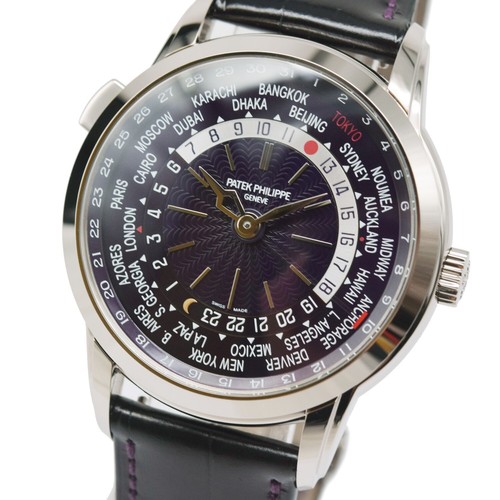
on in the modern room: A world time with an unusual and not before seen dial.
The dial resembles the Bayerische Wappen or 'Coat of Arms'. I assume this watch
will only be made available in Munich at select ADs. Notice that Munich has
replaced Paris on the dial as they are in the same time zone.

Once I saw the sign in the next room I knew I was in the right place. Museum pieces. This is what I was really interested in.

Before I start the history tour, lets start with one of the founders. Antoine Patek, a Polish immigrant who founded this watchmaker together with French watchmaker Adrienne Philippe.

Patek first displayed some fine and usual pocket watches, even some that were dated well before Patek Philippe even existed.

Below a fine complicated pocket watch by Patek from the 1920's with the following complications: Perpetual calender, split seconds chronograph, minute repeater. The white dial is 'Emaille' or Enamel

Below a fine minute repeating wristwatch from 1957. This reference is 2524-1.

The next few pictures are watches that belong to the all time great of Patek Philippe and are among the most sought after wristwatches in the world. Below a fine Patek Ref 1518 in yellow gold.

Equally sought after is what many consider to be the most beautiful chronograph ever made by Patek: The legendary 2499. The dial looks grey but due to the lighting only. Please excuse the poor photography.
 Next is a VERY RARE single button chronograph with split seconds function. The watch is from 1926/1927.

Below an unusual and rare wristwatch with world globe on dial from 1957 in Rose Gold. Reference 2481
 Next a stunning pocket watch with world time function. The Enamel work is a piece of art. This pocket watch is from 1949.
While on the subject of Enamel. Below a beautiful detailed Enamel work (unsigned so unknown watchmaker) around circa 18oo.

One of highlights of the Museum comes next. It is well before Patek Philippe was founded and dated 1810 from Frères Rochat. A petite sonnerie -meaning hour repeater by chirping bird.
 Below a set of dials being made for the Patek world time Enamel watches which is reference 5131. Patek only makes a few of these watches a year and they are extremely sought after by collectors.
 The level of color richness on the Enamel dial is outstanding. No wonder demand is so much higher than the supply.
These dials eventually make their way into watches like this one below. The world time reference 5131
 After two hours of intense observation and concentration I was hungry. Munich is well known not only for the October Fest but also for the good food on offer. Some pictures of the 'Viktualienmarkt' in Munich.

The food market in Munich is impressive.

Even Bagels are available in Munich. A shop only selling Bagels and Doughnuts.
 I then headed to the Goldener Kalb- a restaurant specializing in Meat -as the same suggests 'Kalb' in German means Veal.

For those who are not experts at eating meat- there is a menu explaining the different cuts.

Before eating meat I chose to have some fish. Crab meat (hopefully Alaskan).

After lunch a walk through Munich. A nice autumn day means people sitting outside and enjoying-what else - some beer. Biergarten at its best.

Congratulations to Patek Philippe on organising an outstanding Event. It is said over 1'ooo people came every day to see the exhibition or 'Austellung'.

About the Patek Philippe Calatrava Ref. 2481
The Patek Philippe reference 2481, introduced in the 1950s, is notable for its relatively generous case size for its era, earning it the moniker 'King Size.' This reference is recognized for its diverse range of dial executions, which include both standard configurations with Roman numerals or baton indexes, and highly prized examples featuring cloisonné enamel artistry. It represents a period of design exploration for Patek Philippe, offering a distinct aesthetic within their mid-century catalog.
The watch features a case typically crafted from 18k yellow gold, measuring 37mm in diameter, a dimension considered substantial at the time of its release. The case design is characterized by stepped lugs, adding a refined architectural detail. Powering the reference 2481 is the automatic caliber 27SC, a movement known for its central seconds complication. The watch is fitted with a sapphire crystal and offers a water resistance of 30 meters.
For collectors, the reference 2481 is appealing due to its historical context as a larger-cased Patek Philippe from the 1950s and the variety of its dial designs. The cloisonné enamel dials, in particular, are highly sought after for their artistic merit and rarity. The reference demonstrates Patek Philippe's commitment to both mechanical excellence and decorative craftsmanship, making it a significant piece for those interested in mid-century horology and artisanal dial work.
Specifications
- Caliber
- 27SC
- Case
- 18k yellow gold
- Diameter
- 37mm
- Dial
- Silver
- Water Resist.
- 30m
- Crystal
- Sapphire
About the Patek Philippe Grand Complications Ref. 2499
The Patek Philippe Reference 2499 is a highly significant perpetual calendar chronograph, representing a pivotal model in the brand's history of complicated wristwatches. It succeeded the Reference 1518 and introduced a larger case diameter and updated aesthetic, establishing a design language that would influence subsequent perpetual calendar chronographs from Patek Philippe for decades. The reference was produced in four distinct series, each with subtle variations in dial layout, pusher style, and case construction.
This reference typically features a case crafted from precious metals, most commonly yellow gold, though examples in rose gold and platinum are known. The case diameter is generally 37.5mm, housing a manual-wind movement, specifically the caliber 13''' Q. This movement integrates a perpetual calendar mechanism with a chronograph function, offering indications for day, date, month, leap year, and moon phases. The crystal is typically acrylic for earlier series and sapphire for later iterations.
The 2499 is highly sought after by collectors due to its rarity, complexity, and historical importance. It is considered a benchmark for vintage complicated Patek Philippe watches and represents the evolution of the perpetual calendar chronograph from the mid-20th century. The variations between the four series provide distinct collecting opportunities, with each series possessing unique characteristics that appeal to different connoisseurs.
Specifications
- Caliber
- 13''' Q
- Case
- 18k white gold
- Diameter
- 37.5mm
- Dial
- Silver
- Water Resist.
- 30m
- Crystal
- Sapphire