
foversta
[PuristSPro Moderator]
20814

Baselworld 2013: Harry Winston Histoire de Tourbillon 4
PRESS
RELEASE
HARRY WINSTON HISTOIRE DE TOURBILLON
4
For all of the complexity that the tourbillon embodies, it began with a beautiful idea; and like most beautiful things, the idea itself was very simple.
A watch, after all, is a machine of wonderful economy. There is an oscillator, or a circular balance, which swings back and forth a specific number of times per second. Essentially, the whole rest of the watch exists to count the number of beats per second of the oscillator at its heart, and as long as the beat never changes, the watch will be accurate. Unchanging perfection in precision is the watchmaker's dream. But the dream can be rudely interrupted by reality. Many natural forces can affect a watch’s accuracy, and among the most powerful of these forces is the very power that holds the universe itself together and keeps the planets in their orbits: gravity.

For Harry Winston, the Histoire de Tourbillon collection is an exploration of how the tourbillon –magnificent in its simplicity, mesmerizing in its execution, enthralling in its motion –might evolve. The most recent introduction to this collection, Histoire de Tourbillon 4, continues the spirit of invention that has been the hallmark of the Histoire de Tourbillon timepieces since their inception. In Histoire de Tourbillon 4, a radical re-interpretation of the original design of the tourbillon makes it a tourbillon that is truly a child of the 21st century, with aesthetics that reflect the modernity and high precision instrumentality of this re-interpretation. The tourbillon was patented by its inventor in 1801 and was originally designed to solve a problem inherent to pocket-watches generally kept in waistcoat pockets: since they remained fairly constantly in the same vertical position, the force of gravity had detrimental effects on their accuracy. The tourbillon places the critical regulating organs of a watch in a rotating cage, so that they are never in any fixed position long enough for this to occur. At the time, a tourbillon which had only one cage, rotating in a single plane, sufficed. But the modern wristwatch, which assumes an almost infinite number of different positions during the day, demands a cutting edge solution –and it was from this necessity that Histoire de Tourbillon 4 was born.

The heart of Histoire de Tourbillon 4 is a single oscillator, contained within three concentric cages, each of which rotates not only at a different speed, but at a different angle with respect to the other cages. As the wristwatch is truly an inhabitant of three dimensional space, so the tourbillon must transcend its origins and become one as well. The innermost cage, which encloses the oscillator and escapement, rotates once every 45 seconds. The intermediate cage, which encloses the first, rotates once every 75 seconds. And the third, outermost cage rotates at a stately speed of one revolution every 300 seconds –all together ensuring that at no moment will gravity be able to disturb the steady heartbeat of the oscillator.
Such an achievement is all the more remarkable when one remembers that in an ordinary watch, enormous precision is necessary to get enough power to the oscillator for it to beat strongly and regularly. In a tourbillon, even greater precision must be achieved, as the mainspring must drive not only the heart of the watch, but the cages that protect it from gravity as well. Triple the cages, and you triple the problem, making Histoire de Tourbillon
4 one of the most complex mechanical timekeepers ever made. Throughout Histoire de Tourbillon 4, enhancements and refinements in construction that extend to every aspect of the movement ensure superb performance and split second accuracy, including two, fast rotating barrels to deliver superior energy with lower friction, and a tourbillon that despite its dimensions is almost unbelievably light: only 1.57 grams. The most essential component, of course, is the oscillator itself, the balance wheel and the delicate balance spring, which must be made to the highest standard of precision in order for the triple tourbillon system to fulfill its promise. Thus, the balance is of the variable inertia type, avoiding the potentially disturbing influence of a conventional regulator; the effective inertia of the balance is controlled by means of 18k gold timing screws in the rim.

The balance spring must "breathe" as perfectly concentrically as possible, and so it has been made with a Phillips curve. This is a method of forming the outermost coil of the spring so that it ends, in a Geneva-type stud, above the other spring coils. To provide a strong, light, corrosion-resistant foundation for its mechanism, the plates and the bridges are made of titanium –a use of a high tech material in dynamic contrast to the hand-applied chamfering of the main plate and bridges. These enhancements not only make the Histoire de Tourbillon 4 oscillating system remarkably efficient, but also –thanks to the low energy consumption engendered by such precise construction –allow the timepiece to have a power reserve of a full 50 hours.
The resolutely precision-oriented nature of Histoire de Tourbillon 4 is borne out in its dramatic but refined design, which acknowledges the traditional codes of watchmaking while evoking a highly contemporary architectural style. Arranged in multiple levels, the triple tourbillon carriages are fitted with an indicator for the running seconds reminiscent of the air-carving blades of high performance aircraft propellers. Bold, contemporary colors, and the "open grid" dial configuration which illuminates the movement further suggest both the dynamism and form-follows-function aesthetic of the best of modern architecture and mechanical design, as well as further emphasizing the link to the world of cockpit instrumentation. The multi-level arrangement of domed sapphire crystals and intricately interlocked mechanisms suggest a miniature mechanical metropolis –a utopian dream of horological perfection.
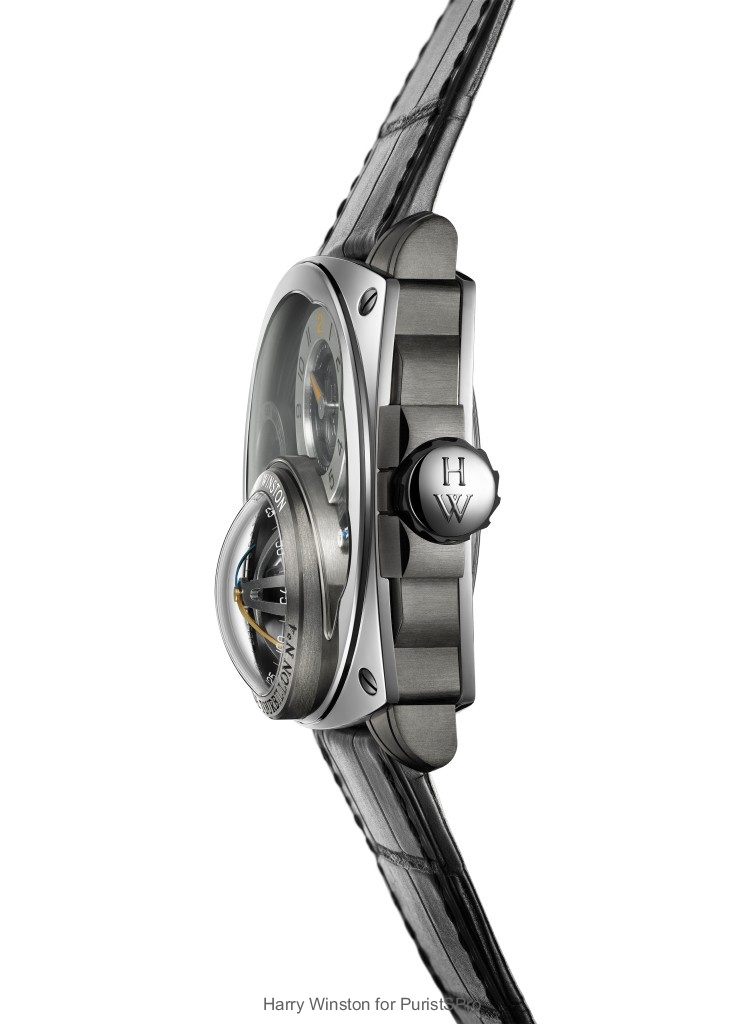
Of course, such work of art does not come into being overnight. Over 3,500 hours of painstaking labor were required to develop Histoire de Tourbillon 4, and further testing and homologation of this most high performance of movements consumes over 400 additional hours. The most skilled watchmakers take a full 160 working hours to assemble the 345 movement components, which are then placed in a luxurious 18k polished white gold case, with Harry Winston's signature ZaliumTM case band, arches, lugs.

This exclusive and magnificently different timepiece is available in a limited edition of only 20 pieces worldwide, and for those who experience it, it will be a living symbol of the endless possibilities to be explored by Harry Winston, in the undiscovered country that is the future of the tourbillon.

