
Marcus Hanke
[PuristSPro Moderator]
11295

A "perpetual" love story
A "perpetual" love story
- and its happy fulfilment at Christmas
by Marcus Hanke
Christmas
is approaching, less than a week is left. It is a time of love and
affection, a time to spend with the family, the beloved ones. However,
sometimes, also an unanimated thing can be the subject of affection, or
at least of permanent admiration. The more appropriate it is if such a
long-time affection finally finds its fulfilment at Christmas time.
But before, I have to briefly tell you the story of my personal relation with mechanical watches:
In the history of my interest in timepieces, there are a few watches that have impressed me so deeply that even now, I remember them in every detail. Ironically, though, I never owned any of them.
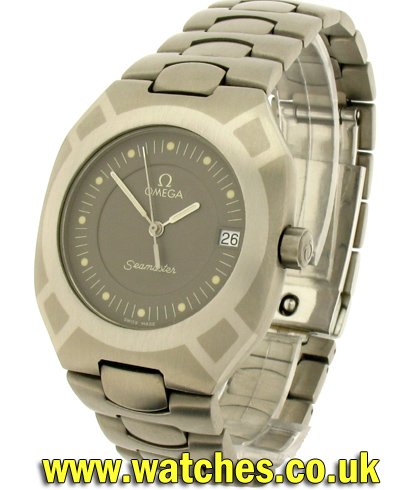
The first of these watches was the Omega Seamaster in titanium. Back then, in the early Eighties, titanium was still a highly exotic material. It was very expensive and difficult to work with. Further than that, titanium was shrouded into a mysterious mixture of science fiction and secrecy. I recall the excitement, when Viktor Belenko defected to Japan with his MiG-25. The West had heard rumours about this jet to be invincible, fast as a lightning. But then, with the real thing at hand, the technicians discovered that not enough titanium was used to assure a longtime maximum speed above Mach 3. So more titanium would have made the "Foxbat" really invincible?
A few years later, titanium appeared as a material for watch cases. The aforementioned Omega was among the first. I never forget the advertising campaign in leading magazines: a titanium-coloured hand with this watch on the wrist, was gripping a glass with amber-toned whisky (or brandy). The watch case had inlays from pink gold. Wow, I was sooo impressed! Even today, I become nervous when I see pictures of this watch.
(c) by ibidem
Unfortunately, it was far too expensive, so I spent my first month salary I earned with my job as junior assistant at university on a titanium Seiko. It was not really titanium, only coated with this precious material. There were a few golden details, and the titanium coat on the bracelet wore off after but a few years. But I was really proud of it. It was a quartz watch. I had no real interest in mechanics vs. quartz, all I looked at was the design. But I was aware that the best variants of the Omega were sold with selfwinding movements.
Several years later, another magazine advertisement attracted my attention: It was the IWC da Vinci perpetual calendar. This one really changed my vision of the world: The bare imagination of a mechanism, consisting of teethed wheels, springs and many other thingies in such a small case, having been programmed to know all the different lengths of the months, even in the leap years, really made me crazy.

reproduced with kind permission by Quadrilette172, forum.watchtime.ch
For the first time, I became aware of the potential of mechanical movements: A "perpetual calendar"! Wow! At once, a new desire started to dominate my thinking. Less than a car, which, by the way, I could not afford anyway, I longed for this watch. Long after that, I was even close to purchase a da Vinci in steel, but it was so difficult to read, so I thought I would soon regret to have spent so much money. But the ad with the da Vinci had a decisive effect on me: I started reading books, magazine, watch catalogues, anything I could find and that dealt with watches.
So I learned that the perpetual calendar of the da Vinci was not the only one on the market, and that there were other interpretations of that theme, some even more innovative, or more complex. I read about Svend Andersen's Secular Calendar, a perpetual that even respects the rule, that every hundred years, the leap years are cancelled. It uses a teethed wheel that needs four hundred years to rotate once! This, gentlemen, is REAL dedication to eternity!
My research and interest in mechanical watches and cosmology finally confronted me with a most fascinating person, who shaped my horological concept of the world: Ludwig Oechslin, one of the last universal geniuses; philosopher, astronomer, historian, archaeologist, physician, and watchmaker. His vision of the cosmos and mankind's position therein became a model for my own thoughts, and changed my imagination of "eternity" in watchmaking. Oechslin's interpretation of the solar system, following the centuries-old tradition of a Jost Bürgi proved to be of never-ending fascination for me. So it is not astonishing that his "Planetarium" became the embodiment of all my dreams, as far as timepieces were concerned. Even now, nine years after I acquired this watch, it still is the perfect symbol of history and future, and my favourite watch.
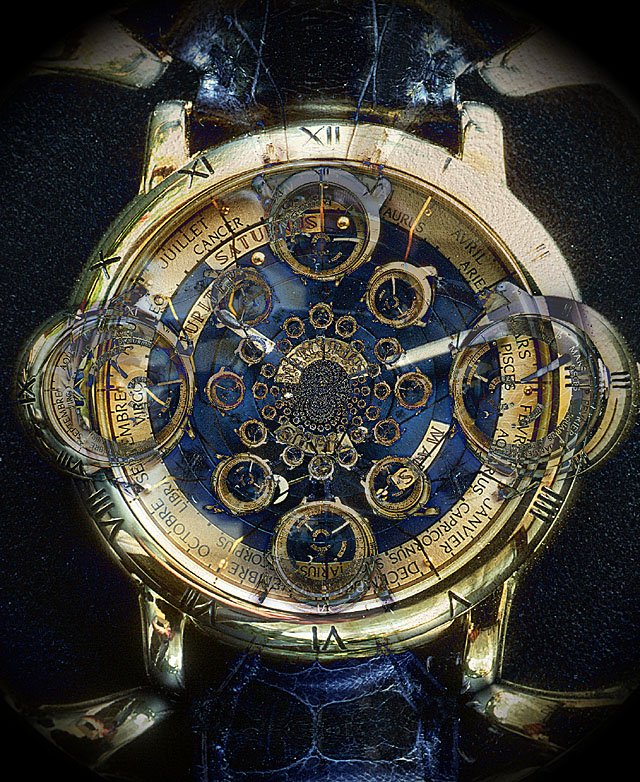
In everyday life, however, this watch has a substantial disadvantage: Despite being a "perpetual" calendar, it does not indicate the current date. This apparent contradiction is the result of Ludwig Oechslin's depiction of "time" and the basic flaw of our "civil" calendar we are using all the time. Our life is divided into days as the fundamental cycles of work, recreation and sleep. We are used to 24 hours being the base of our existence. Our home planet Earth, though, does not really care for our needs, since its path around the Sun, which we define as a "year", lasts a bit longer than 365 days; nearly a quarter of a day longer, to be more exact. The impossibility to divide a year by full days, makes it necessary to introduce an additional day every four years ("leap years"), and since we correct too much by this, to drop this leap year every one hundred years, in the so-called "secular years". Oechslin's astronomical watches do not need this kind of acrobatics, since they follow the mathematics of the planets themselves, by indicating a year with the correct length of 365.24 days. It is not the "Planetarium", that is running wrong, it is our calendar that does.
Due to the fact that I am a part of our 24 hours-based system, I really need a date display, and therefore, the "civil" perpetual calendar, which does its best to tweeze the astronomical situation into the cage of our calendar system, was still an issue of interest for me.
Six years ago, I was privileged to receive Ulysse Nardin's "Perpetual GMT" for a longtime experience test, and I admit that never before, and never again, I felt so sad when returning a test watch to the manufacturer. I had helplessly fallen in love with this piece. Which other watch could fill the above mentioned gap better than Ludwig Oechslin's own development, the "Perpetual GMT"? This watch should not serve as a replacement of the "Planetarium", but more as a completion. Together, they would symbolise both sides of the cosmological coin: the "Planetarium" stands for the "eternal" flow of time, whereas the "Perpetual GMT" expresses the human life and its needs.
From this time on, I dreamed of this watch, as the one I would like to grow old with. Every year, I saw the new releases of the various brands, but still, the original "Perpetual GMT" remained my ideal.
Seven and a half years ago, I posted to a German-language watch forum, that I consider the UN perpetual to be the best one, and that I was dreaming of owning one myself.
Six years ago, I concluded my review of this watch as follows:
And now, finally, my very personal Christmas miracle became true, embodied by this wonderful watch. Consequently, I hereby declare that my quest for the "definite once-and-for-all-times watch" is over, since I have my own "civil" perpetual calendar, taking its due position aside the "cosmic" perpetual calendar:
But before, I have to briefly tell you the story of my personal relation with mechanical watches:
In the history of my interest in timepieces, there are a few watches that have impressed me so deeply that even now, I remember them in every detail. Ironically, though, I never owned any of them.
The first of these watches was the Omega Seamaster in titanium. Back then, in the early Eighties, titanium was still a highly exotic material. It was very expensive and difficult to work with. Further than that, titanium was shrouded into a mysterious mixture of science fiction and secrecy. I recall the excitement, when Viktor Belenko defected to Japan with his MiG-25. The West had heard rumours about this jet to be invincible, fast as a lightning. But then, with the real thing at hand, the technicians discovered that not enough titanium was used to assure a longtime maximum speed above Mach 3. So more titanium would have made the "Foxbat" really invincible?
A few years later, titanium appeared as a material for watch cases. The aforementioned Omega was among the first. I never forget the advertising campaign in leading magazines: a titanium-coloured hand with this watch on the wrist, was gripping a glass with amber-toned whisky (or brandy). The watch case had inlays from pink gold. Wow, I was sooo impressed! Even today, I become nervous when I see pictures of this watch.
(c) by ibidem
Unfortunately, it was far too expensive, so I spent my first month salary I earned with my job as junior assistant at university on a titanium Seiko. It was not really titanium, only coated with this precious material. There were a few golden details, and the titanium coat on the bracelet wore off after but a few years. But I was really proud of it. It was a quartz watch. I had no real interest in mechanics vs. quartz, all I looked at was the design. But I was aware that the best variants of the Omega were sold with selfwinding movements.
Several years later, another magazine advertisement attracted my attention: It was the IWC da Vinci perpetual calendar. This one really changed my vision of the world: The bare imagination of a mechanism, consisting of teethed wheels, springs and many other thingies in such a small case, having been programmed to know all the different lengths of the months, even in the leap years, really made me crazy.

reproduced with kind permission by Quadrilette172, forum.watchtime.ch
For the first time, I became aware of the potential of mechanical movements: A "perpetual calendar"! Wow! At once, a new desire started to dominate my thinking. Less than a car, which, by the way, I could not afford anyway, I longed for this watch. Long after that, I was even close to purchase a da Vinci in steel, but it was so difficult to read, so I thought I would soon regret to have spent so much money. But the ad with the da Vinci had a decisive effect on me: I started reading books, magazine, watch catalogues, anything I could find and that dealt with watches.
So I learned that the perpetual calendar of the da Vinci was not the only one on the market, and that there were other interpretations of that theme, some even more innovative, or more complex. I read about Svend Andersen's Secular Calendar, a perpetual that even respects the rule, that every hundred years, the leap years are cancelled. It uses a teethed wheel that needs four hundred years to rotate once! This, gentlemen, is REAL dedication to eternity!
My research and interest in mechanical watches and cosmology finally confronted me with a most fascinating person, who shaped my horological concept of the world: Ludwig Oechslin, one of the last universal geniuses; philosopher, astronomer, historian, archaeologist, physician, and watchmaker. His vision of the cosmos and mankind's position therein became a model for my own thoughts, and changed my imagination of "eternity" in watchmaking. Oechslin's interpretation of the solar system, following the centuries-old tradition of a Jost Bürgi proved to be of never-ending fascination for me. So it is not astonishing that his "Planetarium" became the embodiment of all my dreams, as far as timepieces were concerned. Even now, nine years after I acquired this watch, it still is the perfect symbol of history and future, and my favourite watch.
In everyday life, however, this watch has a substantial disadvantage: Despite being a "perpetual" calendar, it does not indicate the current date. This apparent contradiction is the result of Ludwig Oechslin's depiction of "time" and the basic flaw of our "civil" calendar we are using all the time. Our life is divided into days as the fundamental cycles of work, recreation and sleep. We are used to 24 hours being the base of our existence. Our home planet Earth, though, does not really care for our needs, since its path around the Sun, which we define as a "year", lasts a bit longer than 365 days; nearly a quarter of a day longer, to be more exact. The impossibility to divide a year by full days, makes it necessary to introduce an additional day every four years ("leap years"), and since we correct too much by this, to drop this leap year every one hundred years, in the so-called "secular years". Oechslin's astronomical watches do not need this kind of acrobatics, since they follow the mathematics of the planets themselves, by indicating a year with the correct length of 365.24 days. It is not the "Planetarium", that is running wrong, it is our calendar that does.
Due to the fact that I am a part of our 24 hours-based system, I really need a date display, and therefore, the "civil" perpetual calendar, which does its best to tweeze the astronomical situation into the cage of our calendar system, was still an issue of interest for me.
Six years ago, I was privileged to receive Ulysse Nardin's "Perpetual GMT" for a longtime experience test, and I admit that never before, and never again, I felt so sad when returning a test watch to the manufacturer. I had helplessly fallen in love with this piece. Which other watch could fill the above mentioned gap better than Ludwig Oechslin's own development, the "Perpetual GMT"? This watch should not serve as a replacement of the "Planetarium", but more as a completion. Together, they would symbolise both sides of the cosmological coin: the "Planetarium" stands for the "eternal" flow of time, whereas the "Perpetual GMT" expresses the human life and its needs.
From this time on, I dreamed of this watch, as the one I would like to grow old with. Every year, I saw the new releases of the various brands, but still, the original "Perpetual GMT" remained my ideal.
Seven and a half years ago, I posted to a German-language watch forum, that I consider the UN perpetual to be the best one, and that I was dreaming of owning one myself.
Six years ago, I concluded my review of this watch as follows:
"Simply the best?
Why do I have Tina Turner's song in my mind, when looking at that wonderful watch? ... But I think it is justified to state it a bit differently:
No other mechanical perpetual calendar watch offers that much practical value, comfort in use as travel watch, easy legibility, ease of maintenance and adjustment, all together in a clean and highly elegant design.
However, the word "simple" is certainly the wrong choice when it comes to describe my personal emotions when wearing that watch. Never before has a design, that looked so sober and simple in the pictures, exerted such a fascination of complex beauty on me. On my personal list of the most beautiful timepieces, this watch is still and unchallenged ranking on the first place.
Most watch enthusiasts follow the quest of finding the "holy grail" of horology. Beautiful the perfect watch should be, elegant, fit for everyday use, complicated, exclusive. Everybody defines this picture of a perfect watch according to his own preferences, so it is clear that such a "holy grail"-watch cannot exist. However, I am convinced that Ulysse Nardin's GMT Perpetual is very close to that ideal. For me, at least, it perfectly fulfils its role as mystic cup . . . "
Even if it is old, I invite you to read this review, I can still underline every word I wrote back then:
Why do I have Tina Turner's song in my mind, when looking at that wonderful watch? ... But I think it is justified to state it a bit differently:
The best simple.
No other mechanical perpetual calendar watch offers that much practical value, comfort in use as travel watch, easy legibility, ease of maintenance and adjustment, all together in a clean and highly elegant design.
However, the word "simple" is certainly the wrong choice when it comes to describe my personal emotions when wearing that watch. Never before has a design, that looked so sober and simple in the pictures, exerted such a fascination of complex beauty on me. On my personal list of the most beautiful timepieces, this watch is still and unchallenged ranking on the first place.
Most watch enthusiasts follow the quest of finding the "holy grail" of horology. Beautiful the perfect watch should be, elegant, fit for everyday use, complicated, exclusive. Everybody defines this picture of a perfect watch according to his own preferences, so it is clear that such a "holy grail"-watch cannot exist. However, I am convinced that Ulysse Nardin's GMT Perpetual is very close to that ideal. For me, at least, it perfectly fulfils its role as mystic cup . . . "
Even if it is old, I invite you to read this review, I can still underline every word I wrote back then:
And now, finally, my very personal Christmas miracle became true, embodied by this wonderful watch. Consequently, I hereby declare that my quest for the "definite once-and-for-all-times watch" is over, since I have my own "civil" perpetual calendar, taking its due position aside the "cosmic" perpetual calendar:


A "perpetual" love story
A "perpetual" love story - and its happy fulfilment at Christmas by Marcus Hanke Christmas is approaching, less than a week is left. It is a time of love and affection, a time to spend with the family, the beloved ones. However, sometimes, also an unanima...


What a journey in Time and Passion, Marcus!
I don't see this perpetual calendar as a completion to your astronomical UN, but as a splendid complement. A superb interpretation of this complication, indeed, sober, complete, intelligent and friendly, as it is the only one to be set by the crown, backw...
Hi Nicolas, your wonderful and long post ont he perpetual ....
... was very inspirational for me. I was so happy that you gave the perpetual the value it deserved. Lately, it seems that the "Freak" and the "Sonata" were those UN watches getting most of the attention. Regards, Marcus

Congratulations Marcus - your story leaves me speechless
You have inspired me. I have developed a love for perpetuals because of the practicality of the complication in every day life. Chronographs are fun and occasionally practical (timing work that is billed by the hour or timing meters, also billed by time),...
Oh my, Mitch, I absolutely love your statement! ....
I hesitate to call it a mere "reply", so enlightening and enjoyable it is. Great to find a similar spirit, who also loves the ideas embodied in that mechanism. Best regards, Marcus


Yes, he is trying to keep up with all the orders ...
... so he came to me earlier. Regards, Marcus

congratulations
for this beautiful pair and the fantastic write-up. I enjoyed your previous piece on the Perpetual GMT very much and I am glad that you were able to acquire one. They certainly make a great duo! Best Andreas
Thank you, Andreas! ....
... I was overwhelming to finally get this wonderful piece! The only difference is that six years ago, I tested the smaller 38.5mm variant, while my watch has a diameter of 40mm, which matches perfectly the Planetarium. Regards, Marcus

Congrats, Marcus!
I'm so happy for you! What a wonderful thing to have occurred and right around Christmas too! Perfect timing! I wish you many more happy years together with your grail! Cheers, Daos
Thank you so much, dear Daos! ....
... the only downside is that my interest in other watches of this category has become massively compromised. Yet I continue to be fascinated by the "other ones" from their technical aspects. Regards, Marcus.
Congratulations!
Knowing how you feel abu this UN, I am very happy for you. You make a persuasve casefor this as the ultimate perpetual as well as a uniquely useful daiy companion. Enjoy i! respo
I know you like it, Ronald! ....
... I recall that somewhere you stated to prefer the more classic design of this variant, over the modern "Sonata-style". I like the latter as well, but, to be honest, I feared I would grow weary of it; certainly not within a few years, but what about ten...

Good memory, Marcus! If you get tired of it, there are other...
UN watches you can buy.

Brilliant timepiece, fantastic story...
Marcus, I concur fully with your evaluation of what I term, the best perpetual calendar watch made today. I know that is a lofty statement, but one that I think is deserved of this masterpiece & genius of micro mechanical engineering. Ludwig's practical b...

congratulations Marcus even though i thought you had one already
reading your posts on the perpetual and yours and Bernards posts on the Freak were major inspirations for me when i bought them so i thankyou for making the effort to review them even though you didnt own them. i'm truly proud to own the Ludwig perpetual ...

Congrats, Marcus . . .
. . . from yet another fan of perpetuals. I'd write a few words concerning my own fascination with the complication, but Mitch has beaten me to the draw ;-) . . . cordially, Art

GMT in 38.5 - 40 - 42mm ?
You got the one you reviewed in 2004 so that's no surprise based on your conclusion, and it seems to be the 40mm RG version, just wondering if you also looked at the 38.5mm and 42mm versions ? As I posted in another thread I tried on the 42mm last week an...
If you are speaking about the GMT Perpetual ....
... I had worn the 38.5 mm version in 2004. I loved it, but it was a tiny bit small for me. So I was happy when the 40mm variant, that originally was available only as limited edition in platinum and red gold, with COSC certificate, was made accessible as...
40mm hard to see !
Thanks for clarifying your thought process, looks like a perfect fit! I didn't realize the bezel was different on the 40mm LE and the 40mm, I found a picture of the 40mm LE here g I tried to see the 40mm in Paris but no go, neither at Kronometry1999, Arij...