
Moonshine Runner
14

Probus Scafusia: The IWC Aquatimer GST, reference 3536-02
Probus Scafusia: The International Watch Co. Aquatimer GST, reference 3536-02
The International Watch Company:
Company formation; ups and downs
In 1868, the American engineer and watchmaker Florentine Ariosto Jones (1841-1916), the former director of E. Howard & Co. in Boston, the leading watch manufacturer in America at the time, founded the International Watch Company in Schaffhausen.
F.A. Jones wanted to combine state-of-the-art technology from the USA with Swiss craftsmanship to produce watches, movements and watch parts for the American market.
Eighteen years earlier, the Swiss industrialist and watch manufacturer Johann Heinrich Moser ("H. Moser & Cie") built the first hydroelectric power station in Schaffhausen, thus laying the foundation for the future industrialization of the small town on the Rhine. He met F.A. Jones in 1868, probably in Le Locle, and showed great interest in his plans to build a watch factory, and so he persuaded the American to come with him to the Rhine. Together they then laid the foundation stone for the only watch manufacturer in north-eastern Switzerland: The International Watch Company in Schaffhausen became reality.
At first, F.A. Jones worked and produced in Heinrich Moser's factory building, but soon there was not enough space there and he leased additional rooms in the Oberhaus, one of the oldest buildings in Schaffhausen. But even in the Oberhaus it soon became too cramped and so Jones decided to build his own suitable building.
With the planning and construction of the factory, which was to provide space for up to 300 workplaces, the Schaffhausen architect G. Meyer was commissioned and in the spring of 1875 the construction work was completed. Initially, 196 people worked in the 45-meter-long factory at Baumgartenstrasse 15.
Jones' plans to increase the sale of watches in the United States did not work out because of the high American import duties, and even the conversion to a stock corporation in 1874 did not bring the company on the road to success, so F.A. Jones withdrew to the United States again in 1880.
IWC was taken over in 1880 by the Schaffhausen manufacturer Johannes Rauschenbach and with the arrival of Urs Haenggi, who was mainly responsible for sales and the associated customer acquisition, and the takeover of the technical management by Johann Vogel, who also introduced the numbering system for IWC calibres, the desired success of the brand finally materialised.
Just one year after the takeover Johannes Rauschenbach died and his son Johannes Rauschenbach-Schenk took over the helm until he too died in 1905. The IWC is inherited by Ernst Homberger-Rauschenbach, the psychoanalyst Carl Gustav Jung and his wife Emma Marie Rauschenbach-Jung and from then on traded under the name "International Watch Co. Rauschenbach's Erben". Ernst Homberger-Rauschenbach took over the shares of C.G. Jung and his wife in 1929 and ran the company now called "International Watch Co. Uhrenfabrik von Ernst Homberger Rauschenbach" until his death in 1955.
The IWC becomes first German and then "African"
Hans Ernst Homberger, the son of Ernst Homberger-Rauschenbach, took over and managed the company until 1978, when he sold the company, which had been hit hard by increases in the price of gold and the fall in the dollar, to the German company VDO Adolf Schindling AG, which already owned the traditional Jaeger-LeCoultre Manufacture. In 1991, both watch brands are sold to Mannesmann AG.
Günter Blümlein, who moved from Junghans to IWC in 1980, takes over the management of IWC and leads it to unprecedented success.
Blümlein founds the "Les Manufactures Horlogeres" (LMH) Group based in Schaffhausen, which holds 100% of IWC, 60% of Jaeger-LeCoultre and 90% of the revitalized Saxon watch factory A. Lange & Söhne, and employs a total of around 1440 people. In addition, he brings Ferdinand Alexander Porsche to IWC in the early 1980s, or rather engages him as designer for the highly successful "Porsche Design by IWC" sports watch series.
In 2000, Mannesmann is sold to the British company Vodafone, and in the same year the LMH watch group goes to the swiss based Richemont Group, founded by the South African Johann Rupert, at a price of CHF 2.8 billion. Despite the acquisition, the autonomy and continuity of the LMH brands as a cohesive unit under the existing management will continue to be guaranteed and both Jaeger-LeCoultre and A. Lange & Söhne and IWC can continue their success.
The horological highlights of the IWC
Genuine horological originals were created soon after the company was founded, such as the Pallweber pocket watch with digital display of the hours and minutes, which was presented as early as 1885.
The "Portugieser" was and is as much an icon in watchmaking as the pilot's watch "Mark XI", which was built from 1948 to 1981 and was the official service watch of the pilots of the Royal Air Force from 1949 to 1981.
The IWC "Da Vinci" presented in 1985 clearly showed that genuine watchmaking art could also be developed and built in Eastern Switzerland, i.e. away from the well-known watchmaking centres. The "Da Vinci" was the world's first mechanical wrist chronograph with the perpetual calendar according to Kurt Klaus. The construction of highly complex watches became a tradition in Schaffhausen: the "Grande Complication" followed, and on the occasion of the 125th anniversary of the company in 1993, the "Il Destriero Scafusia" ("The Schaffhausen Battlehorse"), limited to 125 pieces, was released, the most complicated wristwatch in the world at the time with 22 integrated highly complex functions. To this day, highly complex watches can still be found in the IWC portfolio; currently, the "Siderale Scafusia" is probably the measure of all things.
Even for technically demanding customers, there was always something in the range of the Schaffhausen-based watchmakers. In 1955, the “Ingenieur” was presented, in which the developers succeeded in cheating the magnetism harmful to watches by placing the movement in a soft iron cage inside the watch case, thus protecting the “Ingenieur” against magnetic fields up to a guaranteed strength of 80,000 A/m.
The world record in magnetic field protection was set in 1989 by the “Ingenieur 500,000 A/m”, designed by star designer Gérald Genta, which, as its name suggests, could withstand magnetic fields of 500,000 amperes per metre without complaint, only with new materials in the movement and without the soft iron cage.
What's more, IWC engineers tested the “Ingenieur 500 000 A/m” in a magnetic resonance tomograph and exposed it to magnetic fields with a strength of an incredible 3.7 million A/m, which the watch survived without damage. This means that the “Ingenieur 500 000 A/m” could be the watch that even the Marvel Comics anti-hero “Magneto” could wear without any problems.
But it wasn't only with the materials used in the movement that the Schaffhausen-based company went its own way and broke new ground; IWC also did pioneering work on the materials for the straps and cases. Just as the amagnetic niobium-zirconium alloy for the flat spiral of the “Ingenieur 500 000 A/m” was a novelty, so too was the use of titanium as the case and band material for the “Porsche Design by IWC” watches (from 1981) and of ceramics for the “Da Vinci Ceramics” (1986).
The diving watches of the IWC:
Compared to its major Swiss competitors, IWC got a late start in the diving watch market. While Rolex, Omega and Blancpain were already offering the timepieces vital for exploring the underwater world in the 1950s, IWC did not launch its first diving watch until the mid '60s of the last century: in 1967, the Schaffhausen-based company presented its reference 812 AD, water-resistant to a depth of 200 meters, a diving watch with a “compressor” case with an internal rotating bezel that could be set to the time of descent via a second crown at 4 o'clock. The reference 812 AD was renamed the 1812 with the standardization to four-digit references and, together with the reference 1816 with cushion-shaped case that appeared about two years later, was given the euphonious name suffix “Aquatimer” in the 1970s and, together with the reference 1822 launched in 1978, remained in the IWC range until 1982.
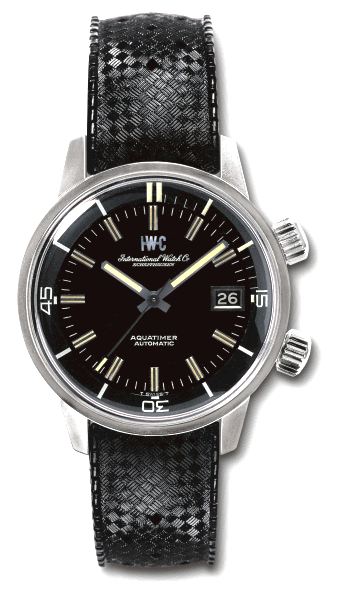
1982 was the end of the “Aquatimer“.
The name disappeared from the watch market for the next sixteen years. Sports, professional and desk divers could still obtain watches suitable for them from Schaffhausen, but now under the sub-label “Porsche Design by IWC” - but buyers had to do without the name “Aquatimer”. The watches, which were pressure-resistant to either 50 or 200 bar and had an elegant, futuristic titanium case, were now called “Ocean 500” or “Ocean 2000”.
The Ocean models were the first IWC diving watches with an external rotating bezel, and they also ensured that the material titanium became much more popular in watchmaking.
Incidentally, the Bundesamt für Wehrtechnik und Beschaffung was so convinced of the quality of Ocean 2000 that IWC was selected as the supplier for the service watches of the combat swimmers and weapon and mine divers of the German Navy.

The IWC GST Aquatimer:
The sporty GST line, where GST stands for the G old, S teel and T itanium case materials used in the series, was launched in 1998. Available were sporty chronographs with diameters of 34 and 40 millimetres, as well as sporty watches with alarm function and a diameter of 39 millimetres and diving watches with a diameter of 42 millimetres.
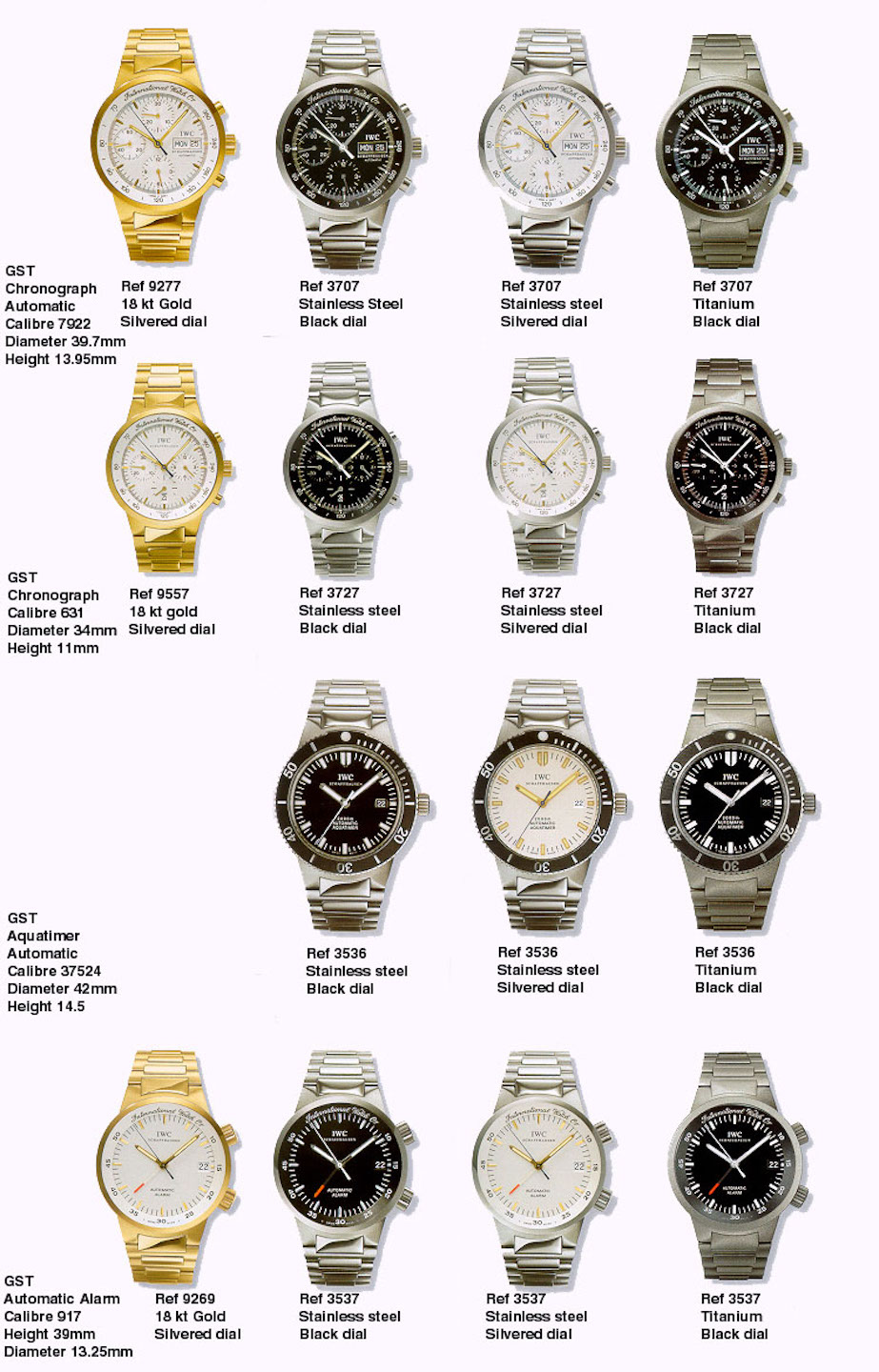
However, in the pressure-resistant models for committed water sports enthusiasts, now once again called "Aquatimer", the IWC dispensed with the gold casings, as the desired resistance to the water pressure of up to 200 bar would not have been feasible here, but the letter combination "GST" in the model name was nevertheless retained for the Aquatimers.
In the "Aquatimer" ticks, like in the predecessor "Ocean 2000", the IWC caliber 37524, which is based on the ETA caliber 2892-A2 and extensively modified.
According to contemporary reports, the modifications made by IWC on the base movement are so extensive, that "one could almost speak of a total revision".
Nearly all important parts, from the escapement to the mainspring, were removed and replaced by corresponding parts from the IWC manufactury, even the steel balls in the rotor's ball bearing were not allowed to stay, they were replaced by balls made of artificial ruby, which reduces the friction in the bearing, at least that's what it says in relevant literature.
Whether the serious changes of the movement are really reality, I can't verify due to missing knowledge and different and reliable sources are not really available, maybe the ruby balls and the modified escapement belong to the realm of myths.

But this does not include the fact that the IWC went its own way in the illumination of the dials between 1998 and 2001. During this period, the Schaffhausen-based company used two different illuminants: The 12 o'clock index, the luminous dot on the bezel and the hands were coated with tritium, whereas Swiss Super-LumiNova® was used for the other indices. From 2002 until the GST series was discontinued, the watches were uniformly illuminated with Swiss Super-LumiNova®.
Due to the use of different luminous materials, the dials had to be inscribed differently. On the one hand "Swiss Made" on the dials coated with Swiss Super-LumiNova® and on the other hand "T Swiss Made T" on the dials coated with Tritium and Swiss Super-LumiNova®. The inscription was applied to the left and right of the 6 o'clock index and the printed minute markings were shortened slightly, three on each side for the tritium dial and only two for the dial coated with Super-LumiNova. But there are also watches that have three shortened markings, but are only signed "Swiss Made". This is not an indication of a fake or a third party dial, but a rare dial from the transitional period in 2002 and apparently only found on aquatimers with titanium cases.
By the way, the dials and hands of the three Aquatimer references are also different.
The most obvious one is clearly the 3536-03, the white dial here is covered with yellow-golden indexes and has matching yellow-golden hands. The reference 3536-02 presented here has polished and rhodium plated indexes and hands and the reference 3536-01, that's the watch with titanium case and bracelet, no overlay but a printed dial and white lacquered hands, the luminous material is the same for all references.

In 1999 the Aquatimer was reinforced: IWC launched the "Deep One" parallel to the still available GST series. A massive diver's watch, available exclusively in a titanium case, now again with an internal rotating bezel and an integrated mechanical depth gauge with a drag indicator and display range up to 45 metres.
For the Deep One, IWC used the well-known titanium case of the Aquatimer, but the specified pressure resistance was only 100 meters, but since the real diving depth is meant here, the Deep One can definitely be counted among the professional diving watches.
In the Deep One, the IWC Calibre 8914 ticked, which has the Jaeger-LeCoultre Calibre 891 as its base.
The design of the Deep One also shows very clearly where the Aquatimer's journey will take it in a few years time...

... the Aquatimer Automatic 2000 Titanium, reference 3538-03, which will be available from 2004 onwards, is the Deep One's face. The watch was also available as a simple steel model (Ref.: 3548), as a Cousteau Edition (also Ref.: 3548), as a chronograph in steel and titanium (Ref.: 3719) and as a split-seconds chronograph (Ref.: 3623)

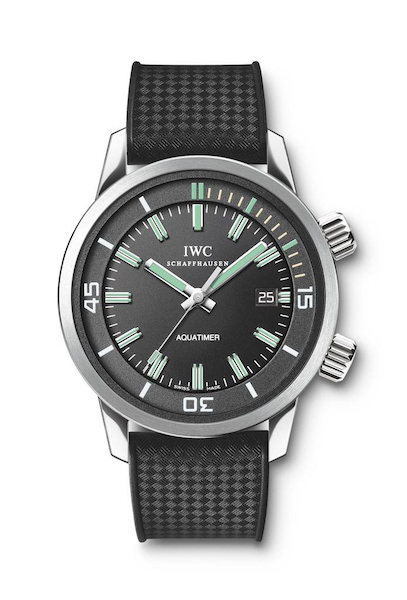
In 2008, to celebrate the 140th anniversary of the company, the International Watch Co. launched a series of watches called “Vintage Collection”, which consisted of gently modernized classics. Of course, the Aquatimer was not missing from this series. The Aquatimer Vintage Collection was given the reference number 3231 and picked up the design of the reference 812 AD released in 1967, but was significantly larger with a case diameter of 44 millimeters. The watch could be ordered with cases in stainless steel, platinum or white or yellow gold and featured the caliber 80111 manufacture movement. The Aquatimer Vintage Collection remained in IWC's range from 2008 to 2012, in parallel with the 3538 / 3548 and 3568 references.
The IWC remained true to the tradition of radical design changes for the Aquatimer also for the following generation, with the Aquatimer Automatic 2000, reference 3568, launched in 2009, the rotating ring once again moved to the outside, there was only one stainless steel version, the watch was again water resistant to 200 bar and could be ordered with a black or white dial and with a steel or rubber strap with folding clasp.

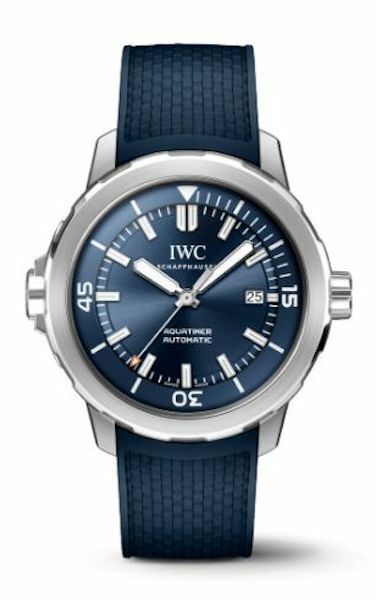
In 2014 the last version of the Aquatimer appeared on the market. Even though during the last model change the rotating ring stayed halfway where it was with the predecessor for a change, the design of the current Aquatimer is radically different again. Fans of symmetry will be pleased with the arrangement of the bezel clutch at 9 o'clock, since the winding crown is at the 3rd position.
Friends of classic watch design, however, will probably be more deterred by the appearance of the reference 3290 than by its high price and the IWC caliber 30120, which is based on the ETA 2892-A2 and only slightly modified...
... by the way, the rotating ring remained only half where it had been with reference 3568, because IWC used a new patent here: the mechanical outside-inside rotating ring with SafeDive system. Here, the external rotating bezel is used to adjust the internal scale.

After eight years, IWC launched a modernized version of the Aquatimer in July 2022, which differs from its predecessor only in tiny external details, but technically takes a big step forward. Now called 3288, the Aquatimer reference received IWC's caliber 32110 manufacture movement with a 120-hour power reserve and Pellaton winding. The older reference 3290 initially remained in the program and was then finally replaced in December 2022.
Prologue (can be skipped):
At the end of December 1988, my four years of service as a soldier at the Bundeswehr ended and I took up my job in civilian life. Now I was earning "real" money and so I afforded myself my first own apartment and the first "expensive" watch, a TAG Heuer 2000 Professional, in addition to the BMW that I had had since the end of my basic training.
I bought the Heuer from my friend Andreas, who was given a Rolex Submariner by his grandmother for Christmas - or was it for his birthday? - and therefore had no further use for the Heuer. From then on, my Casio H101 Marlin, which accompanied me around the clock during my vocational training and the four years in the German Armed Forces, was sent into well-deserved retirement and the Heuer took its place and probably also ensured that the latent interest in the small wonders of great engineering art, which had been present since my first wristwatch, which I got for school enrolment in 1971, grew and flourished.
Some years later the Heuer came to ebay, although I liked the watch very much and liked to wear it. But the part was annoying because it needed a new battery all the time. My friend Volker then put me on the right track: a watch with automatic winding was the last word of wisdom, after all, the perpetual motion machine does not need batteries.
That made sense and so I bought a Tudor Prince Oysterdate with a copper-coloured dial, silver baton indices, oyster strap and sapphire crystal. The Tudor looked good, ran very accurately, but looked a bit small on my skinny arm and so I looked around for something more suitable. Together with Volker I visited the watch market, which was held in the "Flora" in Cologne at that time, I fell in love with Rolex SeaDweller, Zenith De Luca and several other exclusive diving watches and unfortunately had to find out that all the models I was interested in were far beyond my budget. So what to do? A new watch had to be found, because the Tudor was for sale in ebay, the Casio I didn't want to wear anymore and the Swatch GB 105 "Blackout" was too impractical in everyday life. So, to make a long story short: At the end of the day I went home very satisfied and quite proud with a Rolex Oyster Perpetual Datejust, reference 1601, with a "Jubilé" strap, silver dial, baton indices and plexiglass on the wrist.
But the love for exclusive diving watches remained, even if it would take a few more years until the first of such watches found its way to me.
The watch:
A few years ago I decided to give myself a (another) pretty Swiss diving diving watch for my next birthday in April. It was already clear that it would be one of the great classics from Biel, namely the Omega Seamaster 300 M Chronometer "Peter Blake", Ref.: 2254.50.00.
However, a purchase advice thread in a german watch forum that started in January 2019 opened up a few other perspectives for me.
In the end, I narrowed the selection down to five safe and two somewhat wobbly candidates and finally decided on the IWC GST Aquatimer in steel at the end of February, even though the price of the watch ended up being well outside the original budget.
The search for the right watch - I absolutely wanted a non-polished 3536-02 in the best possible original condition with all zippers and zappers - turned out to be not particularly difficult, but also not necessarily easy. First a watch from Great Britain was preferred, but its supplier did not react - or better: much too late - to my inquiries, then one from Malta, but it was sent to another interested party at short notice. In the end I bought my Aquatimer in Germany, in a small town near Aachen.
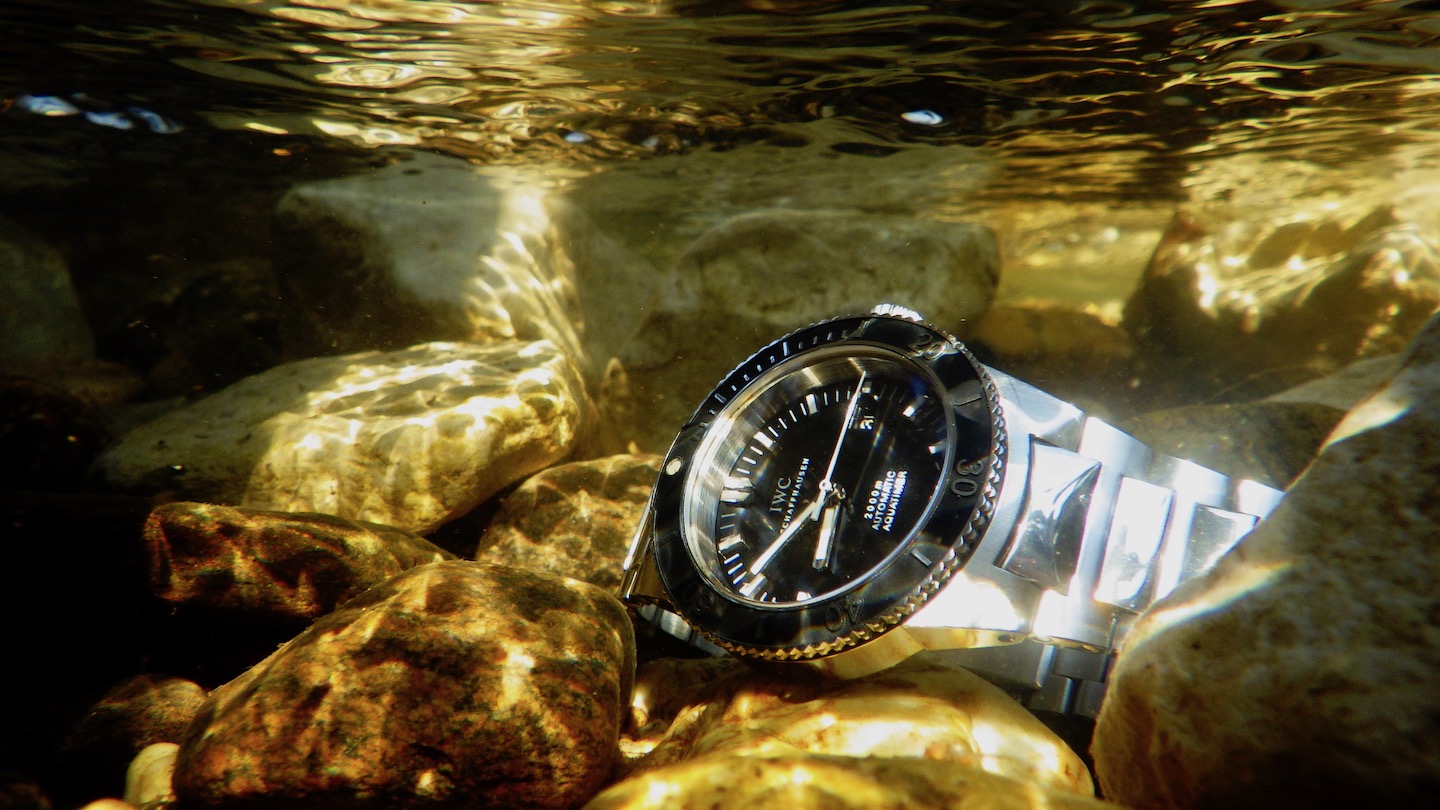
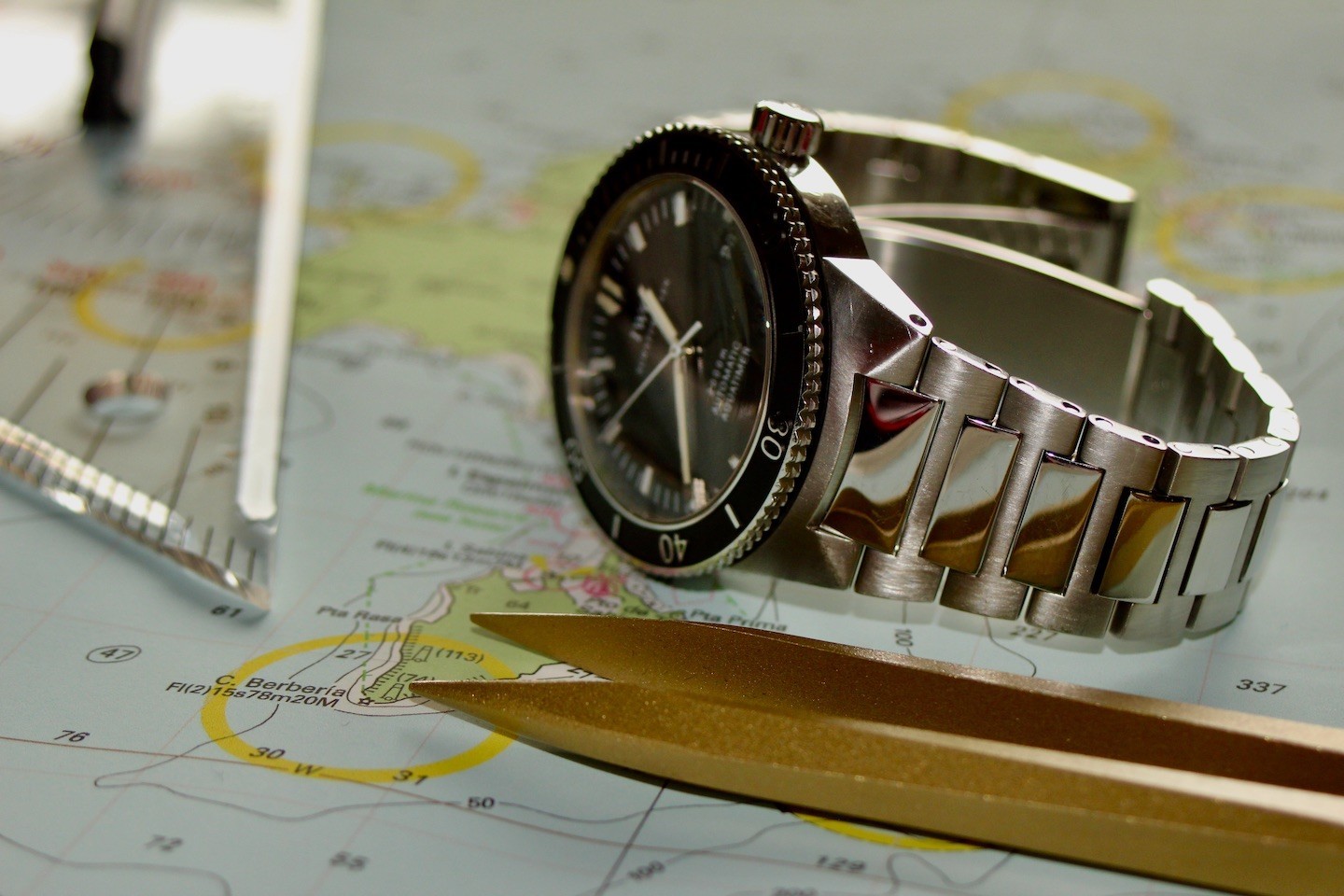
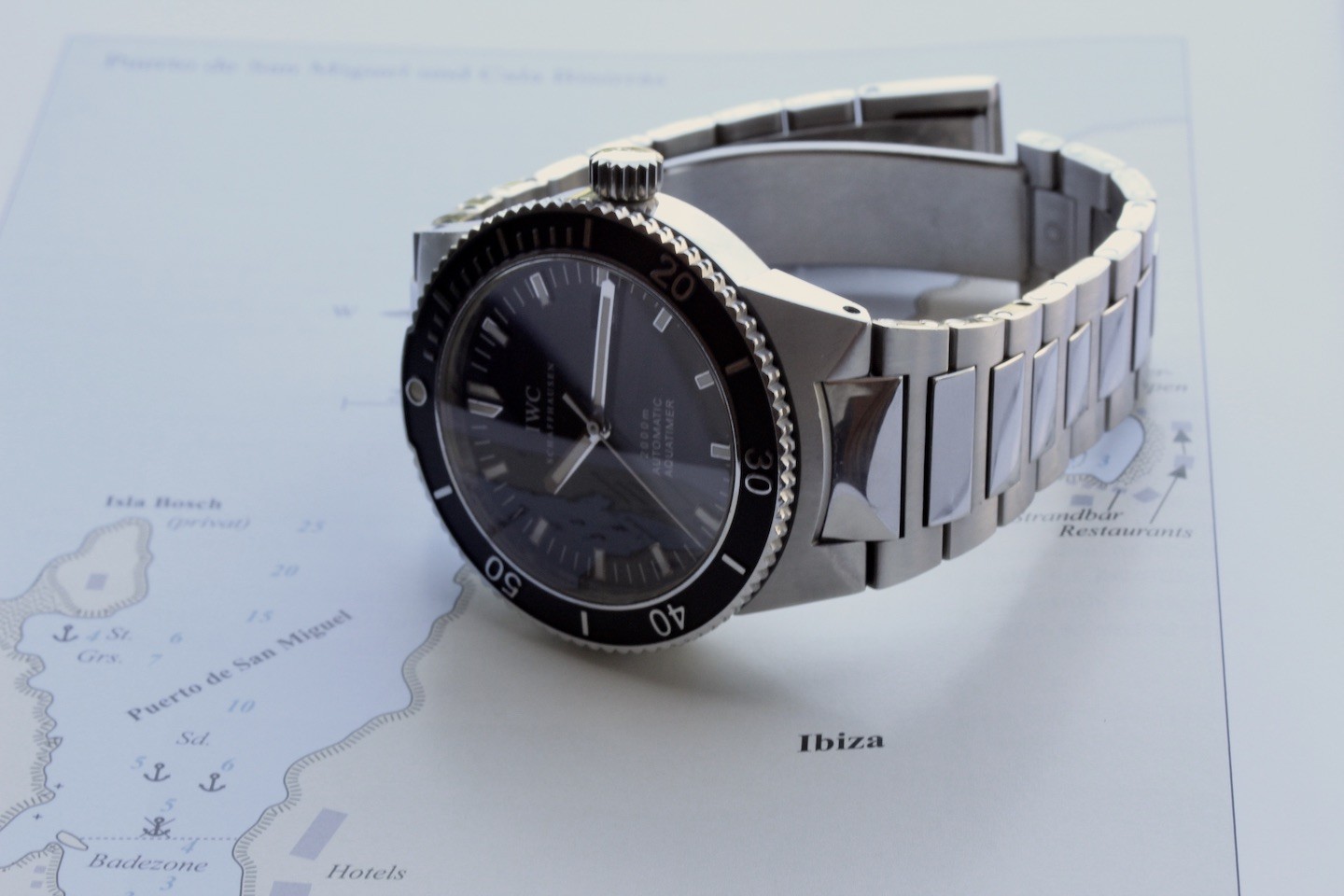
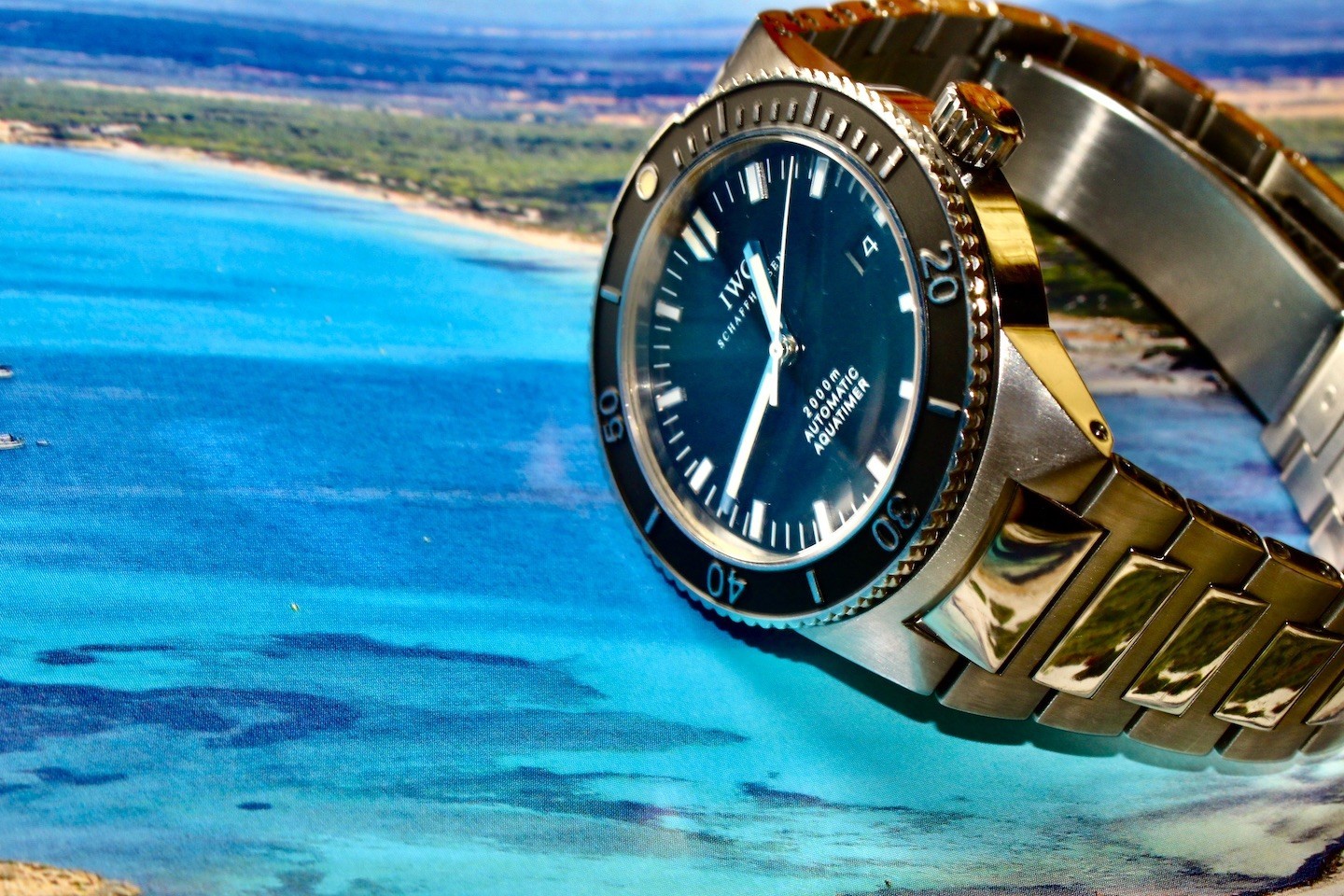
My Aquatimer is a completely original and unpolished model from the first series. The watch is first hand and came in a full set with everything, even the tiny replacement screws for the bezel are included. The Aquatimer was worn and has of course corresponding traces on the strap and case - but nothing wild, no deep scratches, dents or scratches, just superficial traces. The last service was a few years ago but the gaits are excellent for this old sweetie, the Weishi Time Grapher shows an amplitude of >280° in all positions, the beat error is 0.0 milliseconds and the daily deviation on the timegrapher is - 4 to + 2 seconds, on the arm it is about +0.5 seconds per day with my wearing habits.
But the best thing about the watch is that it still has its first, original "T Swiss Made T" dial with the two different luminous masses and also the Tritium hands.
Case:
Material: satin and polished stainless steel
Glass: cambered sapphire crystal, non-reflective
Case back: screwed and engraved case back
Dimensions: Ø 42.00 mm, height: 14.50 mm, length (measured lug to lug): 49.00 mm
Weight: approx. 175 g
Watertightness: waterproof up to a pressure of 200 bar (2,000 m | 6,600 ft)
Features: external unidirectional rotating, snap-in diver's bezel with polished relief numbers and 60 clicks, secured against unintentional adjustment, crown signed with fish symbol at 3 o'clock, screwed-in on the inside, 6.6 mm diameter, 3 seals, separate crown tube made of steel
Dial and hands:
Colour: matt black dial, rhodium-plated and polished hands
Hour scale: applied indices, rhodium-plated and polished and covered with tritium and Swiss Super-LumiNova®, printed minute scale
Date display at 3 o'clock
Hands: rhodium-plated and polished hands, coated with tritium
Movement and functions:
Calibre: gold-plated automatic calibre 37524 (based on ETA 2892-A2), 28,800 A/h, central second, black date disc with white lettering, 21 jewels, Glucydur balance, Nivarox hairspring, shock-protected and anti-magnetic, pearled and decorated with Côtes de Genève stripes, rotor in 21kt. solid gold, stop-seconds, manual winding possibility, date quickset
Power reserve: approx. 42 hours
Function: hours, minutes, seconds and date
Bracelet:
Material: satin and polished stainless steel
Colour: silver
Buckle: signed stainless steel safety folding clasp, key closure, no diver extension
Special feature: proprietary IWC metal band system with safety button lock
optionally available bracelet:
material: nylon
Colour: Black
Clasp: Velcro (hook and loop) closure
List price (1998):
6,300.00 DM (3,221.14 Euro | 3,635.37 Dollar)




Epiloque:
With the GST Aquatimer, the IWC has achieved another great success at the turn of the millennium.
Even today, more than 20 years later, the design is still not considered obsolete. While the matt titanium case radiates a clear and cool technical charm, the steel model with its satin-finished and polished surfaces on the strap and case also radiates a sporty elegance.
In terms of quality, the watch is beyond any doubt anyway, and even though the modified ETA movement used in the Aquatimer does not have the same image as the manufactory calibres used by Rolex and Co., the Aquatimer runs extremely accurately.
The IWC metal bracelet system with safety key lock is ingenious, but, similar to the Oris Aquis, it is not for strap change fans and Nato strap freaks due to the proprietary strap lugs.
At best, you can satisfy your desire to change the strap with the optional Velcro strap (ref.: IWA04925 for the steel version or ref.: IWA04920 for the titanium version).
After a Porsche Design by IWC Sportivo 02, the GST Aquatimer is the second watch from International Watch Co. in my "watch career". Both watches could and can absolutely convince me of the materials used, the quality of workmanship and the precision of the movements used - the Sportivo with quartz movement.
The Aquatimer is the best watch I've ever had, it is definitely one of the few watches that will accompany me for the rest of my life and it should remain in its original condition during the coming revisions.

Conclusion:
With the purchase of the GST Aquatimer I have fulfilled a dream from the early days of my watch life, which I (almost) had already buried and forgot.
After nearly three years, I can honestly say: It would have been a pity if I had not fulfilled this dream.
The watch is very comfortable to wear, despite its size and the not inconsiderable weight.
The quality of materials and workmanship is beyond any doubt, all details are excellently executed, even the fish on the crown is precisely aligned and the Aquatimer is beautiful and perfect.
The construction of the bracelet is, as already mentioned, ingenious, bracelet links can be removed or added in seconds, so you will gladly forgive the watch for not having a diver extension. The bezel was developed just as clever, it can only be turned when it is pressed down at two opposite points.
It might take some getting used to the different luminous material on hands and hour-markers, the Super-LumiNova shines stronger than the Tritium, but the latter shines longer and that was the reason why this unusual solution was chosen.
Post scriptum:
Of course, the history of the IWC is only roughly outlined and incomplete here, because more than 150 years of company history simply cannot be presented completely in such a small outline. Nor can all the highlights and developments be dealt with, because that would fill books (and it does!) and go beyond the scope here. I hope, however, that I was able to convey a small piece of the history of the only watch manufacturer in Eastern Switzerland to date with my amateurish description and that I did not bore you too much and that my English is reasonably understandable.
Source references:
International Watch Co. "The watches from IWC 1998/99" and "Historical Selection - Engineering Time Since 1868" | iwc.com | Chronos "Milestones: IWC" | Wikipedia | Roger Rüegger Dive into Watches
Image sources: Images 1 to 5 and 7 to 10: International Watch Co. | Image 6 and 11 to 36: own work




Probus Scafusia: The IWC Aquatimer GST, reference 3536-02


Another great post…


