foversta
[PuristSPro Moderator]
20814

A visit to the Harry Winston Boutique in London (June 2011)
One year after my first visit at the Harry Winston Boutique in London (read my report here: harrywinston.watchprosite.com
)
, I had the opportunity to come back there, taking advantage of a long week-end we had in France. This visit gave me the opportunity to discuss with the staff of Harry Winston UK about the market, the newest Midnight collection and of course the Opus Eleven. A very interesting talk which confirmed me the increasing success of the Harry Winston Timepieces collection.


But I also wished to see some watches I wasn't able to shoot before: the Opus 9 and two Premier Perpetual Calendar.
Let's start with the Opus 9.
I will come back later to this watch but we can describe in a few words what are its key features.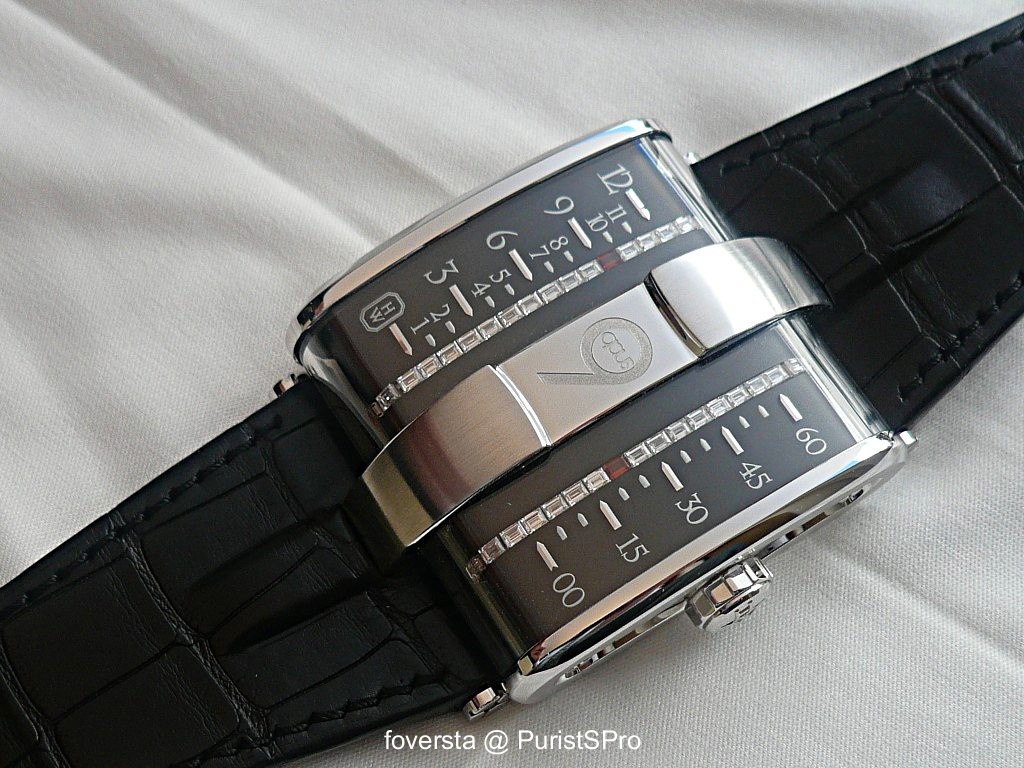
First of all, the Opus 9 is a true homage to the first and main activity of Harry Winston: diamonds. This watch is a sort of a meeting point of the diamonds and horological worlds which live together at Harry Winston. The Opus 9 is not a gems setting watch: the diamonds here play an important role: they tell the time. In fact, time is displayed thanks to two parallel chains, each of them with 33 diamonds. The main trouble brought by this system is the weight of both chains which require a powerful movement to move them. The Opus 9 is powered by an automatic caliber developped in partenership with an old friend of the brand, Jean-Marc Wiederrecht. Jean-Marc Wiederrecht has started his collaboration with Harry Winston in 1989 and his mastery in original time displays like retrograde hands has allowed him to have a strong involvement in the main projects since then.
The designer of the Opus 9 is also well known: Eric Giroud has worked for Harry Winston before with the Tourbillon Glissière. So the partnership Wiederrecht&Giroud was a bit logical to create an Opus but we all know that logic is maybe the hardest way to find an agreement. Anyway, the Opus 9 has a very special place in the collection due to the role played by the diamonds, to the shape of the case (56mmx48mm) and to the very simple time display.
The design of the back and of the sides of the case is really gorgeous (stains are on the protective plastic):

The watch is bulky, its thickness reaches 20mm and due to the rectangular shape of the case, it seems to be even bigger than we may think. As long as you haven't tried it, you can't imagine that it is so massive. Even if its side contributes to make the time more readable, I found it a bit inappropriate in the specific context of this watch because it loses a large part of its elegancy.
Despite the great overall finishings, very nice details and the power of the movement, the fact that we are in front of a "slow" complication and that the whole mechanism is hidden by a solid caseback makes the Opus 9 a bit disappointing for my taste... even if I really felt to be in front of an impressive and rare timepiece. Anyway, it was a very good experience for me to be able to handle it to be able to judge it by myself.
We stay with Jean-Marc Wiederrecht with the two next watches. They are two versions of the Premier Perpetual Calendar, both with a case of 41mm.
The Perpetual Calendar is a very important complication for Harry Winston because it was the first which gave its own pedigree to the Harry Winston timepieces project. In 1989, Jean-Marc Wiederrecht developped the first Perpetual Calendar which was using retrograde hands. More than 20 years later, this complication remains the keystone of the Premier collection, still using retrograde hands... even if the dial layouts have evolved.
The first pictured watch is a LE of 20 watches, with platinum case, which was released 2 years ago to celebrate the 20th anniversary of the first Perpetual Calendar. The retrograde hands allow to open the dial in two sectors (date and months) without disturbing the readability of the data. The dial layout is very balanced taking fully advantage of the off-centered time display and of the two retrograde hands. My only little regret is the little impingement of the leap year window upon the months scale. I really like the blue color of the dial and the subtle yellow touches (moonphases, stars, leap year, second timezone). A true beauty and a perfect combo dial&Premier case.
The beauty of the blue dial:


The GP base:
This one is really perfect on my wrist:
The second Perpetual Calendar watch is the newest version. Movement (GP base + Agenhor module), case and dial layout remain the same. So we are only speaking about aesthetical changes. And there are a lot. We can mention:
- the HW logo and the hours figures are removed
- the moonphases display is totally integrated into the time subdial
- two screws are put into the time subdial
- the months and date sectors are decorated with a circular guillochage
- both months and date scales are wider and become more visible on the dial
- the months hand has been replaced by a shorter and broader one
The new dial design:
The same movement with the GP base:
The same comfort on the wrist but a different feeling due to new dial design. The watch is less formal:
At the end, the outcome of these changes makes the dial totally different from the previous ones. Everything seems to be more circular, maybe more "up-to-date". This design is more an "all-around" one which combines the complexity of the complication with a more casual touch. Frankly speaking, I much prefer the previous version which is, for my taste, more elegant, more subtle with a large moonphases display bringing a touch of poetic atmosphere. With the new dial, the moonphases display almost disappears which is a pity. Anyway, some will prefer the less formal style of the new version and its harmony of colours. In both versions, the several dial layers have been preserved and of course, the finishings are flawless. It is just a question of taste at the end!
I would like to thank a lot the staff of the Boutique in London for the warm welcome and for its availability.
Fx
This message has been edited by foversta on 2011-06-12 03:59:30
A visit to the Harry Winston Boutique in London (June 2011)

Thanks Alex!


Thanks. I can live with either Perpetual....
Oh no, the car is not mine...

Thanks for the report Foversta.
Yes, it is true, I should have written it.

Thanks for the new pictures!
I'm with you


nice post...