
pplater
5432

Are you sitting comfortably? "Once upon a time"...
Some time prior to 1968, a distinguished jewellery designer met a very lovely young lady. She became his muse and his partner; he made jewellery which could not have looked any better than when it was worn by her:

They settled down and had children together. Theirs was a richly artistic, if somewhat ‘alternative’, extended family. Their second son was born in February 1970, and he enjoyed a carefree early life. Here he is on his mother’s hip at the family’s holiday home in 1972:

Their son inherited all of his father’s creative talent (but arguably not so much of his mother’s great beauty!). As he grew the young lad, unafraid of working in metal (as his father did) and fascinated by mechanics, took an interest in restoring old cars and motorbikes. Bikes seem to have won out over cars, and thus an enthusiastic young Viking Bikie (“Vikie”???) was born:

Fortunately for us, in 1989 our Viking Bikie commenced study at watchmaking school in Tapiola, Finland, and in 1994 furthered his studies at WOSTEP in Neuchatel whilst working in the Piaget service department. After completing the WOSTEP complicated watches study course in 1997 he worked on complicated watches for Parmigiani and from 2000 to 2004 spent time working with Vianney Halter, then Christophe Claret, meanwhile striking out on his own. Initially he made watches in his home kitchen; in 2003 he took space in an artists’ community in the old cable factory in Helsinki and there he remains today.
He is, of course, Stepan Sarpaneva, and his watches are known under his eponymous brand ‘Sarpaneva Watches’ and S.U.F. (Sarpaneva Uhren Fabrik), the latter being the less exotic line.
Stepan’s first piece for himself was the ‘Time Tramp’, a pocket watch made in an edition of 6 customised pieces. The case was cut from the kickstart pinion of his old Harley-Davidson motorcycle, combining two of his passions and creating an enduring signature: the pinion shape is echoed in the case of nearly every Sarpaneva watch since that first, perhaps none more so than the Loiste:


The Loiste was followed by the Supernova, each sporting a modified ETA 2824-2 movement. “Loiste” is Finnish for ‘shine’, and Supernova is English for an exploding sun. A solar theme had begun to develop, but was soon cut short by Stepan’s musings about another planetary body, the moon. It was courtesy of a bright moonlit night (and perhaps a couple of glasses of truth serum) that Stepan paid particular attention to the pattern of the grates surrounding the trees planted on his street. He traced it, created a watch dial in the same pattern, and the Korona was born. It was also the first of Stepan’s watches to feature the Soprod A10 automatic movement, which has gone on to be the base for nearly all of his watches since.

[A gratuitous picture of a lunar corona by Stefano de Rosa. Given the palm fronds in the foreground, you can bet it was not taken in Finland]
It was the Korona series, particular the Korona K3, that saw the addition of the moonphase design which has gone on to become another Sarpaneva signature touch.

Describing how he settled on the design, Stepan says: “ I realised that by putting the moon under this dial it would allow you to actually ‘see’ the moon approaching its phases, through the branches of a night-time forest perhaps".
“Everyone here in Finland floats around with an aura of slight melancholy, with a bit of indecision as to whether he is happy or sad in nature. The expression of the moon on the Korona K3 just ‘is’ – the same as the people here”.
Just how pleased is Stepan with the design of his moon’s ‘face’?


(It’s also depicted below the saddle of his custom 1982 Harley FLT!).
Last year someone else became equally smitten with Stepan’s moon design; so much so that Max Busser collaborated with Stepan to incorporate ‘that’ face into a version of the MB&F HM3, the ‘Moonmachine’:


But back to our story…
Speaking personally, it was a limited series in the Korona K3 configuration which first demanded attention: the K3 ‘Black Moon’. Its appeal was two-fold: first, it had a quirky moonphase set to show the phases of the new moon rather than the ‘normal’ moon. Second, it featured a suitably stealthy black dial. Of course, it was presented together with a ripping yarn about ‘Lilith’, the demon temptress, and who isn’t a sucker for a good yarn?

A little while later Stepan released the Kaamos, a limited re-edition of the discontinued K2 (‘kaamos’ being the Finnish word for that period when the sun isn’t seen in Finland for weeks on end: it’s also the name of a Swedish death metal band, but surely Stepan wouldn’t listen to that kind of music – would he???). The appeal of the Kaamos was its black DLC case – darker and darker these watches became!

Around this time Stepan took his signature moon to its ultimate expression in the Korona Moonshine:


From a personal perspective it is just a bit too much of a good thing, losing the ‘sweet spot’ in the tension between form and function. That balance was rediscovered in the Korona KO, Stepan’s first dive watch, and a real beauty at that:

Most importantly, Stepan had the inspiration to add the moonphase complication to his diver (probably one of the few), and did so by a clever trimming of the full size moon from the moonshine. To cap it all off, he presented a version in an all-black case, the ‘Wuoksi’, complete with another ripping yarn about a blacksmith designing a watch (!) to help him save his daughters from the clutches of the Näkki, a lake-dwelling monster of the dark.

Good yarn? Tick. Diver’s watch? Tick. Independent watchmaker? Tick. Simple design? Tick. Stealthy case and dial? Tick. Still, it was a Northern Hemisphere moon, and that was a bit of an issue to a collector in the Southern Hemisphere. ‘Why should that be?’, you may ask. Well, only a small percentage of the population, and apparently an even smaller percentage of watchmakers, appreciates that on any given day the moon appears quite differently in the Northern Hemisphere to how it appears in the Southern Hemisphere.

A few watchmakers have tried to accommodate the Southern Hemisphere watch enthusiast, notably IWC and JLC. Would Stepan? After a few emails back and forth, it became clear that a Southern Hemisphere moonphase diver’s watch would be possible; the placement of the crown stem, however, would render it a difficult exercise. It was originally intended that the watch would display phases of the new and old moon as they waxed and waned in the Southern hemisphere: more of that later. What would be possible, though, was a watch with a moonphase for both hemispheres: a very agreeable compromise! So began the construction of a ‘piece unique’ Sarpaneva KO Wuoksi.
Stepan could not possibly have been more accommodating. He would regularly send photo updates of progress: he kindly fitted different dials, different colour moonphases, different hand sets, all in different combinations, and then photographed them for decisions to be made in the comfort of an armchair on the other side of the globe.
The modified Soprod movement beats at 28,800 VPH and has a power reserve of 42 hours. Here it is fitted with its signature rotor:

Trying out the ‘shutters’ which will eclipse the moons from different directions:

The moon ring prior to finishing:

Reaming out the moon ring:

A pared-down face fitted to the moon ring:

The double faces ready for trialling:

Time to get the colours right:

Choosing the right curtains for the new moon aperture:


Which dial? It was a no-brainer to be honest, but then it doesn’t hurt to be sure. Notice the great act of generosity on Stepan’s part: to permit the watch to be fully featured and yet uncluttered he suggested that his name-plate be removed from the dial:

Looking at different coloured hands:

Casing up the movement; the DLC case is 46mm diameter and 10.5mm high:

The final result? The Korona Wuoksi ‘Uniikki’:

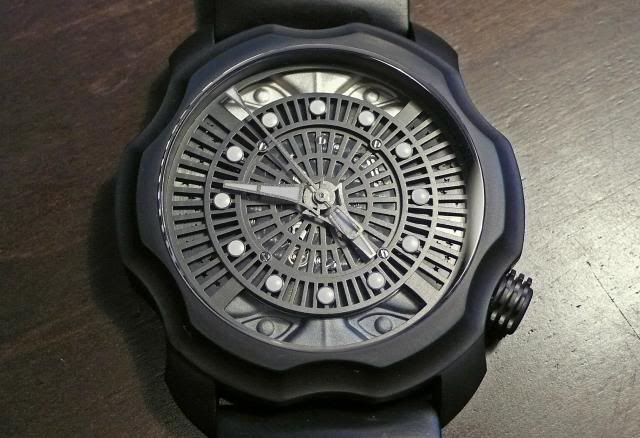

This particular Wuoksi was fitted with a Hirsch rubber strap which is remarkably flexible and comfortable. Two straps are provided and there was quite a range of colour and materials from which to select, including these few:

Being ever-wary of CITES issues, we agreed that the second strap would be frogskin. Here it is, fitted with an alternative buckle. Yes, the tang is bright steel: Stepan felt that it would be less abrasive on the rubber straps. Hmmmmm.

The watch is delivered in a pleasingly functional box, a welcome change from the heavy, lacquered, over-the-top boxes which are becoming increasingly the norm:

Within the packaging Stepan also added some ‘merchandise’; a catalogue in the form of a newspaper and a set of drink coasters relating the tale of the Wuoksi:


From the kernel of an idea to delivery of a ‘Finnished’ watch took only six moons; apparently it would have been two moons less without the customisation required for the piece, and all of this whilst Stepan was preparing novelties for Basel. Indeed, it is an honour to see that Stepan has now incorporated the North/South moonphase in his catalogue, available in the standard Korona line:

Shall we go out with a couple of regulation wristshots?


Oh, what became of that cherubic little boy sitting on his mother’s hip? Well, most of the time he can be found in his workshop or bouncing around the world showing his line. When ‘Lilith’ comes out to play in the dark of the new moon, however, it’s a very different story…

If you have read this far, thank you for your patience and your interest.
Cheers,
pplater.
[As usual, photo credits are embedded in the URL for each picture. To view, right-click on the pictures. All ‘in progress’ shots are courtesy of Stepan and used with his permission. Family shots are from his newspaper catalogue. Stepan's tattoo is by the legendary (and our own) Mo Coppoletta of 'The Family Business" in London and the photo of the newly finished 'ink' was taken by one of the brothers Gronefeld. The photo of the moon pendant is by 'aptronym' and used with permission. Francois Xavier took and posted the shot of the Loiste.]
Are you sitting comfortably? "Once upon a time"...
Some time prior to 1968, a distinguished jewellery designer met a very lovely young lady. She became his muse and his partner; he made jewellery which could not have looked any better than when it was worn by her: They settled down and had children toget...

This is ...
a great post and so is the watch. Congrats! To be honest I was not convinced from the beginning ... ... until I tried it on :-) Oliver ...
Thank you Oliver...
It is remarkably comfortable, isn't it? Probably a combination of the short lugs and very flexible strap. Looks good with your suit! :-) Cheers, pplater.
Thank you for the documentary.
It is excellent. I was like you until I visited Stefan in his atelier and observed the quality and unique design of his watches. I then worked with Stefan over the next 6 months creating the subtle changes in my watch. I was and still remain "shocked" at ...

Impressive post as usual....
I've never seen one in the flesh so the size concerns me a little but I obviously have a little something for the moon, even my cat is called Moon..!! But I do like the cufflinks... can you get these from them directly..? Yours dude, Andy.
Cheers Andy...
The watch wears smaller than its size: as you can see, the case is scalloped inwards and the hour markers are set in from the rim. Give it a go. As for the links: email Stepan if you're interested. He almost always responds immediately. Heck, he'd probabl...
Ha ha...that would be something..!!
I will def try to see one in the flesh, but will get in touch and ask about the cufflinks :) When are you over here again.?? Speak soon dude.
Hey, chum...
...isn't it your turn? When are YOU going to come over HERE??? The fish here is at least the equal of turbot, and we have plenty to go around! :-) Cheers, pplater.
If somebody is paying I'm on the next flight....
and as you have Turbot how could I refuse :) One day my friend....one day :) I think I'll have to do a Purists trip and stop off everywhere....now that sounds like a plan..!! Speak soon dude.
Fantastic.....
Loved the back-story, the history and finally the timepiece. A wonderful juxtaposition of attributes on this one - the moonphase is just plain cool. Look forward to seeing more scans as you get to know one another. Darren
That's another 'pair' between us, Darren...
People are starting to talk! :-) :-) Cheers, pplater.

Vraiment!...
They say that all great artists are a little mad, Nico. On that basis, Stepan is the next Picasso! ;-) Cheers, pplater.

What a post!!!
Pplater, As usual, you shine. Never ever considered this watch ... Until now. Great history. Cheers, Nilo
Thanks Nilo...
You could do a lot worse than consider a Sarpaneva seriously: in this day and age they represent terrific value, and they're anything but boring! Cheers, pplater.
Great report and great watch!
I love this model and working with Stepan is always a pleasure. It really looks great on your wrist and it is cool to see more Uniikkis now being born. Congrats! Andrew
It's an honour...
...to follow your lead in all such things, Andrew (but perhaps not your dance moves!). You have shown what may be achieved if one simply has the presence of mind to ask the question. Any hints about the pieces that must already be on your production line?...
Those dance moves...
took years to master ;-). I always think no harm in asking... the worst they can say... putting it politely... No! Sneak peak on future creations... well they all include a special colour, a few indies in there and a REALLY cool piece I am super excited a...

Where should I start from?
First and foremost by the fact that you my dear pplater went through this incredible experience,and the outcome is just amazing. Like our friend Andrewluff did before ,creating a unikki must be so rewarding,especially if the relation is with a special per...
You and Stepan are birds of a feather, Mo...
...genuine, generous and truly passionate. It would be delicious to hear the whole story of the 'inking', and whether the next tattoo will be traded for a Stepan piece! (Those who are still 'missing' the thrust of what we are saying are invited to read th...

Well done indeed, my Friend!
Once more you have proven yourself to be a true friend of the Independents, a man of impeccable taste, and at the same time far from a slave to convention. We still need to arrange those friendship watches...B Best, Gary
Still not fit, Gary...
...to carry your bags to the ground, as friends of Independents go: your lead is a constant source of wonder and encouragement. As for that friendship watch? We know 'what'; we know 'who': what we don't know is 'when' or 'how much'! We really should conce...
Very comprehensive post
Pplater thanks for another good post This will make Inde lovers to revisit "mad moon" artist Congrats !!
Thanks for the kind words Quan...
What about yourself? Not mad enough for you? :-) Cheers, pplater.

Superb stuff Pplater, fascinating documentary....
about the making of a "crazy" time piece:) I think all great creators are a little crazy, some more than others:) didn't know that some horologers went to the length of adapting a moon for the southern hemisphere! Very diligent of them:) Cheers, Francois
One for you, sandgroper...
...no Antipodean should be without one! :-) It is a shame that you were unable to attend the local 'reveal' a couple of weeks ago: we missed you. Hopefully you are on the mend? Cheers, pplater.
Yes Pplater, you are absolutely right, no antipodean should....
wear a moon phase time piece showing "only" the moon phase for the "podiean":):) Personally ! I think that the problem of Southern Hemisphere/Northern Hemisphere moon "problem" is quite simple. Just add one more, no, two clogs! I am getting better tank yo...
Great post to explain Sarpaneva watches and spirit.
Thanks for that superb post. I like his watches but when I think Sarpaneva, I automatically think of the astonishing Supernova, it went so fast through the watch galaxy. :) Francois
It was too difficult to pronounce, cisco...
Try saying 'Sarpaneva Supernova' after a few social lubricants! :-) It did however deserve a picture - apologies for that omission. Here it is again: Cheers, pplater. ...

You are aware of the fact that I am wearing This One right now?
It also shows the moon phase Down Under - as does the Loiste II - if no way like this! Your stereo-moon Wuoksi turned out just great - as did your report! Not being a traveler of the antipodes, I am completely happy with my mono version. So I can admire b...
Pplater, this is the best write-up on Stephan I have ever read.
Usually, it is quite boring. Perhaps, I have read too much about him and his creations. Here, you manage to couch it into such an interesting story. Regards Ling
Coming from you, Ling...
...that matters a lot - thank you very much for that high compliment. Cheers, pplater.

I read it ..
all the way through with interruption from bloody students... Frankly after seeing first two pictures and reading first two paragraphs I thought that you are finally revealing your true identity :) Awesome & joyful post...only thing I would like to as...
Damjan, you have not studied your material!...
The answer lies in the post. The positioning of the moon cutouts meant that Stepan had to design a new 'grate' for the dial. To have the Sarpaneva nameplate elsewhere on the dial would have 'cluttered' the watch. It was Stepan's kind suggestion, especiall...

Fantastic post.
Thanks for taking the time to do it. I've enjoyed reading it. Love some of his creations. cheers vte

What an intro...
to a new watch! Great post! If it were me, I would only write: "It's beautiful, it's black and shiny, here look at the pictures. Thanks." enviously, cen@jkt
But your pictures, cen...
...speak thousands of words. We each do the best we can with what we have. Thank you for your kind comments. Cheers, pplater.
Excellent post pplater...
...Thanks for sharing ! Puts me firmly back into 'I really should just order that piece I've been discussing with Stepan' mode... :-) Cheers, Rob
You know it, Rob...
Make the call! After all, the cost (for example) is little more than an air ticket home, or perhaps the same as a buckle for one of those fancy wrist-racing-machine-thingies... ;-) Cheers, pplater.


Great post; even more fabulous looking watch.
To me, more so than some of the other creations of Stepan's imagination, this has an mysterious, yet enchanting, quality to it.

I really want...
...those coasters. Quite fascinated by them. Perhaps one day I will have a 'regular' sized Sarpaneva moon but in the meantime, I love my pendant :) A grand post, pplater.
For a magical experience
place a tumbler of malt whisky - or better Jaloviina - on a coaster, peer into the depths lit by a single flickering candle, and watch the story come to life. Repeat several times with a different coaster until the candle burns out. Don't try this at New ...
Hi, fellow coaster ...
You don't want to miss the addition to my previous post, so that we can go coasting along together! Kippis !!! amerix
The right word at the right time
Who better to ask than The Man himself? Stepan mailed me this reply: "Kippis Amery, Kippis! We use skål too if we are too drunk to say kippis? Hölky kölkyn works also." Practise makes perfect! amerix


Yes I am sitting comfortably
and I've still fallen on the floor. :) Well done. Regards, Richard.

I totally missed this....HUGE congrats!!!
And I know of all in this August forum, you would be the one who would enjoy and appreciate Sarpaneva's creations. Wear in good health Best, Horo