SJX
[Purist]
8540

In Conversation with Alain Silberstein - The Architect of Time
In Conversation with Alain Silberstein - The Architect of Time
By Su JiaXian
© November 2007

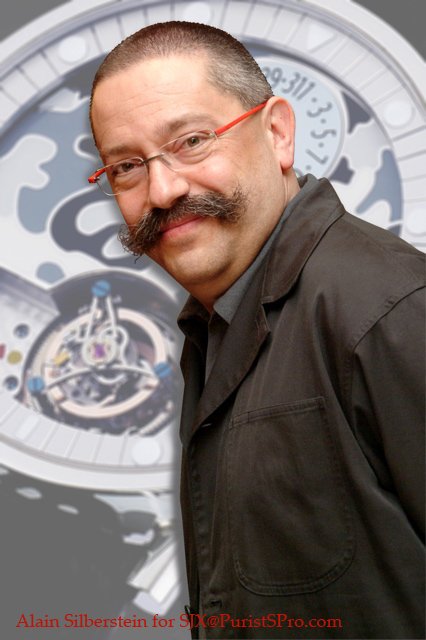
Two decades ago a talented gentleman turned the world of fine watches on its head. He created watches with whimsical designs in fun colours; they were high priced mechanical watches no less. That was in a time when most thought the luxury mechanical watch had run a good race and was on its last legs. Back then, independent watchmaking had yet to become fashionable - Philippe Dufour had yet to make the Simplicity - and the young upstart haute horlogerie company of the day was Blancpain, since 1735. That gentleman's name was Alain Silberstein; and here he shares his thoughts with us.

This interview was conducted in September 2007, during the Tempus watch fair held in Singapore. Many thanks to Catherine Tan and Roslinda Mohd Taib of The Hour Glass as well as Gene Kwek of Vibes Communications for arranging this interview. Below is an edited version of the interview transcript.

Su JiaXian (SJX): Alain Silberstein watches are famous, we all know the watches – are they a reflection of you as a person? How would you describe yourself?
Alain Silberstein (AS): This is a tricky question because it’s a way to ask me to compare myself with the watches. Certainly there is a difference. One reason, I feel at ease in creating watches as an artist. I think watches and clothes are definitely pieces of art. What is art in watchmaking? Art is definitely to create an emotion. When you are in front of a painting or sculpture, sometimes [you feel] nothing, sometimes this is it! It is called in French – appropriation [sic] – that means there is something created between the piece and yourself, your own personality. And this is for me the definition of art – creating emotion. I was really keen to create watches with such emotion. Why?
Watches are definitely not normal objects; they are lonely objects measuring our most personal thing, which is our intimate time. Intimate time – that means related to eternal time; related to death and life.
Today, this is a one of the big differences from watchmaking in the past; there is no obligation to wear wristwatches. We have all the instruments to measure time. In fact we don’t need to have a timekeeper – our laptop gives the time, our mobile – we have so many objects around us. Why add another one on our wrist? I have these two objects on the table, one is my watch and the other is my mobile phone. My mobile phone gives the time but it’s without emotion - it’s not my time. The one I wear on my wrist is definitely mine. So I think people are looking, more or less unconsciously, to have something very unique, while wearing their own time. This uniqueness is my guiding path for my creations.
We are now living a big revolution; this big explosion about innovation, creation in watchmaking. It’s amazing! We have never had so many creations in watchmaking for a very simple reason. Like it was in Geneva in 17th or 18th century, people want to have something very unique, personalized, bespoke. This bespoke approach is why I am creating so much in watchmaking. Today you have different ways [for everyone], of course we are talking about Rolex, you have Oyster; Jaeger, it’s Reverso; Audemars, Royal Oak; and Silberstein, Krono, and of course Francois-Paul Journe, Richard Mille also. We are all major brands and we have a style. I think a brand equals a style and people will find the style they feel at ease with.

Tourbillon d'Art
Even with these offerings, we have to make more and more unique pieces to focus on people. I think the big innovation in watchmaking is that we are trying to focus globally, but personally; we are targeting individuals. This is why Tempus is very important for us, because we are not trying to make [watches] like… I don’t want to name any big brands of the big groups. I don’t care what Mr X or Mr Y is wearing, my customers are not branding people; they don’t care about branding, they care about themselves, they are well-educated people.
For branding, you have two types - one is branding based on quality. In fact, we are working on three fundamentals. This is very important for me to state now to you and your readers. We are innovation, quality and service. This is true branding. You could have a lot of innovation, but if you don’t give full service after 10 years, what does it mean? Nothing. So the quality, the name of the brand, is based on innovation, quality and service. Please understand, the stricter we are about these three rules, the more we respect our customers. It’s a question of respect. My 2000 watches a year will be well produced and disciplined. This year, I am celebrating my 20th anniversary. After 20 years, I am [one of] the old timers; I am able to speak as I wish.
This is why The Hour Glass partnership for me is very important, because Michael Tay [Executive Director of The Hour Glass] and his team, and Kenny Chan [CEO of The Hour Glass], understand what we are doing.
We are very tough producing watches, the customers are also very aware, but in between there is a weak point - distribution. You have retailers who don’t care. They just care about profit – short-term profit – so in between the same fundamentals [of] innovation, quality and service are lost. This [Tempus] is innovation, quality and service; such an exhibition is really innovative. You have the quality, and of course the full service for both us and the end user.

Year of the Rat
SJX: Is an event like Tempus a win-win for both brand and retailer?
AS: It’s a win-win approach. And this is not just marketing, because you see I am talking for this interview, here I am speaking directly to my customers. They rely on you because you offer them something very important. You are like an artist, a painter, you purchase one painting and then you will start to collect paintings. Many of my customers already have collected three or five of my watches, for different occasions, for different styles.
Today you have so many quality pieces in Asia; many people say this is a good opportunity to make big money, but [that is] money without these three fundamentals [of innovation, quality and service]. You say I am able to make the most expensive watches in the world, so this is worthwhile. What’s it worth? Quality, service, innovation.
SJX: You mentioned just now you are celebrating your 20th anniversary. I still remember back in the nineties, your watches were so different from everything else. But today, as you have said, the market is bigger; there are more and more watches that are different, unique. So how do you continue to differentiate your brand?
AS: This is true. Twenty years [ago], we were a little group of watchmakers who organized a renaissance, revival of mechanical watchmaking.
SJX: You were a pioneer.
AS: Yes, correct. And if I look back, I tell you frankly I am quite proud of what we achieved. We had a vision, with Mr Biver. Our master was Mr. Biver from Blancpain; let’s give a name. ( laughs) He opened doors for everybody; we were so few at the time. The watchmaking world was so conservative; even now it’s so conservative. I would say you have pioneers and followers in watchmaking.
I had a vision and I decided to go along my own path. People were quite astonished at the time. Even now too, there is no difference. I try year after year, step by step to improve the quality. I would say now my creations are more radical than they used to be 20 years ago.
Now after 20 years I have achieved my dream. I saw the shapes, the proportion, the radicalism; this is more pure, because I have learnt. After 20 years of apprenticeship, I am able to express myself in a better way. Also because techniques have evolved very quickly, one of the major reasons you have so much innovation in watchmaking is high technology. There is such a broad array of possibilities we all use.
But even now, I tell you frankly, when Richard [Richard Mille], launched his style, look at his followers. I won’t speak of copies, of counterfeiting and fakes, but followers. Today, you still have exactly the same approach there was 20 years ago; you have pioneers with vision, their own style, Felix Baumgartner for instance. Some will prefer to stay in small companies, some of them will develop their companies, but their styles are unique. I think it is very important to make the distinction that even if you have a million dollar communication budget plan, style is still style.
Our customers know everything about communication and advertising, because they are leaders, they are opinion leaders. Opinion leaders lead the world; these people just care about their own taste, their own vision. If I have a vision, my customers also have a vision.
When I started 20 years ago, try to imagine the first Chinese people who purchased my watch when I opened my first shop in Hong Kong. At that time everybody was speaking Patek, the universal language was Patek and the other was Rolex. Other than these two brands - nothing! (laughs) At the top was Patek, and the Rolex people they didn’t know anything about Patek! (laughs) And today you have exactly the same, except you have more brands.
And I myself am very pleased, because at last we have reached the new generation, which is important today. Twenty years ago my customers used to be 30 to 40 years old, and now they are 60 and grandfathers like me. Now they offer their watches to their grandsons, so we have the third generation in 20 years.
We have a watchmaking world, which is now alive and well. Tempus is really the proof that the vision we used to have is true. We were so lonely 20 years ago. If we had thought such exhibitions would occur in 20 years, everybody would have said you are crazy. Now we have the proof that watches definitely mean something for humankind. People want something unique on their wrist, they want art, they want sweat and tears, they want innovation; and we just have to offer the best. Therefore, the real challenge to come is our customers, they are challenging people, and so we have to answer to them.
It’s very difficult to express in 2007 that we have such well-educated people in watchmaking, thanks to the magazines, thanks to the Internet. The creation of a watch magazine, the explosion of the Internet website dedicated to watchmaking, creating a completely new generation in watchmaking, of people who are well aware. I think in our sector we have the most informed people. If somebody gets a call in Switzerland, everybody in Asia will know. For me, this is something very, very interesting.
It’s impossible to hide behind marketing. We have to provide the proof, otherwise you will know.

Krono Rondo
SJX: I understand you were an architect?
AS: By profession, yes.
SJX: So how did you end up, 20 years ago, deciding to go into watches?
AS: I am from Paris, I am Paris-born, and I moved for personal reasons to Besançon, a small town near the Swiss border, which is the former capital of French watchmaking. Ten or 15 years [ago], I rented my own studio, more specialized in fitting shops, restaurants, and hotels – commercial work. Because in this region there were many watch companies at the time, I started to design watches by commission for major clients and Swiss companies. That is how I started.
One of my first projects was to design a watch, which was produced in Hong Kong. (laughs) I tell you, the best school for learning luxury watchmaking was to be told by Chinese watchmakers how to make a $6 watch! (laughs)
During that period of three to five years, it was the beginning of the Swatch craze. I designed many fashion watches for French companies and I was frustrated because as a designer they never followed you. So my wife said… in fact, a guy came to my studio; he was the agent of ETA. Because I was working with the Japanese movement, quartz, from one of my customers, he [the agent] tried to convince me to put a Swiss made movement. He came with a big book; that thick (gestures with fingers). He said, we have just bought an old company in Switzerland specializing in chronograph movements. Maybe we could transform it into a quartz factory; we don’t know what to do. But we have a huge stock of chronograph movements, what do you think about that?
It [the factory] was Valjoux! I tell you, I opened the book and fell in love at once - I had to design something for this. Step by step, for one whole year I designed one watch, a chrono. And so it was in ’85, ‘86, I tried to rent a stand in Basel – no place. So in ’87, 20 years ago, I rented six square metres, no, nine square metres, three by three, in Basel, with three watches. The second day, a Japanese guy came in and said, I love your watch, your style. He placed an order; he’s still my partner in Japan. Next month, in October, we are celebrating a huge event in Tokyo, this partnership. And next came an Italian, and Italy is my major market. So you see Japan and Italy are the two markets, mostly Italy, where people always say we don’t care about quartz, we love traditional mechanical watches. So it started like that.

Krono Bauhaus Alligator Tricolour, Valjoux 7750-based movement
From ’87 to ’90 I tried to run both professions but no way, because for watchmaking you have to travel a lot and in the architectural sector you have to be there when you have constructions [building] and so on. So after three years, with my wife, we made a major step, we finished all our contracts, closed the studio and opened a watch company. People said, you are crazy, you are 40 years old and you are launching a watch.
SJX: It was very brave to start a watch company 20 years ago. Back then it was a different market from today.
AS: Very simple. There is a reason, because as an architect, as a designer, we are first creative people. Watchmaking offers me a major opportunity to meet people from various cultures and civilisations; this enriches me. It’s no secret the Japanese and Chinese civilisations influence me. I have to share my education, my personality with all cultures, with all civilisations, about colours, about materials. It’s opened up my mind to new creations.
Just an example, years ago it was the Year of the Dragon. The Year of the Dragon is very important in the Chinese world, so I had to do a special series with my Chinese partner at the time. The year before he said, I will send you a big art book from the Beijing museum of embroidery, and you can make a special series for the Dragon Year. I still have the big art book with all the full imperial costumes and embroidery. And I started to design a dragon series; I made about 40 pieces.
SJX: Those had enamel dials right?
AS: Yes, all enamel. And at the same time I was told by Mr [Michel] Vermot, in Le Locle, about the art of enamelling. Enamelling in fact came in the Middle Ages from France to China by the Silk Road, and then back again [to Europe]. (laughs)
So I said OK, enamelling is the fusion of techniques of Europe and China, and the theme is dragon for the Dragon Year, and I started to design a dragon. Not like Cartier with four fingers, but five fingers. [The five-clawed dragon was the symbol of the Emperor in imperial China.] I really went in-depth and this is for me like a drug. I worked for a year on the dragon theme. I am still the master of the dragon in China. (laughs)

Year of the Dragon limited edition, cloisonne enamel dial
What I am talking about, when you are in France working on architecture contracts, you don’t have the opportunity to open your work to other cultures and civilisations. I had the same response in Japan. So I think watches are definitely a place of creation, because they open you to other people. It was not challenging for me, you see when you spend 15 years doing the same job, one day you need something refreshing, I needed some input and I found it.
SJX: So the Year of the Rodent watch is a follow-up to the Dragon? Part of a Chinese Zodiac series? [2008 is the Chinese Year of the Rat]
AS: Yes. I had a big gap between [the two Zodiac series] because I was obliged to discontinue for various reasons, representation in Hong Kong. But when I started again with Michael [Tay of The Hour Glass] here we decided to reissue. In fact my wish is to make a special series based on the zodiac, the Chinese Zodiac every year.

Year of the Rat Basik
SJX: Are these Zodiac watches specifically targeting the Chinese market?
AS: In a way, yes. You have two ways to make watches; [one is] you are doing the Coca-Cola watches, so the same watch for everybody, mostly made by big groups. [The other is] producing very few watches.
I am trying to focus on people. When I was making the Dragon series for China, I was talking with my Japanese partner about what to do for Japan, a special series. The Japanese don’t want to express their own culture because it is very intimate – that’s a big difference between the Chinese and Japanese – the Chinese are like the French, we are proud of our culture so we use it, we express it. So we tried to figure out what to do as a special for Japan, and I made my Santa Claus wristwatch! (laughs) So the same year we had the dragon in China, I had Santa Claus in Japan.
For me, to work on the Chinese year is to render homage to your culture. This [Year of the Dragon] is the most joyful moment for the Chinese people; I do a creation as a salute to this moment. This is not a lot of marketing; I am doing a little series, one that is very expensive, because it uses enamelling.
Now I am doing something very simple, for younger people [referring to the Year of the Rat watch]. The idea is I am trying, as a designer, to participate in a very joyful movement. And if I think my crazy watch will be a little gift between two persons, because it’s a tradition to make a gift at that moment, we’ll be very happy. I think watches are definitely given for joyful moments.
SJX: But in the Chinese culture, to give a clock or a watch is bad luck isn’t it?
AS: In Europe you never give your time to somebody else.
SJX: So in Europe it’s the same?
AS: Exactly. Only between father and son [is it considered appropriate to give a watch as a gift].
SJX: I see. There is an Asian inspiration for your watches, and also Santa Claus. Where else do you find inspiration for all your creations?
AS: Everywhere. Just to go back to [the topic of] bad luck, when I am designing watches, the Rat watch, this is for people themselves. Because if you want to buy, this is for yourself, you understand what I mean?
For me, what is important is to give the opportunity. Maybe there is no market, I don’t care. This is a watch for everybody. I will give you an example. In Denmark, there is a tradition of tableware; to make one new plate [which is] specially designed every year. The big manufacturers in tableware produce one special year plate every year. So I say this tradition is good in Northern Europe, I will do the same. Why take the year? Because it is important. Sometimes it is Santa Claus and the others will be the Zodiac themes, and I am now working on Hindu themes.
SJX: And your inspiration for your designs?
AS: Inspiration for my designs… Today, the most important thing for me is a very conservative approach. The first point is to know the culture and people where I’m working better. That means if you’re working in this area, Malay, Chinese; I am working in Thailand, today I am working in the northern part of Thailand, Chiangmai, where you have the Northern Kingdom, and a very ancient and grand civilisation. Now I am working on India, but I still have a lot to learn.
SJX: So aside from watches, what are your other hobbies? You are obviously a well-travelled person with many interests.
AS: I am involved in scouting.
SJX: Scouts?
AS: Yes, scouting. Because what opened my mind to other people is scouting. I am involved as a volunteer in scouting in France. So when I am not working with watches I am with my boys and girls in the forest in France. [Editor’s note: Alain Silberstein is the designer of a series of four limited edition watches issued to mark the 100th anniversary of the Scout movement.]

SCOUT2007 Tourbillon, limited edition of 100 pieces cased in titanium
SJX: You don’t collect cars? Or have other high-life pursuits? Those seem to be popular nowadays with successful watch industry folks.
AS: I am fond of nature, because I am working in a very human world. I just went for a two-week vacation in the south of France, Provence. There is food in nature, nothing else.
You were asking about source of inspiration; nature is my prime source of inspiration, and second, human culture. Why? Because if you are not able to make the connection with nature and the Earth, you are missing something. I think today, we have to be very cautious, because our urban civilisation, our urban culture, is on the verge of disconnecting with our own intimate nature. We are human beings living on the living Earth. We spend all of the time in cities, so we have to make a break in nature. And why with young kids? Because they inspire me, they are like a breath of fresh air.
It’s not a question of globalization, when I am talking with you, English is not my mother tongue nor yours. Globalization helps us speak and communicate, but still we have our own intimate richness, and this is what I am looking for in my creation. I think I need the connection with nature to go in-depth. It’s impossible for me to disconnect both.
For 12 years I went to Japan for various reasons, and then I had the chance to go there with my wife on vacation. [Until then] I didn’t know the countryside! You could ask me anything about Tokyo if you want, or Kobe or Osaka. So one day we decided to go to discover. All the same, it’s not because you are going to Shanghai or Beijing or Hong Kong, that you learn something from the country. China is so huge. I don’t know China actually. The Chinese landscape is so extraordinary but it’s so huge. So I would say the people who are rich are the people who are going to take time to visit, to discover.
We are too urban actually, and the urban lifestyle involves a little too much branding and marketing, so we are at ease, it is our business everyday, but we still have to make the connection with our own environment. This is something I really feel I need. For instance I am living in a forest, ten minutes by car from the office, I need to be connected with nature.
SJX: Thank you, I will put the article up on ThePuristS.
AS: When I read interviews, people are just marketing their work. In a way I am very happy when you speak about watches; if people want information they look at your website. But I think I have to explain, for me, the future for you journalists is to be able to speak about some of us, not all. We are pure; we are true artists. There is no reason to speak about me or Picasso or sculpture, our way of expression is watchmaking, for painting you need brushes and colours, sculptors will use tools, hammers and stones, but watches are my way of expression. So I really thank you for your questions, because you asked me as an artist and not as a watchmaker. I hope the reading will be at this level.
SJX: Yes, definitely. Thank you once again for your time.
--------------------------------------------------------------------------------
Copyright November 2007 - Su JiaXian and ThePuristS.com - all rights reserved
PuristSPro Homepage | ThePuristS Homepage
Comments, suggestions, and corrections to this article are welcome.

In Conversation with Alain Silberstein - The Architect of Time