
foversta
[PuristSPro Moderator]
20814

My first feelings about the Girard-Perregaux Laureato (2016) Blue dial
I had the opportunity to handle two days ago the new Girard-Perregaux Laureato with Blue Dial. Sadly, the White Dial one was not available but it is not a main issue: at least on pictures, my fav version was the Blue one. Actually, I was very eager to see in the metal because I found it very seducing on the press pictures. But we all know that only the test in the real life can validate if our initial feelings are right or not.
When the Laureato left the collection several years ago, I was a bit surprised. The Laureato was in my mind one of the few remaining iconic watches from Girard-Perregaux and after this removal, only the gold three bridges was the flag bearer of the identity of the brand. The problem is that the watches featuring these bridges are expensive and for Girard-Perregaux the question of the presence of a more affordable and easily recognizable watch in the collection became critical.
It is the reason why the come-back of the Laureato is an excellent news. It plays different roles in the strategic move of the brand:
- both versions use a stainless steel case and so reinforce the Girard-Perregaux move toward "less precious" and somehow more affordable pieces (like the SS 1966 Automatic)
- they fill the gap in the collection which was missing with a more casual yet elegant piece, the Sea Hawk and Chrono Hawk being too sportive and not dedicated to a formal context
- and thanks to their design inspired by the first Laureato which was launched 41 years ago, they contribute to the image of Girard-Perregaux as a historical manufacture which has had a significant position in the swiss watchmaking tradition.
But, and for me it is a bit strange due to what I wrote previously, this come-back is done in the context of limited editions of 225 pieces each (to celebrate the 225th anniversary of GP). I would have seen at least one of these watches enter the permanent collection!
Actually, the come-back of the Laureato is not an easy task. The original Laureato was clearly featuring the codes of the 70s (and its quatz movement is also the proof of this) and the different evolutions which came later managed to keep some of these codes even in a much more elegant or technically impressive environments. But, and it is always the problem with this kind of watches, two watches from the same period are dominating the segment: the Audemars Piguet Royal Oak and the Patek Philippe Nautilus, both being designed by Gerald Genta. These watches are so present in people's minds that they tend to think that some watches of the period and I would say, cultural context and market trends, were also created by Gerald Genta. So the difficulty is to perceive the own identity of these other watches like the Laureato.
I do believe that Girard-Perregaux managed to overcome this hurdle. It is mainly due to two key elements of the design:
- the clous de Paris pattern on the dial which creates on the Blue version superb shades of lights
- the shape of the bezel. You will say: but, come on, it is again an octogonal bezel. Yes and no. Yes because we can easily feel this shape. No because it is much more than that. First of all, the bezel is actually made of two parts: the upper bezel is octogonal but the lower one is circular. On top of that, the upper one is not flat but features a kind of pebble effect with some nice sensual curves.
It is the detail I like the most in this new Laureato. It manages to combine a sharp design with several smooth details and this combo at the end creates the identity of the watch. It is also emphasized by the contrast between the polished and brushed parts. 
The finishes of the case and of the integrated bracelet are excellent and the watch is worn with a lot of comfort. By chance, the bracelet of the watch I wore had the right number of links for my wrist.
The applied indexes on the dial contribute to the good perceived quality and to the excellent legibility. The writing on the dial is fine, at the beginning I found them a bit too large but I changed my mind. Howerer, I would have preferred for the blue version a date window of the same color. Girard-Perregaux took the decision to keep this contrast, why not.
The watch is powered by an old friend, the GP03300 movement with a 4hz frequency and a power reserve of around 46 hours. It is too small for the case (its own diameter is 25,6mm for a 41mm case diameter) and we can feel it on the back of the watch but not dial side due to the thick bezel. The dial remains balanced with a date window close to the flange.
My main mixed feeling is related to the visual rendering of the movement. As I said, its size is too small for the case and I would have expected a bit more "spice" or a detail which would have made it more appealing. It is of course a nice looking movement. And I like its winding efficiency and its thin height. But in a very competitive market, each little detail counts.
The different shades of blue of the dial: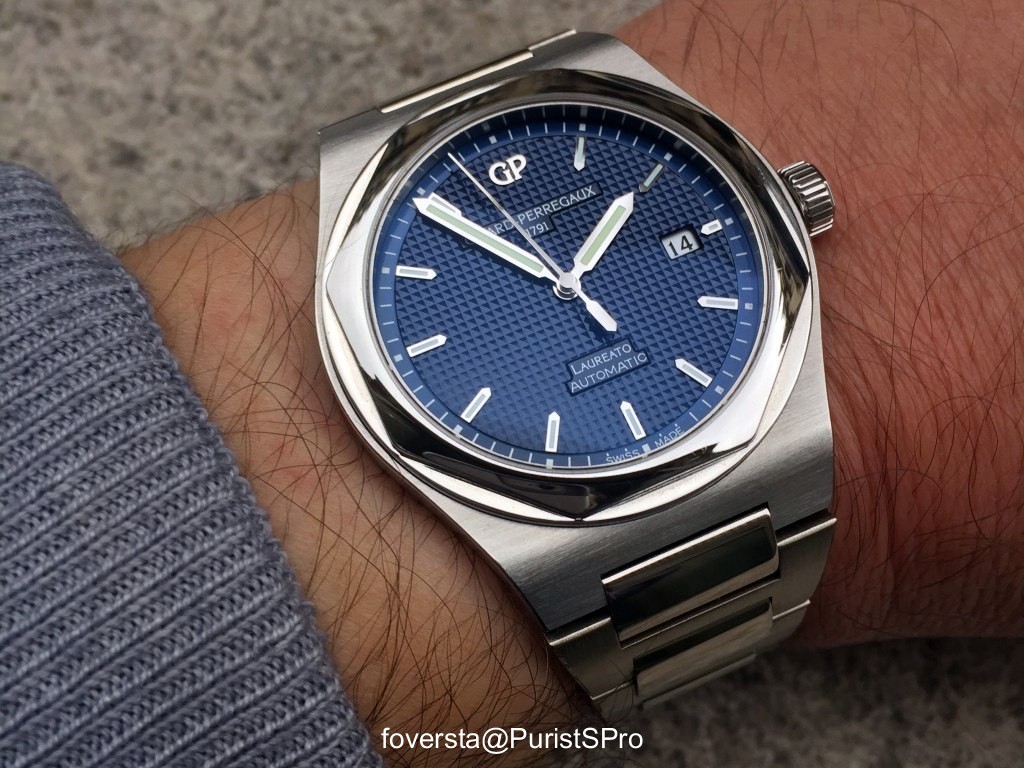
Despite this point, I experienced a lot of pleasure by putting the watch on the wrist. The shades of blue of the dial, the energy brought by the luminous elements, the blend between shart and soft parts make the Laureato very seducing. And the 41mm case diameter is perfect due to the thick bezel.
I hope that this watch will become successful and will contribute to the new dynamic of the Girard-Perregaux manufacture.
Pros:
+ a successful design
+ great dial finishes
+ the comfort on the wrist
+ the winding efficiency of the movement GP03300
Cons:
- some refined details should have been added to improve the perceived quality of the movement
- I don't understand why both versions are unveiled in the context of Limited Editions. At least one should have entered the permanent collection
Thanks to the Girard-Perregaux France team.
Fx
This message has been edited by foversta on 2016-02-14 05:20:35




My first feelings about the Girard-Perregaux Laureato (2016) Blue dial

There are two details which are easy to improve...

Thank you for this review, Fx!

This watch is the first modern GP, what I like!

Very comprehensive and great to read write-up.. Excellent pics, needless to say !.. Have seen only on pics, therefore real needed !
Which is another strong argument in favor of a not limited edition...
Thx kndly, Fx !.. That is a good piece of information !..

Too high IMO

Very nice review, Fx.


Of course i like the design

Thank you for this detailed review.

I find the case and bracelet design interesting

Bracelet watches
Well, the watch to go, the ultra slim in white gold is very expensive...
I received a bad report...
30 m is what is guaranteed....