Kong
[Moderator]
7855

Something More about Monique Wyssmüller
Something more About Monique Wyssmüller
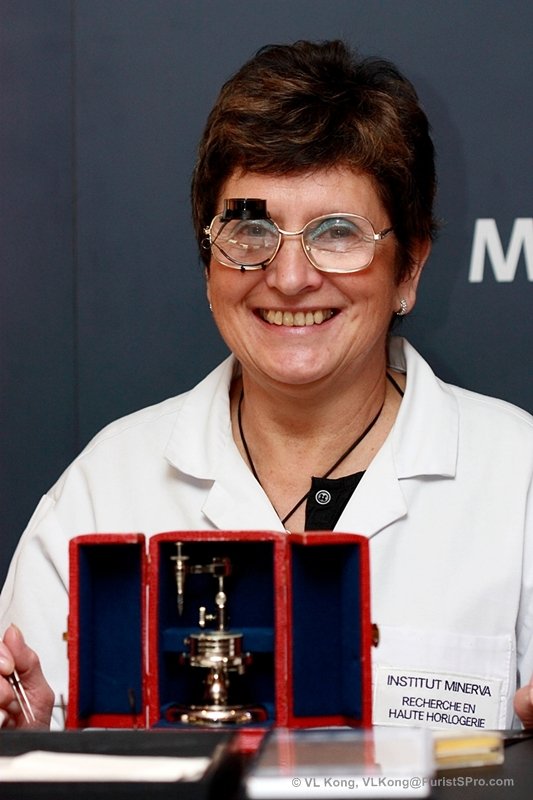
A Saturday afternoon, 15 November 2008, the first time I met Madame Monique Wyssmüller during the exhibition of the 150th anniversary of Montblanc Minerva at the Sincere Haute Horlogerie (Singapore).


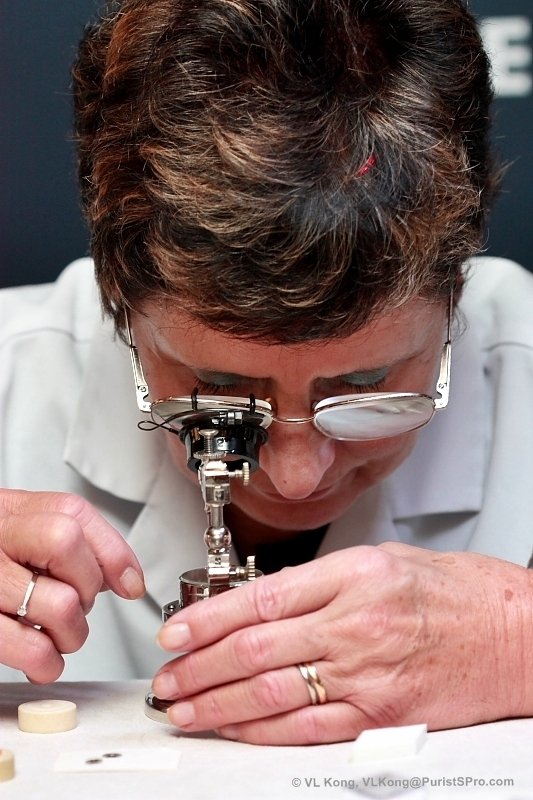
Not distracted and unperturbed by the flashes and nearing camera-lenses, she continued to assemble the balance wheels. She sat quietly, focusing on her work and demonstrating her craft.
I stood in front of the workbench observing her for over an hour without realising it. No words exchanged. Just gazing at her hand-movements, change of tools and contemplated.
This was the first time I got to witness an almost complete manual assembling of the balance wheel!
Most important is meeting the craftsman and soul behind the 'heart of mechanical watches', who is still assembling & regulating the balance consisting of many small components with such dexterity at her age. Truly remarkable.
It is a must to tell the story of this modest lady and craftsman.
Curious to find out more about this lady, I approached one of the staff to ask and a neat gentleman came by.
He was Mr. Alexander Schmiedt (now Managing Director of Institut Minerva de Recherche en Haute Horlogerie) but we did not know each other at that moment. He introduced Madame Monique's specialty, a bit of her working history and a description of the steps she was demonstrating.
Prior to this writing, there were several posts and many magazines had covered about Madame Monique's roles and her demonstration.
This post will try to uncover a bit more about Madame Monique's personal side, her horological journey and more pictures of her demonstration of the soon dying skills.
Kong
-----------------
Get to know a bit about the 'mechanical-watch heart-surgeon'
Questions (in blue) are by PuristSPro while the 'unplug' replies and the three photographs are from Madame Monique. Thank you Ma'am. Thanks to Alexander Schmiedt and Valerie Tan for assisting in the interview.
1. How did you decide to go into watchmaking? (Any influence from family members?)
I wanted to be a hairdresser or a shop assistant but my father “forced” me to study at the Ecole d’Horlogerie in Saint-Imier.
The reason was maybe that my father was engaged in making watch-cases and my mother was working in fitting the hands. Ten of my uncles worked in the watchmaking. Today, I am really grateful that I have been “forced” to go into watchmaking.
In fact some of my girlfriends at that time (and later in times of the quartz crisis) laughed at me and the “old-style” profession I learned. I just recently met one of them at the supermarket in Villeret. I told them that I was just preparing to leave for Singapore to do the “reglage”- they could not believe it!
2a) Why did you choose to be a "Certificat Régleuse plat et Breguet"? (Specialist in assembling of the balance wheel and the counting of the spiral)
To be a spring-fitter was at that time a very good job (nobody foresaw the quartz crisis at that time). But you also needed to have some patience, concentration as well as to handle with dexterity. My father apparently saw that I had these talents…and apparently it was also right.
b) What were the requirements to be certified? ( Eg. number of hours, number of countings done)
You needed to have studied in a complete way: for example, I learned to produce all kind of little tools for the watchmaking. At the end of the studies, we had an exam during two days : 1 day of theory and 1 day of practical. The whole studies took 2 years from 1964-65.
c) Were the pre-requisites to be a Certified Regulator more stringent than other specialties?
The requirements to enter the course were not really more strict. It was rather the personal qualities and talents a person brought with him/her to decide whether a person could be a good regulator in the future.
d) Was it more prestigious to be Certified Regulator at that time?
e) How many were in your class graduated as a Regulator?
f) Were they tend to be ladies? (If so, any reason/s ?
 )
)One reason why so many women did that job is easily explained: in fact that was the perfect profession in order to be able to keep working at home once you got married. There were 42 young women in my class and 36 of us graduated from the Ecole (6 others dropped out- see above c)- maybe the job requirements were not the ideal fit with their personality). I was the second best of the 36!
We only were young women because the young men were studying in order to be watchmaker. Honestly, I believe this is also because women tend to have better skills for the spring-fitter.
3) During the quartz crisis, after being laid-off you kept your tools. Why were you confident your skill & techniques would be required again?
Even during the quartz crisis, I never worked with quartz.
My father has advised me to keep preciously my tools because he was sure that the mechanical watches would once come again. From the 1976, after having stopped working as regleuse for Tissot, I did not want to work with quartz watches and instead I worked for the Swiss Post Office in Villeret. It is only from 1996 that I joined Cartier in order to fit different parts of the watch. I believe that the fact I worked for the post office actually helped my return to become again a regleuse: Because all people in Villeret knew me and my background, that was the way how Minerva found me in 2000.
4a) Now that you are back at Institut Minerva de Recherche en Haute Horlogerie, how many person/s would you be training to pass on the techniques?
A young lady is taking benefit from my experience. We work together and I try to pass some of my experience over to her. In the end, however, it is her skill and her own experience that will form her as a good regleuse. I hope when I retire, she will be able to pursue the tradition.
b) What are the most important traits to be a great Regulator?
You have to be passionate for your job, to have some patience, dexterity and wanting to maintain the tradition. And you must have steady hands-no allowed trembling even at the age of 61…If my hands would start to tremble, I would have to stop the next day.
5) How long does it take you to fully assemble, count and bend the Breguet overcoil?
It takes about one hour for one complete regulation.
6) Understand that the traditional comptage device is used for current 2.5Hz/18,000 vph.
Could the device be used for 4Hz/28,800 vph?
In theory, yes. The device can be used for all different frequencies. You would have to change the referenced balance-wheel ( the one which is inside of the tool) to the required frequency. These “potences” usually came with a set of reference balance wheels. Traditionally, these were used for 14’400, 18’000, 19’800 which were the traditional frequencies until the mid 19’00s and 21’600 later on. 28’800 is a frequency used starting from the 1980’s- but nevertheless could be worked on if you have a corresponding reference balance device.
7) During the demonstration, I saw you just bend the overcoil on the spot. I have seen other company-specialists using a template and profile-projector to assist in bending the overcoil.
Do you adhere to same procedure shown in demonstration for production components?
Yes ! I am working always like this, it is a question of experience. I curve the spiral by hand as it was done in the past, no computer tells me whether I am right or not. It will only show once the watchmaker puts the balance in the final watch. However, I have to say that I very rarely get any complaints back from the atelier…
The Other Interesting Side of Monique Wyssmüller
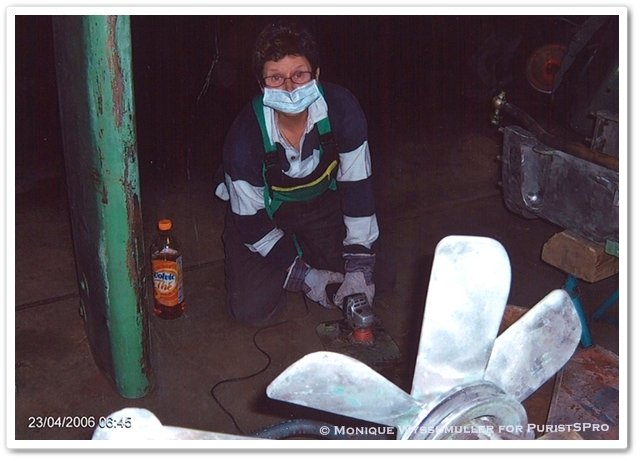
8a) Heard that you have a special hobby. How did it start?
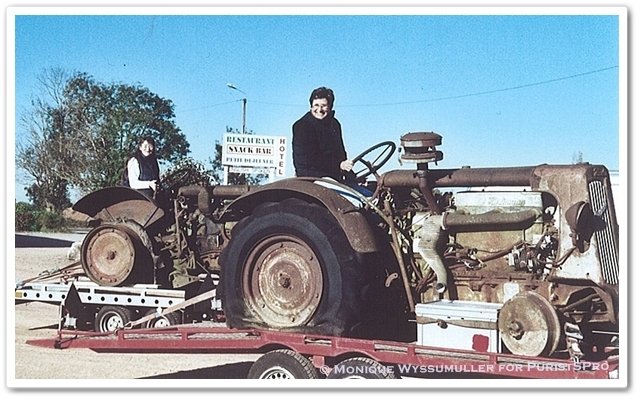
I like to help my family to restore some old tractors. Actually, it started in 1990 when my son received from his grand-father his old tractor (the grand-father was farmer). My son decided to restore the tractor and very soon the virus of restoring old tractors won the whole family
.
b) Why this hobby? ( to keep your dexterity ? )
Everyone is helping everybody when we want to restore old tractors. There is a whole group of aficionados around Europe who share this hobby. Every two years, we organize a meeting of “old tractor” aficionados in Villeret- last one was in last summer. More than a hundred of collectors came (some of them even came by tractors from Paris- took them quite some time….).
c) How many did you collected?
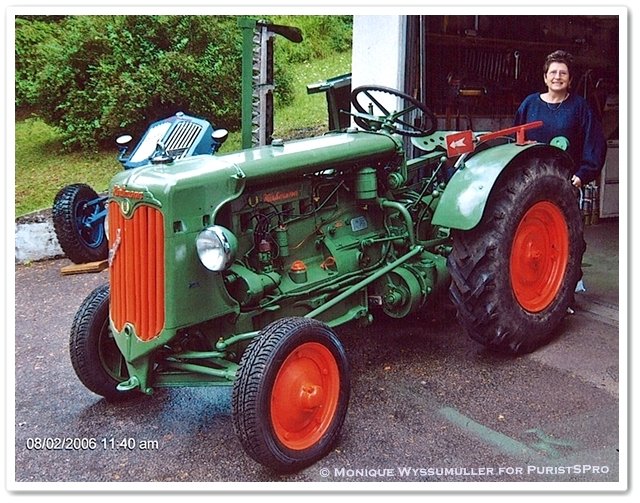
We have about 60 old tractors in which 12 have been restored (fortunately my son has a farmhouse with an empty stable…). Sometimes a farmer calls us and tells us that we can pick up a wreck- and then we have one more.
9) Anyone in your family in the watchmaking currently?
No.
10) Do you have happen to have a idol-watchmaker? Why this person?
An old watchmaker was working in Les Longines, in the years 1966-1968. At that time, I was working there and with him. He was very very strict with his profession- and very strict with me as a young regleuse just out of school. He was a kind of “watchmaker father” for me and he taught me a lot. I learned a lot from him- especially because he did not tolerate any mistakes.
-------------------------
Some pictures of Madame Monique's demonstration ...
Her Tools
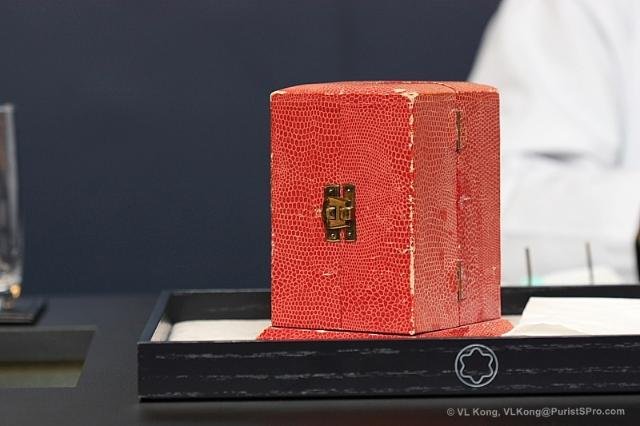
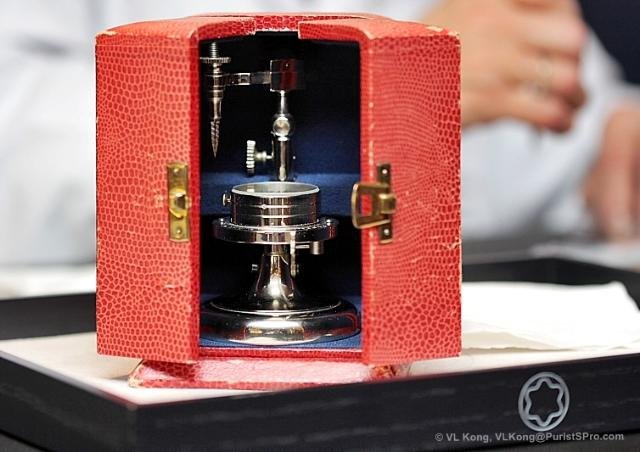
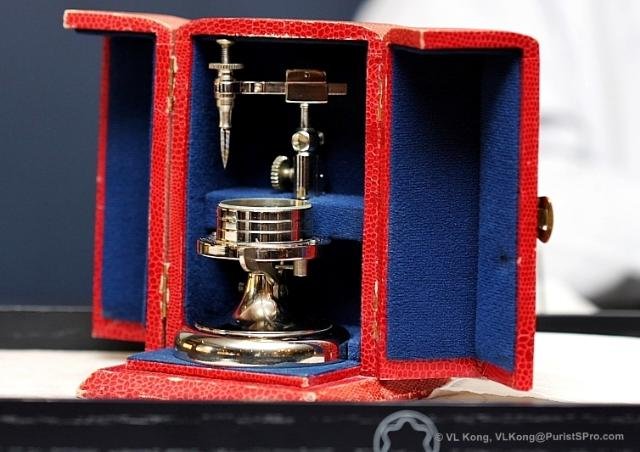
The 'secret weapon' which is with her for more than 40 years...
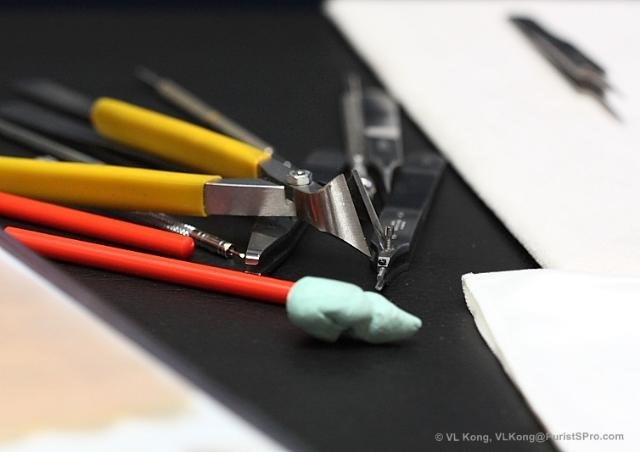
Tweezers, sharp cutter, watchmaker screwdriver, etc.
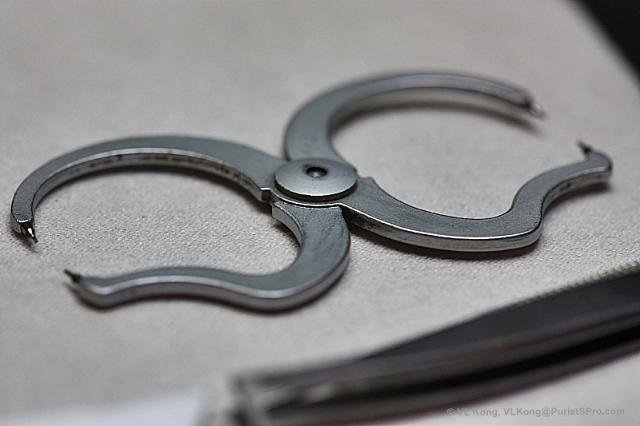
A caliper for truing the balance.
Back to the 'secret weapon' ....
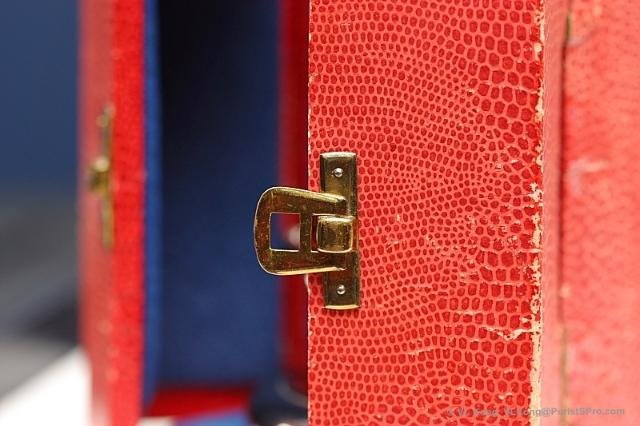
The well-aged mini trunk-case open ...
The Components she works with ...
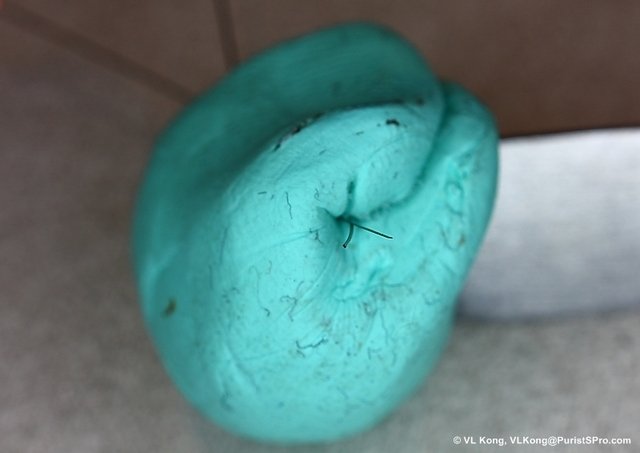
The material for spiral/hairspring ...
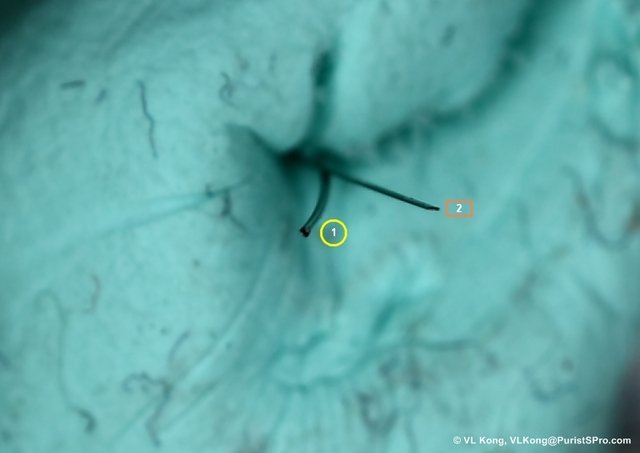
Zoom in ...The proprietary raw material for the hairspring (marked as '1') which is round, of diameter about 0.65mm.
The final form (after through 9 fine-wire drawing process), the cross-section is flattened to the thickness of 0.05mm.
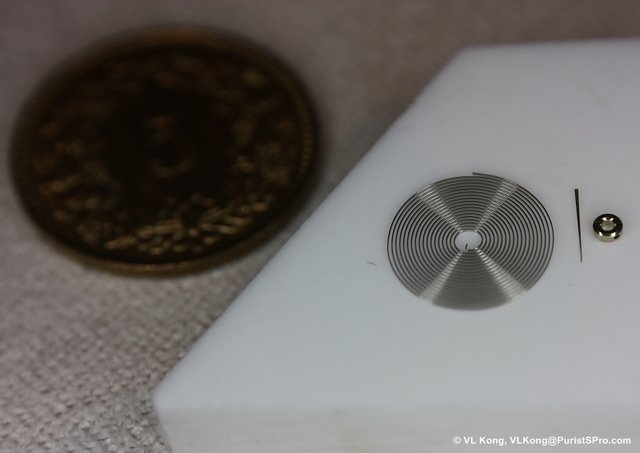
Was using a Singapore 5-cent coin as a reference for size, Madame offered her 5 centimes of diameter 17.15mm.
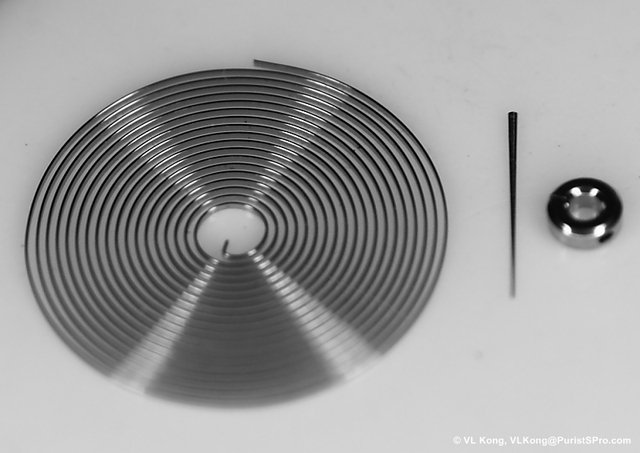
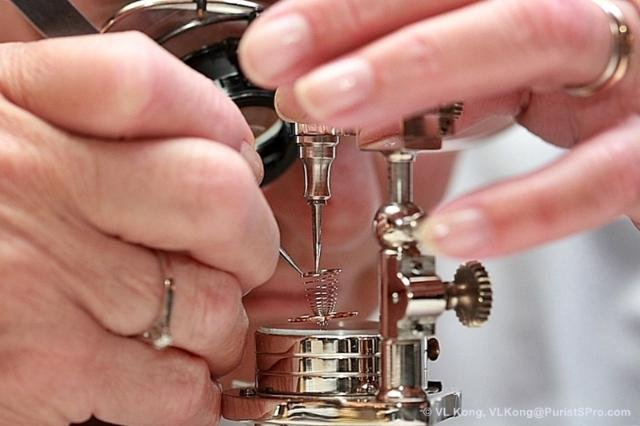
A closer view of the spiral, the pin and collet.
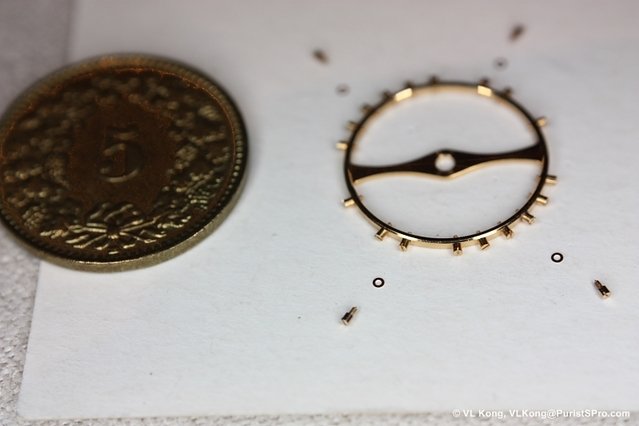
The beryllium copper balance wheel is produced in-house too. Edges were bevelled and holes were tapped for the tiny
mass screws. The balance wheel was poised too.
Initially , 4 sets of quarter mass-screws and washers were mounted.
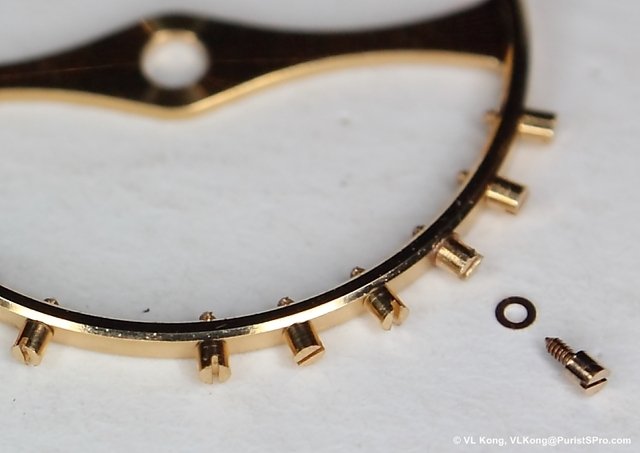
The rest of the holes were put in without the washers.
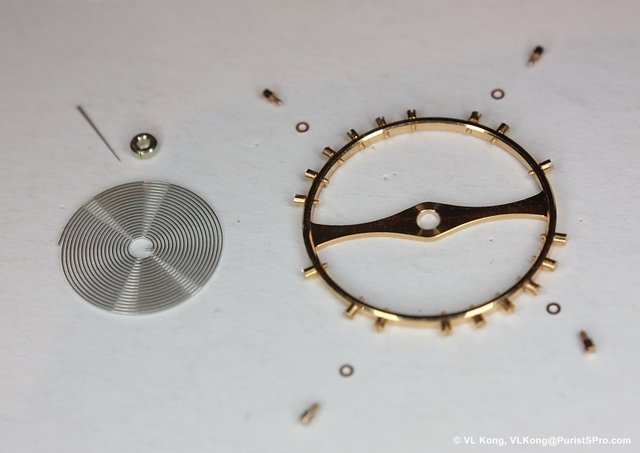
Another overview of the components before the comptage (the counting & active length determining step)
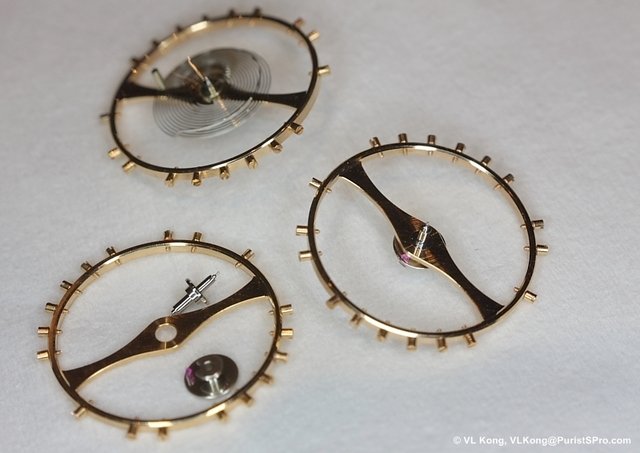
A snapshot of the rest of the components and a fully assembled piece (the piece above with the overcoil spiral).
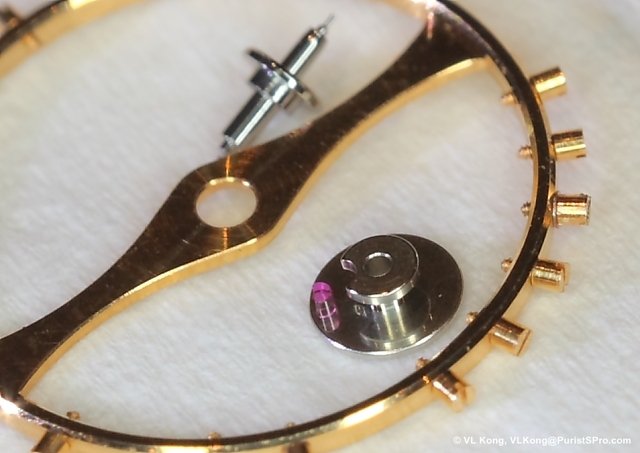
Another component on the flip side of the balance - the balance staff and the impulse ruby pin
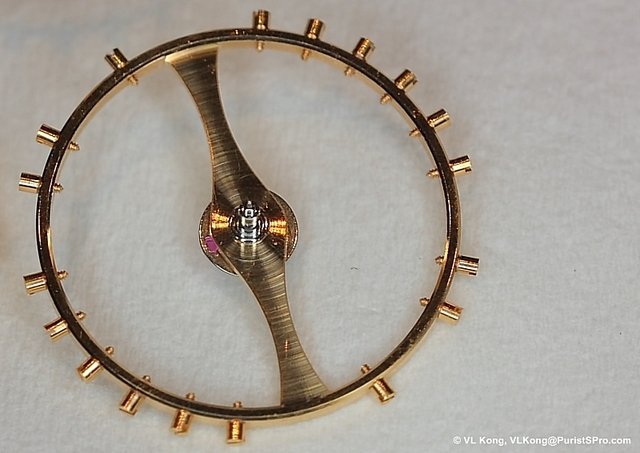
Fitted without the spiral
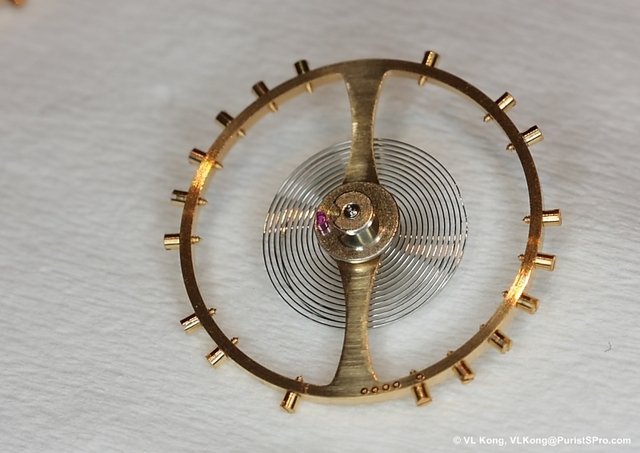
Side-tracking.... please note the few holes on the rim.
This was done during the poising step, and that area was the heavy point, thus material was removed by drilling (not through).
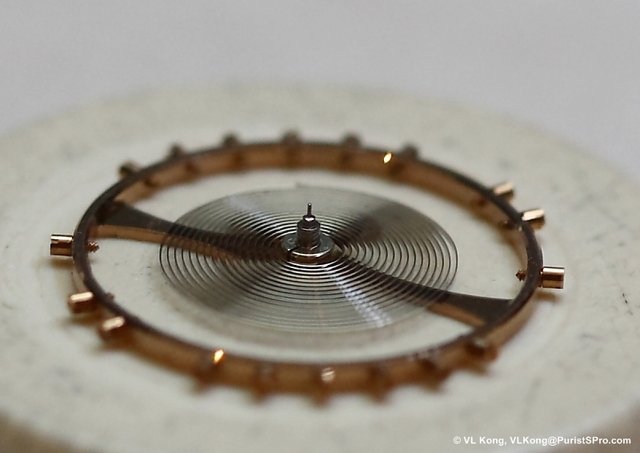
This is how the semi-assembled balance looked like.
After this, is Comptage time!
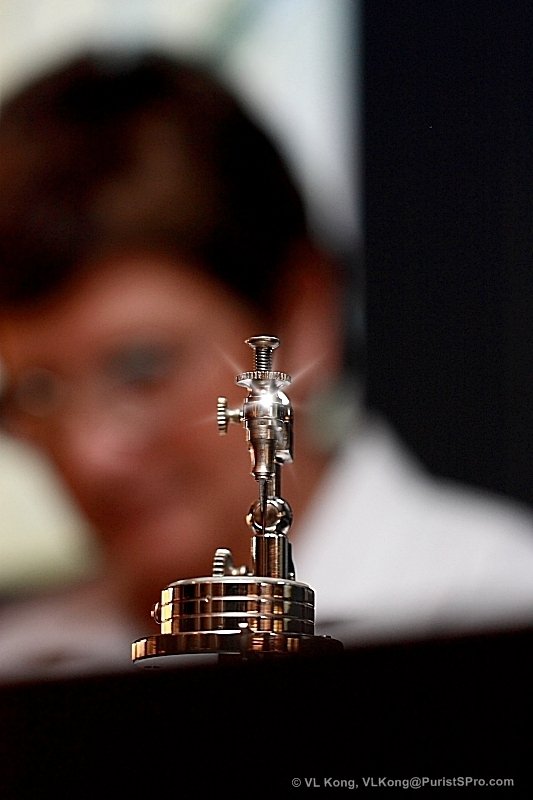
The traditional Comptage device for manually determining the active length of a hairspring.
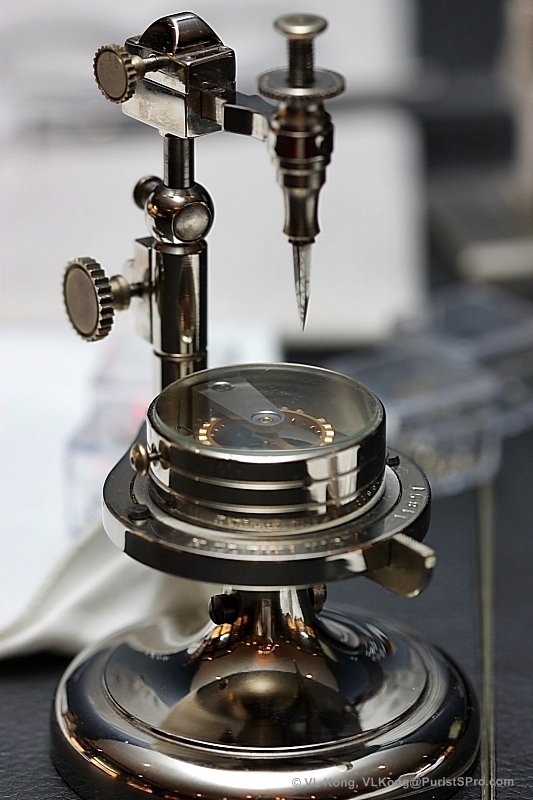
This one oscillates at 18,000 vph or 2.5 Hz.
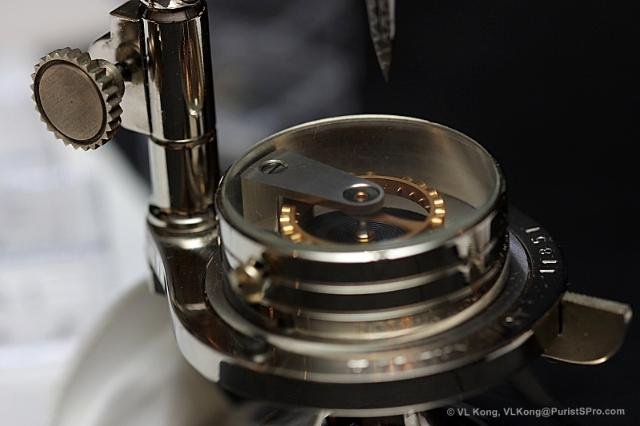
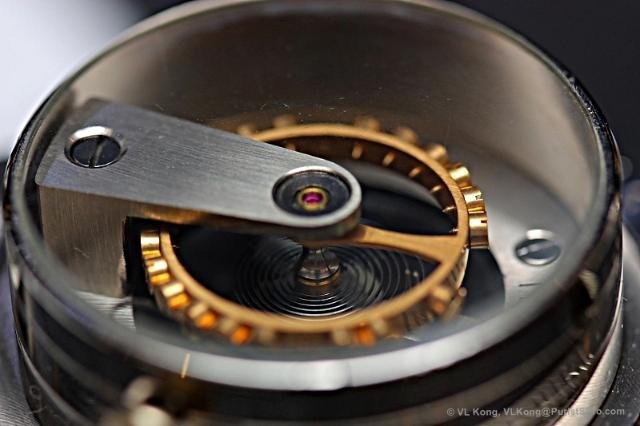
A clearer look of the reference balance inside the comptage device.
Now, to see Madame in action ....
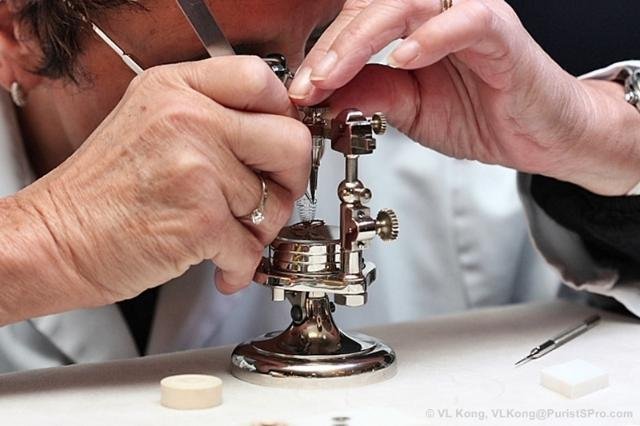
With a pair of tweezers, she attached the outer end of the spiral to the comptage device upper clamp suspending the balance
wheel over the reference balance (in the device).
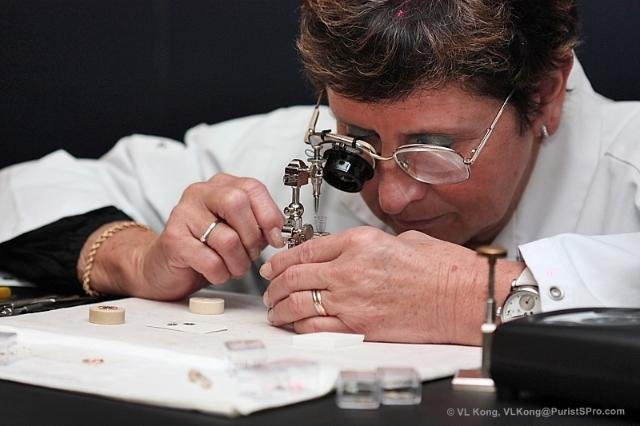
Adjust till the end of the balance stuff touched the glass and level the balance to the glass surface.
Next align balance wheel stuff directly above the reference balance endstone.
Then set both the balance wheels in motion and the counting process began.
Oh...guess what watch she is wearing (with dial and straps matching her lab-coat)
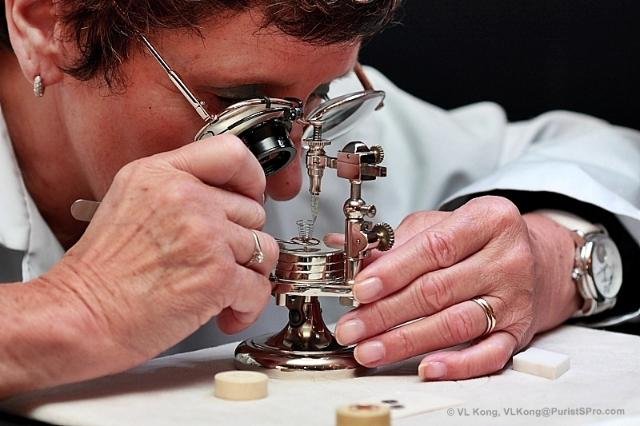
Setting the wheels in motion ...
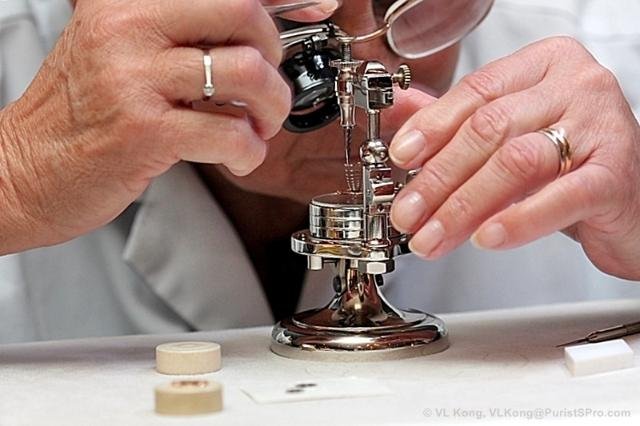
The counting process continued by moving the outer end of the spiral till the both the balance wheels began to oscillate
synchronously.
From the pictures below, you could observe Monique adjusting the end of the spiral to get both balances in synch!
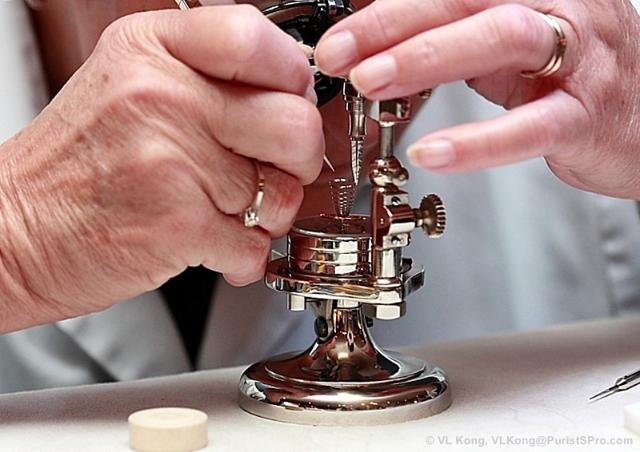
Counting ...
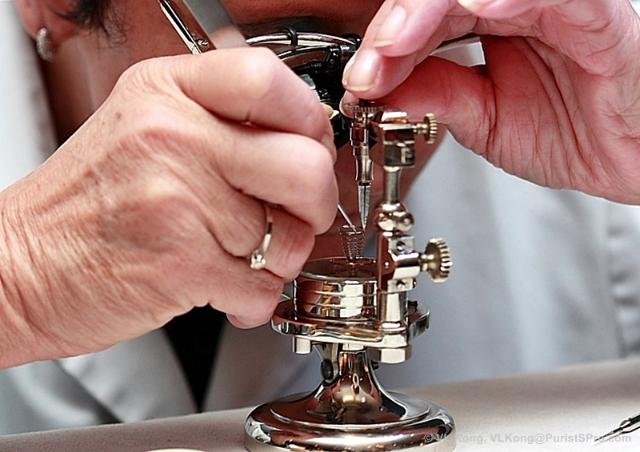
Releasing the grip of the clamp and moving the end of the spiral ...
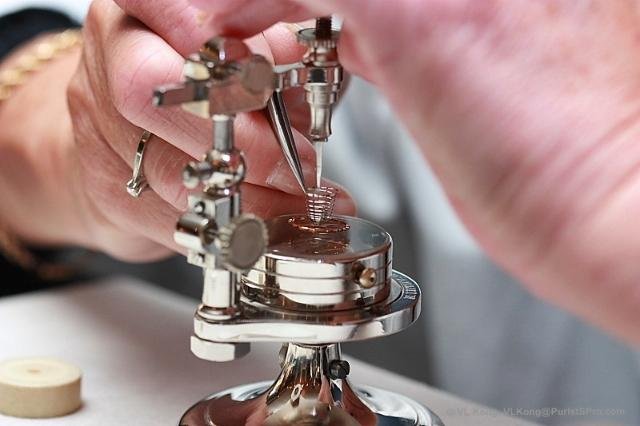
View from another angle ...
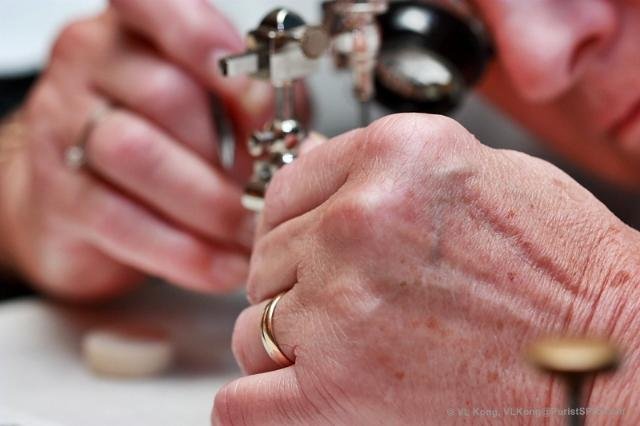
These nimble hands that make 'comptage' and bending the Phillips overcoil look easy ...
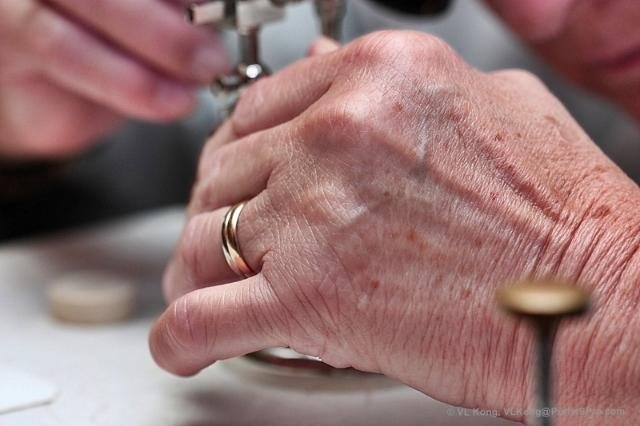
The same hands that handles heavy equipments and restoring tractors!
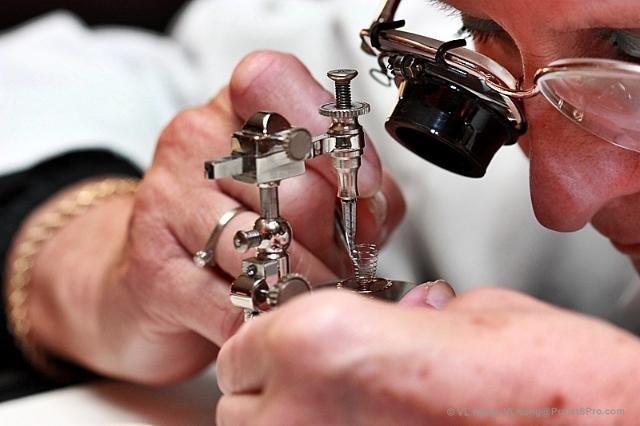
Focusing... centering the balance wheels with each other...
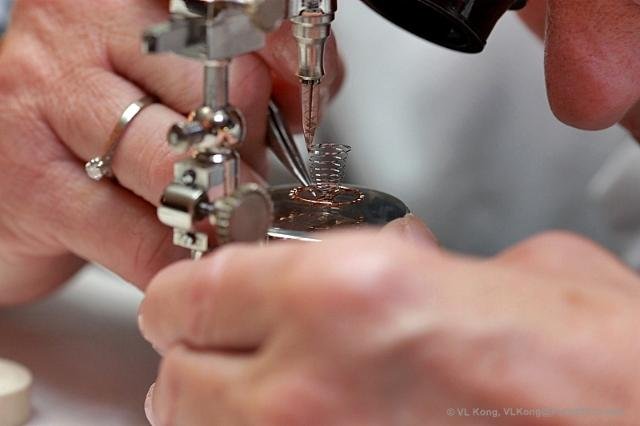
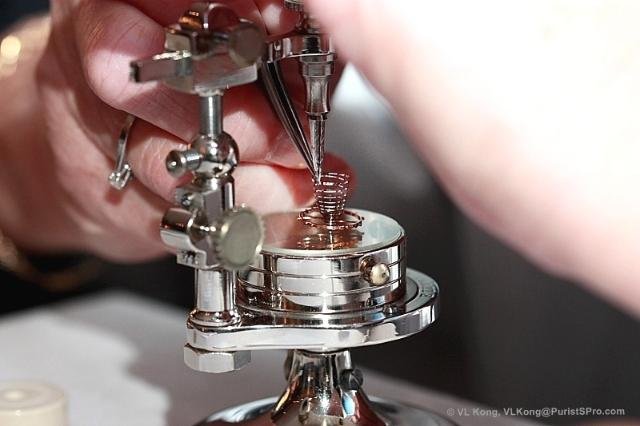
Readjusting the length again, by moving the end of the spiral ...
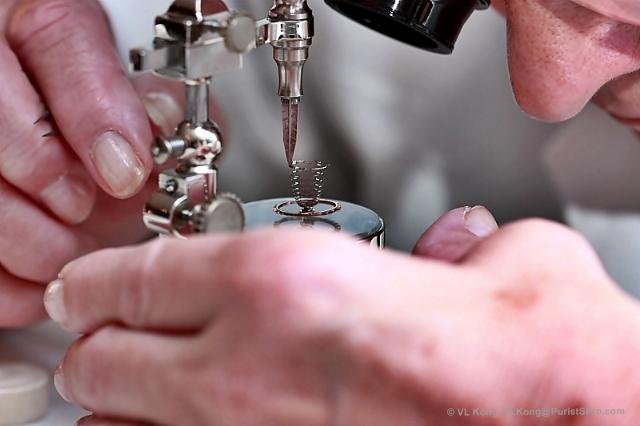
Counting ...
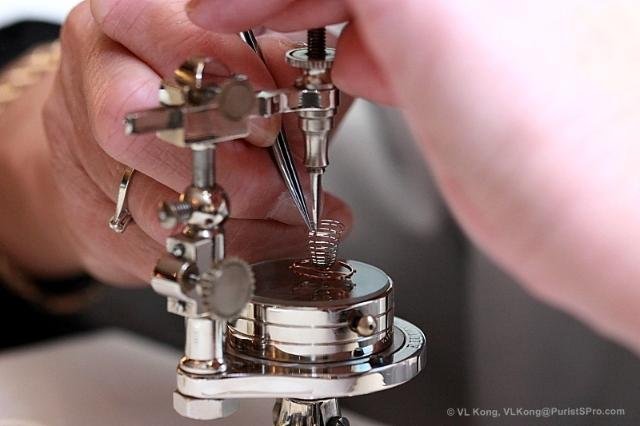
The process iterated ...
Alas, the correct length determined!
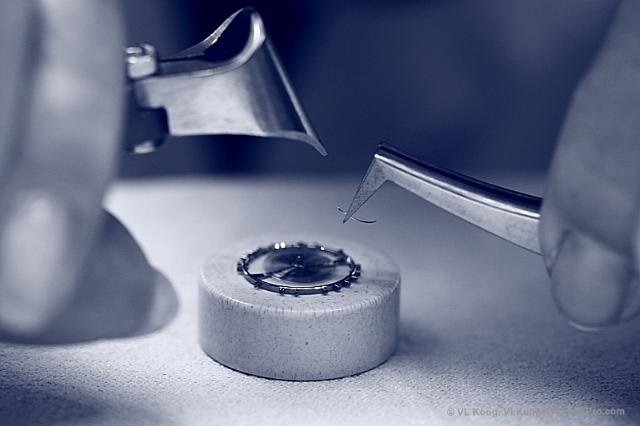
The excess length removed ...
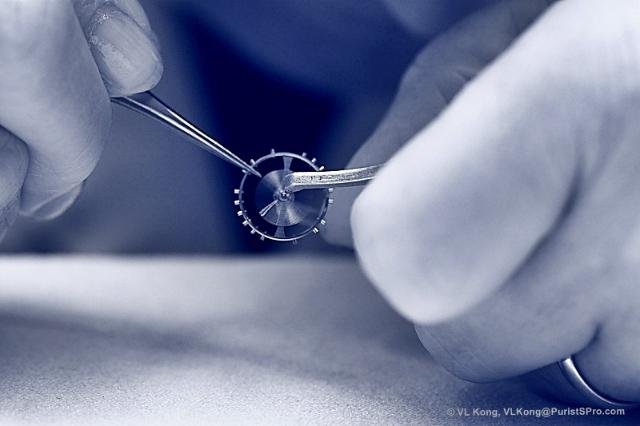
Placed onto the caliper to recheck the truing ...
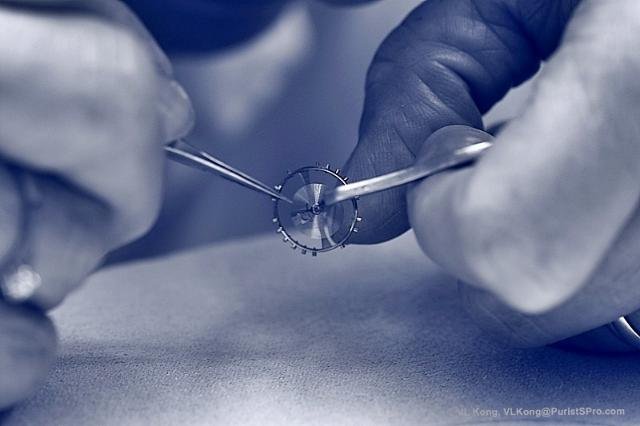
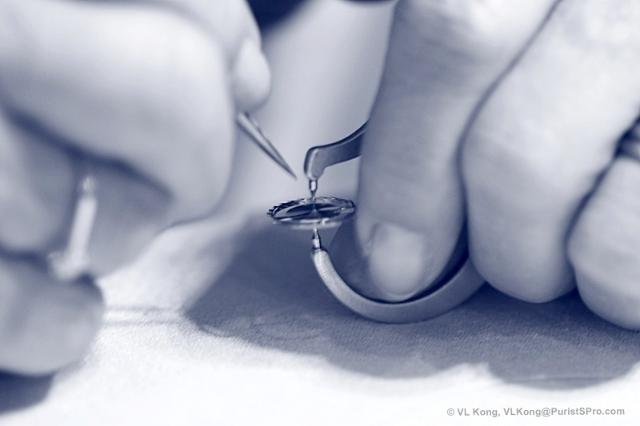
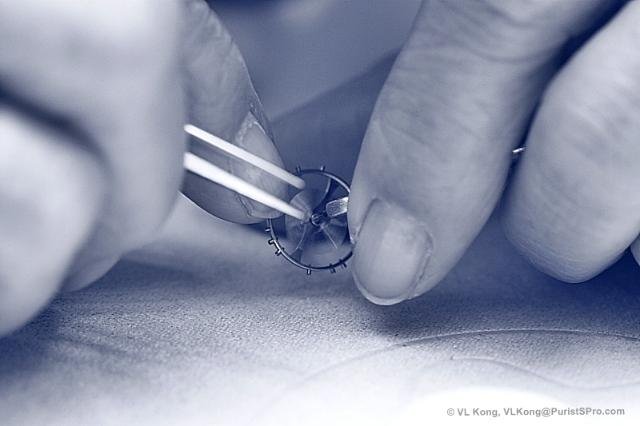
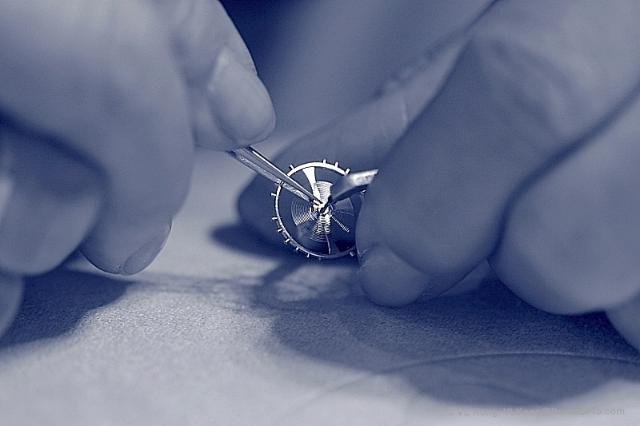
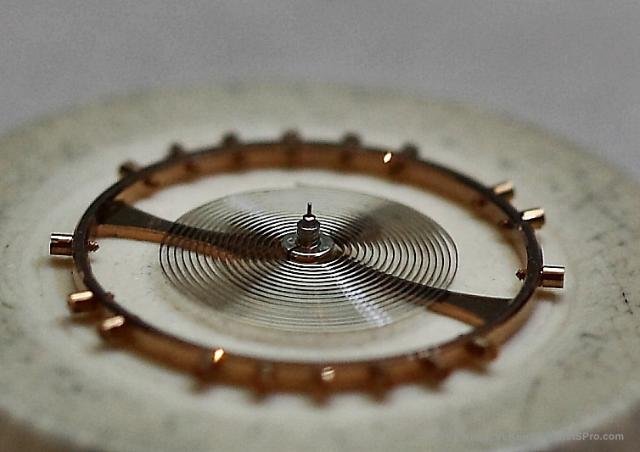
Now ready to bend the Phillips terminal curve ... another skill which requires many years of experience, time and concentration
to execute.

With special tweezers, the steady hands bend the outer end of the spiral upward and inward forming the Phillips terminal
curve or overcoil.
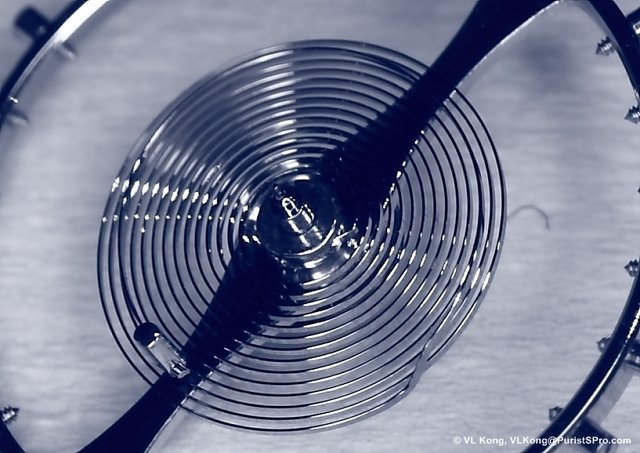
A close up of the completed balance wheel assembly.
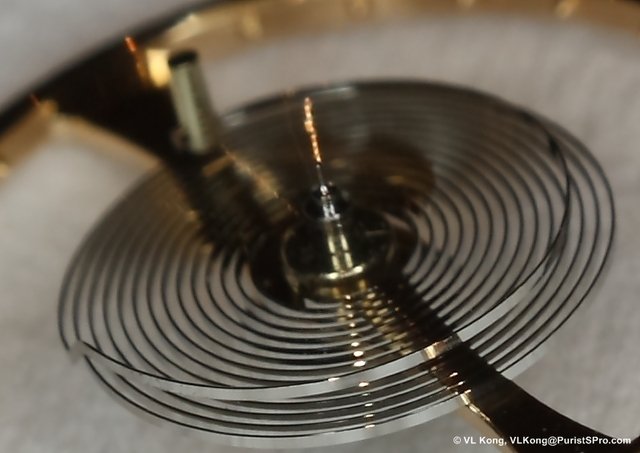
The terminal curve or overcoil.
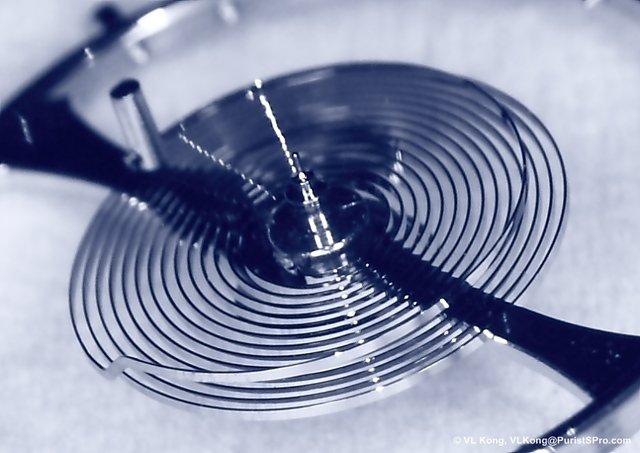
In monochrome for a clearer view.
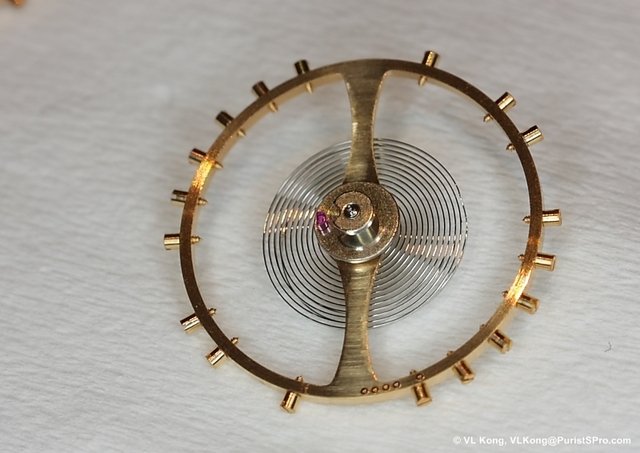
The view from the underside.
Thank you Madame Monique. It is a privilege to see you in action and I hope
many more enthusiasts would have the opportunity too.
Kong
For further readings, please refer to :


Mike Ting's post, please click here.
SJX's post , please click here.
MTF's HK coverage, please click here
Details about poising, for John Ei8htohms' article : please click here.
Details about comptage , for John Ei8htohms' article : please click here.
This message has been edited by AnthonyTsai on 2009-05-04 06:13:23
Correct broken link to MTF's HK coverage.
This message has been edited by Kong on 2009-05-04 12:57:13 This message has been edited by AnthonyTsai on 2009-05-10 15:37:07
Something More about Monique Wyssmüller
Something more About Monique Wyssmüller A Saturday afternoon, 15 November 2008, the first time I met Madame Monique Wyssmüller during the exhibition of the 150th anniversary of Montblanc Minerva at the Sincere Haute Horlogerie (Singapore). Not distracted ...

Thanks for these personal details, here is a pic of the finished product...
which I still have at home! Cheers, Magnus...
Thanks Magnus for the nice pic ...
How do you derive the number (N) of the terminal curve? Kong
Paul Gerber once presented me with a booklet on Phillips terminal curves...
which contains graphs of the different curves, and we sat together and tried to figure out which one it was... Great fun! Best, Magnus

Thoroughly fascinating article, Kong . . .
. . . and my respects to Mme Wyssmüller. Movement assembly has progressed immensely over the decades, but the facility to manually perform the adjustment of a hairspring imbues Minerva's movements with an aura of tradition that few others can aspire to, l...
Well said Art. Indeed the preservation of the craft is important however ...
I'm particularly interested in this spiral /hairspring comptage-overcoil craft, as it has functional attributes and not purely aesthetic. Kong

The Institute part of Montblanc-Minerva.......
Thanks Kong and Monique for the stories. I am fascinated that there are other enthusiasts (tractors) even more crazy than watch collectors. I guess they are PuristS as well.......driving from Paris to Villeret at 20km/h requires some form of mental illnes...
Heard about the initiative of supporting new young creative watchmaker ...
and looking forward to any update. I am equally curious what the tractor-enthusiasts did throughout the journey Kong

Thanks for the article Kong
I'd like to see Monique in action someday to see if I'm visualizing everything in my head correctly after reading all the recent reports here on comptage. Oh yeah, love the picture you took of the comptage device. The sparkling glare on the device is bril...
If have a chance to watch Monique work, please do!
A, thanks for the kind words. Hope Monique would be going to USA. If you know French, it will be a big advantage, otherwise it will be sign-language Hmm...on her wrist, should be a Star Lady Automatic with moonphase. Think with MoP dial too. A pic for you...

Excelent post, and...
...a very interesting insight to a less known aspect of watchmaking. Thanks! Carlos Torres

Utterly fascinating
Thanks, Kong, for a fantastic post. Madame Wyssmüller is a living treasure. I wonder if women might be better suited to being spring fitters, as Madame posits in her interview, because of their smaller hands/fingers? Her tractor restoration hobby mak...

Thank you Madame Monique Wyssmüller for sharing your story
and Kong for reporting it to us. I look forward to owning a watch whose "heart" is personally crafted by Monique one day. Best, Mike

A good read...thanks Kong.
I must say she is a very capable lady with talented skills. Montblanc....hmmm.... Regards


Fantastic post.
I really enjoyed the reading. She got some skills. Amazing job. Thanks for sharing. Vte