Kong
[Moderator]
7855

The new 2011 L.U.C Quattro
L.U.C. was officially started in 1996, with the first revered movement, the L.U.C 1.96, joined by the tonneau-shaped L.U.C 1.97 and then the shocker 4-barrels hand-wound L.U.C 1.98. At that time, around year 2000, the four sequential barrels with 216 hours of power reserve is an incredible feat, which is still today as not many houses have such capabilities.
The calibre L.U.C 1.98 is very important as it is the base from which evolved ithe tourbillon-movements L.U.C 1.02 and L.U.C 4TXX series, not forgetting the L.U.C Regulator variation which won 2004 Watch of the Year.

The first L.U.C Quattro model with the movement L.U.C 1.98 issued in year 2000.

The L.U.C Quattro Regulator 4R, which won the 2004 Watch of the Year prize awarded by a jury of professionals brought together by the Montres Passion and Uhrenwelt.
One of the earlier version of L.U.C tourbillon with movement L.U.C 1.02 ...
and also in the latest L.U.C Triple Certification piece !
After Chopard's 150th anniversary last year, the 2011 collection is with a more contemporary look and also given a clearer identity, to clearly differentiate L.U.C among the various Chopard lines of watches (like the Mille Miglia, Grand Prix de Monaco Historique, SuperFast, Jacky Ickx and the Happy Series).
Starting in 2011, the brand name now is clearly labeled in full - " L.U.Chopard ".
Actually the first piece which had this new identity was the Anniverary piece L.U.C Louis-Ulysee - The Tribute.
The 2011 L.U.C Quattro, a more contemporary look, designed to attract the younger audience and segment that prefer less classic aesthetic. This model comes in either 18K white gold or 18K rose gold case.
Beside the facelift, the case is enlarged to 43.00mm. Fortunately, the calibre L.U.C 1.98 is not small, thus the dial layout is still balanced and proportionate.
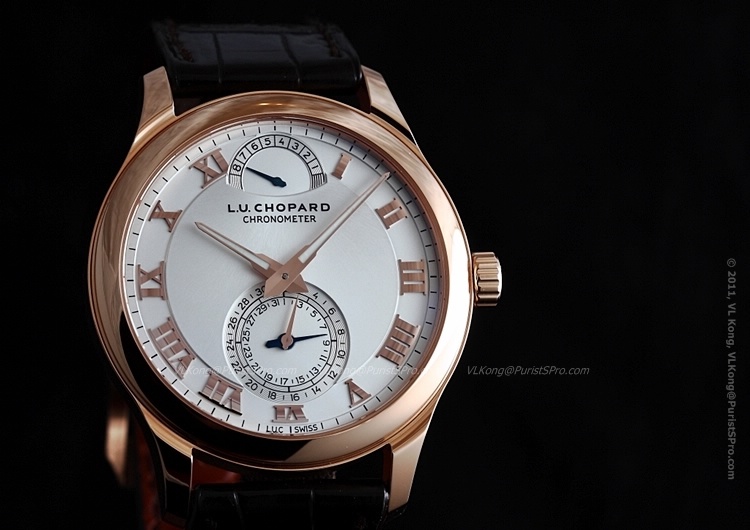
The power reserve indicator is at 12H, but was reversed (flipped up) from the previous version to look like a speedometer.
The maximum power marked is 8-day even though the power reserve is 216 hours or 9 days.
The reason is to ensure the timekeeping is consistent, it signals the owner to wind the watch before reaching the unstable zone of the 9th day.
This watch could be designed for people who enjoy winding their watches during their leisure time. A good time to wind could be on a quiet weekend evening with a nice glass of drink ( and perhaps cigar), turning the crown, seeing the power being injected and the indicator rising. After that, turn over and enjoy the beautifully decorated Calibre L.U.C 1.98 . This could be an every weekend routine, before the start of the new week, completely charge up to go for another week.
It is also logical to have a power reserve indicator on a manual-wind than on an automatic, in my opinion. As long as an automatic is being worn, the barrel will be charged up, which in a way, making the power reserve indicator less useful or serve a purpose, and perhaps just present to serve a reason for an extra line in the specifications. Since it is always being charged, it is kind of robbing the fun of a prolong winding routine 
Previous model, about 90 turns of the crown could fully charge the barrels. With a slightly bigger crown in this 2011 model, I guess it could be around the region of 70 to 80 turns though.

At 6H subdial, some people were puzzled with the functions.
It is a combination of the date and small second function.
The dark blue hand is the date-hand. The date indicator has two rings - the outer ring for even date while the inner ring which the dark blue hand could block is for the odd date.
Perhaps the odd number ring is sufficient and make it less cluttered, however due to the enlarge case and dial, the extra even number ring was added.
The date is not easy to read for someone with longsightedness without their glasses.

Both the newly designed dauphine hands are coated with superluminova for low light reading.
The dial as seen above is silvered satine and layered to provide depth.
Roman hour-indexes applied on.

Case is finishing to create the contrasting effect, with the side of the caseband brush-finished whereas the rest of the areas are gloss polished. Signed 18K gold crown of diameter 6.50mm.
Sapphire crystal is double anti-reflective, providing exceptional clarity.

At 43mm case diameter, these lugs protrude out when worn on smaller wrist. I would prefer the case diameter to be smaller, at maximum 40mm and more tapered down lugs to flow nicely on a smaller wrist. May even suitable for ladies.
The case thickness is slick at 8.80mm . Water resistance rating is at 50m.
The hand sewn alligator strap is luxuriously lined with a layer of brown alligator leather.


Sapphire caseback allowing the display of full splendour of the L.U.C 1.98.

The L.U.C 1.98 is COSC and Geneva Seal certified. Bridges adorned with Cote de Geneve and with bi-colour inscriptions. Swan neck regulator. The L.U.C 1.98 with four stacked and series-coupled barrels beats at 28,800 VPH (4Hz).
Some pictures of the white gold version for reference and comparison ...
Suitable for those who prefer to be understated ...
I quite like this white gold version, clean look with small dose of contrasting blued hands on both the power reserve indicator and date-hand.


And two wrist-shots on a gentleman's wrist ... a bigger wrist than mine ...


The new L.U.C Quattro is a really nice business watch. However, it is advisable to try it on in the boutiques or authorised retailers as reading the date could be challenging and the pictures above are all close-up shots. For friends who like manual wound movement, check the Quattro out, as it is the only manual wound base-movement for L.U.C at the moment, and if you really like classic design, the first generation is also very charming.
After seeing these two pieces, which appeal to you more?
Thanks for viewing.
Kong


This message has been edited by Kong on 2011-12-07 09:45:57 This message has been edited by MTF on 2011-12-07 17:25:20 This message has been edited by Kong on 2011-12-08 06:04:20


The new 2011 L.U.C Quattro


Interesting question
I can live with the small date but...

Another wonderful report Kong.

Those advises ...

Thank you Kong, very appealing report

White metal, all the way and always.
