
Marcus Hanke
[PuristSPro Moderator]
11295

Calendar mechanisms: their classification and adjustment
Hi Chris,
I hope I did interprete your questions correctly. Not being a native English speaker, it can sometimes be tricky for me to guess what is really meant.
First, regarding the differences of the various calendar designations:
The moonphase does not have anything to do with the fact whether a mechanism is a perpetual calendar or not. There are perpetual calendars on the market without the moon phase display. Normally, the differences are as follows:
1. "Normal" or monthly calendar: has a date display (either window or hand) from 1 to 31. Changes the date every midnight, but has to be corrected manually in every month with less than 31 days.
1.a. "Day-date": Adds a weekday display to the date, but the mechanism is still the same: at the end of every month with less than 31 days, it has to be corrected.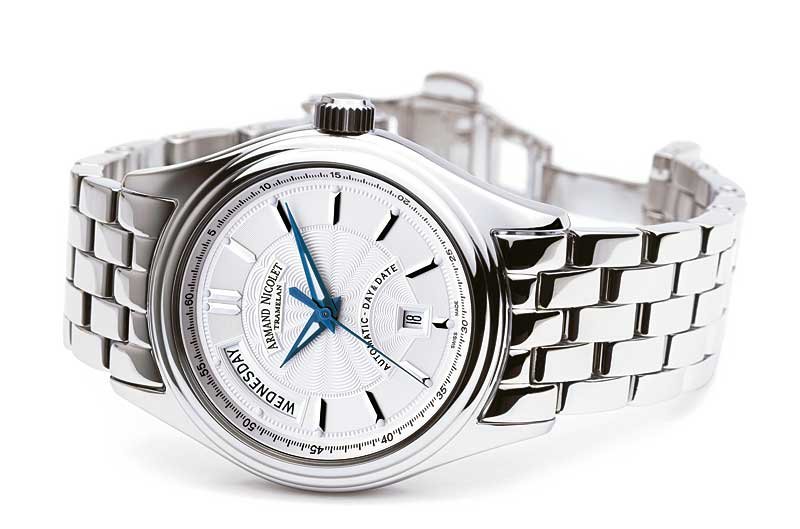
1.b. "Full calendar": Adds a month display, and - sometimes - also a moon phase. 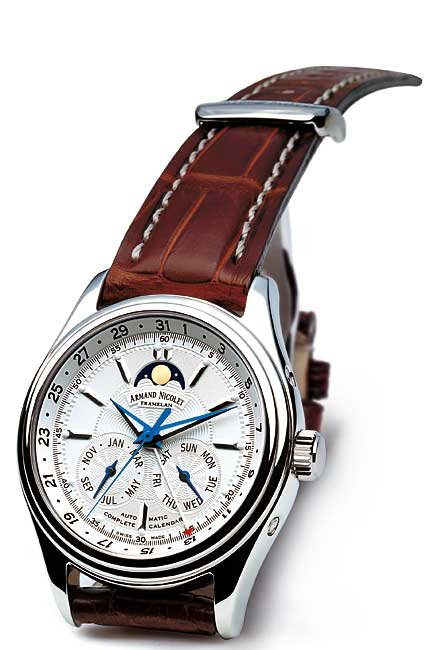
The mechanism's intelligence is still the same, but additionally, you have to adjust the correct month and the moon phase. Some movements do switch to the next month whenever the date jumps from 31 to 1 of the next month, but there are also movements where the month display does not have any automatic gear at all, but has to be advanced manually every month. For the moonphase, the wearer has to adjust that manually as well. See my article on moon phase mechanisms and their accuracy:
ulyssenardin.watchprosite.com
Generally, the presence of the moon phase display is independent of the calendar mechanism, and can also be adjusted independently. There are exceptions, but these will be mentioned later.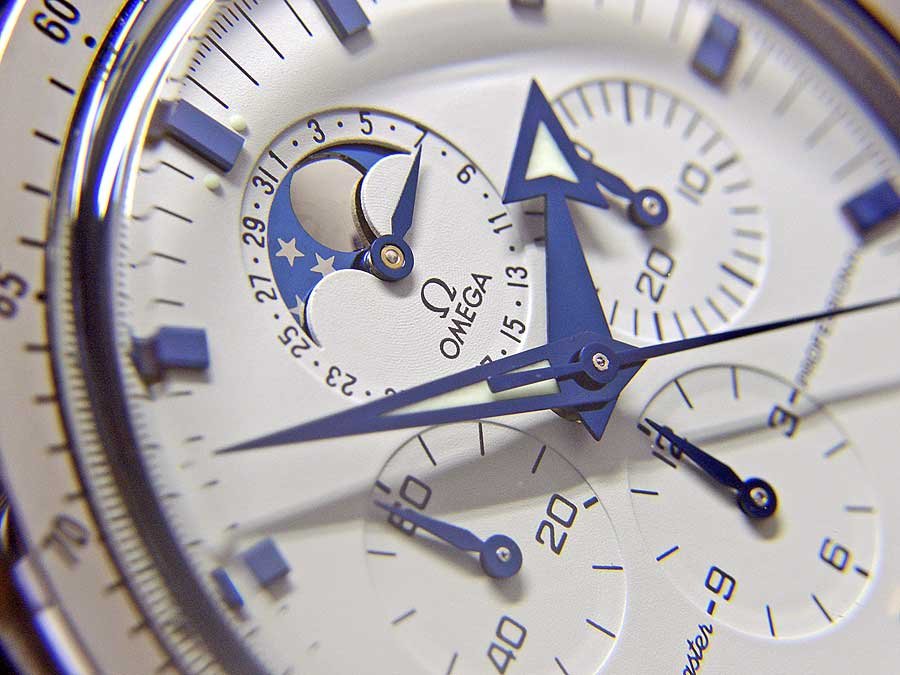
Example of a moonphase display, paired with a date hand, on an Omega Speedmaster.
2. "Annual" calendar: This mechanism derives its name from the fact that it has be manually adjusted by the wearer only once a year. Contrary to the standard watches with date display, these calendars already need some kind of mechanical program: the sequence of months with 31 and 30(special case February is now treated as 30) days is as following: X - X - X - X X - X - X. The gearing is pre-programmed to show all 31 date numbers in months with X, but to quickly pass over the 31 and immediately switch to 1 from 30 in months with -. Unfortunately, the February is a special case, normally having 28 days, with a 29rd day every four years (leap year). This month is not recognized in the program, so every year, the owner has to manually interfere, by changing from 28th (or 29th) of February to the 1st of March.
These annual calendars are rare, but a highly interesting complication. For correct use, they only need a month display aside the date: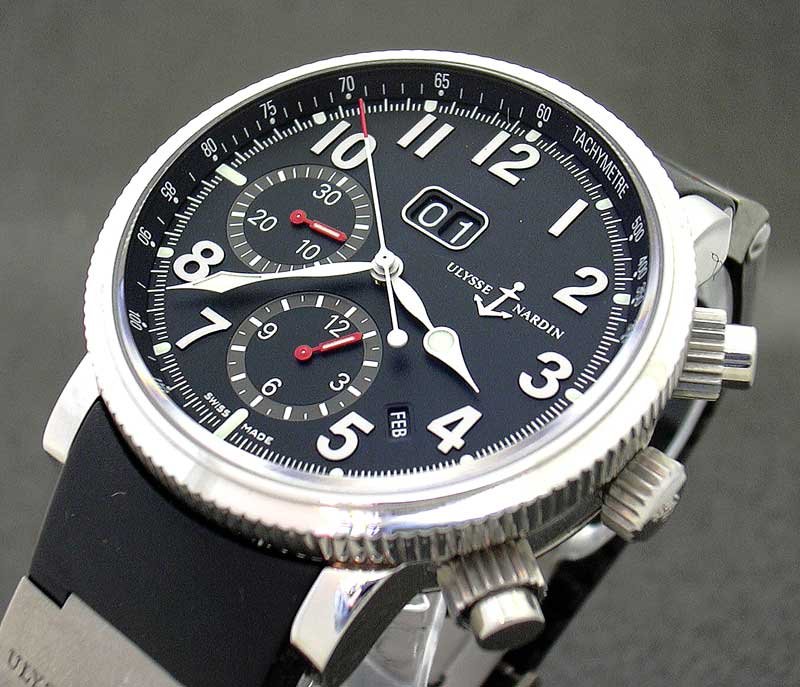
Sometimes, other indications, such as weekday and/or moon phase can be added, but do not affect the classification as "annual calendar".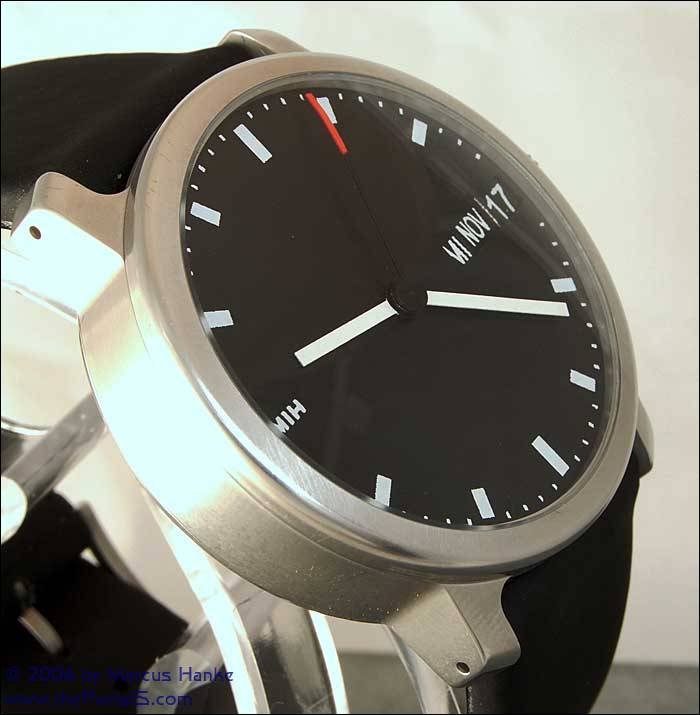
3. "Fouryears calendar": These are really rare, I am aware of only an older Breitling offering this complication. The "program" of the annual calendar is extended her, by recognizing the February as a month with 28 days. As a consequence, the owner needs not to interfere with the mechanism for four years. Only in leap years, he has to manually change the February from 28 to 29.
4. Perpetual calendars: The next step is the extension from recognizing the 28 days February every year to the recognition of the one February with 29 every four years (leap year). Counting the program interval, this means that the watch has a full four years program, that is constantly repeated. Thus, it is not really a "perpetual" calendar, because our Gregorian calendar system will drop a leap year every 100 years. Consequently, nearly all mechanical perpetuals on the market will have to be manually corrected every 100 years.
Again, the designation as a "perpetual" is based solely on its mechanical program, and not on the number of indications. There are perpetuals without moon phase and others that show the year: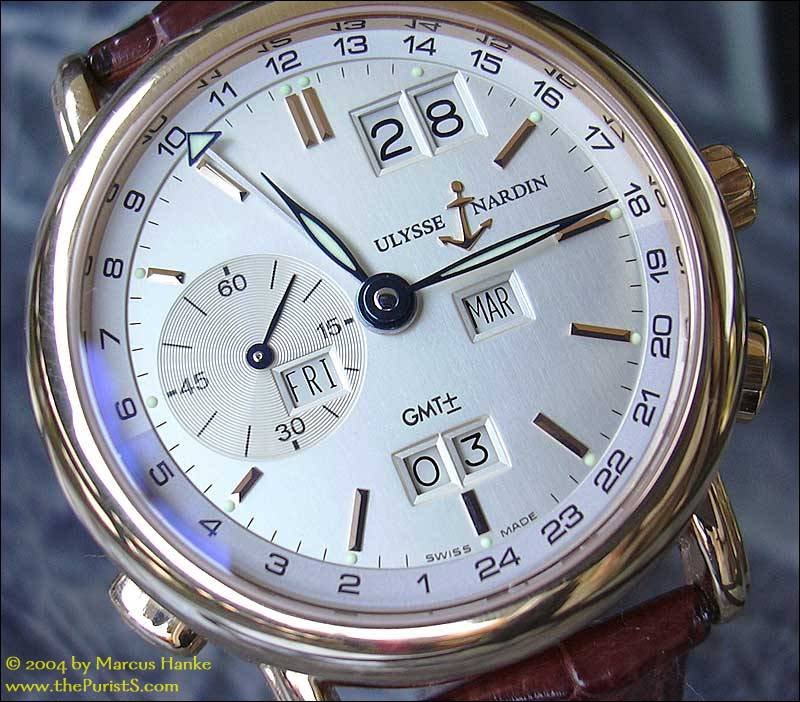
This Moser perpetual only shows the date and the month, neither weekday, nor moon phase is shown: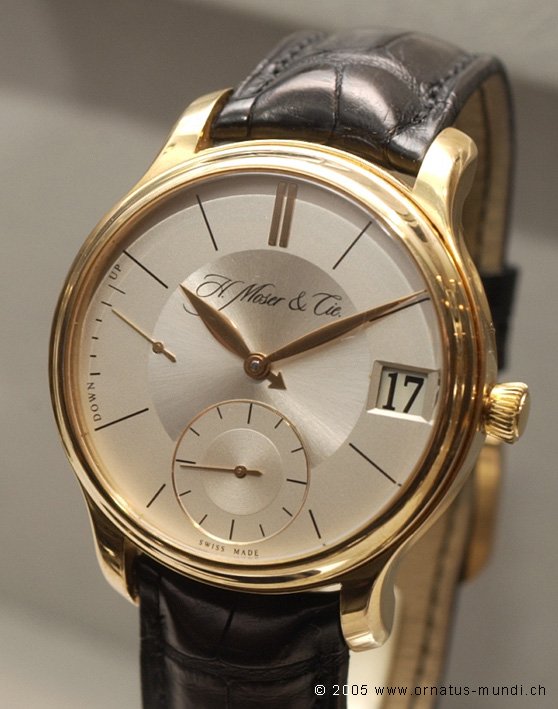
5. Secular calendars take this over the top, by even knowing this 100 years rule, and are independent from user interference for 400 years even, when the calendar arithmetics enforces an exception from the 100 years rule (happened in 2000, luckily for most owners of perpetual calendars).
As you rightly mentioned, the theoretical accuracy of the calendar mechanism has not much to do with the physical reality: Whenever a watch is stopped for a time, all indications have to be newly set. It is then a question of the individual mechanism's ergonomics and usability whether this procedure is simple or complicated, or can even damage the delicate mechanism when something is done wrongly.
The majority of perpetual calendars, regardless of the number of their indications, offer a correction pusher for every indication. Thus, the owner can "compose" every possible date, including the moon phase. This enables him to keep his watch in hand, even in those infamous "exception years" mentioned above, making the necessary adjustments himself. The problem is that in most cases, you simply cannot stampede towards the pushers however you like, pressing them in arbitrary sequence; one has to follow a very precise procedure, and otherwise risks a costly repair.
Therefore, some manufacturers produced a more "foolproof" system, by firmly coupling all indications together. This means that the watch knows which weekday is the 5th of March 2012, and which phase of the moon this day has. All the user has to do, when the watch has stopped for a while, is adjusting the indications forward until the correct date is shown. This system's disadvantage lies in its rigidness: If the owner, full of enthusiasm and energy, "overshoots" the current date, his only option is to lie his watch to sleep again, until the desired day has come (I call this the "Sleeping Beauty-problem"), or to send the watch to the manufacturer, asking to adjust it to the correct date, which is of course a costly solution. Also, these watches have to be sent for adjustment every 100 years to correct the mechanism in the exception years.
IWC's Da Vinci is a prominent example of this system:
A few manufacturers opted for a system that permits a simple adjustment by the owner, by decoupling only one indication, mostly that of the weekday. Setting the weekday independently is somehow a compromise between the "adjust every single indication" approach and the foolproof full program. This system permits a flexible and relatively simple adjustment by the user, while keeping the mechanism user-friendly and solid.
Hope this explanation is not too long, and helps you.
Regards,
Marcus
This message has been edited by Marcus Hanke on 2010-09-07 04:29:08 This message has been edited by Marcus Hanke on 2010-09-07 04:32:05 This message has been edited by Marcus Hanke on 2010-09-09 03:58:21 This message has been edited by Marcus Hanke on 2010-09-26 13:34:37

Perpetual Calendars - Questions!
Calendar mechanisms: their classification and adjustment


Many thanks Marcus

very concise explaination Marcus and some of my favourite watches on show
Thanks Marcus, That is not an easy job.
