chintu
505

Well, Here I go again
Hi
The first paragraph was from IWC ( as reported by the forum member that received it).
The second paragraph in quotes was the comment by that forum member.
Hope that clarifies.
On your comment that a jeweller could gold plate a 2892 for US$ 10 is perfectly accepted. But then if you would look at the parts that IWC replaces ( per IWCs own statement ) one would need to acknowledge that the modifications are extensive and not cosmetic. Of course it may be ideal to get IWC to once again reiterate the list of their modifications to the ETA 2892 to put this to rest.
Did IWC do well to choose the ETA 2892 in their perpetual. The answer is an absolute YES.
I did refer to the perpetual calendar module. Let me clarify a little more. The century slide in the iWC perpetual has a wheel train reduction ratio of ( hold your breath) 1:6,315,840,000. ( In fact I made a simple mistake of earlier stating this to be 1 : 6 million whereas it is MUUCH more; a tiny error after all...) . What does this mean. After completing 25,228,800,000 vibrations of the balance, the century slide moves ( take another deeeeep breath) 1.2mm!!!. If you are doubting these numbers you may kindly refer to Page 47 of IWCs 2007 catalog ( Watches from IWC 2007).
I would like to draw your kind attention to Page 47 of Patek Philippe Catalog - Collection 2006/2007E. I quote from the paragraph " Forever and a Day" in that page which proclaims Patek's acknowledgement of the complication associated with the perpetual calendar mechansim when detailing their models 5140, 3940 etc. This is what it says "The Gregorian calendar - with its months of variable duration and the extra day every four years to conform with Earth's orbit around the Sun- has since been adopted nearly all over the world. This set of rules presents a formidable challenge to the watchmaker working on a calendar mechanism because a mechanical memory spanning 1461 days ( or four years) is necessary to keep track of the months with 31, 30 and 28 as well as the 29th of February which occurs once every four years" . The Patek 240Q which powers the perpetuals have 275 individual components
None of Patek watches have any "year indicators" except the pointer based leap year indication.
Now that the grande dame of horology Patek has acknowledged that the perpetual calendar poses a formidable challenge , let me turn to IWC.
IWC handles not just 1461 days but 14,610 to handle the decade slide and then 146,100 days to keep track of the century slide and move it by that 1.2mm. To top it all the perpetual calendar module is all of 83 components ( excluding the ETA 2892 base components). In the context of the fact that a simple "power reserve module" takes close to 50 components to build, this is astounding. Simplicity is IWC's essence. And IWC chose the ETA 2892 ( or the 7750 as in Davinci perpetual) to be the base . Should that not endorse the confidence the IWC has in the ETA workhorse?If the base module stops working , the perpetual module anyway is useless. I am inclined to believe that IWC takes that risk is because of the fact that the ETA is suitable, robust and on top of it IWC has modified it to last the next 500 years. I rest my argument. Thanks for bringing up the issues as I enjoyed doing some more research to find the anwers.
Oh.. by the way the moonphase in the IWC perpetual ( davinci/ portofino perpetual) is accurate to 0.002% ( 1 day deviation) after 122years of use....and all of these riding on that thankless uncomplaining ETA/ Valjoux.
Regards
Narsi
Available on the marketplace
1,375 IWC listings are live on the eBay market and 587 collector listings on the WatchProSite marketplace.
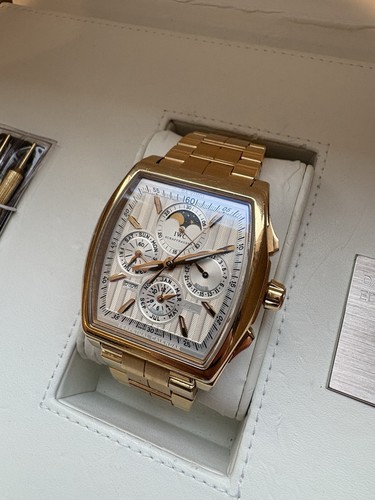
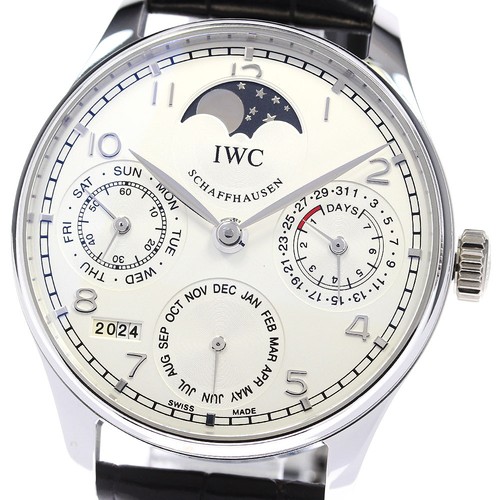


IWC Deserves better ....

Wow, Narsi,that's a great defense!

Thanks and one more...

Tx for the great post.


There is a big difference



I don't think anyone was.....
IWC does make extensive modifications. Here goes...
