
Marcus Hanke
[PuristSPro Moderator]
11296

Everyday Beauty - Marine Annual Chronograph experience review, pt. 3
Everyday Beauty:
Ulysse Nardin’s Marine Annual Chronograph
An experience
review
by Marcus Hanke
Part III
Movement:
Compared with the rest of Ulysse Nardin’s production line, one has to state the Marine Annual Chronograph to be one of the least original Ulysse Nardins - technically at least. While most other UN watches make use of own mechanical developments, at least in the shape of indigenous modules, the Marine Annual uses a Dubois-Dépraz 4900 movement. Dubois-Dépraz is a company renown for modifications of standard (ETA) movements, and especially for modular complications. Its cal. 4900 is in fact an ETA 2894 chronograph movement, with an annual calendar/big date module developed by DD. An annual calendar is programmed to “know” the sequence of months with 30 and 31 days. The only need to manually adjust the mechanism is during the transition from February to March, when it is necessary to set the date display from 28 (or 29) to 01.

Originally, DD had also offered a four years-calendar, and even a perpetual calendar version. Apparently, these never made it into a series production. Already the annual calendar is a rarity, and despite its practical aspects, is barely offered by watch manufacturers. Of these, the Dubois-Dépraz is the most popular, which however means that since its presentation some ten years ago, only a handful of watch manufacturers used it. The first ones were Nivrel and Maurice Lacroix, followed by the Marine Annual of Ulysse Nardin. Since the modular concept permits to adapt the calendar mechanism to various base movements, a few unique variants have been presented only very recently: Aside Carl F. Bucherer, the most exclusive version is integrated into a new watch by Richard Mille.
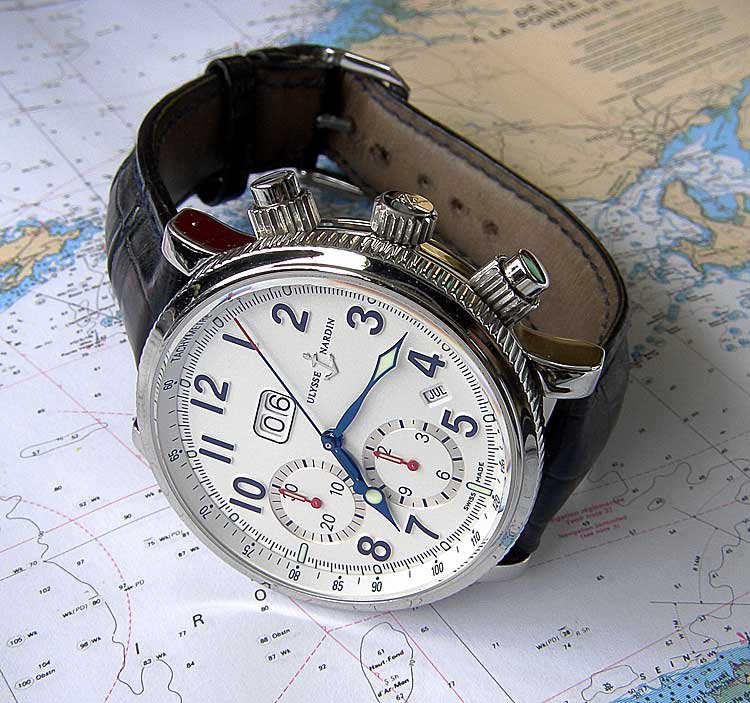
The big advantage of the DD annual calendar module is its versatility. It does not need additional adjustment pushers, which would reduce the case’s water tightness. Instead, the adjustment works quickly by using the standard date quick setting by means of the crown. Even if it is necessary to turn forward a whole year, this does not need longer than a few minutes. Another very convenient feature is the central big date window at 12. Despite its separating bar, hiding the gap between the two wheels, it is very attractive, due to the fact that both calendar discs are on the same layer.

There are a few drawbacks as well: The calendar does not show the day of the week, and the month indication is so small and hidden between the 4 and 5, that it is mostly used only as a guide when adjusting the calendar manually. And, a disadvantage in theory at least, the “pancake stack” of modules (base movement, chronograph module, calendar module) accumulates the parts count, and thus the potential sources of trouble.
However, during my already long experience using the watch, I did not encounter any problems that could be credited to a lack of mechanical robustness of the stacked modules. In the contrary, I was surprised by the smoothness of the chronograph operation shown by the movement. Other 2894s I had tried shared a very rough feeling when operating the pushers. They need considerable force to make them switching the chronograph mode, and the chronograph hands would start with a large leap, covering several second markers. This bad behaviour is certainly the result of ETA’s policy to sell the chronograph module not as parts kits, but only fully assembled. Apparently, the finish of the module’s components is rough, causing energy losses in the path from the pusher to the chronograph’s coupling. Yet the technical design of the module would support a much smoother operation: it has a - rather primitive - column wheel and a vertical clutch, both features are regularly quoted as indicators for “really fine” chronograph movements.
Ulysse Nardin proves that it is possible to teach the module some really good manners. I have barely encountered a similarly smooth chronograph operation, be it in modular or in integrated designs. Even when concentrating on the feel and sounds, it is impossible to differ between the start and the stop (the apparent difference is typical for lever-operated chronographs, but even column wheel chronographs often show differences, be it only in sound), and the chronograph hand does not jump when being started, nor does it show any irregular move or stutter when running. I encountered a similar smoothness only once, in a 2894 used by Chopard.
Checking the accuracy is difficult in a watch that has no permanent second hand. Using the chronograph hand as a replacement would not be the same, since it would not disclose how far the additional components of the chronograph influence the base movement’s performance. Anyway, my personal rule of thumbs established over many years states that a watch is running good, when its deviation stays under a minute per week. On the wrist, the Marine Annual easily keeps under this value. Generally, it needs about three weeks to be off by a minute, which is within the chronometer limits.
Strap/Bracelet and Clasp:
Originally, I acquired the Marine Annual chronograph with both, the unique rubber/titanium strap and the stainless steel bracelet. The latter was ordered with partially satined links. The standard is an all-polished finish, but the satined outer links are available on special request, without surcharge. I considered the sportive black dial to be a good match with these two bracelets, and I was not wrong.
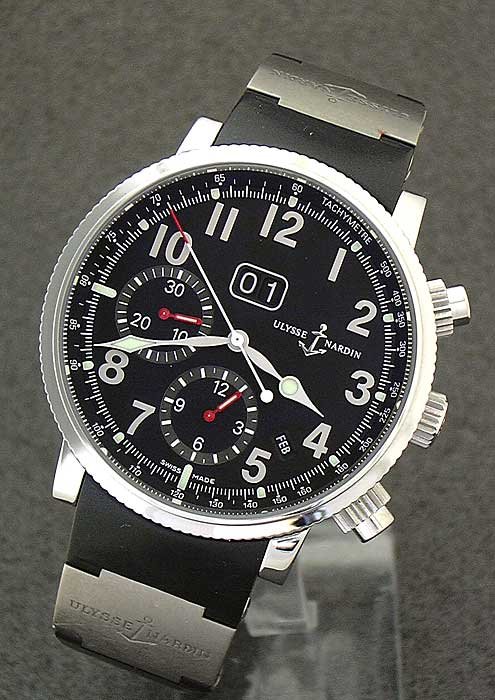
It is not necessary to lose words about the marvellous rubber/titanium strap; I sang its praise for numerous times. Five years after I got my Marine Diver with this strap, I still consider it one of the best and most convenient ways to attach a watch to the wrist.
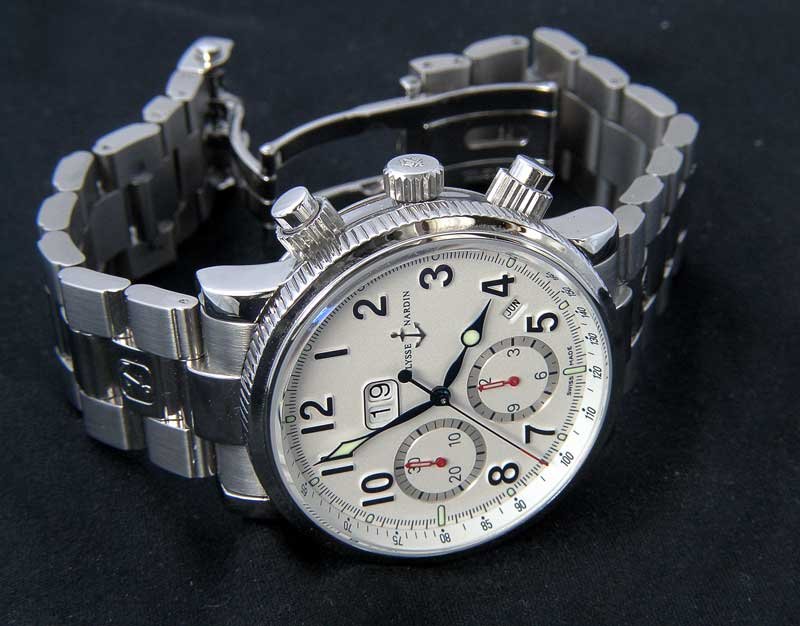
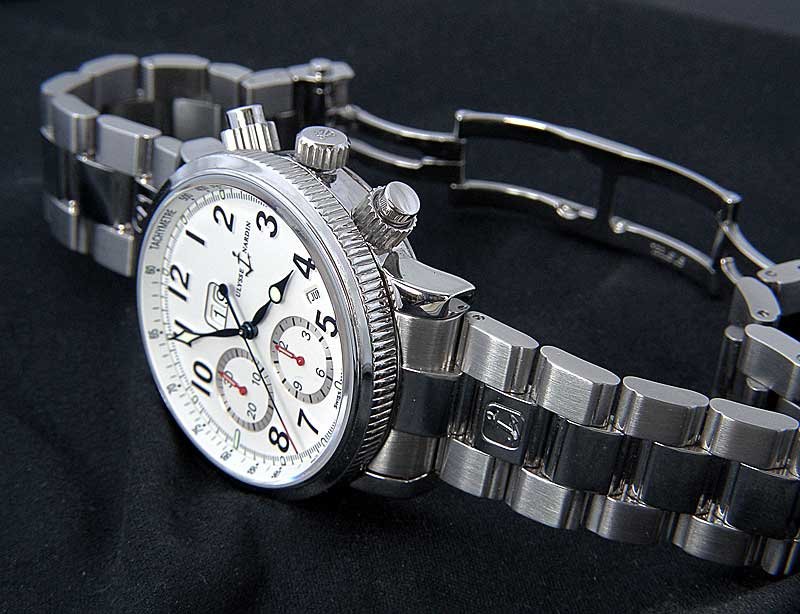
The steel bracelet is very well made. Unlike the bracelet for the 42 mm Maxi Diver, which has a single folding clasp with integrated extension, this bracelet has an extension-less double folding clasp. Design-wise, I prefer the latter, since it hides its presence more effectively.
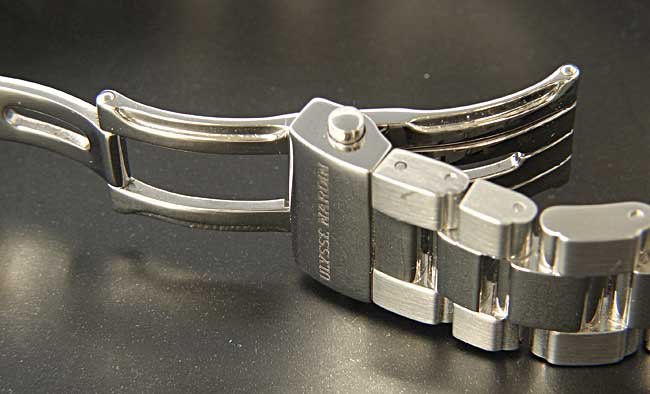
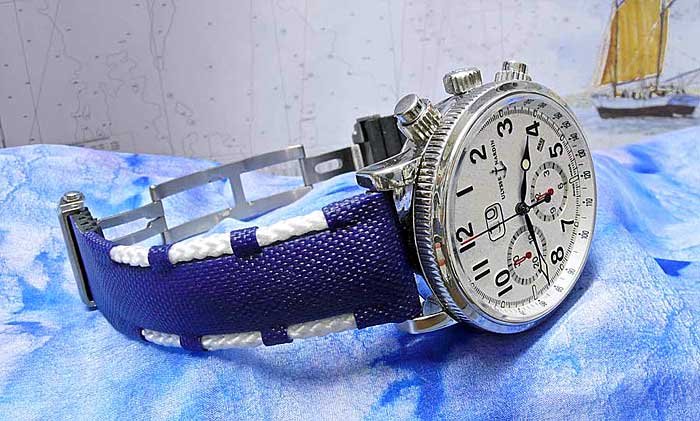
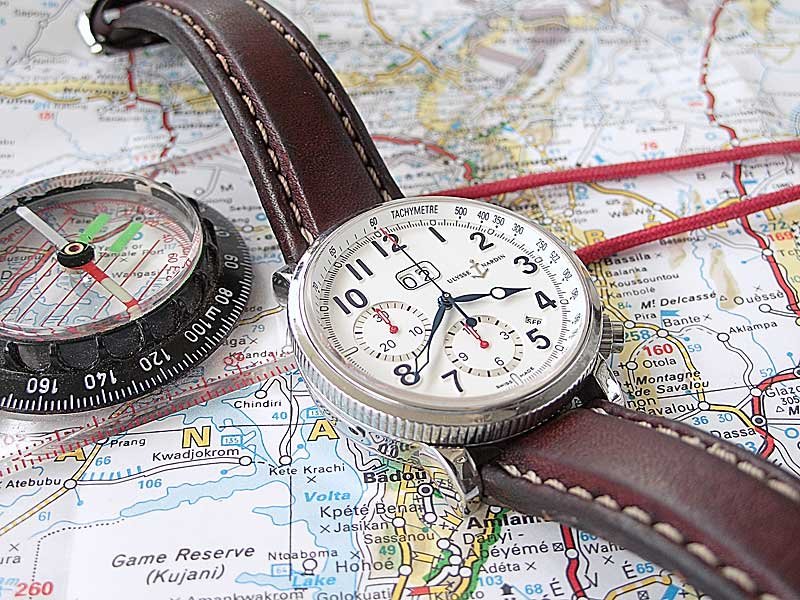
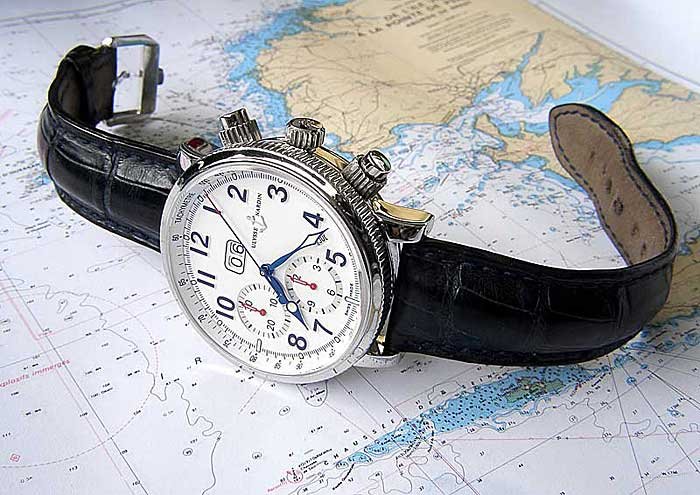
After the chronograph was changed to the white face, however, I found the rubber and steel bracelets to be a bit too sportive for the rather classic appearance. Consequently, I am mostly using leather straps with the chronograph, while the steel bracelet is often attached to the Marine Diver.
Conclusion:
From a technical point of view, the Marine Annual Chronograph might be one of the least original Ulysse Nardin watches, since it does not use any of the self-developed mechanisms. However, its unique design, and, most of all, convincingly high level of quality does not leave any doubt about its heritage. It is a wonderful everyday watch, with the ability to appear both casual, and very elegant; typical Ulysse Nardin, I would say.
Everyday Beauty - Marine Annual Chronograph experience review, pt. 3
Everyday Beauty: Ulysse Nardin’s Marine Annual Chronograph An experience review by Marcus Hanke Part III Movement: Compared with the rest of Ulysse Nardin’s production line, one has to state the Marine Annual Chronograph to be one of the least original Ul...

Marcus, many, many thanks on this review>>>
it is so helpful to receive your information, insights and views, always a thrill when you post one of these reviews. It was also very interesting to hear and see what can happen with the SL issues inside the movement and how well UN did to solve the issu...

Thanks for the review Marcus
The UN Marine Annual Chrono has always been one of the best bangs for the buck IMO, and I was so close to buying one but decided on my ex-Acqua Perpetual instead. A beautiful watch and highly versatile depending on which strap you put it on. Never knew ab...
I love mine....and a small story...
I too have the UN Annual Chronograph. Mine is like your original one with the black dial and I have the stainless bracelet. I have had mine a little over 3 years and I agree with your fine review. I have never had a problem with particles of lume inside t...


Questions Questions
Marcus, First, some thanks for a comprehensive review from a user's perspective. Common watch magazines only give a re-hash of the PR handouts and photos You PuristS however, actually use these watch thingies! About setting dates: if one travelled backwar...