
Ornatus-Mundi
[Zenith]
7136

Zenith coffee house tales XVII: The Elite Chronograph Classic in steel
There are times when a mid-boggling mix of contrast is just the right environment for delivering a simple message.
Today, I took out Zenith's most simply and elegantly dressed chronograph out for breakfast into the most opulent Vienna's coffee houses: Meet the Zenith Elite Chronograph Classic in steel:
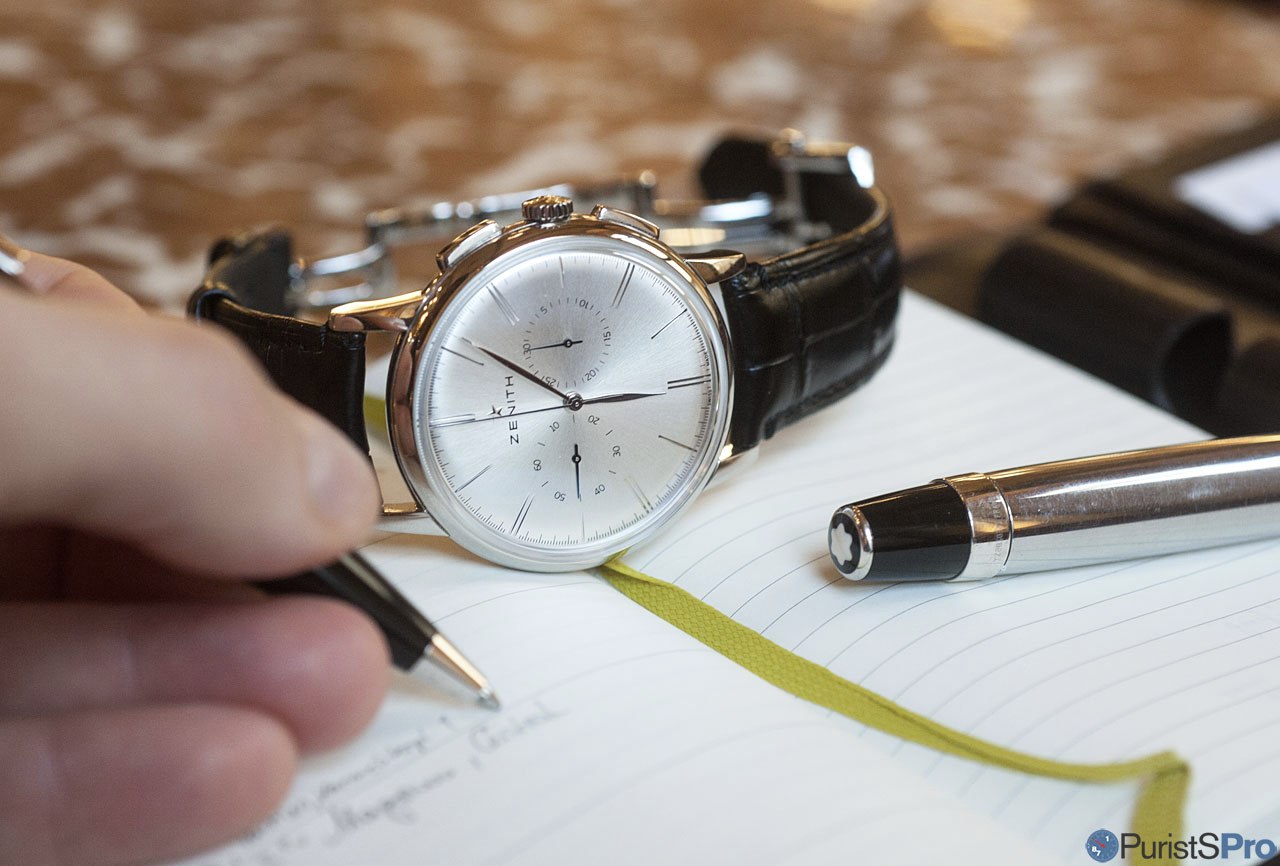
Elite chronograph? Did you notice the oxymoron? Elite: that name stands for the automatic time-only movement Zenith created in the mid-1990s, but it has recently accepted a second duty as the collective name for Zenith's more elegant pieces. At this time I fail to make much sense of it, but BaselWorld 2016 is not far away, and and soon we'll probably be a bit wiser...
That is the only change theEl Primero's Elite Classic has experienced between its presentation in Basel and now. Very elegant, very "1950s" chronograph clad in a 42mm steel case:

The mystery lies entirely in its silver dial with a sunburst motif as the only finish.
Elite chronograph? Did you notice the oxymoron? Elite: that name stands for the automatic time-only movement Zenith created in the mid-1990s, but it has recently accepted a second duty as the collective name for Zenith's more elegant pieces. At this time I fail to make much sense of it, but BaselWorld 2016 is not far away, and and soon we'll probably be a bit wiser...
That is the only change the
The mystery lies entirely in its silver dial with a sunburst motif as the only finish.
With this monochrome arrangement the heat-blued seconds hand really stands out, and it rightfully does.

Indices are set into the dial and then polished (to give a nice reflective effect), with finely printed partitions as well as permanent seconds and minute counter subdials.
Indices are set into the dial and then polished (to give a nice reflective effect), with finely printed partitions as well as permanent seconds and minute counter subdials.

The movement is the new automatic Cal. El Primero 4069: basically an El Primero 4010 sans big date function (and thus only 254 instead of 308 parts):

The back of the case is most fascinating to look at with a simple constrasting theme well employed to give a maximum of effect - I am talking about the matte-finished bezel around the case back, adjacent to the highly polished case band:

The back of the case is most fascinating to look at with a simple constrasting theme well employed to give a maximum of effect - I am talking about the matte-finished bezel around the case back, adjacent to the highly polished case band:
This specific watch came with a deployant clasp that mimics quite well an ordinary tang buckle. I prefer the latter for pure reasons of wearing comfort, and I doubt that will ever change...

Every little detail on this watch is just made to ensure a pleasant impression. The restrained but very effective dial design, the slight curvature of the dial itself, combined with the domed crystal and the sensual, rounded case. The proportions of hands in relation to the indices, subdials, diameter...
Every little detail on this watch is just made to ensure a pleasant impression. The restrained but very effective dial design, the slight curvature of the dial itself, combined with the domed crystal and the sensual, rounded case. The proportions of hands in relation to the indices, subdials, diameter...
The suspense created with the lively leaf-shaped hands and the straight and simple indices - one is inclined to use the word 'perfection', and this does not seem to be out of place.

With 42mm the watch is not exactly small, but still within the mainstream range, by today's customs.

Being almost devoid of any intrinsic colour, the watch is immensely versatile to wear.

It is still an eye-catcher, which I think is the true mastery of this watch.
With 42mm the watch is not exactly small, but still within the mainstream range, by today's customs.
Being almost devoid of any intrinsic colour, the watch is immensely versatile to wear.
It is still an eye-catcher, which I think is the true mastery of this watch.
I personally was astounded to note how long my eyes were glued to its face (and I had other watches on the table as well!).

So, to conclude, I would say that the new Elite Chronograph Classic is an immensly important watch in Zenith's stable: pleasant, elegant and versatile are, I guess at least, convincing ingredients of a successful career as a watch. It will appeal 'to the masses', I am sure (although this sounds a bit exaggerating), and such a piece is exactly what Zenith needs.
The Elite Classic is not a watch which is particularly innovative, groundbreaking or daring. No, it is exactly the opposite.
So, to conclude, I would say that the new Elite Chronograph Classic is an immensly important watch in Zenith's stable: pleasant, elegant and versatile are, I guess at least, convincing ingredients of a successful career as a watch. It will appeal 'to the masses', I am sure (although this sounds a bit exaggerating), and such a piece is exactly what Zenith needs.
The Elite Classic is not a watch which is particularly innovative, groundbreaking or daring. No, it is exactly the opposite.
It is a piece for the connoisseur: destined for personal admiration and pleasure. I am personally glad that Zenith created this timepiece, it is a genre which is seen less and less in-the-wild.

Thanks for reading,
Magnus
Our venue: The Café Central in Vienna:

The café occupies the ground floor of the former bank and stockmarket building, today called the Palais Ferstel after its architect Heinrich von Ferstel.

The 'Central' is a place of profound historical relevance: The café was opened in 1876, and in the late 19th century it became a key meeting place of the Viennese intellectual scene. Key regulars included: Theodor Herzl (founder of the modern political zionism), poet Hugo von Hofmannsthal, architect Adolf Loos, Austrian novelist and mathematician Leo Perutz and Marxist revolutionary Leon Trotsky. In January 1913 alone, Josip Broz Tito, Sigmund Freud, Adolf Hitler, Vladimir Lenin, and Trotsky (the latter two being regulars) were patrons of the establishment.
Imagine this 'ensemble' all at once in this place!

This message has been edited by Ornatus-Mundi on 2016-02-09 13:01:26

Community
Zenith serves as Official Timekeeper for the 34th Copa del Rey MAPFRE regatta, a royal sailing event in Palma. Discover Zenith's role.
0 replies196 views

New Release
Explore Zenith's 2013 Pilot Montre d'Aéronef Type 20 collection, including GMT, Red Baron, and Annual Calendar models, honoring aviation history.
2 replies3742 views

Review
Hands-on review of Zenith El Primero Georges Favre-Jacot Titanium. Explore its Superleggera case design and constant force escapement.
12 replies5418 views
Review
Explore the Zenith Elite 6150 Red Gold, a standout from BaselWorld 2016. Discover how its red gold case and Cal. 6150 movement elevate its classical design.
9 replies5434 views
Review
Gup502 reviews his 1996 Zenith Elite 682 GMT, detailing its dual time zone, thin profile, and impressive accuracy. A testament to Zenith's enduring quality.
11 replies3713 views

Discussion
Ornatus-Mundi reviews Zenith's lively 2014, covering Captain refinements, El Primero re-editions, and artistic marvels like the Christophe Colomb Grand Voyage.
8 replies4310 views
Zenith coffee house tales XVII: The Elite Chronograph Classic in steel
There are times when a mid-boggling mix of contrast is just the right environment for delivering a simple message. Today, I took out Zenith's most simply and elegantly dressed chronograph out for breakfast into the most opulent Vienna's coffee houses: Mee...

Following this piece for a while...
... I think it\'s time to see it in metal... very sublime sub-dials and presenting harmony with this dial. Thanks for the thread.


Great pictures and review
I was able to see the piece in person last week. It is very nice, and Zenith should be commended for issuing this classically styled piece. Although this chronograph is 42mm in diameter, it seemed to wear smaller, even despite its thin bezel and silver di...
Movement
I enjoyed it on my wrist too, clean, sober, and elegant. I found it a bit thicker than anticipated though. And the movement is still small for this size case. Look at the sub-dials and imagine they contain circles. They run right up to the center pivot an...
I cannot quarrel with you on the need for an El Primero 2.0...
and quite honestly - I had expected this for the 150th anniversary. It did not happen, and I would be surprised if it will happen soon (the gossip, you know?). Still, considering the constraints of the movement, they did a great job. Magnus
I said it before, this was the 2nd time I had the watch in my hands...
while at first I greatly preferred the RG version, my view has now changed. The steel is soo apropos for its style, versatility and price. The second point I think is very important, as for many people an El Primero is as far as they can realistically get...
The steel version is definitely the top version for me as well...
but I was still longing to see the RG version in person as it looks fantastic in pictures. Impossible to beat the versatility of steel, though. I imagine this piece would look amazing in steel with a blue dial. Cheers, John

Superb post my friend
Really a nice experience reading your post and enjoying the pics of your very elegant Zenith and the coffee and cafe Cheers Robin

It's a clean and elegant timepiece,
and the name "Elite Chronograph Classic" is as nice as the watch itself.
With a watch like this, it is a true elite,
which will not and should not be reckoned as the little brother of El Primero.

Attention to details the Zenith Elite Chronograph.
Beautiful balance with elegant sophistication. Bravo to Zenith and thank you for this great report. Bill


Love this watch... but...
I really wanted to buy this watch as my next pick up. I just sold a watch and sent it off in its FEDEX package last night so there is now room for the next watch (per my agreement with the boss to keep this hobby under control). Why am I having second tho...
Its a monochrome watch for sure...
so by its nature it cannot compare (in contrast) to say a RG watch or the one with a blue dial. Having said that, the small (permanent seconds and chronograph minute counter) hands are crafted in blued steel, thus have ulitmate contrast. Further, the cent...

What a stunning watch!
Such an elegant looking chronograph, not to mention at a very reasonable price! Thanks for the wonderful photos.