
Breguet Aéronautique Navale
In the 1950's and 1960's, several manufacturers supplied chronograph wristwatches to the French military forces. These were originally designated Type 20. After a period, it became expensive to maintain and repair these watches and a new series was introduced using more modern movements, the Type 21.
One of the French Defense Ministry's requirements for the Type 20 and Type 21 was the flyback (retour en vol ) function. The flyback is also called the "Taylor system" or "permanent zero setting." The flyback allows you to instantly stop, reset, and restart the chronograph with a single press of the lower button. This is useful when you don't really need to know the actual event duration, only that the timed event was completed within a certain limit, and are then going on to monitor another event. While not a significant mechanical complication, the flyback feature is a great convenience for a operation that is common in aviation. The "permanent zero setting" mechanism, implemented on the basic two-button chronograph function invented by Breitling in 1933, was patented by Longines-Francillon in 1936.
Other basic mechanical specifications for the Type 20 included an accuracy within 8 seconds/day, a power reserve of more than 35 hours, and the ability to handle the start-stop-reset operation 300 times without any problems.
The primary recipients of these chronographs were the pilots and flying personnel of the French Air Force, French Navy (Marine Nationale), and the CEV (Centre D'Essai en Vol, the French flight test center). Some of these watches saw duty in the French Indochina war. A number were also sold to the air forces of Morocco and Argentina. The watches belonging to the French forces were overhauled every year (in theory, anyway). After servicing, the casebacks were marked with the letters FG which stand for Fin de Garantie (end of warranty) and the date of the next scheduled maintenance:
The Breguet Type 20 chronograph was produced in small numbers until it won the official approval of the French services in 1950. From 1954, Breguet was commissioned by the French government to supply the Type 20 to the Air Force, the Naval Air Arm, and the CEV.
In 1958, the French Navy ordered 500 watches with a 15-minute larger register for their pilots. Unlike the previous version for the Air Force, these watches had signed dials, were engraved with BREGUET MARINE NATIONALE AERONAUTIQUE NAVALE and had an antimagnetic interior shield.
(Source: S. Sugiyama, K. Knirim)
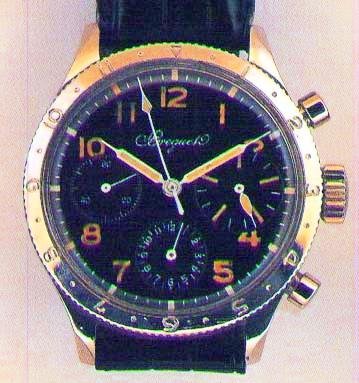
Here's my Aéronautique Navale :

The bezel and winding crown are from another Breguet Type 20 version, they have been replaced by the previous owner and I still have the original parts.
According to the Breguet registers, this watch was delivered to the Marine Nationale in 1960:

Here's the nice case back engraving with the Breguet number, the watch number in the batch of 500 and the Fin de Garantie:

The movement is a Valjoux 222 with 17 jewels, straight line lever escapement, monometallic balance, self-compensating Breguet balance-spring:

The watch with another Breguet Type 20 from the 1970's:

A wristshot in front of a Breguet airplane:

Another example sold at an auction:


The modern version - There is one thing I do not understand ....
I bought a Breguet Type XX recently and find it to be IMHO the most elegant looking chronograph watch on the market. The only "fault" I can find on it is in the layout of the minute register at the 3 o'clock position. Why does each baton represent a 2min period which makes it very difficult to read at a glance. I had thought originally that it was for historical reasons where the models from the 50's and 60's had a similar layout and it was important for pilots to be able to read time as a percentage of an hour - (such that each of the large batons (5 in total) represented 10% of an hour) but it seems that this is not really the case and was some marketing spin.
Most owners of these histroical pieces say however that vintage models did have 15 min totailsers and 15 batons - this begs the question; is the new version only a 30 min totailser because the lemania 1352 movement has a 30 min wheel and it is only the dial with the 15 batons that is been kept for historical reasons - not good.
In defence of the historical argument and the 10% of an hour thing, I did read a review on the net www.finertimes.com that said that a few watches were made with 15 registers (CEV editions) which i think is probably partly correct because if you look at the picture of the watch in Gordon Bethune's collection that has the chronograph activated - it can be seen that the second hand is almost at the 12 position (i.e one minute has almost elapsed) and the minute hand in almost between two batons - that this must be a 30 min register with 15 batons. It says that this is a CEV edition in his collection so why does the article say the CEV watches have 15 min totailsers when this one clearly has a 30 min totaliser?
What i suspect is that only a very few were made with 15 min totalisers and 15 batons but the bulk did in fact have 30 min registers with 15 batons.
I would just like to understand whether the use of a 30 min register with batons at 2min on the new version has been kept for historical reasons - which i actually think is quite charming, or whether the new versions have just decided to copy the old dial (that was a true 15 min register) but did not change the movement to be a 15 min wheel and make it 100% "true" to the originals.
Anyway a great watch non the less
Mark
I believe
this is the correct explanation:
the new versions have just decided to copy the old dial (that was a true 15 min register) but did not change the movement to be a 15 min wheel and make it 100% "true" to the originals
but how do you explain the picture in the link ....
the 1950's CEV that is in the collection of Bethune - this is clearly a 30min register with 15 batons.
MK
Here it is..
This is - according to the article http://www.finertimes.com/asp/articles/type20.asp
"is one of the rare 3-register models issued to the CEV. Another example of a 1950s 3-register Breguet, part of Gordon Bethune's collection, is shown on page 26 of the Feb/Mar 1999 issue of InSync.
From the position of the minute hand on the register (bang in between two of th batons) and the second nad about to complete one full minute - it must be a 30 min register with batons at 2min intervals.
Therefore the new type 20s are "true to their history" and these are actually 30 minute registers with batons at 2min intervals.
MK
Mmh
if you have ever seen a vintage Breguet Type 20 with a 15 min register work, you know that the chronograph minute hand moves "in two steps": since the original movement with a 30 min register has been modified to have a 15min register, the chronograph minute hand makes "a first step" when the chronograph second hand reaches 55 (then it is between two markers), and a "second step" when the chronograph second hand reaches 5 (then it reaches the marker).
It is a little hard to explain (I should make a video !), but there are a few seconds where the chronograph minute hand is right between two markers. ...and that's axactly what you see on the picture.
So I think the watch has a correct 15 min register.
I hope this helps.
Interesting & makes sense but what do you make of all these.....
I just typed "Bregut Type xx" into the Antiquorum site and took few screen shots of the many breguets they have there. Some they say in the description that watches form the 50's are 30 min registers, some say 45 min registers, some from the 70's are 15 min and some 30min - just seems like no one has a clue
Do you not think that at least some of the old 50's models did have 30 min registers with 15 batons at 2min intervals?
MK


Some of these descriptions are strange
I need to see the watches work to have an idea...
On thing for sure : the first one does not have the correct dial or the correct caseback...

Don't trust .....
don't trust anything written in the internet (of course this here included :- )!
An awfull lot of all info is copied, copied, copied...........and once some misinformation has started to float around it's almost impossible
to stop it.
So I'll tell my personal experience and opinion only.
This dials are originally intended for a 15 minute register only - period.
All others you see with a 15 increments dial and internally counting 30 minutes or whatever aren't correct - again IMO.
The modification was done in the most economic way - the center chrono runner which usually has one finger to trigger the minute register/counter (via sliding gear), got a second finger 180 degreee offset. I.e. the minute register was triggered when passing through zero and when passing through 30 seconds (i.e. twice a minute) - the original 30 teeth minute register wheel is advanced twice a minute.
Making it a 15 minute register in the most economic way.
The chrono runner is a typical replacement part, and those with the 15 minutespecific two finger design weren't easily available - so many of those watches simply received the wrong replacement part and voila you have a 15 increments dial with a 30 minute register movement.
Than there are also those (and believe me, it''s not too few) franken and marriage pieces - sometimes with a large part "semi" original parts. Just keep in mind that those watches weren't rpoduced by Breguet and the original manufacturere also sold the very same watch (sometimes with slight differences) to other companies.
Today those pieces, non Breguet labeled originally are often used as base for a Franken piece.....
But all above my humble, personal view only.
Best regards
Suitbert
I completely agree
if a Breguet with a 15min register dial is described as "30 min counter":
- either the description is wrong
- or the watch does not work properly
- or the movement has been replaced
- or the watchmaker who has serviced the watch did not know how the watch should work (I have seen that)
Jeff
Thank you - very Interesting
So the modern type XX has the dial layout of the originals (for historical reasons) , but instead of the true 15 min register it has a 30 min register (as that is what lemania made I assume) - I guess however on a three register chrono is would be very difficult to read quater of an hour on the hour register.
Thank you all - interesting post
MK


Great review, Jeff
One more thing...
Do you know a Type XX Vintage with the Salmon dial?
I'm very interested to know more about this piece, as I own the modern version, in platinum...
Thanks, my friend, and congrats for this post!
Nicolas

Here is a Breguet XX from 1966 to round out the collection
Best regards,
Tim

Very nice three registers !
it looks in amazing condition !
Do you have other pictures ?
Here are a couple more pictures
Best, Tim


Tim, this Type XX is in amazing condition
It's really impressive!
Nice story behind this watch...Thanks ofr sharing.
Nicolas
It was quite a find and only one of two watches
Best, Tim

Great article DrStrong!
The Type XX Aeronavale is one of the iconic pilot's chronographs of the 20th century. In my personal opinion, the Type XX and the Luftwaffe chronographs made by Hanhart, Tutima (I like the watches, nothing about the politics) and others are the best looking pilot's chronographs.
- SJX


Looking for vintage Breguet type20