Comments:

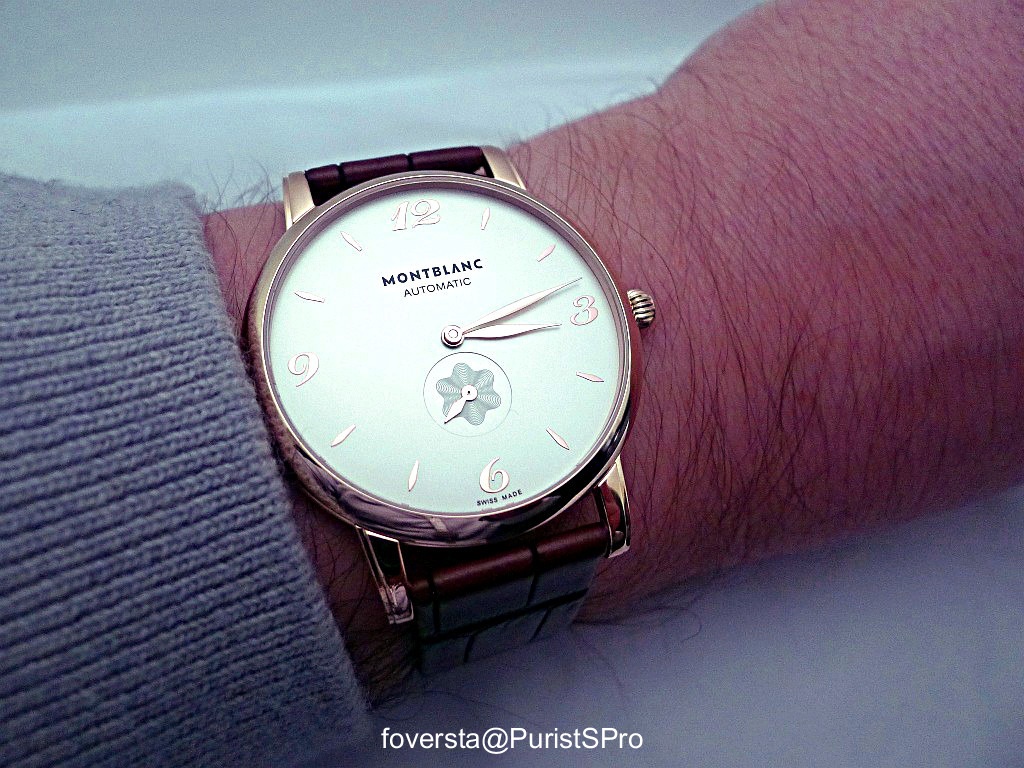


I appreciated its presence on the wrist:


Fx




Coming back to the Montblanc Star Twin Moonphase
I would like to come back about one of the 2014 novelties which was unveiled a few days ago: the Star Twin Moonphase.
First of all, I would have never imagined a few months ago to come back to a Star watch. Frankly speaking this collection is far from being my fav one within Montblanc. Obviously, any high horology lover is attracted by the exclusivity and the perfect craftsmanship of the Villeret collection. You may also be seduced by the quiet originality and the in-house movements of the Rieussec collection. The TimeWalker one proposes more contemporary designs and can fulfill the expectations of people looking for pieces which manage to be classic without being old-fashioned thanks to the touch of spice and the daring attitude they have. But the Star collection? It seems to be the entry level of the Montblanc watchmaking world and sometimes I thought that these watches were a bit too quiet.
Hopefully, the Montblanc creation department has started to work in order to give a new ambition thanks to the addition of new complications and a more personalized aesthetic approach.
Two years ago, I discovered the Star Classique Automatique.
Of course, this watch is not very revolutionary but at least, it is nicely made thanks to its applied indexes and figures, the shape of the hands and the "star" inside the subsial.
First of all, I would have never imagined a few months ago to come back to a Star watch. Frankly speaking this collection is far from being my fav one within Montblanc. Obviously, any high horology lover is attracted by the exclusivity and the perfect craftsmanship of the Villeret collection. You may also be seduced by the quiet originality and the in-house movements of the Rieussec collection. The TimeWalker one proposes more contemporary designs and can fulfill the expectations of people looking for pieces which manage to be classic without being old-fashioned thanks to the touch of spice and the daring attitude they have. But the Star collection? It seems to be the entry level of the Montblanc watchmaking world and sometimes I thought that these watches were a bit too quiet.
Hopefully, the Montblanc creation department has started to work in order to give a new ambition thanks to the addition of new complications and a more personalized aesthetic approach.
Two years ago, I discovered the Star Classique Automatique.
Of course, this watch is not very revolutionary but at least, it is nicely made thanks to its applied indexes and figures, the shape of the hands and the "star" inside the subsial.
It was a step in the good direction even if I would have loved a case diameter much more compatible with the caliber one (an ETA 2895): sadly, the subdial is too close to the center of the watch. Despite a reasonable size (39mm), the watch looks a bit too big.
Before and after this Star Classique, several models were unveiled in the Star collection including the Star Retrograde (in 2011) which features the same display than the TimeWalker Retrograde. The watch is powered by a Soprod movement or at least uses a Soprod module if I remember well.
Before and after this Star Classique, several models were unveiled in the Star collection including the Star Retrograde (in 2011) which features the same display than the TimeWalker Retrograde. The watch is powered by a Soprod movement or at least uses a Soprod module if I remember well.
A few weeks ago, I had the chance to handle the Star Quantième Complet and I really started to consider the Star Collection with a different perspective!
The watch is nicely made with a good dial balance thanks to its classic lay-out:
The watch is nicely made with a good dial balance thanks to its classic lay-out:
The "star" is outlined on the segment of the subdial located below the moonphase indicator. The dial offers several types of finishings to bring a dynamic style and to avoid the watch to fall into a design seen thousand times. The permanent details of the collection remain like the shape of the case and of the rown. Even the date displayed by a hand doesn't disturb me (and I usually hate this kind of display).
The watch is powered by a Sellita movement + a Dubois-Depraz module:
The watch is powered by a Sellita movement + a Dubois-Depraz module:
I appreciated its presence on the wrist:
I will not tell you that it is an ultimate watch! But at least, I could appreciate its flawless execution and it symbolized to my eyes a step-ahead in terms of perceived quality.
The Star Twin Moonphase is at the end, very similar to the Quantième Complet:
- a classic complication
- same case diameter (42mm)
- a Sellita movement which powers the Dubois-Depraz module
- a touch of originality
The interest of the Star Twin Moonphase can be found in the complication and in the dial design:
The Star Twin Moonphase is at the end, very similar to the Quantième Complet:
- a classic complication
- same case diameter (42mm)
- a Sellita movement which powers the Dubois-Depraz module
- a touch of originality
The interest of the Star Twin Moonphase can be found in the complication and in the dial design:
There are a lot of watches which combine moonphase display and date indicator. But Montblanc took the decision to propose an unbalanced dial to create a more daring style. Even if the date location requires time to get used with it, I think it is a good idea to put it on the top side of the dial. The date is displayed thanks a small crescent hand which is, in the context of this watch, a reference to the complication! On the other hand, this unusual dial lay-out leads to a small feeling of emptiness on the left side of the dial. It is something I will have to check by putting it on the wrist.
Let's have a closer look to the complication. I highly appreciate the ability to read the moonphases for both hemispheres (so the name of the watch). It combines the classic display (moonphases for the Northern Hemisphere) + a display through a long hand which indicated at the same time: the moon's age (expressed in days ie the days past the new moon, the top half of the subdial) and thanks to the other end of the hand, the moonphases as seen in the Southern Hemisphere (bottom half of the subdial). Montblanc has the exclusivity of the use of the moonphase module in this configuration.
The date and the moonphases are set thanks to integrated pushers. The last comment I can make is about the performances of the movement which are without any surprise: a 4hz frequency and a power reserve of 42 hours.
Since I love the moonphases display, I can't wait to discover the watch in the metal without forgetting the watches of the new collection, the Heritage.
So stay tuned on Montblanc forum to discover the SIHH reports from the mods who will be present in Geneva within 10 days.
Let's have a closer look to the complication. I highly appreciate the ability to read the moonphases for both hemispheres (so the name of the watch). It combines the classic display (moonphases for the Northern Hemisphere) + a display through a long hand which indicated at the same time: the moon's age (expressed in days ie the days past the new moon, the top half of the subdial) and thanks to the other end of the hand, the moonphases as seen in the Southern Hemisphere (bottom half of the subdial). Montblanc has the exclusivity of the use of the moonphase module in this configuration.
The date and the moonphases are set thanks to integrated pushers. The last comment I can make is about the performances of the movement which are without any surprise: a 4hz frequency and a power reserve of 42 hours.
Since I love the moonphases display, I can't wait to discover the watch in the metal without forgetting the watches of the new collection, the Heritage.
So stay tuned on Montblanc forum to discover the SIHH reports from the mods who will be present in Geneva within 10 days.
Fx
This new Montblanc Star Twin Moonphase watch is a nice all round watch
It's useful for everyday wear. I still wish it weren't an asymmetrical dial though  I would have preferred the date subdial to be at 12 o'clock instead of the 1:30 position.
- AT
When I look at these
When I look at these, all I see in my head is Nicholas Cage's goofy expression in the magazine ads, and billboard ads in Chinese airports. Wish I could just focus on the watches as they are not at all bad.
Dean
Fully agree with you Dean!
I find their ads with the pianist Lang Lang to look much better imho.
I come from an advertising background and I feel Lang Lang fits in MB's focus on culture and arts much better as an ambassador.
There are many more popular celebrities MB can choose from I am sure for their watch ads!
Anyway, I also like their ads without celebrities. The watches alone look great! My favorite is the billboard ad I saw on the Greytech twinfly, which I saw at Marina Bay Sands Singapore beside the MB Boutique.
The Greytech has been haunting me again! !
Cheers
Robin
I come from an advertising background and I feel Lang Lang fits in MB's focus on culture and arts much better as an ambassador.
There are many more popular celebrities MB can choose from I am sure for their watch ads!
Anyway, I also like their ads without celebrities. The watches alone look great! My favorite is the billboard ad I saw on the Greytech twinfly, which I saw at Marina Bay Sands Singapore beside the MB Boutique.
The Greytech has been haunting me again! !
Cheers
Robin
Thanks Fx for another great MB post
I had the chance to try on the Star quantieme in rose gold and steel in detail with a friend of mine recently at an MB boutique in Singapore. He was looking for a dressy watch in rose gold and after looking at many brands, he found the MB Star Quantieme his favorite so far, along with a rose gold master thin (one of the variants with sub seconds dial I think). He is not into inhouse movement or not.
I find the steel version very good value. The dial is very interesting in the metal with a nicely executed moonphase and calendar info. The blued steel hands look very attractive too in typical MB watch hands design.
The 2014 Star twin moonphase sounds very interesting so far but like Fx, I suspect the 10 o'clock area will look quite empty when the hour or min hands are not pointing there. Have to look at it in the metal. Let's wait for pictures from our mods in sihh 2014! Are you attending Fx? Looking forward!
Cheers
Robin
I find the steel version very good value. The dial is very interesting in the metal with a nicely executed moonphase and calendar info. The blued steel hands look very attractive too in typical MB watch hands design.
The 2014 Star twin moonphase sounds very interesting so far but like Fx, I suspect the 10 o'clock area will look quite empty when the hour or min hands are not pointing there. Have to look at it in the metal. Let's wait for pictures from our mods in sihh 2014! Are you attending Fx? Looking forward!
Cheers
Robin
Thanks Robin for your comments!
Yes, if everything is ok I will attend the SIHH and I have my appointment with Montblanc!
Fx
Fx
And what did you think of the combination, Robin ?
That's funny you talk about the Star rose gold + steel. I had a crush on it and went to my boutique to try it last week.

And you know what ? I was not convinced by the combination of the two metals in the same case ! It was like a sandwich... especially visible at the lugs.
And to my surprise, I tried the simple steel edition, and found it beautiful !
Did you have the same feeling ?
I meant Rose Gold version and Steel version separately
Hi Olivier


I also don't like bi-metal combinations in general (personal taste). I meant we looked at the Steel version and Rose Gold version. And we were looking at the Star Quantieme, not the Star Classic in your picture.
Here are some pictures I took at the boutique on the Star Quantieme in steel (which I like) and in rose gold (which my friend likes and is at the top of his choice now, along with a JLC Master thin with sub dial). He is also look at the simplier Star Date Automatic in rose gold but the felt the Star Quantieme had a nicer and more balanced dial at a slightly higher price (which to him it's good value for the nice moonphase and full calendar)
cheers
robin