Comments:


 Load More Comments >>
Patek Philippe Reference 5196P - one to consider?
I have a passion for vintage Calatrava. I didn’t start out aiming to build up a collection of such pieces, but it did evolve into a collection. Over the course of this year, I have reviewed several in my collection. My collection, overall, is about half vintage and half modern (i.e 1990s onwards). I do not own a modern Calatrava, so I thought it might be useful to review a modern current production Calatrava that definitely piques my interest. The 5196P.
The mother of all Calatrava models is the Reference 96. This was first produced in the early 1930s and continued through to the 1970s. That is an incredible production run for a reference. The Reference 96, however, came with a case size of just over 30mm, and for the modern era it became clear that a new Calatrava was needed. Of course, there have been many iterations between the 1930s and 1970s that addressed this issue. The Reference 570, known as the Grand Calatrava, was released in the late 1930s with an almost identical dial layout to the Reference 96, but with a case size of around 35mm. In its day, this 35mm reference was seen as very large and radical. But for the new millennium, something bigger still was required. One such offering was the Reference 5196.
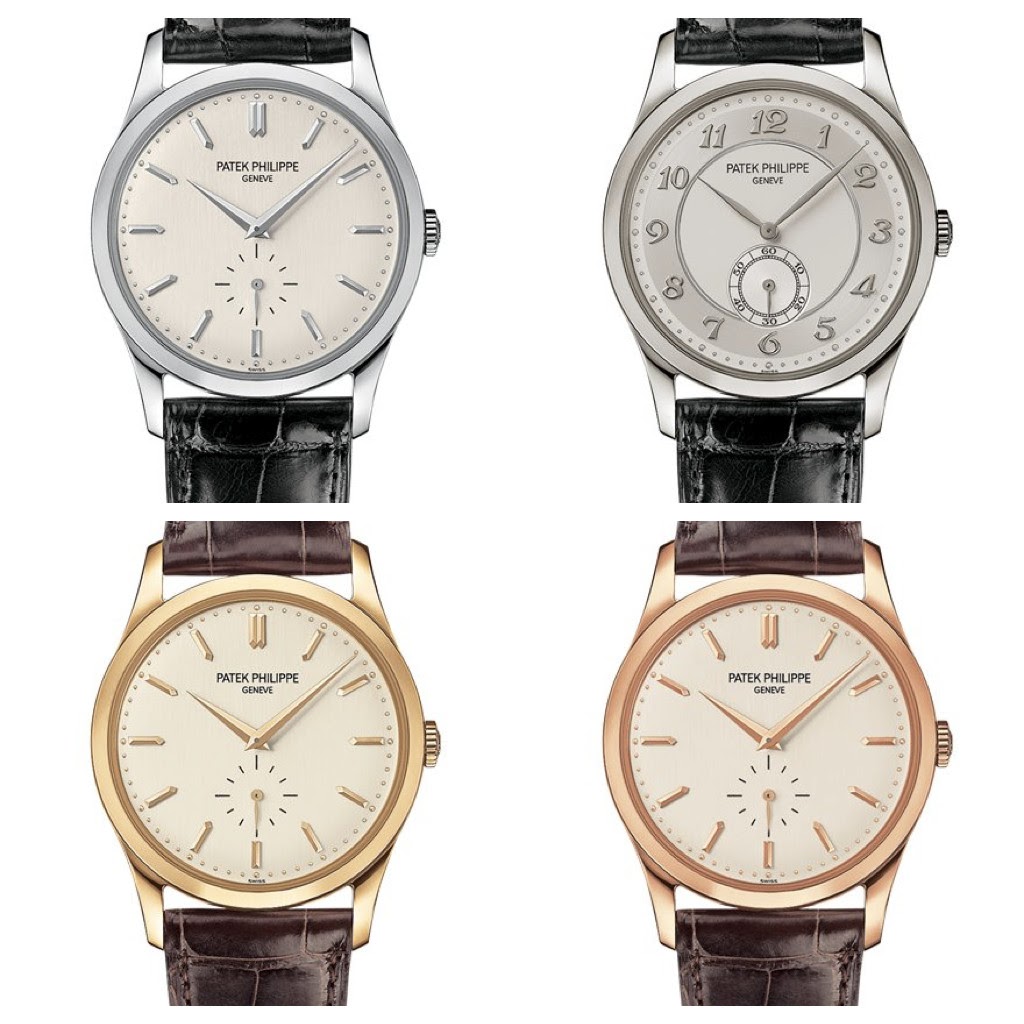
Coming in four precious metals, the 37mm case of the 5196 offered a modern rendition of the Reference 96. The white, yellow and rose variants were all similar in dial approach, but the platinum variation was markedly different. It is often the case that Patek Philippe will depart from a reference genre for platinum, and that is very much the case for the 5196P. I am comparing the dials of the four variations in the following image. Such a difference in approach. Three very similar andthe platinum standing out as very different. Even the hands were changed. Whereas the golds are very distinctly elegant and formal, the platinum version features enough variation to make it usable both formally and casually.
What do I like about it?
What are the drawbacks?
To deal with this issue, Patek Philippe chose to make a feature of the sub-dial, ensuring that it is quite bold and most clearly having it not bite into the 6 marker. For the case back, the 5196s have solid casebacks. In this modern era, most watches now have visible case backs because it is seen as part of the attraction of ownership to be able to view the movement. This would not work for the 5196, so it is one of the very few (if not only) production watches that has a solid case back. In this sense, it is the last of its era, and I find that quite attractive. Would I prefer that it had a bigger movement that fitted the case better and had a crystal case back? Yes. But at the same time, I really find the solution that Patek Philippe found for the 5196 to be a good one.
On the wrist, the watch feels and looks fantastic. As a modern Calatrava that is versatile enough to be used formally or casually, the 5196P certainly ticks a lot of boxes. For me, I see it as a watch that would need to be featured amongst possible modern targets.
The mother of all Calatrava models is the Reference 96. This was first produced in the early 1930s and continued through to the 1970s. That is an incredible production run for a reference. The Reference 96, however, came with a case size of just over 30mm, and for the modern era it became clear that a new Calatrava was needed. Of course, there have been many iterations between the 1930s and 1970s that addressed this issue. The Reference 570, known as the Grand Calatrava, was released in the late 1930s with an almost identical dial layout to the Reference 96, but with a case size of around 35mm. In its day, this 35mm reference was seen as very large and radical. But for the new millennium, something bigger still was required. One such offering was the Reference 5196.
Coming in four precious metals, the 37mm case of the 5196 offered a modern rendition of the Reference 96. The white, yellow and rose variants were all similar in dial approach, but the platinum variation was markedly different. It is often the case that Patek Philippe will depart from a reference genre for platinum, and that is very much the case for the 5196P. I am comparing the dials of the four variations in the following image. Such a difference in approach. Three very similar andthe platinum standing out as very different. Even the hands were changed. Whereas the golds are very distinctly elegant and formal, the platinum version features enough variation to make it usable both formally and casually.
What do I like about it?
- I like the fact that it is a manual wind watch. Its just a personal preference for this type of watch. With a 44 hour power reserve, its very usable.
- I like the fact that it is a platinum variation. I own no platinum Calatrava, so adding one like this would certainly fit the profile of my collection.
- Two tone silver/grey dial is very attractive to my taste. In different lights, the nuance of the dial and its texture plays around into many forms. Also, the dial itself has many areas of interest. The dial is almost comparmentalised into different zones. Fascinating to look at.
- Breguet numerals are a taste issue. I don’t like Roman for example (and that has ruled out many former Calatravas for me). I love Breguet numerals.
What are the drawbacks?
- The biggest drawback is that the movement is way too small for the case. The 215PS calibre has a diameter of 21.9mm compared with a case size of 37mm. The practical drawback from this is that the second hand is too close to the centre of the watch. Further, for a see-through case back, the movement would look quite strange.
To deal with this issue, Patek Philippe chose to make a feature of the sub-dial, ensuring that it is quite bold and most clearly having it not bite into the 6 marker. For the case back, the 5196s have solid casebacks. In this modern era, most watches now have visible case backs because it is seen as part of the attraction of ownership to be able to view the movement. This would not work for the 5196, so it is one of the very few (if not only) production watches that has a solid case back. In this sense, it is the last of its era, and I find that quite attractive. Would I prefer that it had a bigger movement that fitted the case better and had a crystal case back? Yes. But at the same time, I really find the solution that Patek Philippe found for the 5196 to be a good one.
On the wrist, the watch feels and looks fantastic. As a modern Calatrava that is versatile enough to be used formally or casually, the 5196P certainly ticks a lot of boxes. For me, I see it as a watch that would need to be featured amongst possible modern targets.
without a second thought 5196G....
if i got a sponsor, 5196P ;-)
go for it, the x-mas is close by...
Best,
mahesh.,
A watch that looks superb in all three variants but ...
looks unproportioned on the wrist: it is simply to slim to be in 37 mm.
A comparable 5199 is way better proportioned.
Maybe 36 mm or even 35 mm would have been more fitting but these sizes are difficult to sell, at this moment in time.
It is a big shame for the 5196 as this reference is so classic and a good entry level Patek.
Totally agree
37mm seems to be too large for this ref while e.g the 5127, another 37mm Calatrava, is just right.
The 5196P offers a more modern look for me compared to its three other cousins. They even could be two different references with these two very different dials
If I were a Patek collector with a deep wallet, I won’t go for the four different versions (too easy) but for the P and the R. Not opposite but definitely complementary for me.
Thank you for this interesting comparison and you personal feeling.
Best wishes
Alkiro
Thank you for this interesting comparison and you personal feeling.
Best wishes
Alkiro
5196P is a watch to seriously consider. Yes, the Cal 215 is too small, which makes the small second subdial look too centered.
BUT this is such a charm and beauty!
Go, my friend, go. I had one... Which was stolen alas...I loved it!
Best,
Nicolas.
There is another version to consider, in steel, for the Calatrava lover... Ref 5565.
Credit picture: Only Watch.

Listen to Nico....
They can be found.
History
Steel
Size
Manual wind
Ticks all the boxes
But the 6196P also brings some attraction
J
History
Steel
Size
Manual wind
Ticks all the boxes
But the 6196P also brings some attraction
J
A superb reference in my book
and no issue for me with the movement size, I think overall I see no negative impact on the dial layout.
Now interestingly, the P leaves me cold, just don't like the look of the dial, but the R is the most alluring, followed by the G.
CC
Now interestingly, the P leaves me cold, just don't like the look of the dial, but the R is the most alluring, followed by the G.
CC
While I would enjoy a 5196p in my collection,
I think it has some proportion issues, which become more evident not so big wrists like mine. I do not think I will find it as enjoyable as its vintage predecessors. But don't get me wrong, all in all I think it is a great reference, specially the platinum version!
Cheers,
Alex
Cheers,
Alex
Nice ref and post Joe, thank you.
Although the movement is too small for the case size, I am somewhat relieved that the watch comes with a solid case back unlike the 5119. So at least e can't seen the movement drowned in the case back like the 38mm 5123R for example. Nice watch in all variants and amazingly at 37mm, the lugs stick out on my wrist! 
As much as I like this reference, and particularly in P version, I am not convinced.
I like almost everything about it. I love the 'sector' dial, distinguishing this from the other version. I absolutely love Breguet numerals. I also like the size.
But like I said, almost. The main issue is with the seconds subdial. IMO, it is too close to the center and throws everything off. Of course, this is complete nit-picking, but it is what draws my eyes first. And that would be a deal-breaker for me.
But, as you already know the advice I give, get whatever you like.
I'm a fan of the G
The P does have its appeal, as you say a bit more casual, maybe the only wristwatch for a classical Gentleman (yes, I do mean to capitalise the letter).
I also regret the too-small movement, the top-high sub-seconds, the closed back. I have been wondering when we will see a 6196 (?) with a new, larger hand-wound movement with modern proportions to address this and remembering reading somewhere that Thierry Stern was talking about a new Calatrava, and wonder if this could be what he was referring to.
But I tried on a 5196G not long ago and ooooooooh it is lovely. Those Dauphine hands! Those perfect indexes! Those minute markers! Those lovely lugs hugging my wrist! Swoon...yes, I could allow myself to succumb to this one.
Now, an idea: how about a special 5196P with the G's dial but perhaps in grey, blue, slate or black, and with diamond baguettes, a la 5170P and the anniversary Nautilus models?
Best
E.
I also regret the too-small movement, the top-high sub-seconds, the closed back. I have been wondering when we will see a 6196 (?) with a new, larger hand-wound movement with modern proportions to address this and remembering reading somewhere that Thierry Stern was talking about a new Calatrava, and wonder if this could be what he was referring to.
But I tried on a 5196G not long ago and ooooooooh it is lovely. Those Dauphine hands! Those perfect indexes! Those minute markers! Those lovely lugs hugging my wrist! Swoon...yes, I could allow myself to succumb to this one.
Now, an idea: how about a special 5196P with the G's dial but perhaps in grey, blue, slate or black, and with diamond baguettes, a la 5170P and the anniversary Nautilus models?
Best
E.
My Calatrava would be a VC Patrimony Traditionelle small seconds, preferably the rg boutique edition with guilloche.
here is the pt version (click)
https://d23x6d9cx8qezf.cloudfront.net/wp-content/uploads/2013/08/vacheron-constantin-patrimony-small-seconds-01.jpg
https://professionalwatches.com/assets_c/2016/06/Vacheron-Constantin-Patrimony-Traditional-Chronograph-thumb-1440xauto-29665.jpg
and here is the boutique rose gold guilloche (click)
Thinking of it versus a Breguet 7787 or 5410!
What do you think?
The 7787 classique
https://i.pinimg.com/736x/76/35/09/76350912892748ac94ccf2c8f46c8644--breguet-php.jpg
And the 5410 heritage
https://www.deployant.com/wp-content/uploads/2017/08/breguet-5410-wrist.jpg
The 7787 classique
https://i.pinimg.com/736x/76/35/09/76350912892748ac94ccf2c8f46c8644--breguet-php.jpg
And the 5410 heritage
https://www.deployant.com/wp-content/uploads/2017/08/breguet-5410-wrist.jpg
Do you want to buy the VC and sell one of these two Breguet or the opposite?
Best wishes
Alkiro
Alkiro
Neither! :) I am think of buying one of those and I'm happy to hear your take on each of them
Please!
Well, hard choice but, as I mainly select my watches from an aesthetic point of view, my ranking would be as following (purely subjective and based on my personal tastes of course)
Third position: Breguet 5410
Why? I’m not a big fan of the Heritage models. Maybe I’m too conservative but when I buy a Breguet, I buy a piece of history what I can’t find here with this tonneau case. Breguet wants to try to please everyone with this one but the mix between modernity (case, big date...) and history (guilloché...) doesn’t work very well together for me (as always, it’s my opinion).
Second position : Breguet 7787
Here, I have a split. This reference offers two types of dial. One with a guilloché and Roman numerals and another one with a splendid enamel dial and Arab numerals. This latter one is definitely my favourite.
An enamel dial always offers another “dimension” to its owner and are quite rare. I love the very subtle details on the dial too. Pay attention to the very little indexes every 5mn (excepted 15, 30, 45 and 60mn) which make me think to a little man and are truly cool (at least for me).
First position: VC Patrimony and its guilloché dial
You have here a pure marvel. I had a true favourite when I saw this specific reference in rose gold I didn’t know. The guilloché dial is amazing. A true work of art. You see it and you’re mesmerised. Maybe a simple two hands would have been more appropriate with such a dial but you would have lost this little touch of dynamism that the sub second dial gives you.
The size (38mm if I’m right) is perfect too for that kind of classy (but not boring) timepiece. It’s an example of pure equilibrium for me. In addition, it’s a manual timepiece (my favourite) while both Breguet have an automatic mouvement.
Even if it’s truly hard to compare these three timepieces as they’re so different, my (subjective) choice would go for the Vacheron as you probably already understood 😉
My humble two cents.
Best wishes
Alkiro
Why? I’m not a big fan of the Heritage models. Maybe I’m too conservative but when I buy a Breguet, I buy a piece of history what I can’t find here with this tonneau case. Breguet wants to try to please everyone with this one but the mix between modernity (case, big date...) and history (guilloché...) doesn’t work very well together for me (as always, it’s my opinion).
Second position : Breguet 7787
Here, I have a split. This reference offers two types of dial. One with a guilloché and Roman numerals and another one with a splendid enamel dial and Arab numerals. This latter one is definitely my favourite.
An enamel dial always offers another “dimension” to its owner and are quite rare. I love the very subtle details on the dial too. Pay attention to the very little indexes every 5mn (excepted 15, 30, 45 and 60mn) which make me think to a little man and are truly cool (at least for me).
First position: VC Patrimony and its guilloché dial
You have here a pure marvel. I had a true favourite when I saw this specific reference in rose gold I didn’t know. The guilloché dial is amazing. A true work of art. You see it and you’re mesmerised. Maybe a simple two hands would have been more appropriate with such a dial but you would have lost this little touch of dynamism that the sub second dial gives you.
The size (38mm if I’m right) is perfect too for that kind of classy (but not boring) timepiece. It’s an example of pure equilibrium for me. In addition, it’s a manual timepiece (my favourite) while both Breguet have an automatic mouvement.
Even if it’s truly hard to compare these three timepieces as they’re so different, my (subjective) choice would go for the Vacheron as you probably already understood 😉
My humble two cents.
Best wishes
Alkiro
It’s not an in-depth review of course but more a personal feeling. Maybe you could launch a new thread with these three timepieces to know what other PuristS think about them. That could be helpful in my opinion
Best wishes
Alkiro
Alkiro