Comments:


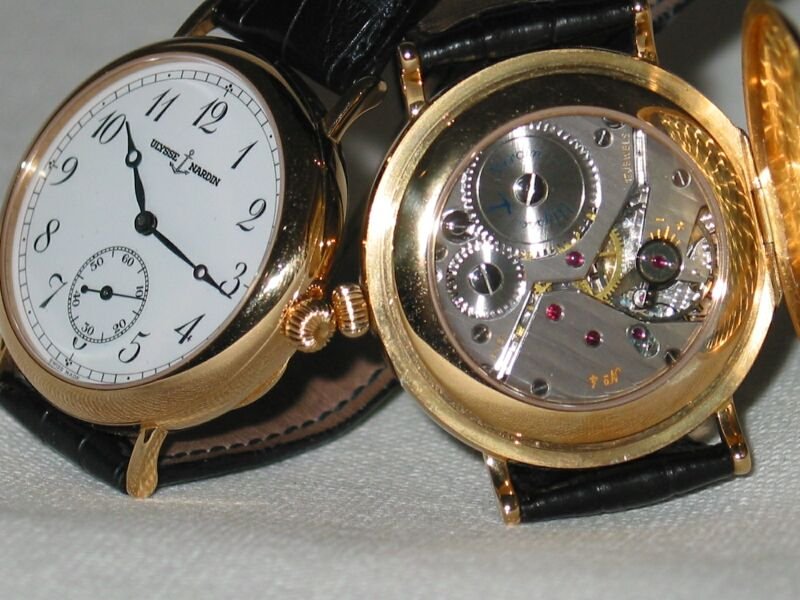
I have limited information as we got the first watch (#5) back in 1999 without any knowledge about UN. We asked no questions because we did not know what to ask. My wife liked the elegant dial with blued Breguet hands and painted black Breguet numerals. The large, sensously curved half-hunter case and onion crown were also favourite design features. In fact, we got the first watch thinking it was #5125. A few days later, the papers arrived and we were pleasantly surprised to see it was #5 of 25.
This watch was not promoted, advertised or pushed in any way. It had just arrived that day and sat in a display case waiting for it's papers to arrive. It did not even have a price tag as it was a weekend and head office had not printed one yet. That's why the papers had to be sent later from head office. I know, I know...it was reckless buying a gold watch without papers especially when its your first and you never heard of UN before...call it fate or my wife, Lucky Angel (see Patek forum).
After a year of hassle trying to get some wrist-time, I decided to get my own watch . I tracked down #4 from the same London dealer and now we have 9% of the world supply... hehe.
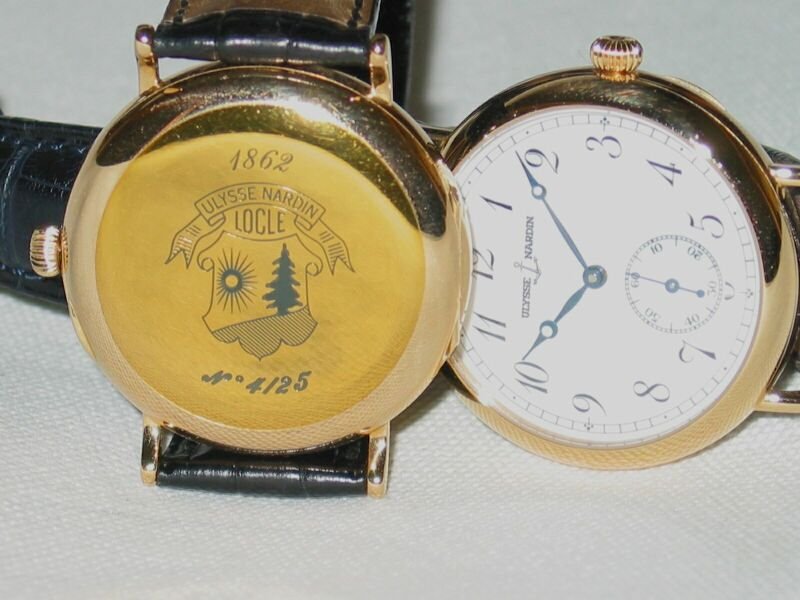
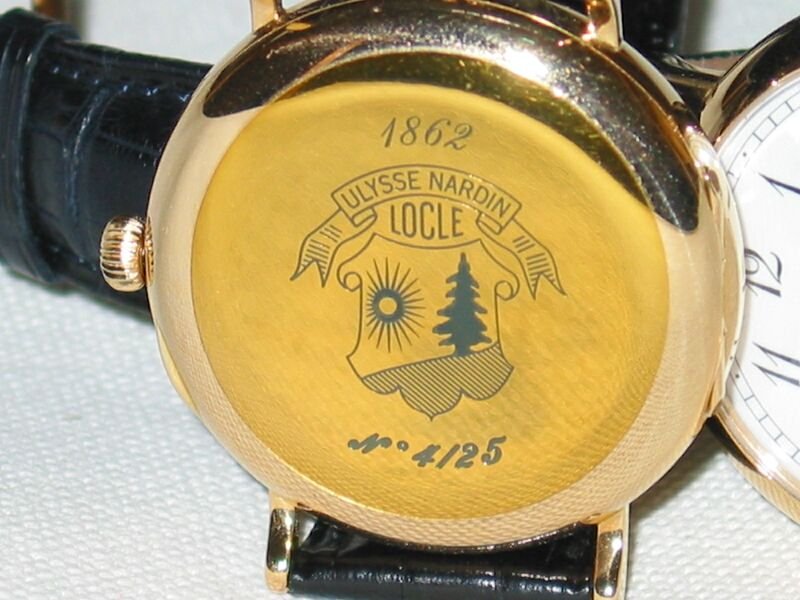
From the engraved back, one can see how this could be mistaken for #4125 by a newbie.
The clue is the year 1862 which is when UN won a horological prize in London. The watch must be a tribute to that Prize and the watch meant for the British market.
It is a large heavy watch and the case is pocketwatch size with plump curves of watchglass, sides and caseback. The half-hunter lid hinges to reveal a glassback and the movement within. The feel during winding is reminescent of the Unitas movements but much smoother than any of the other Unitas movements in our collection. Surprisingly, both #4 and #5 feel the same during winding. I would have thought that such a small run would give variability.
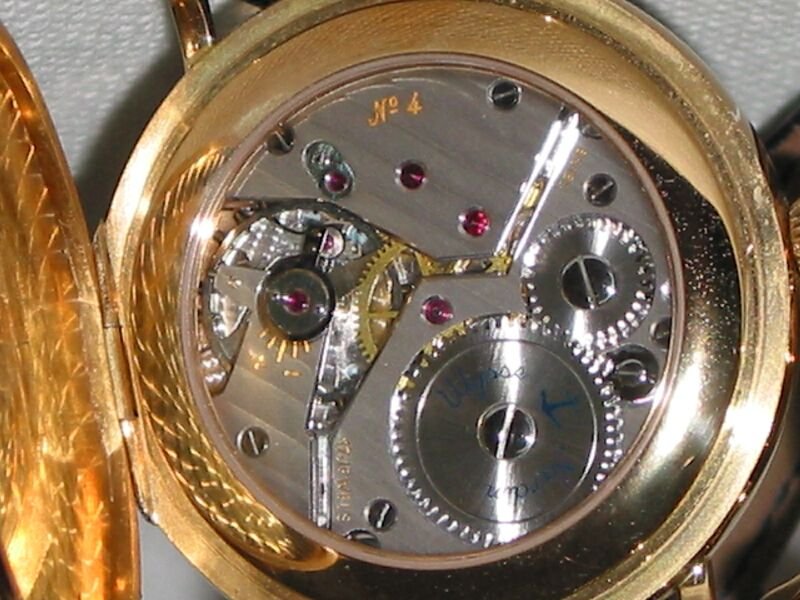
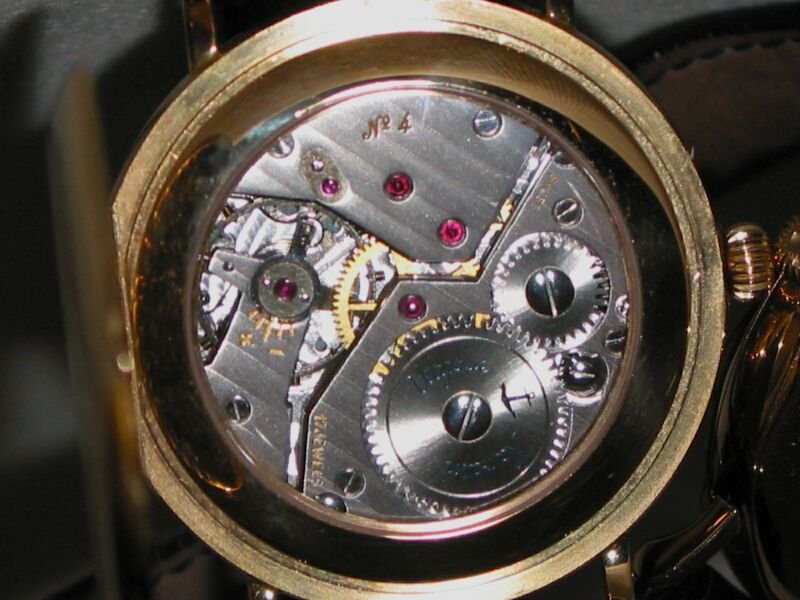
I would still appreciate information about the case maker and definitive movement...
Regards, Melvyn
What's this watch? (teaser photo)
I showed it to Herr Schnyder once but no details were forthcoming... he was distracted by a Freak promotion at the time
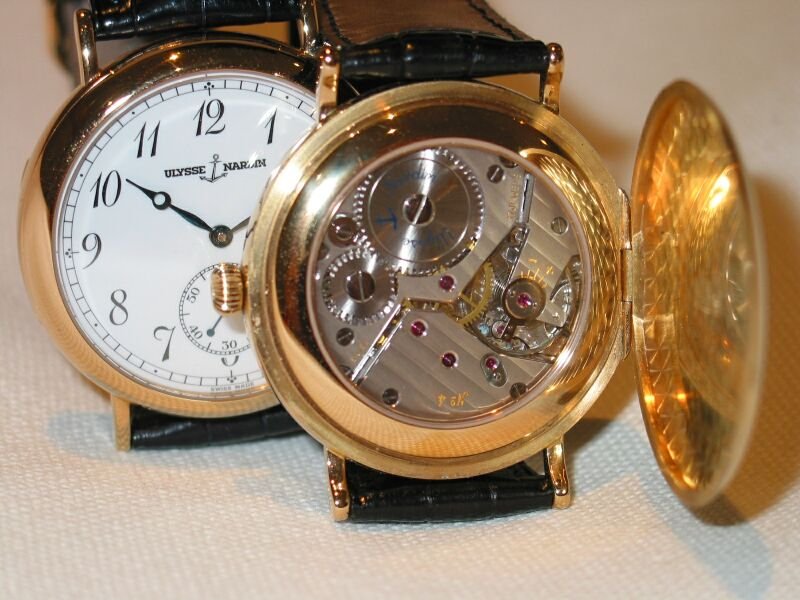
Is it a UN?
What year of manufacture?
How many were made? [OK, at least 2 made ]
What is the movement?
Who made the case?
Is it a UN?
What year of manufacture?
How many were made? [OK, at least 2 made
]What is the movement?
Who made the case?
What a beauty! Personally, I am clueless, however ...
How large is the watch? At fist sight, I thought the movement's base could be a Unitas 6498, but the two wheels of the winding system (crown and locking wheel ?? - sorry, don't know the correct English terms) are in a different location. Also possible (depending on the size of the watch) would be an extensively reworked Peseux 7001. Unfortunately I am not an expert in vintage watches, so I do not know if it is a really old piece or not. Anyway, I would be very thankful if you could update us once you received better info on your beaatiful watch.
Marcus
Marcus
I think it is an UNITAS 6497, the Savonnette version of the 6498 (Lepine), finish.
seems to cover aesthetics and function (pallet stone on screwed plate).
Nice watch!
Regards,
Magnus
Nice watch!
Regards,
Magnus
Are you sure? I always thought 6498 to be the Savonette ...
... with the second at 6. But yes, the watch depicted is extremely nice, I wish I could get more info about it.
Marcus
Marcus
UN 276-022 >>
I have limited information as we got the first watch (#5) back in 1999 without any knowledge about UN. We asked no questions because we did not know what to ask. My wife liked the elegant dial with blued Breguet hands and painted black Breguet numerals. The large, sensously curved half-hunter case and onion crown were also favourite design features. In fact, we got the first watch thinking it was #5125. A few days later, the papers arrived and we were pleasantly surprised to see it was #5 of 25.
This watch was not promoted, advertised or pushed in any way. It had just arrived that day and sat in a display case waiting for it's papers to arrive. It did not even have a price tag as it was a weekend and head office had not printed one yet. That's why the papers had to be sent later from head office. I know, I know...it was reckless buying a gold watch without papers especially when its your first and you never heard of UN before...call it fate or my wife, Lucky Angel
(see Patek forum).After a year of hassle trying to get some wrist-time, I decided to get my own watch
. I tracked down #4 from the same London dealer and now we have 9% of the world supply... hehe.From the engraved back, one can see how this could be mistaken for #4125 by a newbie.
The clue is the year 1862 which is when UN won a horological prize in London. The watch must be a tribute to that Prize and the watch meant for the British market.
It is a large heavy watch and the case is pocketwatch size with plump curves of watchglass, sides and caseback. The half-hunter lid hinges to reveal a glassback and the movement within. The feel during winding is reminescent of the Unitas movements but much smoother than any of the other Unitas movements in our collection. Surprisingly, both #4 and #5 feel the same during winding. I would have thought that such a small run would give variability.
I would still appreciate information about the case maker and definitive movement...
Regards, Melvyn
Here is a scan of the ETA UNITAS 6498-1 for comparison..
scan is from ETA's web-page:

Looks pretty much the same, doesn't it?
Regards,
Magnus
Looks pretty much the same, doesn't it?
Regards,
Magnus
Thanks Magnus >>>
Unitas 6498-1 it is then...very, very smooth winding though. One answer done, one more to go...
Case is 39mm but highly curved so >>
actual diameter available for movement is snug. Movement may be around 35 mm diameter which makes the Unitas more likely; 17 jewels though.
Help! I respect both Stephen's and Marcus's opinions but need definite i.d.
MTF
Help! I respect both Stephen's and Marcus's opinions but need definite i.d.
MTF
You are right ...
The two wheels of the winding mechanism have their locations changed, compared with the ETA Unitas picture. Otherwise, it looks the same. Hold your breath, I am trying to get better info soon.
Marcus
Marcus
Movement identified ...
... I hope so, at least. At first sight, the movement seems to be a Unitas 6478, the well-known pocket-watch movement, which has been hurled into a renaissance by Panerai. However, close inspection of the pictures reveal that the winding mechanism is different.
I did some research, and thanks to Roland Ranfft and his movement database, I found the movement which has apparently been used in that beautiful UN:
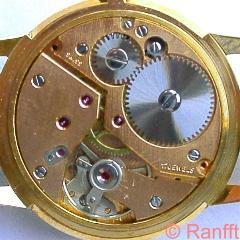
Compare:
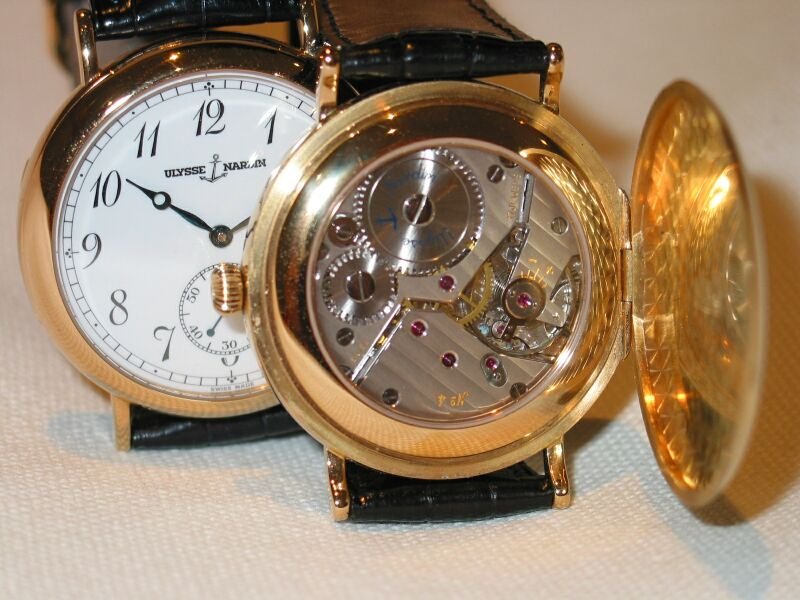
The Unitas 6310 is smaller (13''' = 29mm) than the abovementioned 6478, and was produced somewhen in the Fifties. Apparently there has been a whole family of movements, designated 6310 to 6318. I hope to find out more about them.
Marcus
I did some research, and thanks to Roland Ranfft and his movement database, I found the movement which has apparently been used in that beautiful UN:
Compare:
The Unitas 6310 is smaller (13''' = 29mm) than the abovementioned 6478, and was produced somewhen in the Fifties. Apparently there has been a whole family of movements, designated 6310 to 6318. I hope to find out more about them.
Marcus
Explains the different winding and ticking >>
feel and sound to my other Unitas 6498 watches.
Thanks for detective work.
Darn! Now, I will have to do my mind experiment again on movement loudness vs quality comparison (see Watchrap forum 17 Feb 2003 thread). In that previous experiment, I compared 5 watches with what I thought were Unitas 6498 movements. Well at least part of the experiment was valid, same family of movements to reduce variability of observation.....
Thanks for detective work.
Darn! Now, I will have to do my mind experiment again on movement loudness vs quality comparison (see Watchrap forum 17 Feb 2003 thread). In that previous experiment, I compared 5 watches with what I thought were Unitas 6498 movements. Well at least part of the experiment was valid, same family of movements to reduce variability of observation.....
I have 21/25
Sold only via Harrods in London, only 25 made, 18ct gold case, 17 jewels but otherwise I know nothing more.