
The Watch That Went to War
Vacheron Constantin: The Watch That Went to War
U.S. Army Corps of Enginers

Description
Case: four-body bassine case of polished 0.900 silver, hinged inner cuvette engraved ‘VACHERON & CONSTANTIN GENÈVE’, back engraved ‘CORPS OF ENGINEERS U.S.A. No. 2407’. Diameter 52 mm. Case no. 240449. Manufactured 1919.

Dial: white enamel with luminescent Arabic numerals, outer minute and chronograph ring with red Arabic numerals at 5 second intervals, and subsidiary seconds at 6 o’clock with black Arabic numerals at 10 second intervals. Blued steel luminescent cathedral style hour and minute hands, blued steel chronograph and subsidiary seconds hand.

Movement: caliber R.A. 19’’’ 73 Chrono, gilt brass, 20 jewels, straight line lever escapement, cut bimetallic balance, blued steel Breguet balance spring with swan neck micrometer regulator, one minute chronograph with button on winding crown. Movement no. 384440.

History
The United States Army Corps of Engineers had its beginnings during the American Revolutionary War of 1775 when General George Washington appointed the first Chief Engineer who went on to organize an official Corps of Engineers in 1779.
With the outbreak of the Great War on the European continent in August of 1914, the United States was determined to stay neutral. However, several events conspired to change that sentiment. The German campaign of unrestricted submarine warfare followed by the discovery of secret negotiations between the German and Mexican governments led President Wilson to change his position and urge Congress to declare war on Germany, which they did on April 6, 1917. By July of that year, American soldiers were marching in the streets of Paris and by October were fighting at the front.
These troops were organized as the American Expeditionary Force (AEF) under General “Black Jack” Pershing. By 1918 the Americans had mustered 420,000 troops and by the time armistice was signed on November 11, 1918, Pershing had almost 1.2 million soldiers in Europe and had suffered 117,000 casualties. Final peace came with the Treaty of Versailles in June of 1919, at least for another twenty years…
As their first war fought on foreign soil in defence of foreign territory, World War I was an immense learning experience for the Corps of Engineers. Initially, American engineers formed railway regiments, then combat engineers were used to construct bridges and roadways, and forestry troops produced the required supplies of lumber. Other engineer units built port facilities and storage yards. Technical engineers organized the earliest tank units and began chemical warfare operations.
Military Watches
While marine chronometers had been used for accurate navigation by the world’s navies since John Harrison’s breakthrough watch design of 1761, military-specific watches only began to appear in the late nineteenth century for such martial functions as timing artillery rounds to target and even ringing out a marching cadence. Models with integrated compass and map scale graduations made an appearance in 1914.
At the beginning of the Great War, the U.S. Army Corps of Engineers used American-made Hamilton pocket watches for timekeeping duties. Having adopted the General Railroad Timepiece Standards of 1893, the Corps required that each watch incorporate several technical features to ensure easy winding, legibility and accuracy to within 30 seconds a week.
Upon arriving in Europe, the Corps of Engineers brought with them 1,000 such Hamilton watches for the supervision of railroad operations in France. In an effort to reduce their reliance on the vulnerable trans-Atlantic shipping routes, the AEF Quartermaster Corps decided to procure as much of its supplies as possible from Europe. Within a few months of landing, purchasing agents were active wherever supplies might be available.
Swiss Watches
Both the American Signal Corps and Corps of Engineers required an ongoing supply of high-quality timepieces. Key Swiss manufacturers were contracted by the AEF; Zenith and Ulysse Nardin for time-only watches and Vacheron & Constantin for chronograph and non-chronograph watches. These manufacturers, in turn, sub-contracted with others to meet their large orders. Ulysse Nardin engaged IWC, Moser and Movado. In total, contracts for over 10,000 pocket watches were tendered to Swiss factories, including an order for chronographs to Vacheron & Constantin. Similar activities occurred on the British side, with Rolex and Cortebert filling production contracts for pocket watches and “wristlets”. The Germans too had orders for Swiss watches of very similar specifications.
The AEF order for Vacheron & Constantin was signed in May of 1918 for 5,000 pieces to be delivered in lots of at least 100 per month and 150-200 whenever possible. By the time deliveries concluded in 1920, a total of 3,289 Vacheron & Constantin timepieces had been received by the Corps. The great majority of these watches were single-button chronographs in sturdy silver cases, while a few time-only watches are also known. The general pattern for the Vacheron & Constantin U.S. Army Corps of Engineers watches was as follows:
Chronograph
Case: four-body bassine case of polished 0.900 silver, inner cuvette engraved with maker’s name, back engraved with Corps of Engineers number. Diameter: 52 mm. Some examples with plain polished backs are known. Very rare gold-cased examples are known.
Dial: white enamel dial with luminescent Arabic numerals, outer chronograph track with black or red Arabic numerals at 5 second intervals, sunk subsidiary seconds at 6 o’clock. Blued steel cathedral or skeleton style luminescent hour and minute hands, blued steel central chronograph and subsidiary seconds hands.
Movement: 19 lignes gilt or nickel-plated brass, 20 jewels, straight line lever escapement, cut bimetallic balance, blued steel Breguet balance spring with swan neck fine regulator, visible chronograph works in steel.
Details: chronograph with button on the winding crown. Signed on dial, case and movement. Vacheron Constantin archive photo reference 1524, 1525.
Time-only
Case: four-body bassine case of polished 0.900 silver, inner cuvette engraved with maker’s name, back engraved with Corps of Engineers number. Diameter: 52 mm.
Dial: white enamel dial with luminescent Arabic numerals, outer minute track and sunk subsidiary seconds at 6 o’clock. Blued steel cathedral or skeleton style luminescent hour and minute hands, blued steel subsidiary seconds hand.
Movement: 19 lignes, gilt or nickel-plated brass, 15 jewels, straight line lever escapement, cut bimetallic balance, blued steel Breguet balance spring.
Details: signed on dial, case and movement.

References
-
Military Timepieces by Konrad Knirim
Time-only Version
Sorry for the wrong photo of a time-only 15 jewel Corps of Engineers watch. Here is the real thing from an unkown website. Note the field modification of 24hr time scale stamped onto dial.


Will have to read it again, Tic Talk, BUT
It is a very interesting post.
It reminds me the Lecoultre Torpedo Boat Chronometer.
Thanks a lot, your post, and the watch are both keepers!
Best,
Nicolas

Thank you for the detailed history, Dean....
I've always been a bit fascinated by these watches which show up at auction a couple of times a year, though I've never gotten the nerve to acquire one because they are too distant from my collecting priorities.
You mentioned that the movements were both nickel and gilt finished. Was the nickel found on the earliest models and then they switched to gilt finish? Or vice versa (and why?)
Bill
Movement Finish
Hi Bill. We know this order by the Corps of Engineers taxed V&C's abilities to deliver the required numbers, and in fact they did not succeed! I'd speculate that they began with movements assembled from parts in stock, then moved to regular production. At the time a gilt finish was typical for this grade of chronograph, however, we know the mercury vapor deposit process was a specialized skill that was slower than the nickel-plating process. I'd suggest that they proceeded with both methods simultaniously to maximize production. Just a guess however. There are also movements with a mix of both types of finishes but that may have been from field repairs by the Quartermaster Corps. These watches were also frequently re-cased by returning soldiers who wished to convert them for civilian use.
Here is the only photo I've come across of an original gold-cased production version:




Great watch and article, but
keep the dial and hands sealed at all times. The Radium decomposes into a fine powder, which will become air bourne in the slightest air current. It can then be breathed in, where it becomes trapped in one's lungs and causes trouble!
Would love to see dials and hands like this one some modern pieces!
--
Cheers,
--
Richard.
Wonderful story & beautiful watch!
I have several deck chronometers, but I think the nicest of the group is my V&C, this one from the British Hydrographic
Service. Typical silver case, straightforward dial and blue hands, and with the expected fabulous V&C movement!
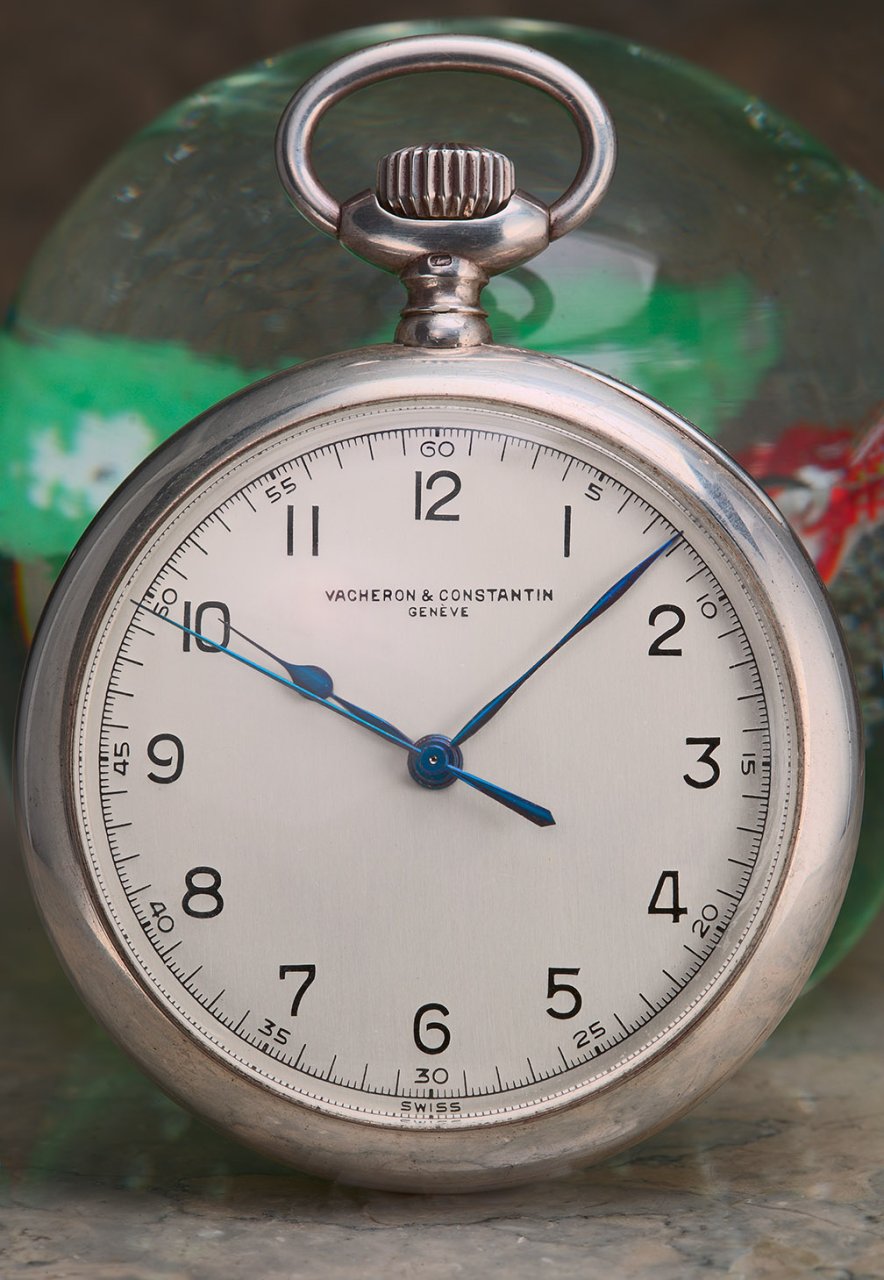
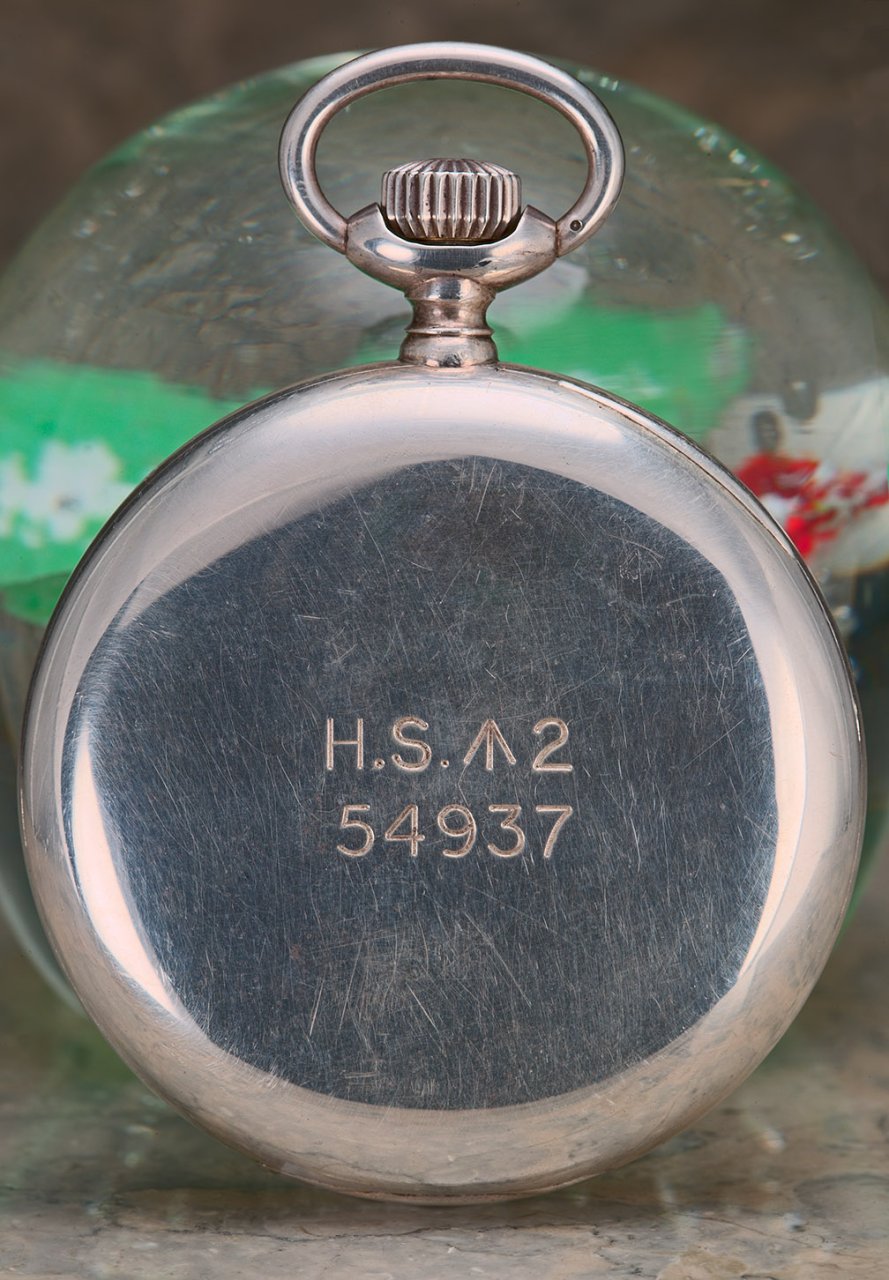
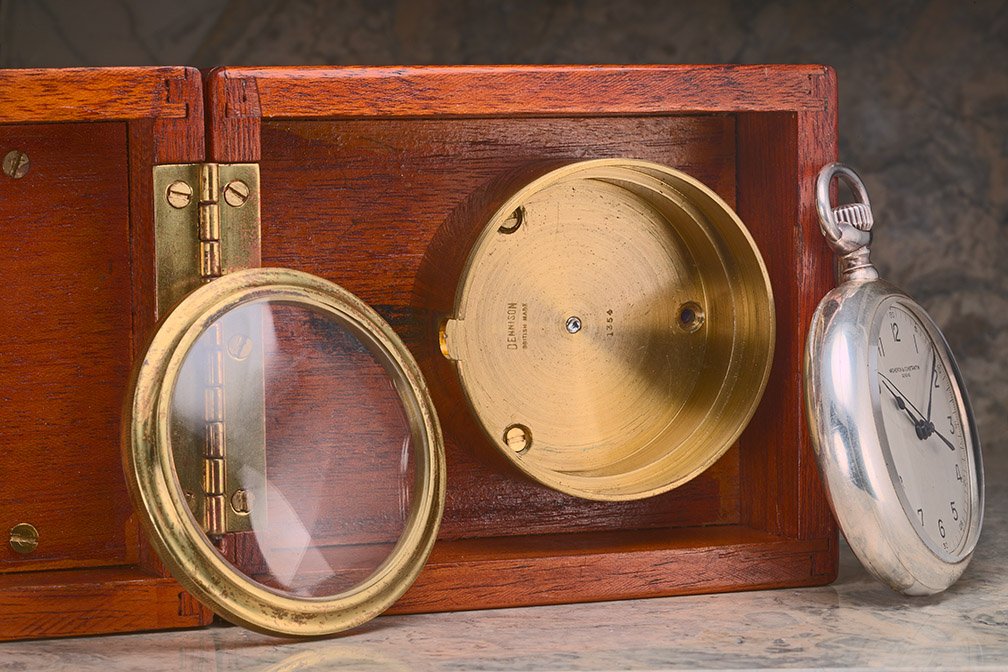
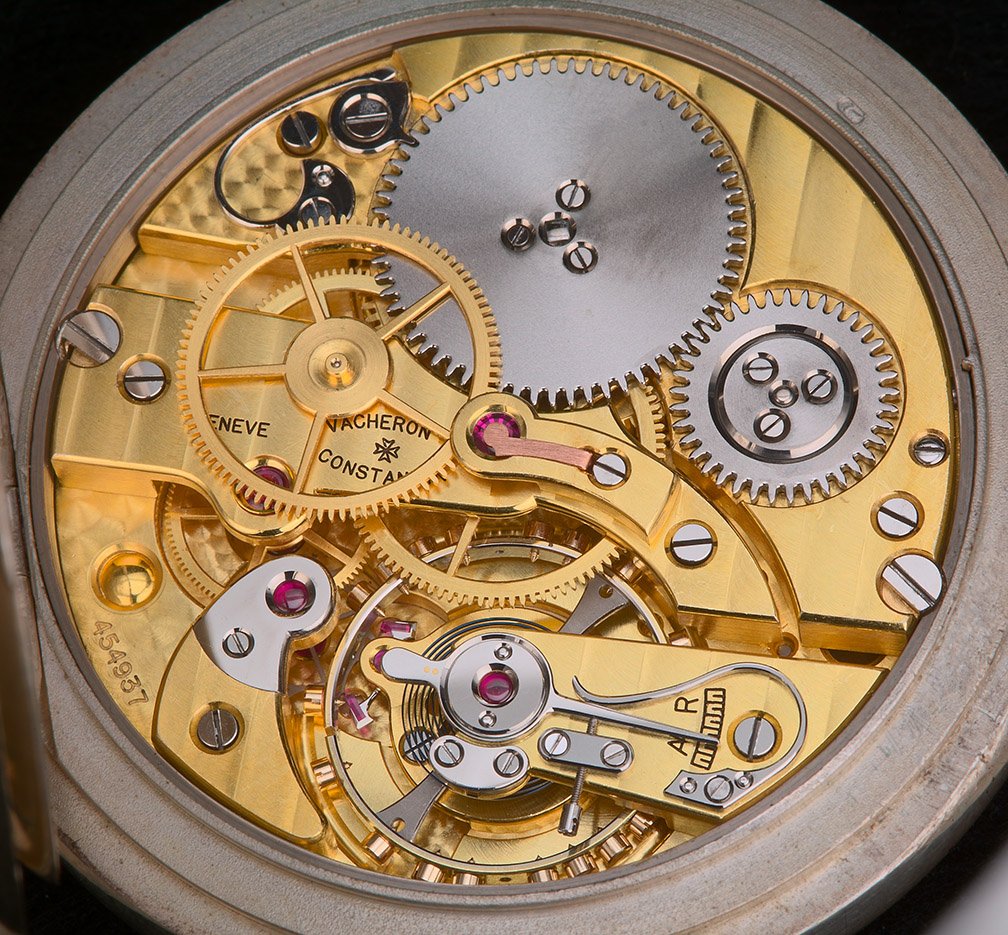
The movement has all the fun stuff, Guillaume balance, blued-steel overcoil hairspring, swan's-neck regulator and
incredibly polished steel parts:
OMG thats gorgeous!


Another movement picture...

The quality invested in these timepieces was amazing, considering the time and purpose for which they were constructed. Much like the Rolls Royce armored cars in use during the period.
Very nice indeed....
Correction to your misinformation!
A nice article, but...
you wrote;
The AEF order for Vacheron & Constantin was signed in May of 1918 for 5,000 pieces to be delivered in lots of at least 100 per month and 150-200 whenever possible. By the time deliveries concluded in 1920, a total of 3,289 Vacheron & Constantin timepieces had been received by the Corps. The great majority of these watches were single-button chronographs in sturdy silver cases, while a few time-only watches are also known. The general pattern for the Vacheron & Constantin U.S. Army Corps of Engineers watches was as follows:
Sorry to correct you but this is the first of many mistakes!
The order (to V & C) was for 2000 watches and nor as commonly cited 5000.

Regards
Thanks for this additional information!
However, one letter doesn't capture the entire contract with V&C...the total figure of 5,000 ordered and 3,289 watches delivered was provided by Vacheron Constantin themselves. What you have is the order for the time-only, non-chronograph silver-cased C of E pocket watches, as you can see by the number series 10,351 to 12,350. I have 10,540 in my collection.
Your contribution is greatly appreciated as you have unwittingly answered the question as to how many time-only watches were ordered - likely not all were delivered. Collegial discussions are always welcome but perhaps you may want to tone down a bit so you don't come across as rude ;-)
My apologies
Best Regards
other caseback numbers
Also 1094 V & C, 10159 V & C, 9665 Ulysse Nardin,
Best Regards