
Essay on a Haldimann Pre-Basel World Premiere: the H9 (exclusively on PuristSPro)
My latest essay on an iconic Haldimann Pre-Basel World Premiere: the H9 (exclusively on PuristSPro)
Introduction
Dear PuristS
Some of you may remember my essay on the stunning Haldimann H8 as well as my report on a visit at Beat Haldimann's workshop. After some time Beat recently invited me again to his workshop to give me an exclusive sneak preview of an incredible watch. I have been deeply touched by this creation and tried to write down my thoughts in the following essay. I also had a chance to shoot some pictures. In the end Beat agreed to my posting these images alongside the essay exclusively on PuristSPro. So, be prepared for a truly philosophic Pre-Basel novelty.
H9 – The Power Of Reduction
How much watch do we need in order to be able to describe something as a watch? The German word for "watch" has its roots in the Middle High German word ûr, which is derived from the Latin word hora. This word means "hour" in english. Thus, if you were a German speaker, the name of this object would already describe its function: measuring time. How this measurement is to be accomplished is, however, not to be divined from this word. "Uhr" and "watch" are technology-neutral and focused on the object's raison d'être. Indeed, many different objects and even machines have resided under the guise of this unimposing moniker over the centuries and even millennia, all of which have measured time using various phenomena: these include sundials, water clocks, candle and oil lamps – all of which have documented the passing of time. As different from each other as these devices may be, they all have one thing in common: they make the documentation tangible for us human beings, whether it is through scales or acoustic signals (such as the sounding of a bell).
Now, what happens when this information is missing, when the time continues to be measured, but not displayed? Can we still call this a watch? And if not, then what?
This borderline area of time measurement has held particular allure for Beat Haldimann for several years. The attraction has culminated in a wave of resonating inspiration, resulting in creations that philosophically and playfully, yet seriously, ask where the border is and what the relationship between the watch and time is. Beat Haldimann does this using his own demanding manner of craftsmanship and aesthetic.
In 2008, Haldimann presented his H8 to an astonished public. "Where are the hands?" was the question that some journalists and connoisseurs from all over the world directed at him – at times in a reproachful tone, at other times in sheer awe. The vehemence of these reactions impressively illustrates how fixed our idea of the watch, and even that of the passing of time, has become. In our generation of electronic agendas, to-the-minute train and flight times and sporting events that are timed to the hundredth of a second, relative time is bound to our individual experiences and thus has become our personal time. The monotonous, even-tempered passing of time – linear time – has taken over our way of being. Nonchalantly, the H8 stepped out of line and allowed us to take a look at our personal time. The removal of hands was worth the trouble, as the stage is then entirely dedicated to the grandiose tourbillon in the centre. Justifiably, the H8 can well be described as a sculpture for the wrist.
Famously in art, various paths exist with which one can reach one's audience. Clarity and details are one way, reduction and spiritualisation are another way. The latter ideals are united in minimalism. As different as the works of minimalists are, when one observes their oeuvres it becomes obvious that their remarkableness has not been reduced by leaving out that which was expected. Instead, this reduction sets a thought process in motion with which we instinctively begin to think about that which we had expected.
Experiencing a minimalistic work of art is thus tied to one's own creative outlay. The observer receives the reward for this outlay in the form of personalised enjoyment, which seamlessly fits into his or her own realm of experience. Should this process be successful once, it hardly needs explaining ever again, which is why the alliance between a work of art that can be anonymous and seemingly undercooled at first glance and its observer is especially pronounced.
Before me on the table is the wooden case put there by Beat Haldimann. It is open and my view is directed at the H9 inside. I have occupied myself passionately with watches for the last 25 years. How many thousands of models, styles and concepts have I already seen in my life? Despite this, a look at the H9 leaves me gaping, awestruck. In front of me is a watch with a case and a strap, like we are used to seeing. It also has a sapphire crystal and a crown. But the case does not house a dial; it frames blackness, nothing.
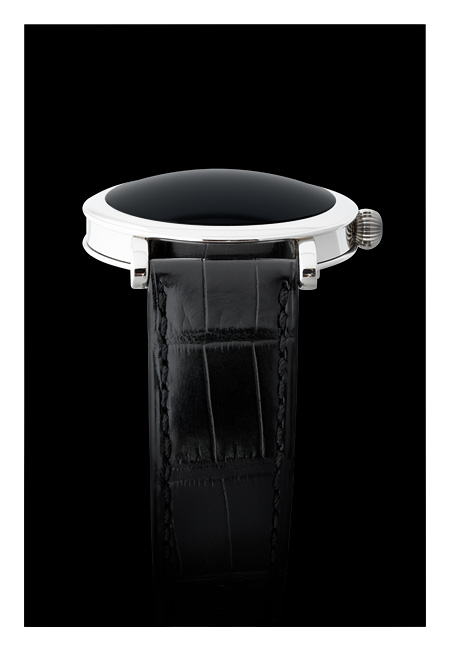
The iconic and mysterious H9, sporting its captivating black dome
And this nothing has a secretive grace about it. A strongly domed sapphire crystal coated with black vaporised colour on the inside pulls my gaze down into its immeasurable depths. This black dome is completely opaque. My eyes futilely search for the usual view of a watch, looking for hands, markers or anything upon which they can rest. Beat's inviting library is mirrored in the round crystal, the sparkling windows reflected. Carefully, I take the H9 from its velvety cushion and allow it to hug my wrist. The presence of this watch is captivating: a black hole on my wrist, sucking up my gaze.
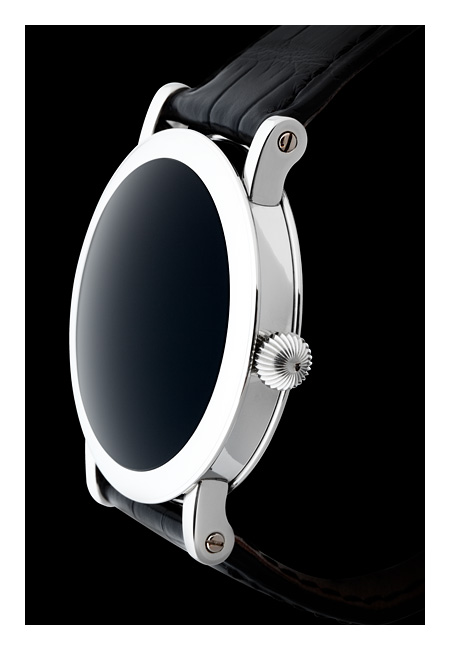
A black hole on your wrist
As I move my arm back and forth to marvel at the black dome from every possible perspective, I suddenly catch a melody.
Memories are aroused immediately. I think back to my first encounter with the H1 and the H8. There it is again, the song of the tourbillon. This song seems purer than ever, an intimate friend whose source is hidden underneath the domed blackness, seeming so familiar. With the H9, Beat Haldimann has reached a final destination in his puristic pursuit. The H9 has something conclusive to it, its endearing presencewill suffer no sequel. The H9 is here for eternity.
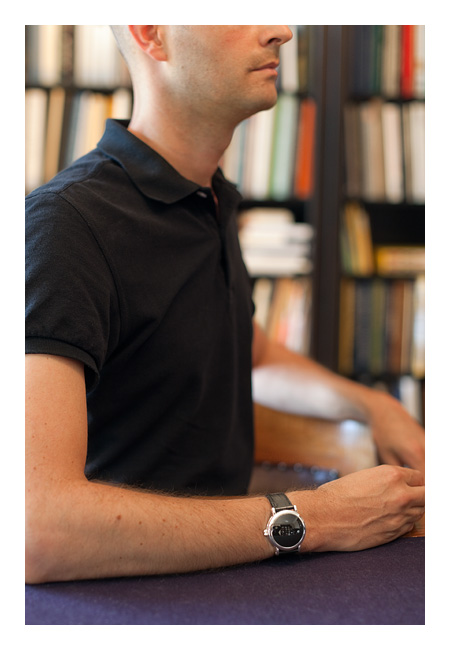
The obligatory wrist shot
I hoped you liked my little essay and pictures. Thank you!
Cheers, Valentin

that is too Zen for me
I think I got the H8 but count me out on this one. Thanks for the report though.
Best
Andreas
+1
Ztirual

Andreas, Ztirual, Andy, I know where you're coming from. Let me tell you
Thanks for your extra info Valentin...but
I'm afraid for what the H9 is going to cost, and I suspect it isn't the price of a Swatch, I'd like it to at least do something. If was a minute repeater I could understand it more.
Thanks for your info and enjoy your H9.
Andy.
Thanks again, Andy. By the way, I am
I think that is an important distinction
as a work of art, it is certainly thought-provoking. As a watch it is a failure "by definition".
And commercially? After all you were pointing out this was a "Pre-Basel" announcement ... If one wanted to be cynical I assume one could say that Haldimann will get a lot of buzz at Basel with no horological innovation, involved whatsoever ... the H8 is the H1 minus hands and the H9 is the H8 with a crystal made opaque. We sometimes critizise established manufactures for just presenting the same movement in various different case-dial-style combinations, but isn't this a bolder version of the same kind of sound financial logic?
Best
Andreas
Andy, I think it is inevitable that some people

Thanks Valentin...
Like the Pendule Neuchâteloise in my home that I almost never look at, but hear all the time.
I do think this watch needs at least a sounding passing hour, but a grande sonnerie would be even better.
Don
Thank you, Don. Your idea of

Trying to be open minded, but ultimately ....
silly in my view.
I adore Haldimann's earlier timepieces, although it's unlikely I'll ever be fortunate enough to own one. But as much as I admire his work up to immediately prior to the H8, I lost a bit of respect for him when this watch was released. The watch community incessantly mocked Romain Jerome upon the release of it's "timeless" tourbillon, but Haldimann got somewhat of a free pass I thought. A watch that does not tell time is a toy or something close to it. To now encase this movement such that it can no longer be viewed somehow seems to "jump the shark." I would have expected this watch during the go-go days before the crash when everything was possible and everything was produced.
I would rather a watchmaker with this level of talent create watches, but that's just one opinion.
Darren
Darren, thank you for being so outspoken. Your reaction


I keep an open mind..
and would like to think outside the box but this is mindblowing! A black hole with a tourbillon beating inside with no indication of time passing? This is seriously cool/or not !
I am waiting for someone to philosophically talk us through this H9 creation. I was half convinced by the H8 but this may require a bit more.
Thanks Valentin for getting me out of my slumber on a Sunday morning!
F
Fernando, you're welcome. And thank you for

First of all...
...really wonderful to see a post from you, Valentin! Always informative and thought-provoking to read your thoughts, and I remain grateful for all of the guidance that you have given me on photographic topics.
About the watch -- there is something really intriguing about it. To me it is the meeting of two ideas: the traditional point about hidden finishing (parts that will never be seen by the owner are beautifully finished just because) and Schrodinger's cat in a box, which is simultaneously dead and alive to the external viewer because that viewer cannot see inside.
So, a really intriguing thought experiment. But, I am afraid, way too expensive a thought experiment for me to consider! H1 or H2 would be splendid, though...
Best,
Gary G
Gary, thanks a lot for

It definitely works...
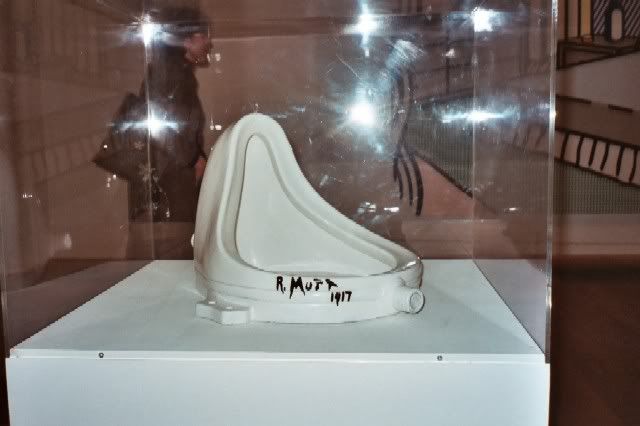
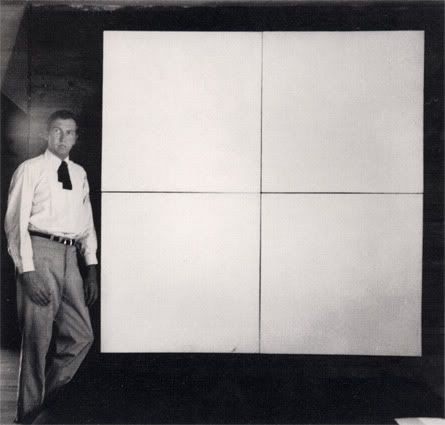
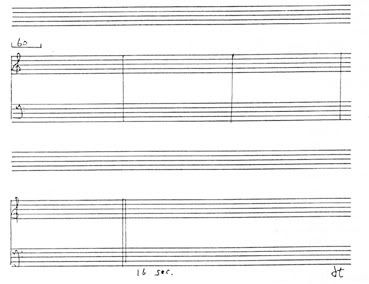


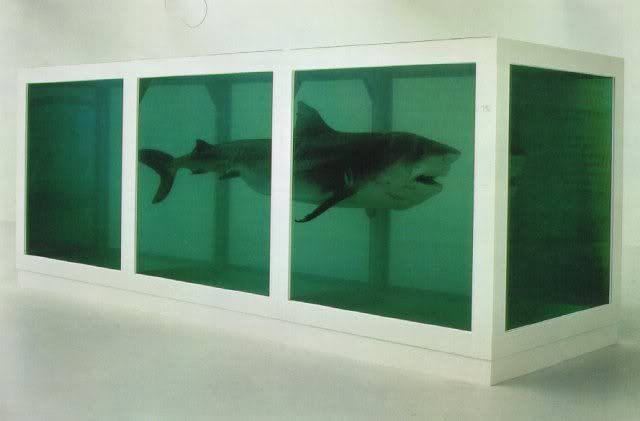
Thank you so much, pplater, for bringing in


Post modernism and horology
There is a fine line
Thank you, Arthur. One can indeed wonder if the H9 is still a watch or not. This

"..challenge our notion of time."
I guess it does, about as much as a mobile phone with the display turned off.
Next up, a watch that beats, but the hands don't move....ummm, I already have a few of those.
Thanks. Obviously, the H9 is not for everyone. Without opinions such as yours, the H9
So the creation of...
..contrived 'controversy' and utterly banal 'philosophy' is the reason for its existence? Great.